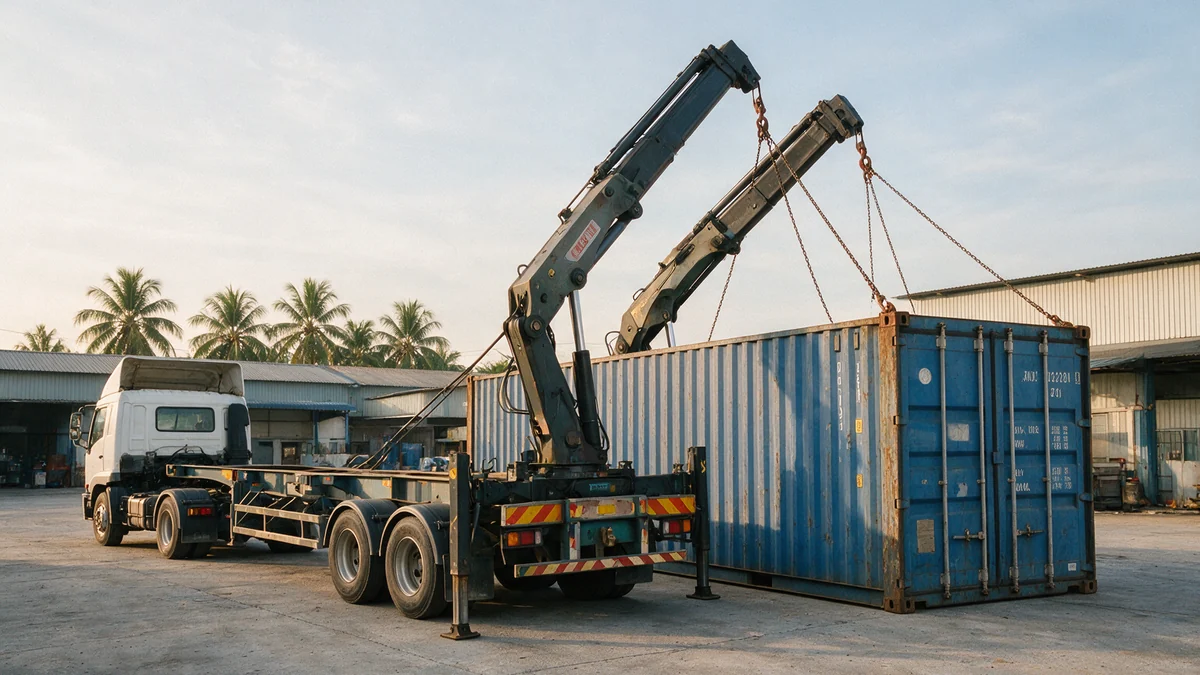
Side loader delivery uses a container trailer that carries its own pair of hydraulic lifting cranes, so the box is lifted off and set on the ground at your premises with no forklift, reach stacker or crane at your end. Malaysian importers book it when the delivery site has no container handling equipment. It is an add-on to a normal haulage job, charged as a surcharge per trip.
Key takeaways
- We publish a typical side loader surcharge of RM150 to RM350 per trip in our Port Klang haulage rate guide, against RM50 to RM120 an hour of waiting charges once free time runs out.
- At Port Klang the binding number is not the crane: the hauliers’ trade body, the Association of Malaysian Hauliers, set a 22,000 kg VGM limit for side loaders, against 25,000 kg for trailers, in its circular of 10 March 2025.
- The units we book take 20ft and 40ft containers and lift 30 to 37 tonnes, so the equipment is rarely what stops the job.
- The site must offer firm compact ground, clear airspace and nobody within 5 metres of either side while lifting (New Zealand good practice, endorsed by WorkSafe NZ, 2023).
- Grounding the box in your yard does not stop detention: DP World defines that charge as running until the empty unit is returned.
What is a side loader, and how does it unload a container?
A side loader — also written sideloader, and called a sidelifter in safety literature — is a container trailer with two hydraulic lifting cranes built into its chassis. The manufacturer Hammar describes it as “two side lifting cranes combined with a trailer or truck”. The cranes swing out, lift the box clear of the deck and lower it to the ground beside the trailer.
How does the lift work, step by step?
- The driver parks alongside the spot where the container will stand.
- The stabiliser legs come down on the lift side — on soft ground the New Zealand guidance is to “put pads under the stabiliser legs if needed to spread the weight of the legs across the ground”.
- Both cranes swing out over that side and chain onto the container.
- The box lifts clear of the deck and lowers to the ground. Hammar puts a full handling cycle at 2–4 minutes.
If your site has no forklift or crane, send us the delivery address and container size and we will quote the lane with the lift included.
When do you need a side loader in Malaysia?
You need a side loader whenever the container has to come off the trailer and nothing at your site can lift it: premises with no forklift of sufficient capacity, cargo too slow to unstuff inside the free time, a box you intend to keep on the ground, or a site where the truck cannot wait.
Four situations make a side loader necessary rather than optional:
- No handling equipment on site — no forklift, no reach stacker, no gantry; common at smaller factories and new warehouse units.
- Unstuffing will outrun the free time — we usually allow 2 to 3 hours at the delivery site, agreed per job, before waiting charges run by the hour.
- You want the container itself on the ground — site storage, a staged production feed, or stuffing an export load.
- Site offices and cabins — Hammar Malaysia lists the use plainly: “use the Sideloader to transport containerized housing, for example temporary offices for workers”.
DNE’s own fleet includes side-loader trailers for sites with no forklift or crane, as our Selangor and Klang Valley haulage page sets out.
When is a side loader the wrong choice?
A side loader is the wrong choice when your site cannot offer firm, level ground and clear space, when the load sits over the hauliers’ 22-tonne VGM limit at Port Klang, or when a cheaper option already exists. A forklift you own, or unstuffing at a depot near the port, often beats a lift surcharge on every container you import.
| Option | What your site must provide | Best when |
|---|---|---|
| Skeletal trailer, your own equipment | A forklift or reach stacker of adequate capacity | Regular volume into an equipped yard |
| Side loader delivery | Firm ground, clear airspace, 5 metres clear either side | No handling equipment, or the box stays on the ground |
| Unstuff at a depot | Nothing — it happens off site | Tight sites, or cargo needing sorting |
Can a side loader lift your container’s weight?
At Port Klang the binding number is the haulage weight limit, not the crane. After the Ministry of Transport instructed the Port Klang Authority to enforce its overweight policy, the hauliers’ trade body, the Association of Malaysian Hauliers, set a “Side Loader VGM Limit: 22,000 kg” in a circular dated 10 March 2025, against 25,000 kg for 20ft and 40ft trailers. Load to that figure, not to the crane’s rating.
The equipment lifts far more than the policy allows: the side loaders we book take 30 to 37 tonnes, and the Hammar 160 is quoted at “36 tonnes Safe Working Load”, against a 30,480 kg maximum gross weight for a 40ft dry container. A heavy box hits the 22-tonne ceiling long before the cranes run out. Tell us the verified gross mass at booking — our guides to verified gross mass and Malaysia’s container trailer rules cover where that figure comes from and how the port enforces it.
What does your site need to provide before the lift?
A side loader needs stable ground, a level lift side, clear airspace and clear space around the trailer. The clearest published conditions come from New Zealand’s industry good-practice guide for sideloaders and a Queensland safety alert — overseas documents, so good practice here rather than Malaysian law, and both describe what a competent operator already does.
- Stable, compact ground — the NZ Intermodal Transport Safety Group guide tells operators to “check that the ground where the sideloader will be operating is stable and compact enough to keep the sideloader stable when in operation”.
- Room to get the vehicle in — a 40ft prime mover and trailer needs roughly 18 metres of turning radius, as our rate guide sets out; a yard too tight for the combination is too tight for a side loader.
- Clear airspace — the lift area must be free of obstructions “including overhead obstructions such as power lines or tree branches”. Awnings and cable runs over a yard entrance are the usual culprits.
- Room to keep people back — the same New Zealand guide is blunt about the exclusion zone: “make sure no-one is within 5 metres of either side of the vehicle during lifting”.
- A known container weight — a 2009 Workplace Health and Safety Queensland alert makes it a condition of the lift that “the load being transferred is within acceptable limits according to the load chart”.
“Do not use the sideloader if there is ANY slope towards the vehicle on the lift side”
NZ Intermodal Transport Safety Group, Good Practice Guidelines for the safe operation of sideloaders, June 2023, endorsed by WorkSafe NZ
Send us photographs of the unloading spot and anything overhead when you book, and we will tell you before the truck rolls whether the lift works.
What does side loader delivery cost in Malaysia?
Side loader delivery is priced as a surcharge on top of the normal haulage rate for the lane. We publish a typical surcharge of RM150 to RM350 per trip, by container size; the figure for your lane comes with the quote. It replaces nothing else on the invoice: base haulage, toll, fuel adjustment and waiting time are still charged as usual.
| Line item | Typical range | When it applies |
|---|---|---|
| Side loader surcharge | RM150 to RM350 per trip | Every trip where the lift is used |
| Free time at your site | Usually 2 to 3 hours | Before waiting charges begin |
| Waiting charges | RM50 to RM120 per hour | While the truck is held after free time |
| Overnight charge | RM200 to RM400 | When the truck must stay overnight |
The side loader surcharge looks expensive until you price the alternative: at our RM50 to RM120 an hour, an unstuff that overruns by four hours is RM200 to RM480 in waiting charges, more than the lift that would have avoided it. Our breakdowns of the fuel adjustment factor and 20ft versus 40ft container costs cover the other movable lines.
Does grounding the container stop demurrage and detention?
No. Putting the container on your own yard releases the trailer, not the container. DP World defines detention as a charge that “typically applies after the container has been collected from the terminal and continues until the empty unit is returned”. A grounded box is still the shipping line’s equipment, and that clock keeps running.
A side loader buys time against the haulier’s waiting-charge clock, which runs in hours; it buys none against the carrier’s detention clock, which runs in days. Our guide to demurrage and detention sets out how to avoid both.
Frequently asked questions
Can one visit drop a loaded container and take an empty away?
Yes. A side loader lifts in both directions: the NZQA unit standard for sideloader operators covers loading a container from the ground onto the vehicle, unloading it onto the ground, and transferring it between vehicles. Tell us at booking if an empty goes back.
Will a side loader work on an unpaved yard?
Often, with care. Hammar notes that low ground pressure makes the Sideloader more suitable for unprepared terrain, which is why compacted hardcore and new industrial lots are usually workable. The ground still has to be stable and compact enough to hold the unit steady while it lifts.
Is the surcharge charged again when the empty is collected?
We price the side loader surcharge per trip, so a delivery and a separate empty collection are two trips and two surcharges.
Sources
- Association of Malaysian Hauliers — Official Circular Notice on the LPK overweight policy and haulier weight limits, 10 March 2025 (side loader and trailer VGM limits).
- Hammar — Why a Sideloader (definition, handling cycle, ground pressure), the Hammar 160 specification and Hammar Malaysia, construction logistics.
- NZ Intermodal Transport Safety Group — Good Practice Guidelines for the safe operation of sideloaders, June 2023, endorsed by WorkSafe NZ; Workplace Health and Safety Queensland, 2009; NZQA unit standard 17679.
- Turkon Line 40ft dry van specification; DP World glossary: detention; DNE’s own Port Klang haulage rate guide (charges, lifting range, turning radius).