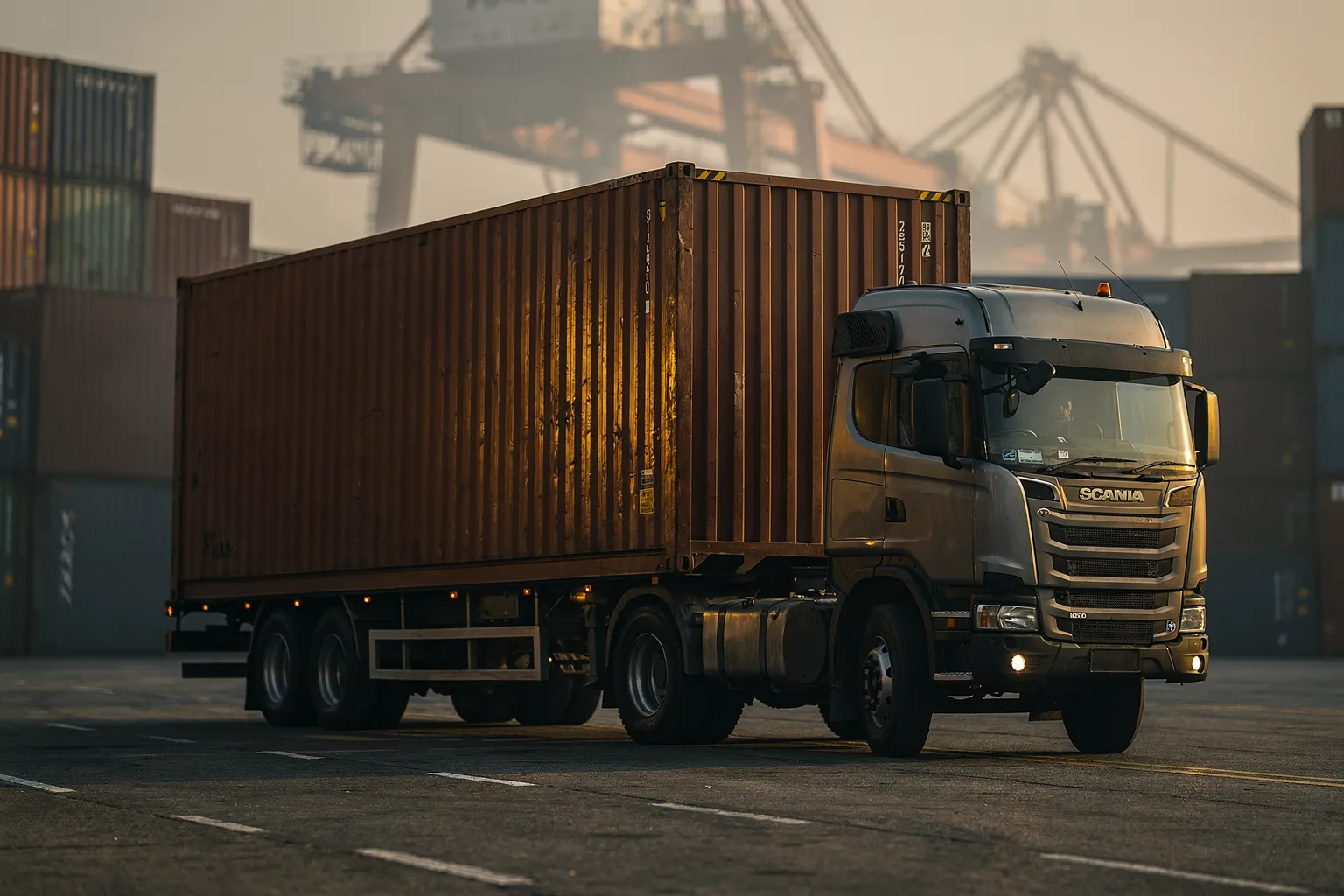
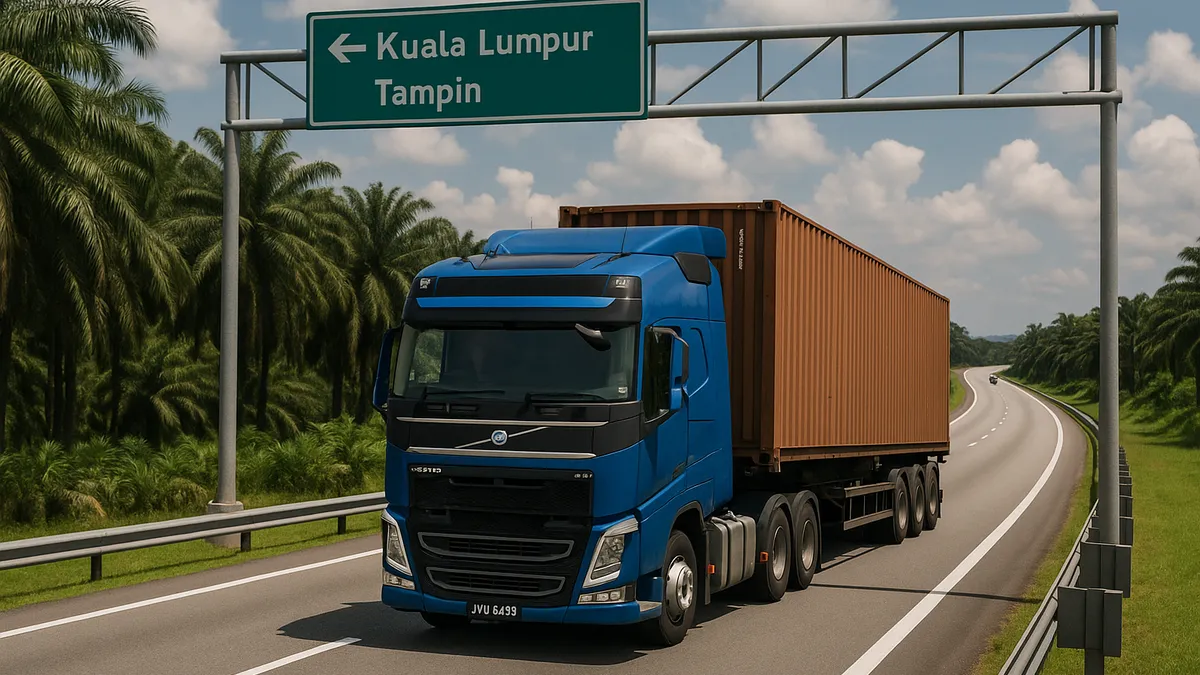
A container is only useful when it reaches your factory floor. Between the Westport berth and your unloading dock sits a 20-90km haulage leg through some of Malaysia's busiest road infrastructure — and a regulatory environment that changed dramatically on 11 May 2026 when MOT, APAD, and JPJ began jointly enforcing new container-haulage rules.
DNE runs its own GPS-tracked container fleet across Selangor and the Klang Valley, with established partner hauliers for further-out destinations. Every trailer is JPJ-registered, APAD-permitted, and MOT-compliant under the May 2026 open-platform rules. Every move is visible on the WizForwarding portal in real time.
What we haul, and where
Container haulage from Port Klang covers a daily corridor across Selangor, Negeri Sembilan, and into Pahang. Our own fleet handles the dense Selangor + Klang Valley delivery zone:
- Shah Alam, Klang, Bukit Raja, Bandar Bukit Tinggi — manufacturing districts adjacent to the port, typical haulage 30 minutes to 2 hours.
- Petaling Jaya, Subang, Sungai Buloh, Kepong — Klang Valley industrial and warehouse zones, typical 1-2 hour haulage.
- Kuala Lumpur, Cheras, Ampang, Puchong, Cyberjaya — KL and southern Klang Valley.
- Semenyih, Bangi, Nilai, Senawang, Seremban — Negeri Sembilan industrial corridor.
- Penang, Johor, Pahang, Kedah, Kelantan, Terengganu — handled via established partner hauliers vetted to our SOPs.
- Sabah and Sarawak — not a haulage leg at all but a sea leg, and priced under the cabotage rules. If you are comparing a Klang Valley delivery against an East Malaysia one, read our breakdown of what the cabotage policy does to Port Klang–Sabah/Sarawak costs before you budget the two the same way.
Trailer types we run
Different cargo needs different trailers. DNE's fleet covers the main container-haulage profiles:
- 20ft (1×20 or 2×20) trailers — single 20ft GP container or twin 20ft. Most common haulage profile.
- 40ft / 40HC / 45HC trailers — single 40ft GP, 40ft High Cube, or 45ft High Cube.
- Side-loader trailers — self-discharging for sites without forklift or crane. Critical for container stuffing at industrial sites.
- Low-loader / flatbed — for out-of-gauge, project, and breakbulk cargo. Limited fleet, advance booking required.
- Tank container trailers — for ISO tanks (liquid bulk, food-grade, chemical).
Why DNE haulage delivers on time
How a haulage job moves
1. Booking, against the cargo plan
Haulage is booked the moment customs declaration is filed — not the moment cargo is released. By the time JKDM clears the container, the trailer slot, driver, and route are already locked in. This is why DNE customers rarely sit in port waiting for a truck.
2. Container pickup at terminal
Once Customs Release Order (CRO) is in hand, our driver collects the container at the Westport or Northport gate. Trailer documentation, weight slip, and gate-pass are processed during gate-in, typically 30-60 minutes.
3. Transit with live GPS
The trailer departs the port and routes via the most efficient corridor — Federal Route 2 for Bukit Raja and Shah Alam, KESAS for Petaling Jaya and Subang, LATAR for Kepong and Sungai Buloh, North-South Expressway for outstation. Real-time location is on your WizForwarding dashboard throughout.
4. Delivery, unstuffing, POD
The driver arrives at your consignee location, supervises container unstuffing (or drops a side-loaded container for you to unstuff at your pace), and obtains signed Proof of Delivery. POD photograph, signed delivery slip, and timestamp are uploaded to your WizForwarding portal the same day.
5. Empty container return
Empty containers are returned to the carrier-nominated depot — typically the same terminal or a designated depot in Klang. Detention time is monitored carefully to avoid carrier per-diem charges on idle empty containers.
Haulage rates — how they're built
Container haulage rates from Port Klang depend on five variables:
- Distance — short-haul (Klang, Shah Alam, Port Klang industrial areas), mid-haul (PJ, KL, Subang, Semenyih), long-haul (Seremban, Ipoh, Johor Bahru, Penang).
- Container size — 20ft, 40ft, or 45ft. Heavier or oversize cargo affects rate.
- Trailer type — standard, side-loader, low-loader, tank trailer. Specialised trailers have higher base rates.
- Peak season surcharge — Chinese New Year, Hari Raya, year-end peak typically add a small surcharge due to capacity constraints.
- Detention exposure — if your site has a known long-stuffing time, we price in driver waiting.
Indicative bands published May 2026: a 40-foot container from Westport to a Shah Alam consignee ran RM 800-1,200 depending on detention risk; long-haul to Johor or Penang RM 2,500-4,000 depending on backhaul availability. Treat those as the shape of the cost, not today's price — the only figure that binds is the one on your quotation.
What actually moves a haulage rate, as of August 2026. Unlike ocean freight, haulage out of Port Klang is priced off domestic costs, so it does not follow the shipping headlines. Three things are pushing on it right now. First, volume: Port Klang moved 6.38 million TEUs in January–May 2026, up 5.4% on the same five months of 2025 (The Edge Malaysia, 28 August 2026) — more boxes leaving the same gates on the same road network. Second, the May 2026 trailer framework, which restricts 20ft containers to skeletal chassis and requires newly built open-platform units rather than retrofits, so compliant capacity has grown gradually rather than all at once. Third, your own detention exposure, which is the one variable you control. WhatsApp the pickup terminal, delivery address and container size for a same-day rate on your actual lane.
Common haulage scenarios we handle
The May 2026 trailer rules — what you need to know
From 11 May 2026, three Malaysian regulators — MOT (Ministry of Transport), APAD (Land Public Transport Agency), and JPJ (Road Transport Department) — have applied a six-condition framework to open-platform semi-trailers carrying ISO containers. As of August 2026 it has been running for roughly three months, so it is now a standing compliance requirement rather than a new announcement.
It is widely misread as a crackdown. It is not. MOT granted conditional approval for a trailer type that previously sat in a regulatory grey area — an enabling measure, on strict terms. Two of those terms decide most of what an importer actually feels:
- Only 40ft and 45ft ISO containers may travel on an open-platform trailer under this approval. 20ft boxes must move on a skeletal chassis. If your import profile is heavy in 20-footers — common for chemicals, machinery parts and dense raw materials — the question to ask your haulier is whether they have enough skeletal units for your volume, not whether their flatbeds have twist locks.
- The BDM (laden weight) ceiling is 53 tonnes for the whole combination — prime mover, trailer, container and cargo together — so the headroom for goods is far less than the headline figure suggests. Underdeclared cargo weight is the most common way a compliant trailer becomes a non-compliant load. We check declared weights against the VGM before a box is dispatched.
The approval also covers newly built vehicles only (an old flatbed cannot be retrofitted into compliance), caps trailer length at 45 feet including the twist locks, requires a KA container-service permit with the prime mover licensed under use code BQ, and limits operation to Port-to-Business and Business-to-Port legs — so inland factory-to-factory or warehouse-to-warehouse container shuttles fall outside it.
DNE upgraded the entire fleet ahead of the enforcement date and continuously audits compliance. Read our full breakdown of the new MOT/APAD/JPJ rules for the six conditions, the three lane-types most exposed, and the BDM ceiling most importers don't realise affects them.