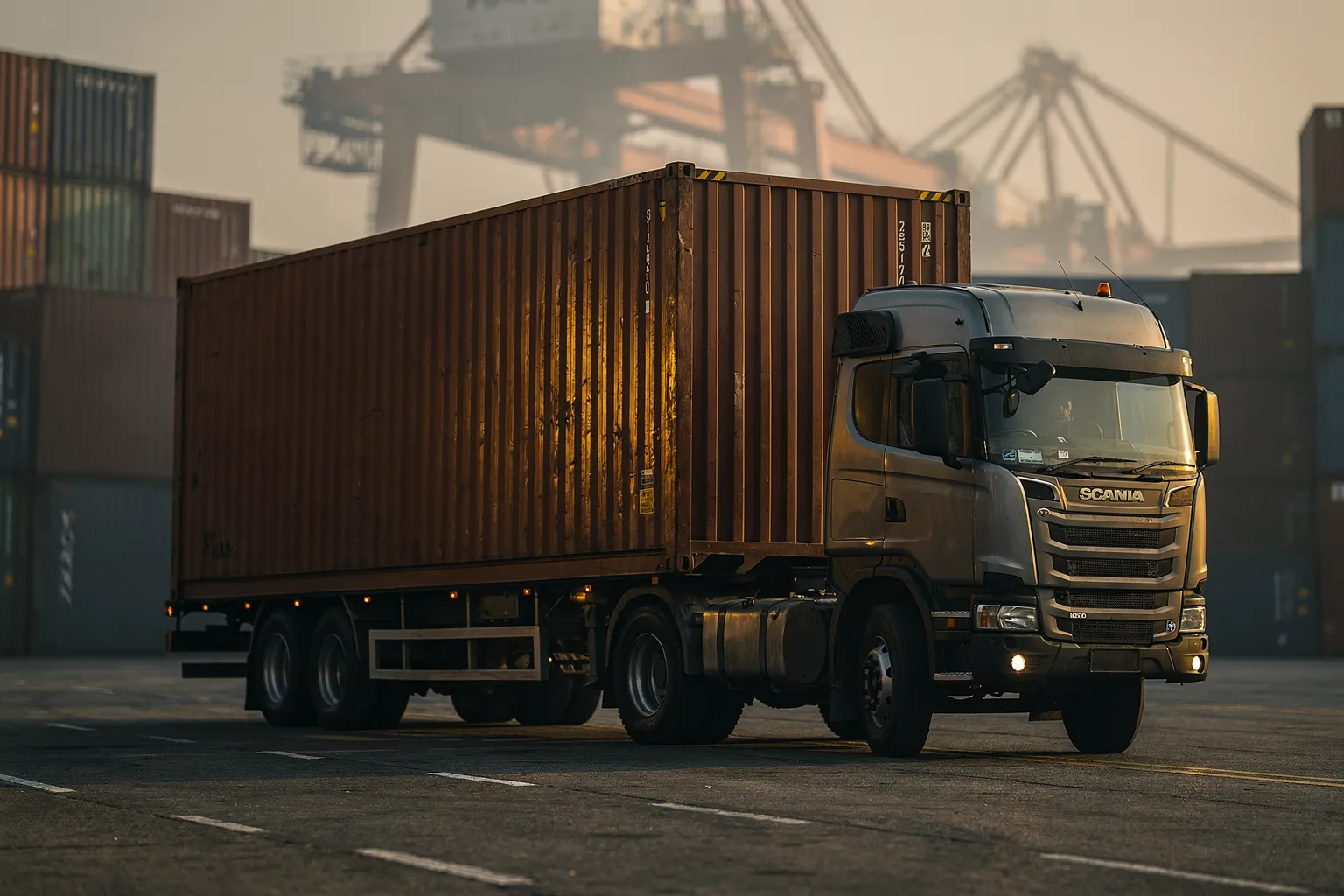
In a media statement dated 12 March 2026, the Ministry of Transport (MOT) granted conditional approval for the registration and licensing of open-platform semi-trailers fitted with twist locks to carry ISO containers, subject to six conditions. Industry guidance circulated the rules with an operative date of 11 May 2026. As of August 2026 the framework has been running for roughly three months, and it is now a standing compliance requirement rather than a new announcement.
The single most important thing to understand — and the thing most widely got wrong when the rules first circulated — is that this is an enabling measure, not a crackdown. MOT is permitting a trailer type that previously sat in a regulatory grey area, on strict conditions. And the first of those conditions is decisive: the approval is limited to the technical plans of new vehicles only. You cannot retrofit an existing flatbed into compliance.
If you are a Malaysian importer or exporter, the regulation does not sit on you. It sits on the haulier. But every operational consequence, from a stopped trailer to a missed delivery to a backed-up yard, lands directly on your customs clearance timeline and your factory's production calendar. This article unpacks the six conditions as MOT actually wrote them, what to check with your haulier, and the lane-types most exposed at Port Klang.
The Six Conditions at a Glance
As listed in the MOT media statement of 12 March 2026.
- Design and length — limited to technical plans for new vehicles only; maximum semi-trailer length 45 feet including the twist-lock system; prime-mover-to-semi-trailer ratio stays at a maximum of 1:7
- Container types — only 40-ft and 45-ft ISO containers may be carried; no 20-ft
- Motor vehicle licence (LKM) rate — set as for container lorries, use code BQ (Penggerak Utama Kontena)
- Service type — licensed under the container service type, operating permit KA (Perkhidmatan Kontena), subject to the load set in the technical plan
- Scope of operation — Port-to-Business (P2B) and Business-to-Port (B2P) only
- Laden weight (BDM) — maximum 53 tonnes, subject to detailed technical conditions set by JPJ
What Actually Changed, and Why It Still Matters
Open-platform (flatbed) semi-trailers have been the workhorse of Malaysian container haulage for decades. They are cheaper to build than skeletal chassis, easier to repurpose for non-container loads, and form the backbone of mid-tier haulier fleets serving Port Klang, Pasir Gudang, and the inland industrial belts. For years, the regulatory line on how an open-platform trailer secures a container — and what classes of container it may carry — sat in a grey area that hauliers interpreted variably.
The MOT guidelines close that grey area. The rules are not new tax policy or new tariffs, and they do not ban the open-platform trailer. They set out the terms on which one may be registered and licensed to carry an ISO container at all: the right build, the right length, the right licence class, the right container sizes, the right routes and a hard weight ceiling.
The consequence that matters commercially is a capacity one, and it follows directly from the new-vehicles-only rule. An operator whose container work runs on older open flatbeds cannot spend a few thousand ringgit on twist locks and carry on. The compliant path is a newly built, newly registered trailer on a KA permit — a capital purchase with a lead time, not a weekend upgrade. That is why compliant open-platform capacity at Port Klang has expanded gradually since May rather than arriving all at once, and why the operators who invested early are the ones quoting confidently now.
Condition 1: The 45-Foot Length Cap
The first condition carries three separate requirements, and the first of them is the one that decides everything else. The approval is limited to the technical plans of new vehicles only. An existing open flatbed cannot be brought into this category by modification; the compliant trailer is one built and registered to the approved plan.
Second, the maximum semi-trailer length is 45 feet including the twist-lock system — the locks count toward the measurement, not on top of it. Historically some hauliers ran longer trailers (more common in cross-border trucking to Singapore or specialty cargo) and used them opportunistically for container loads. Those are outside this approval regardless of how clean the rest of the paperwork is.
Third, the ratio of prime movers to semi-trailers stays as it was, at a maximum of 1:7 — so an operator cannot simply park a large trailer fleet against a handful of prime movers.
If your haulier's fleet includes longer or older trailers, ask which units in their roster are registered under this approval. A haulier with a mixed fleet does not have a fleet problem; they have an assignment problem. Insist that only compliant trailers be assigned to your loads, and that the trailer number be confirmed on the job sheet before the truck leaves the yard.
Condition 2: The Twist-Lock System and Permitted Containers
Twist locks are the corner-fitting devices that physically lock a container to the trailer deck, and the twist-lock system is what the whole approval is built around: MOT's statement is specifically about open-platform semi-trailers fitted with that system. It is the equipment that makes the trailer type registrable for ISO container work in the first place.
The reason is safety, and MOT says so plainly — the container-size restriction is imposed “to ensure safety aspects are prioritised.” A twist-locked container is held to the deck by its corner castings rather than by whatever securing arrangement a driver improvises, which is what keeps a box on the trailer through hard braking or an evasive swerve.
On this approval, an open-platform semi-trailer may carry 40-ft and 45-ft ISO containers only. The 20-ft container — the dominant size for heavier or denser cargo — is excluded and must move on a skeletal chassis built for it.
The practical question to put to your haulier is not “have you fitted twist locks?” but “is this trailer registered and licensed under the open-platform twist-lock approval, and what is its permit number?” Because the approval covers new vehicles only, fitting locks to an old flatbed does not produce a compliant unit, and a haulier who answers the first question but not the second has not answered it.
Condition 3: KA (Perkhidmatan Kontena) Licensing
The KA licence is the operator's class authorisation issued by APAD specifically for container service. It is distinct from the broader carrier permit a general haulier may hold. Many established Port Klang container hauliers already hold KA licences as a matter of course; many smaller regional operators do not, having historically operated under a general goods licence.
Under this approval the trailer is licensed under the container service type, operating permit KA, subject to the load set in its technical plan and the permit conditions imposed by the authorities. There is a paired requirement on the prime mover: the motor vehicle licence (LKM) rate is set as for container lorries, under use code BQ — Penggerak Utama Kontena. A trailer carrying a container on a public road must therefore be operating under a valid KA permit linked to the operator's company; if the permit is missing, expired, or held against a different vehicle, the unit is not compliant and the cargo's onward movement becomes the operator's problem to resolve.
For importers, the practical step is one document request: ask your haulier for a copy of the KA licence number and validity period. A compliant operator will hand it over within hours. A non-compliant operator will delay, deflect, or claim it is held by a sister company. That delay is your signal.
Condition 4: P2B and B2P Routes Only
This condition is the one most importers misunderstand. The guidelines restrict open-platform trailer usage with ISO containers to Port-to-Business (P2B) legs (pulling a container from Westport or Northport to a factory or warehouse) and Business-to-Port (B2P) legs (returning a loaded export container from a factory to the port). Inland-to-inland container moves — for example, shuttling a loaded container between two factories, or warehouse-to-warehouse — are not within the open-platform allowance.
For most Klang Valley importers, this is not a problem in practice. The standard flow is Port Klang to factory and back, both of which are covered. Where this bites is in warehouse consolidation, return-empty inland repositioning, and certain regional distribution patterns. If your supply chain includes any of those, ask your forwarding agent to map the routes against the P2B/B2P definition and identify any legs that need to shift to skeletal chassis.
Condition 5: What the 20-ft Exclusion Means for Your Planning
The container-size restriction is set out above, but its planning consequence deserves its own treatment. Because an open-platform trailer on this approval may carry only 40-ft and 45-ft boxes, the 20-ft container — the dominant size for heavier or denser cargo — must be carried on a skeletal chassis built for the purpose, typically a 20-ft skeletal or a 40-ft skeletal with 20-ft locking positions.
This sounds technical but has a real planning consequence. If your import profile is heavy in 20-ft boxes (common for chemicals, machinery parts, dense raw materials), confirm with your haulier that they have sufficient skeletal capacity for your volume. Mid-tier hauliers who had been moving 20-ft boxes on opens for years now need to either rotate skeletals into the dispatch pool or partner with sub-hauliers — both of which take time.
Condition 6: The 53-Tonne BDM Ceiling
The Berat Dengan Muatan (BDM) is the JPJ-prescribed maximum laden weight. This is the one condition with a hard number attached, and it is the number most often missing from summaries of these rules: the maximum BDM is 53 tonnes, subject to the detailed technical conditions set by JPJ. A trailer that is structurally compliant but loaded beyond that ceiling is not compliant.
This is the condition that most importers and shippers underestimate, because it shifts attention to the cargo weight declared at booking. The 53 tonnes is the whole combination — prime mover, trailer, container and cargo — not your cargo alone, so the working headroom for goods is a great deal less than the headline figure suggests. Underdeclared cargo weight is one of the most common errors in container shipping; a shipper who quotes 18 tonnes when the actual stuffed weight is 23 tonnes has just put the haulier (and your delivery) in the BDM danger zone without anyone realising. Confirm declared weights against actual VGM (Verified Gross Mass) data before the box leaves the port.
| Condition | What to verify | Who provides proof |
|---|---|---|
| New vehicle, 45 ft incl. twist locks | Trailer registration showing it is registered under the open-platform twist-lock approval | Haulier |
| Twist-lock system | Trailer photograph showing the corner twist locks, plus the approved technical plan | Haulier |
| KA permit + BQ use code | KA operating permit number and validity; prime mover licensed under use code BQ | Haulier |
| P2B / B2P route compliance | Route plan against your delivery network | Forwarding agent |
| 40-ft / 45-ft container only | Container size declared on booking; trailer assignment | Forwarding agent + haulier |
| Laden weight within 53 t BDM | VGM data from shipper; trailer BDM rating on the technical plan | Shipper + haulier |
Which Port Klang Lanes Are Most Exposed
Across the volumes we move at Port Klang, three lane-types are disproportionately exposed under this framework:
- Pasir Gudang to Port Klang and back. Long-haul export cargo, often moving via mid-tier hauliers operating mixed fleets — the operators least likely to have funded new compliant trailers.
- Melaka leg deliveries. The Port Klang to Melaka inland leg is a significant lane for several manufacturing customers. The route is unambiguously P2B (compliant), but distance and round-trip empty returns multiply the exposure to weight breaches and licence checks. A single trailer stoppage on this lane creates a half-day delay rather than the two-hour delay that a Klang-internal lane would.
- Klang-internal warehouse moves. Importers running consolidation flows between port-side warehousing and inland warehousing are most at risk of falling outside the P2B/B2P definition. If your operation includes those moves, this is the highest-priority lane to review with your forwarding agent.
Your Compliance Checklist
This is not a "monitor for further updates" situation. The framework is settled and in force. Here is the operator's checklist for any importer or exporter moving containers through Port Klang:
- Send your haulier a written proof request covering the KA permit number, the trailer's registration under the open-platform twist-lock approval, and the BDM rating of each trailer type they plan to assign to your loads. Response time is itself a signal — under 48 hours is acceptable; longer than that warrants a backup conversation with an alternative haulier.
- Audit your import lanes with your forwarding agent. Any leg that is not strictly Port-to-Business or Business-to-Port needs a different solution. For warehouse-to-warehouse moves, that may mean skeletal chassis or a different vehicle class entirely.
- Tighten weight declarations. Insist that VGM data from the origin port is captured on the booking and shared with the haulier before the box leaves the terminal. Underdeclared weights are the easiest BDM trap to fall into.
- Identify a compliant backup haulier for your most time-sensitive lanes. A single haulier dependency under a capacity-constrained regime is a brittle setup. A pre-qualified second haulier, even at 10–20% of your volume, gives you a fallback when a primary trailer is unavailable.
- Brief your shipping/operations team on the six conditions. Most missed compliance breaks at the trailer-assignment step, not the policy-decision step. The dispatcher releasing the order needs to know which trailers in the haulier's fleet are compliant and which are not.
The One Line to Send Your Haulier
"Under the MOT conditional approval for open-platform semi-trailers with twist locks, please confirm in writing, for every trailer your dispatch will assign to our container loads: the KA operating permit number, that the trailer is registered under that approval as a new vehicle, and its BDM rating against the 53-tonne maximum. Please also confirm whether any of our scheduled moves fall outside the P2B/B2P definition."
How DNE Forwarding Is Approaching the New Rules
At DNE Forwarding, container haulage moves at Port Klang are split across compliant national hauliers. Our operational stance has been consistent since the rules took effect: only trailers with a verified KA permit, registration under the twist-lock approval, and BDM-appropriate ratings are accepted onto our customers' jobs. That means we will occasionally turn down a marginal-cost option from a mid-tier haulier in favour of a more expensive compliant one. Typically that is a small premium on the trip cost; when a non-compliant unit is turned back, it is the difference between a delivered container and a stopped one.
For customers running significant volumes through Klang, we are happy to share which legs in your specific lane profile are most exposed under this framework, and which compliance proofs you should be requesting from your hauliers. The earlier you check, the cheaper the answer. If your lanes run beyond the Peninsula, note that cabotage rules for Sabah and Sarawak add a separate layer to the same planning question.
The rules do not change what you import, where you import from, or what your landed cost looks like. They change one thing: which trailer can legally pull your box from Westport to your factory. That is a small change with an outsized impact, and the importers who treat it as a paperwork issue rather than an operations issue are the ones caught out by a stopped delivery.
The regulation isn't the risk. The hauliers who can't prove compliance are. It is worth finding out which category yours falls into.
Sources
- Kementerian Pengangkutan Malaysia (MOT) — Siaran Media: Pendaftaran & Pelesenan Semi Treler Open Platform dengan Sistem Twist Lock, 12 Mac 2026 — the primary statement of all six conditions, the new-vehicles-only limit, the 1:7 ratio and the 53-tonne BDM maximum.
- Jabatan Pengangkutan Jalan (JPJ) and Agensi Pengangkutan Awam Darat (APAD) — the authorities MOT directs operators to for registration and licensing procedure.
Part of a guide: this article is part of DNE's complete guide to container haulage in Malaysia.