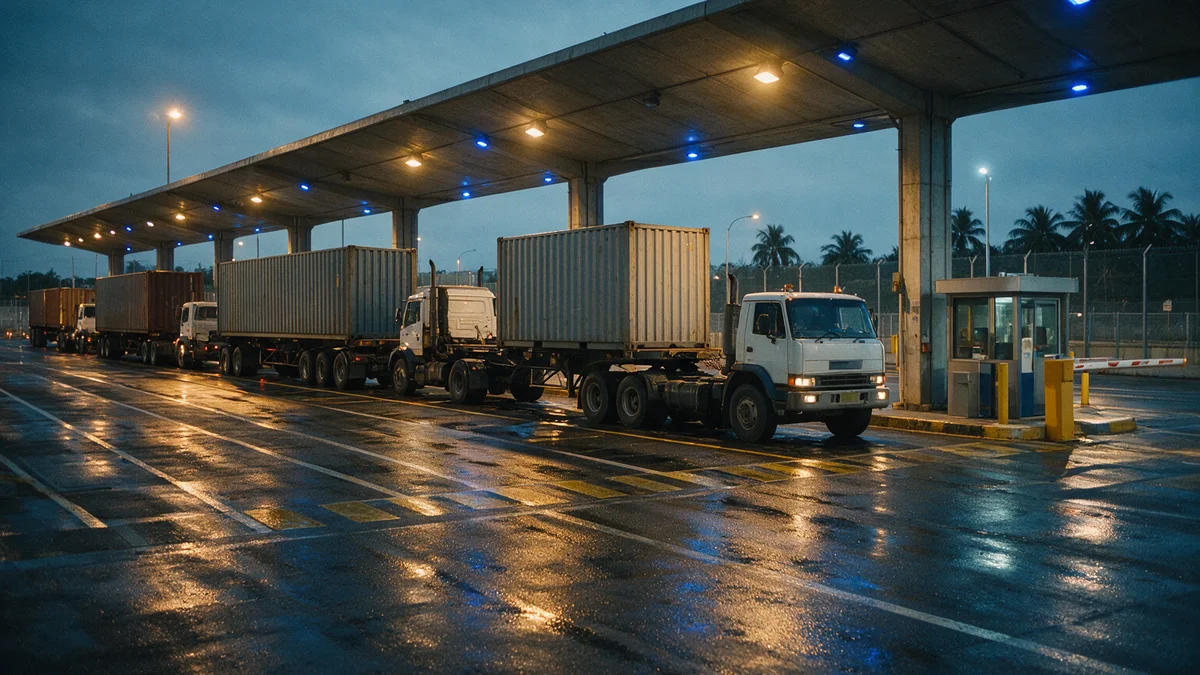
A container reaches Singapore from the Klang Valley one of three ways: a Malaysian lorry with a valid ASEAN Goods Vehicle Permit drives through Woodlands or Tuas, the load transfers to a Singapore-plated truck near the border, or it leaves Port Klang by sea. Licensing, not price, decides which cross-border trucking option is open to you — Malaysia's permit pool is capped, and Singapore checks the full set at the booth.
Key takeaways
- APAD's guideline offers a quota of 500 ASEAN cross-border goods vehicle permits in total, and only a Sdn Bhd or Berhad with an active Carrier A licence may apply.
- Singapore's Goods Vehicle Permit fee for foreign lorries rises from S$40 to S$70 per calendar month on 1 January 2027 — a 75% increase, or S$360 more per truck per year.
- From 2 November 2026, LTA will not accept an application from a foreign-registered vehicle with outstanding Singapore traffic, parking or vehicular-emissions fines, lorries included.
- A land import must have the customs permit, invoice and packing list presented at the checkpoint; a sea import into Singapore need not.
How does cross-border trucking between Malaysia and Singapore actually work?
A cross-border move is two customs declarations and one licensed vehicle: the exporter declares the goods out of Malaysia, the Singapore consignee or its declaring agent declares them in, and the truck must hold permits from a regulator in each country. The Department of Statistics Malaysia puts two-way trade at RM402.8 billion in 2025, up 1.6% on the year, making Singapore Malaysia's second-largest trading partner.
Nobody hires a lorry on Monday and crosses on Tuesday — the lane runs on capacity that is already licensed.
- Through-trucking — one permitted Malaysian vehicle loads at your premises and delivers in Singapore. Fewest handovers, heaviest licensing burden.
- Border transfer — the cargo or trailer changes to a Singapore-plated vehicle near the border. The usual answer when the Malaysian vehicle is not permitted.
- Out of Port Klang by sea — slower door to door, but it needs no cross-border vehicle licence and uses ordinary Port Klang container haulage on the Malaysian leg.
Which permits must a Malaysian lorry carry to enter Singapore?
Six things, and LTA lists them as a set rather than a preference: a valid ASEAN Goods Vehicle Permit (GVP), an activated Autopass card, valid road tax, a valid certificate of insurance for use in Singapore, LTA's GVP approval email, and proper licence plates front and back. Operators are told to apply for the GVP and Autopass card at least two weeks before the intended entry date.
Foreign-registered goods vehicles, buses and taxis detected at Woodlands or Tuas Checkpoint without valid LTA's GVP / PSVP approval email, GVP/ PSVP, Autopass card, insurance and road tax or are in violation of Singapore regulations will be turned back from Singapore.
— Land Transport Authority, Goods Vehicles Registered in ASEAN Countries
A vehicle found inside Singapore without them faces enforcement action including seizure. The Autopass card is not a toll convenience either: the driver must insert it at the immigration booth on entry and exit to record the visit and pay the fees, "even when the barrier at the immigration booth is lifted". Insurance is the one easy item — a Malaysia-registered vehicle insured with a Malaysian insurer needs no separate Singapore cover, provided the policy meets Singapore's Motor Vehicles (Third-Party Risks and Compensation) Act 1960 throughout the stay.
What does Malaysia require before a truck can run this lane?
This is the half of the answer almost no guide carries, and the half that decides capacity. On the Malaysian side the cross-border permit is not a form but a capped licence, issued by the Land Public Transport Agency (APAD) through the iSPKP system: the guideline (28 December 2023) states a total offered quota of 500 permits, applications are processed in 14 working days, and a permit is valid for no more than one year.
The thresholds sit at company level. An applicant must be a Sdn Bhd or Berhad with an active Carrier A goods vehicle operator licence and paid-up capital of at least RM250,000 for non-container Carrier A, or RM500,000 for container Carrier A, and every vehicle must already be licensed under Act 715 in that class before APAD will look at it.
The vehicle rules are equally specific. Only closed bodies qualify — ISO-certified container vehicles, refrigerated boxes, tankers and box bodies — and no permitted vehicle may be more than 15 years old from its year of manufacture; trailer configuration is governed separately by Malaysia's new container trailer rules. APAD's fee schedule bands the approval fee by maximum laden weight: RM300 per vehicle up to 21,000 kilograms, RM600 from 21,001 to 25,000 kilograms, RM1,800 at 25,001 kilograms and above.
Which customs declarations does the shipment need on each side?
Two declarations, two systems, two liable parties. Out of Malaysia the exporter or its agent declares the goods on Customs Form No. 2 (K2) electronically, full and true, before the export happens, and Royal Malaysian Customs requires those export records to be kept in Malaysia for seven years. Into Singapore the importer must obtain a customs permit through TradeNet before the goods arrive; our step-by-step export guide covers the K2 sequence.
The Singapore side has a prerequisite that catches exporters selling on delivered terms: the importing company needs a Unique Entity Number and an activated Customs Account before any import permit application can be submitted at all, and it then either appoints a Singapore declaring agent or registers as one itself. If your buyer has neither, no permit exists to clear the truck — which makes the Incoterm you agreed a customs question, not only a cost one. Three details are specific to a land crossing:
- For containerised cargo the Singapore permit must declare the container number and the shipper seal number.
- By land, the permit copy, commercial invoice and packing list must be presented for verification at the checkpoint; by sea, they need not be.
- A haulier failing to produce the goods and permit for endorsement is an offence in itself; Singapore Customs sets the penalty for importing without a permit at a fine of up to S$100,000 or three times the value of the goods, whichever is greater, on a first conviction.
Prevailing Singapore GST is charged on the CIF value, including duties on dutiable goods and all costs incidental to the sale and delivery into Singapore, so the cross-border freight and insurance sit inside the taxable value. The ASEAN Customs Transit System, which moves goods across participating ASEAN states on a single declaration and guarantee, is built for multi-country transit rather than a single land crossing: it still needs a TradeNet permit, a guarantee lodged in the country of departure, a truck holding an ASEAN Goods Vehicle Cross-Border Permit, and a stop at the checkpoint.
What changes in 2026 and 2027, and what will it cost?
Four dated changes land on this lane, all announced in 2026, and every cost below is a regulatory fee, not a freight rate. LTA raises the Goods Vehicle Permit fee for foreign-registered lorries from S$40 to S$70 per calendar month on 1 January 2027 — S$840 a year instead of S$480. From 2 November 2026, an unpaid Singapore traffic, parking or vehicular-emissions fine blocks the application itself.
| From | Change | What it means |
|---|---|---|
| 1 April 2026 | ERP2 On-Board Unit offered to foreign-registered vehicles at S$158.70 including GST until 31 December 2026, installation extra | Optional; fitted only in Singapore by authorised workshops |
| 2 November 2026 | LTA stops accepting applications from foreign-registered vehicles with outstanding Singapore traffic, parking or vehicular-emissions fines | An unpaid fine becomes a licensing problem, not a checkpoint one |
| 1 January 2027 | GVP fee rises from S$40 to S$70 per calendar month | A 75% increase: S$840 a year per truck instead of S$480 |
| 1 January 2027 | Flat-rate ERP fee of S$10 per ERP operational day for vehicles without an OBU | Charged for every operational day on Singapore roads |
The fines rule is broader than it first reads. LTA's definition of "vehicle entry permits" expressly covers "ASEAN Goods Vehicle Permits for goods vehicles such as lorries", so a traffic fine nobody chased now sits between a lorry and its renewal. Timing is a small lever: owners may keep buying the GVP at S$40 before the revised fee takes effect.
When is trucking the wrong answer for a Singapore delivery?
When the volume is small, irregular or new. A capped permit pool, a company-level capital threshold and a per-vehicle monthly fee all reward fleets that run the lane constantly and punish occasional shippers. For a pallet a month, a consolidator or a border transfer usually beats chasing a permitted through-truck; for full containers on a predictable cycle, moving the box out of Port Klang keeps the shipment inside a system you already pay for.
DNE Forwarding's position here is deliberately plain. As a JKDM-licensed forwarding agent at Port Klang moving 1,000+ containers a month with its own haulage fleet across Selangor and the Klang Valley, DNE handles the Malaysian legs: the K2 export declaration and the road move to the port, the border area or a consolidator. DNE does not operate Singapore-side delivery and neither applies for nor advises on permits in either country; where a shipment genuinely needs a permitted cross-border vehicle, the honest answer is a referral.
Frequently asked questions
What permits does a Malaysian lorry need to enter Singapore?
A valid ASEAN Goods Vehicle Permit, an activated Autopass card, valid road tax, a valid certificate of insurance for use in Singapore, LTA's GVP approval email, and proper licence plates front and back. A goods vehicle detected at Woodlands or Tuas without them is turned back, and faces seizure if found inside Singapore.
How long does a Malaysian cross-border goods vehicle permit take?
APAD processes each application in 14 working days and returns the decision through the iSPKP system. The company must first hold an active Carrier A licence with paid-up capital of at least RM250,000, or RM500,000 for container Carrier A, and each vehicle must already be licensed under Act 715 in that class. The permit lasts one year at most.
How much will the Singapore Goods Vehicle Permit cost in 2027?
S$70 per calendar month per foreign-registered goods vehicle from 1 January 2027, up from S$40: a 75% increase, or S$840 a year instead of S$480. Owners may keep buying the permit at S$40 before the revised fee takes effect; any permit whose validity period begins on or after that date is charged at the new rate.
Can my Singapore customer clear the goods without registering with Singapore Customs?
No. The importing company needs a Unique Entity Number and an activated Customs Account with Singapore Customs before any import permit application can be submitted, and the permit must be obtained through TradeNet before the goods are imported. It may appoint a declaring agent to file on its behalf, but registration cannot be skipped.
Sources
- Land Transport Authority — Goods Vehicles Registered in ASEAN Countries; Updates for Foreign-Registered Vehicles (6 February 2026); Outstanding fines and entry permits (15 May 2026)
- Singapore Customs — Import Procedures; Obtain a Customs Import Permit; Documents for Clearance of Goods; ASEAN Customs Transit System
- APAD — Garis Panduan Pelesenan Kenderaan Barangan Rentas Sempadan ASEAN
- Royal Malaysian Customs — Panduan Ringkas untuk Pengeksport (2023); Export Procedure
- Department of Statistics Malaysia — External Trade Statistics, 2025