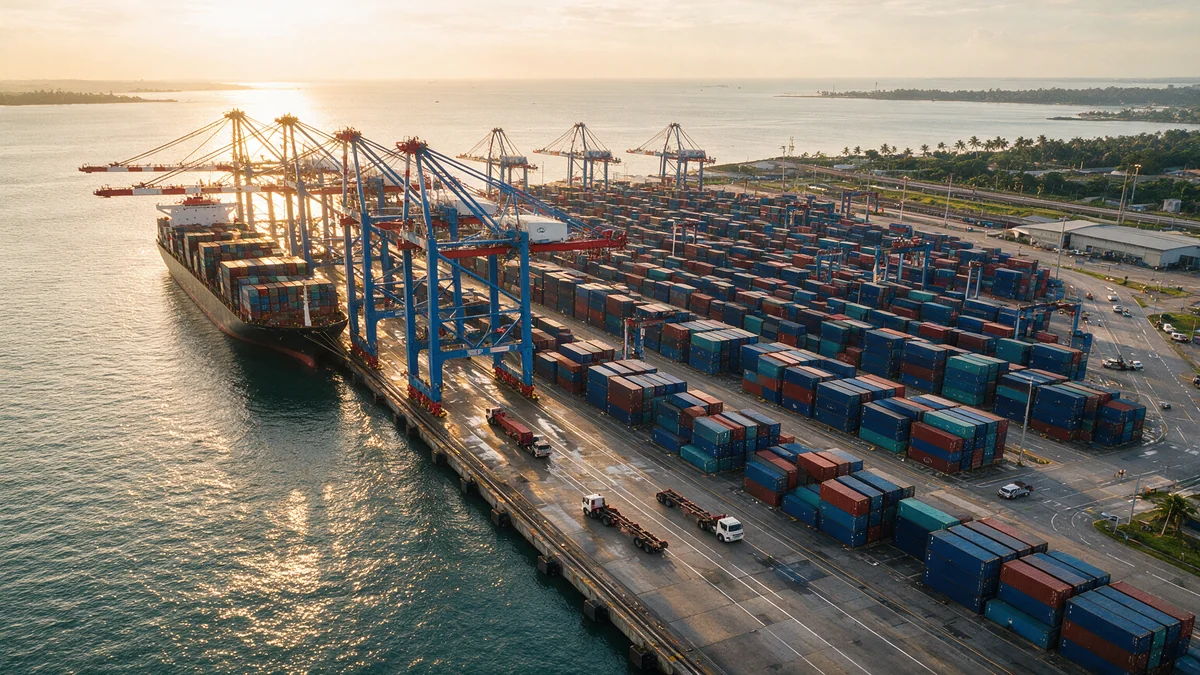
For a Malaysian importer or exporter, Port Klang is almost always the right gateway. Port of Tanjung Pelepas (PTP) and Singapore are primarily transhipment hubs, where boxes change ships rather than enter the country: transhipment is 94% of PTP's throughput. Port Klang handles 55% of Malaysia's containerised seaborne imports on the most recent national breakdown. Choose on inland distance to your cargo, not on port league tables.
Key takeaways
- PTP is 94% transhipment (Netherlands Enterprise Agency, 2022), so its throughput has little to do with Malaysian cargo — a transhipment hub moves boxes between vessels; a gateway port is where cargo legally enters a country and clears customs.
- Port Klang is Malaysia's designated national load centre, taking 55% of containerised seaborne imports and 53% of exports (2018 baseline).
- Strip out transhipment and Penang — not PTP — is Malaysia's second-busiest container gateway.
- Singapore is a foreign customs territory, so routing through it means an export from Singapore and a fresh import into Malaysia.
- Inland haulage and free storage time decide the real cost, not the terminal handling rate.
What is the difference between a gateway port and a transhipment hub?
A gateway port is where cargo physically enters or leaves a country and passes through that country's customs. A transhipment hub is where a container is lifted off one vessel and onto another without entering the local economy. Port Klang does both. PTP and Singapore are overwhelmingly transhipment operations, which is why their throughput figures overstate their relevance to Malaysian shippers.
This is why most "biggest port" comparisons mislead Malaysian shippers. Throughput counts every lift, so a box that arrives at PTP on a mainline vessel and leaves on a feeder is counted twice while never clearing Malaysian customs or touching a Malaysian truck. The Netherlands Enterprise Agency's 2022 survey of Malaysia's port landscape puts a number on it: "Although transhipment (94% of total throughput) is the core business of PTP". Port Klang's 2025 split is far more balanced: of 15.14 million TEUs handled, 8.41 million were transhipment, leaving roughly 6.7 million TEUs of gateway cargo. Our guide to transhipment through Port Klang covers the mechanics.
How do Port Klang, Tanjung Pelepas and Singapore compare in 2025?
Singapore handled 44.66 million TEUs in 2025, Port Klang 15.14 million and PTP 14.03 million. On raw throughput Singapore dwarfs both Malaysian ports. On gateway cargo relevant to a Malaysian business the order reverses entirely, because Singapore and PTP are transhipment-led while Port Klang is the country's designated national load centre.
| Port | 2025 throughput | Year-on-year | Primary role | Relevance to Malaysian cargo |
|---|---|---|---|---|
| Singapore | 44.66m TEU | +8.6% | Global transhipment hub | Foreign customs territory |
| Port Klang | 15.14m TEU | +3.4% | Gateway and transhipment | National load centre |
| Tanjung Pelepas | 14.03m TEU | +14% | Transhipment hub (94%, 2022) | Limited local gateway cargo |
According to the Maritime and Port Authority of Singapore, the port handled 44.66 million TEUs, up 8.6%, and Port Klang's record 15.14 million was announced by Transport Minister Anthony Loke in March 2026. PTP's 14.03 million was reported by The Star in January 2026, which noted Northport's growth was "supported by the growth of Gateway Cargo, improved hinterland connectivity, and the expansion of shipping services".
Which port do Malaysian imports and exports actually move through?
Port Klang. It is designated Malaysia's national load centre and handles 55% of the country's containerised seaborne imports and 53% of its containerised exports. The more surprising finding is second place: once transhipment volumes are excluded, Penang Port — not Tanjung Pelepas — is Malaysia's second-busiest container port for actual import and export cargo.
The Netherlands Enterprise Agency report states that "55% (2.39 million TEUs) of Malaysian containerized seaborne imports enter the country through the port and 53% (2.35 million TEUs) of all its sea transported containerized exports leave Malaysia through it", and that Port Klang "is designated the national loading centre of Malaysia". It adds that "when leaving out transhipment in measuring containerized cargo throughput, Penang Port surpasses the Port of Tanjung Pelepas as Malaysia's second busiest container port". Those shares rest on 2018 baseline data; the 2025 records are throughput totals that do not split gateway cargo by port.
Port Klang's gateway dominance is not geography alone. It sits at the mouth of the Klang Valley, which holds Kuala Lumpur, Shah Alam and Petaling Jaya.
When is Port Klang the right choice for your cargo?
Port Klang is the default choice when your consignee, factory or warehouse sits in the Klang Valley, Selangor, Negeri Sembilan or Perak. It offers a wide direct-call service network into Malaysia, both Westports and Northport terminals, the adjacent Port Klang Free Zone (PKFZ), and the shortest inland haulage leg to central Peninsular Malaysia, usually the largest controllable cost in the door-to-door bill.
The practical argument is inland distance. A container discharged at Port Klang is typically an hour or two from a Klang Valley factory; the same box at PTP sits at the southern tip of the peninsula and needs a long haul north, adding cost, transit days and risk. Our container haulage rates and routes from Port Klang shows how fast that leg accumulates, and the Westport versus Northport guide covers terminal-level differences.
Malaysia runs a fully automated National Single Window and has fully implemented the WTO Agreement on Trade Facilitation since June 2021. Import border compliance time fell from 69 to 36 hours in the World Bank's 2018 assessment, after reforms that included the port operation system at Port Klang.
When is PTP or Singapore genuinely the better option?
PTP makes sense when your cargo originates or terminates in Johor, when you are already inside the PTP free zone, or when a specific mainline service calls there and nowhere else in Malaysia. Singapore is worth considering only for genuine regional distribution, for services with no Malaysian direct call, or when your buyer contractually specifies it. Neither is a shortcut for cargo destined for central Malaysia.
One constraint appears in no throughput table: Singapore is a separate customs territory. Routing goods through it and trucking them north means an export declaration out of Singapore and a fresh import entry into Malaysia, with duty and SST assessed at the Malaysian border.
What does the wrong port choice actually cost you?
Two costs decide it, and neither appears in a throughput ranking: inland haulage from the port to your door, and free storage time before charges start. At Westports, import laden containers get 96 free hours for non-ASEAN cargo, 120 for ASEAN-origin and 72 for dangerous goods. Once that window closes, storage charges escalate step by step.
| Import container type (Westports) | Free storage | First charged step, 20ft | Second step, 20ft |
|---|---|---|---|
| Non-ASEAN cargo, laden | First 96 hrs | RM18.80 | RM37.50 |
| ASEAN cargo, laden | First 120 hrs | RM18.80 | RM37.50 |
| Dangerous goods, FCL | First 72 hrs | RM31.30 | RM62.50 |
| Transhipment containers | 14 days | — | — |
That ASEAN split is worth planning around: a container imported from Vietnam earns 120 free hours, while the same box arriving from China gets 96. These figures come from the Westports container terminal handling tariff effective January 2026, which measures the free period as "time from container received to out from yard". That matters: the clock starts at discharge, not when your declaration is lodged, so a slow customs file eats free days. Separately, Malay Mail reported that the Port Klang Authority's own storage tariff is being revised under a staggered three-year plan to 2027, with the Authority stating that "port users who move containers within the free storage period would not be affected by the targeted increases".
"This has been a major contributor to yard congestion, as the port has been used as a low-cost, long-term storage option, leading to inefficient use of terminal facilities."
— K. Subramaniam, General Manager, Port Klang Authority, on why storage tariffs were revised (Malay Mail, 17 June 2025)
In DNE Forwarding's own operation — more than 1,000 containers a month through Port Klang at 99%+ documentation compliance — the pattern is consistent: shipments that miss their free-time window almost never miss it because of the port, but because the declaration was filed late or filed wrong. See the true cost of importing a container to Port Klang and the wider Malaysia sea freight guide.
Frequently asked questions
Is Tanjung Pelepas bigger than Port Klang?
Not in 2025. Port Klang handled 15.14 million TEUs against PTP's 14.03 million, though PTP grew faster at 14% versus 3.4%. For a Malaysian importer the gap matters less than it looks, because transhipment is 94% of PTP's throughput while Port Klang carries most of the nation's gateway cargo.
Can I import into Malaysia through Singapore?
Yes, but it is a two-country movement. Goods landed in Singapore and trucked north are exported from Singapore and imported into Malaysia, with Malaysian duty and SST assessed at the border. That suits regional distribution, but it is usually costlier for a straightforward Malaysian import.
Which Malaysian port is second-busiest for actual import and export cargo?
Penang Port. The Netherlands Enterprise Agency found that once transhipment is excluded from containerised throughput, Penang Port surpasses Tanjung Pelepas as Malaysia's second-busiest container port, on 2018 baseline data. That reverses the raw ranking, because 94% of PTP's volume is boxes changing vessels rather than Malaysian cargo.
How many free days do I get at Port Klang before storage charges start?
At Westports, import laden containers get 96 free hours for non-ASEAN cargo, 120 hours for ASEAN-origin cargo, 72 hours for dangerous goods and 168 hours for boxes arriving from another Malaysian port. The period runs from when the container is received in the yard until it leaves, so customs delays consume it. Our step-by-step customs clearance guide sets out the filing sequence.
Sources
- Netherlands Enterprise Agency — Port Development in Malaysia (2022)
- Maritime and Port Authority of Singapore — 2025 port performance (13 Jan 2026)
- Malay Mail — Port Klang's record 15.14 million TEUs (16 Mar 2026)
- The Star — Port Klang and PTP container records (2 Jan 2026)
- Westports Holdings — container terminal handling tariff (eff. 1 Jan 2026)
- Malay Mail — Port Klang Authority defends tariff revision (17 Jun 2025)
- WTO — Trade Policy Review: Malaysia (2023)
- World Bank — Malaysia business environment reforms (1 Nov 2018)