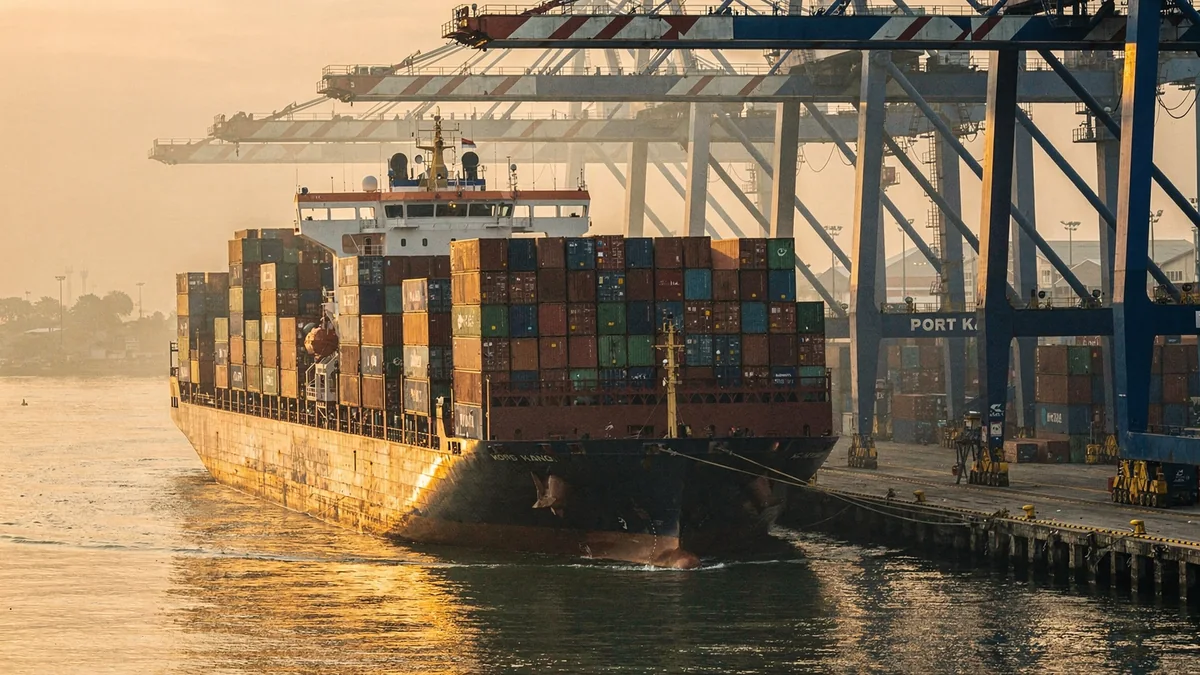
Importing from Vietnam to Malaysia is fast and, for most goods, duty-free. Sea freight from Ho Chi Minh or Haiphong to Port Klang takes about 2 to 3 days direct, or 5 to 7 days with transhipment; air freight, 1 to 3 days. Under ATIGA, a valid Form D Certificate of Origin clears qualifying goods at 0% import duty — though SST still applies.
Last updated: 13 August 2026
Vietnam is one of Malaysia's largest ASEAN trading partners and a key China Plus One sourcing base for furniture, footwear, textiles, electronics and components. Because Vietnam sits inside the same free-trade bloc as Malaysia, the duty maths is very different from China. Here are the routes, transit times, cost drivers, and the one document that decides whether you pay duty at all.
How long does shipping from Vietnam to Malaysia take?
By sea, plan for about 2 to 3 days direct or 5 to 7 days with transhipment, port-to-port from Ho Chi Minh City (Cat Lai) to Port Klang. Air freight typically takes 1 to 3 days. Door-to-door is longer once pickup, customs and haulage are added, so the paperwork timeline usually decides delivery.
Direct sailings are quick: Fluent Cargo lists the fastest Port Klang–Ho Chi Minh City crossing at roughly 2 days 19 hours, with daily departures. Most cargo, though, moves with consolidation and transhipment, so DocShipper puts typical sea transit at 5 to 7 days and air freight at 1 to 3 days.
How much does it cost to import from Vietnam to Malaysia?
Landed cost has four parts: ocean or air freight, local charges at both ends (handling, documentation, customs), inland haulage from Port Klang, and taxes. Because most Vietnam-origin goods qualify for 0% ATIGA duty, the tax line is often just SST — so freight and handling are the bigger variable.
We will not quote a fixed freight figure — rates move with peak season, fuel and capacity — but here is where the money goes.
The four cost buckets on a Vietnam import
- Main freight: ocean or air. Whether you book a full container or share one (FCL vs LCL) is the biggest lever for smaller shipments.
- Origin & destination charges: terminal handling, documentation, B/L and customs at both ends.
- Inland haulage: trucking the container from Port Klang to your warehouse.
- Taxes: import duty (often 0% with a valid Form D) plus SST. Who pays freight and insurance depends on your Incoterms — FOB, CIF or DDP.
Do I pay import duty on goods from Vietnam? (ATIGA explained)
For most goods, no — if you have a valid Form D. Both countries are ASEAN members, so trade falls under ATIGA (the ASEAN Trade in Goods Agreement). Malaysia has eliminated import duty on 98.74% of its tariff lines, so a qualifying Vietnam-origin shipment with a Form D clears at 0% duty. SST, however, still applies.
This is the crucial difference from China, which uses ACFTA and a Form E; Vietnam goods use ATIGA and a Form D (per MITI). But 0% is not automatic: without a valid Form D, Customs charges the Most-Favoured-Nation rate — Malaysian duties run from 0% to 60% by HS code, per DHL Malaysia — and SST is still payable. ATIGA wipes out the duty, not the tax.
| Scenario (illustrative) | Import duty | SST |
|---|---|---|
| Vietnam-origin goods, valid Form D (ATIGA) | 0% |
Applies |
| Same goods, no Form D (standard MFN rate) | up to 60% by HS code |
Applies |
For how ASEAN and other agreements drive your rate to zero, see our guide to RCEP, CPTPP and FTAs for zero duty.
What is the Form D Certificate of Origin and why does it matter?
Form D is the ATIGA Certificate of Origin that proves your goods genuinely originate in an ASEAN country — Vietnam, here. Your supplier applies for it from a designated authority before shipment. Present it at Port Klang clearance and Customs grants the 0% rate; without it, you pay full duty.
To qualify, goods must meet ATIGA's Rules of Origin — typically wholly obtained in ASEAN, at least 40% ASEAN regional value content, or a qualifying change in tariff classification. MITI states that goods must be accompanied by the COO Form D “to support the claim that they are eligible for preferential tariff treatment.”
The Form D is now electronic
Since 1 January 2024, all ten ASEAN member states transmit the e-Form D electronically, and customs may reject a hardcopy for preferential claims, per the ASEAN Single Window. A mismatch in HS code, value or quantity is the classic reason a 0% claim is rejected, so your forwarder should confirm the e-Form D matches the declaration.
The same certificate works in reverse when you sell into ASEAN: if you also export, our Certificate of Origin guide for Malaysian exporters covers how a Form D is applied for on this side of the trade.
Which Vietnam ports ship to Port Klang?
Most Vietnam-origin sea cargo leaves from Cat Lai (Ho Chi Minh City) or the nearby Cai Mep deep-water port in the south, or Haiphong in the north. It arrives at Port Klang — Malaysia's main gateway — split between the Westports and Northport terminals.
Ho Chi Minh City's port system, anchored by Cat Lai, is Vietnam's largest container gateway, handling roughly 9.1 million TEUs in 2024 per UNIS; Haiphong serves the north. Cargo lands at Port Klang, which handled a record 15.14 million TEUs in 2025 — up 3.4% on 14.64 million in 2024, its highest since the port began operations in 1973, and among the world's top 10 container ports, per Transport Minister Anthony Loke Siew Fook in March 2026.
One number in that record is worth understanding before you route a Vietnam shipment: 8.41 million of those 15.14 million TEUs were transhipment — boxes that changed ships at Port Klang without ever entering the Malaysian economy. That is the difference between a container that merely passes through and one that is genuinely imported. Only the latter is declared to Malaysian Customs, needs a Form D to claim 0% duty, and attracts SST. If a Vietnamese supplier or freight agent tells you cargo “goes via Port Klang,” confirm which of the two you are buying — the paperwork, the timeline and the tax treatment are not the same. If you are weighing gateways for a Vietnam lane, our comparison of Port Klang, Tanjung Pelepas and Singapore sets out where each one wins.
What documents and permits do I need?
The core documents are the commercial invoice, packing list, bill of lading (or air waybill), and — to claim 0% duty — the ATIGA Form D, lodged with the customs declaration in SMK via Dagang Net. Some goods need extra permits from MITI, SIRIM or other agencies.
Vietnam import document checklist
- Commercial invoice & packing list — values and quantities must match the declaration.
- Bill of Lading or Air Waybill — the carrier's transport document.
- ATIGA Form D Certificate of Origin — the document that unlocks 0% duty.
- Import licence / permit (if applicable) — controlled goods may need MITI, SIRIM or MAQIS approval.
- Correct HS code — the right HS classification drives the duty rate and whether your Form D matches.
The declaration is lodged in the Customs system (SMK) via Dagang Net, the National Single Window. Align the declaration, HS code and Form D and clearance is routine; any discrepancy triggers queries and delay.
Common mistakes importing from Vietnam
- No Form D, or it arrives late. If the e-Form D is not in the system at clearance, you pay full duty — have your supplier apply for it before the goods sail.
- Confusing ATIGA with ACFTA. Vietnam goods need a Form D; a Form E (the China/ACFTA certificate) does not apply.
- Under-declaring value. Customs can re-value and penalise, so declare the true transaction value.
How DNE clears your Vietnam shipment
DNE Forwarding arranges your sea or air freight from Vietnam, pre-checks the Form D, clears the shipment at Port Klang, and hauls the container to your door. In our 25-plus years clearing Port Klang, moving 1,000-plus containers a month at 99%+ documentation compliance, we make sure you actually get the 0% ATIGA rate.
DNE Forwarding (M) Sdn Bhd is a JKDM-licensed forwarder. For Vietnam imports, we:
- Book the freight — sea (FCL or LCL) or air from Cat Lai, Cai Mep or Haiphong into Port Klang.
- Pre-check the Form D — confirm the e-Form D exists and reconciles with the invoice before clearance, so the 0% claim holds.
- Clear it at Port Klang — lodge the declaration in SMK via Dagang Net and manage Customs queries as your broker.
- Haul it to you — our own KA-licensed haulage delivers from quay to your warehouse across Peninsular Malaysia.
Note: Vietnam-origin cargo reaches Malaysia by sea or air — DNE does not run cross-border trucking from Vietnam. Our haulage covers the Peninsular-Malaysia leg only, from Port Klang onward.
Frequently Asked Questions
Do I pay import duty on goods from Vietnam to Malaysia?
For most goods, no — qualifying goods trade under ATIGA at 0% import duty, provided you present a valid Form D at clearance. SST still applies even when duty is zero.
What is the difference between Form D and Form E?
Form D is the ATIGA Certificate of Origin for ASEAN-origin goods (including Vietnam); Form E is the ACFTA certificate for China-origin goods. They are not interchangeable, so a Vietnam shipment needs a Form D.
How long does sea freight from Ho Chi Minh to Port Klang take?
Direct sailings run roughly 2 to 3 days port-to-port, with departures most days. Allowing for consolidation, transhipment and handling, plan for around 5 to 7 days; air freight takes 1 to 3 days.
Which Vietnam port should my supplier ship from?
Factories in the south near Ho Chi Minh City usually ship from Cat Lai or the deep-water Cai Mep port; those in the north near Hanoi ship from Haiphong. All connect to Port Klang.
Do I still need a forwarder if duty is 0%?
Yes. The 0% rate is only granted if the Form D, HS code and declaration all reconcile and are lodged correctly in SMK via Dagang Net — which is what turns “eligible for 0%” into actually paying 0%.
Sources
- MATRADE — Malaysia–Vietnam bilateral trade promotion
- MITI (FTA Portal) — ATIGA / AFTA tariff elimination and Form D requirement
- ASEAN Single Window / Cross-Border Paperless Trade Database — e-Form D under ATIGA
- Malay Mail — Port Klang 2025 record throughput (15.14m TEUs), transhipment split and global ranking, March 2026
- Fluent Cargo — Malaysia–Vietnam sea freight transit times
- DocShipper — Malaysia–Vietnam sea and air freight transit times
- DHL Malaysia — Malaysia import tax, duty range and SST
- UNIS — Ho Chi Minh City / Cat Lai port throughput
Part of a guide: this article is part of DNE's complete guide to importing into Malaysia.
Part of a guide: this article is part of our complete guide to Sea Freight Malaysia 2026: Complete Port Klang Guide.