DNE Forwarding has cleared and coordinated freight through Port Klang since 1999. Today we handle over 1,000 TEUs each month across customs clearance, container haulage, and FTZ warehousing — all run from one Klang office, all visible to clients through the WizForwarding portal.
If you import or export through Port Klang — whether through Westport, Northport, or the Port Klang Free Zone (PKFZ) — you need a forwarder who knows the terminal layouts, the customs officers, the haulier circuit, and the regulatory landscape. Cargo doesn't move at the speed of spreadsheets; it moves at the speed of the people on the ground. That's the part DNE has spent 25 years getting right.
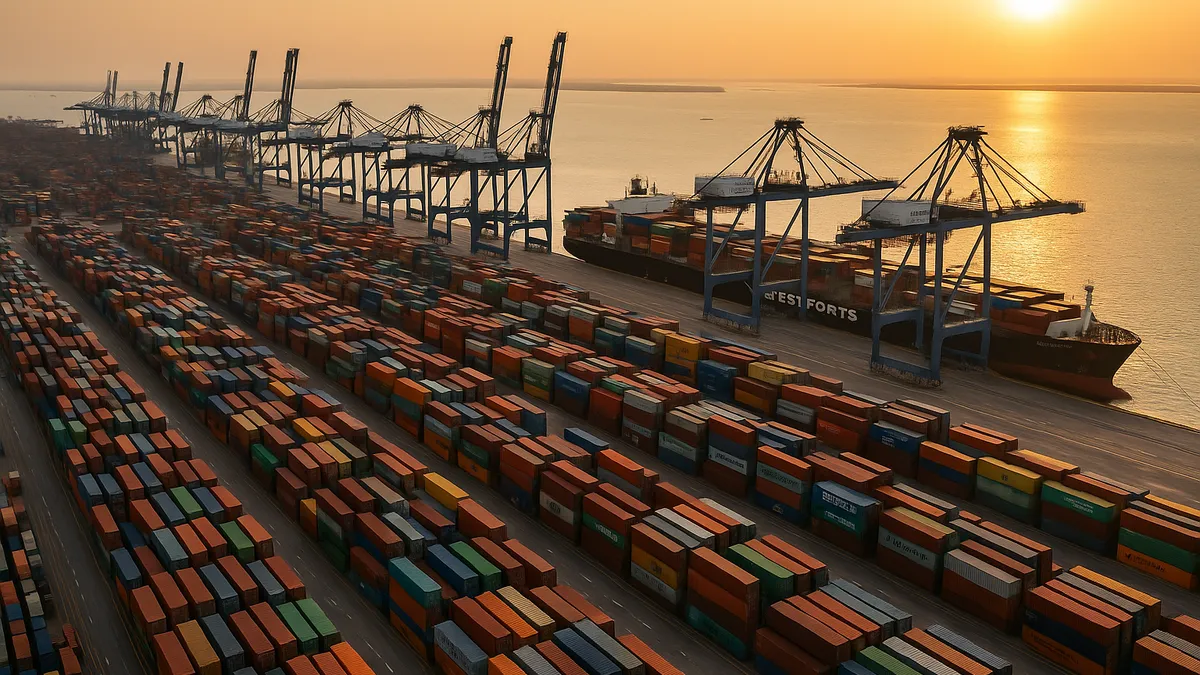
The scale is real: according to Transport Minister Anthony Loke, Port Klang handled a record 15.14 million TEUs in 2025 — up 3.4% on 2024 — making it the world's 10th-busiest container port (The Star; Malay Mail). Westports moved 11.33 million of those TEUs and Northport a record 3,804,173 TEUs (up 3.8% on 2024, MMC Ports) — and every single box needed a declaration, a clearance, and a truck.
The 2026 run rate is higher still. Port Klang handled 6.38 million TEUs between January and May 2026, up 5.4% on the 6.05 million TEUs it moved in the same five months of 2025, according to Transport Minister Anthony Loke (The Edge Malaysia, 28 August 2026). For an importer that is not trivia: rising volume through the same terminals means gate queues, haulage capacity and free-storage windows all get tighter, and the forwarders who plan the declaration before the vessel berths are the ones whose boxes still leave on time.
"With this achievement, Port Klang has again made history by recording the highest container handling since operations began in 1973." — Anthony Loke, Minister of Transport, on Port Klang's 2025 throughput (Malay Mail, 16 March 2026)
Key takeaways
- DNE Forwarding has cleared and coordinated freight through Port Klang since 1999, and handles over 1,000 TEUs a month today.
- One operator covers the whole chain: ocean and air bookings, K1/K2/K8/K9 declarations filed through SMK, container haulage, and documentation.
- Declarations go through SMK via the National Single Window; supporting documents (invoices, packing lists, permits) go through MyCIEDS.
- Port Klang moved a record 15.14 million TEUs in 2025 — Westports 11.33 million, Northport 3.80 million — and a further 6.38 million TEUs in January–May 2026, up 5.4% year-on-year, so terminal choice changes your haulage and timing.
- The cost drivers you can actually control are free-time management, correct HS classification, and clean documents — not the freight rate alone.
What we do as your forwarding agent
A freight forwarder is the link between you and everything else — the carrier, the terminal, the customs department, the haulier, the warehouse. We absorb the operational complexity so your team focuses on production and sales.
- Ocean freight bookings — FCL (20ft, 40ft, 40HC, 45HC) and LCL through every major carrier serving Port Klang, including MSC, Maersk, CMA CGM, Evergreen, ONE, Hapag-Lloyd, COSCO, OOCL, and the Asian carriers (KMTC, SITC, Wan Hai).
- Air freight through KLIA and KLIA2, working with the major freighters and combination carriers — Cathay, Singapore Airlines Cargo, Korean Air Cargo, Emirates SkyCargo, Qatar, Turkish, Lufthansa Cargo, FedEx, UPS, DHL.
- Customs declarations — K1 (import), K2 (export), K8 (transit), K9 (warehoused goods). Full SST compliance built into every declaration, filed through SMK with supporting documents via MyCIEDS.
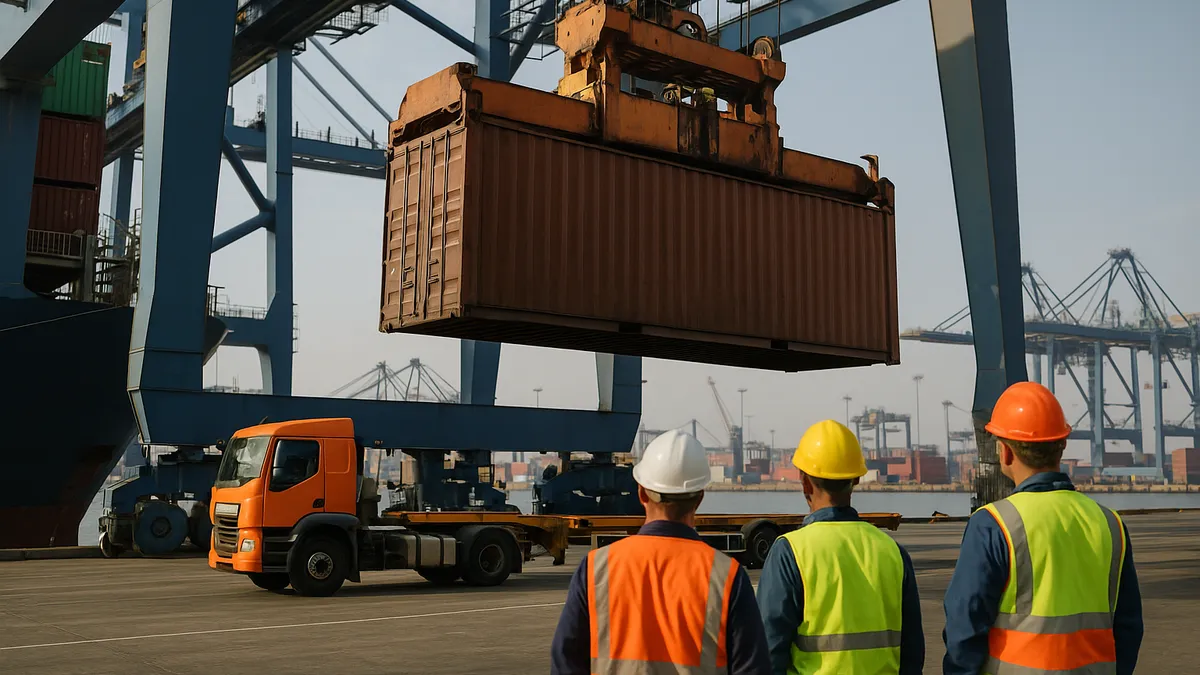
- Container haulage from Port Klang to your floor — anywhere in Peninsular Malaysia, with our own fleet for Selangor and Klang Valley deliveries.
- FTZ and bonded warehousing at Port Klang for consolidation, repacking, kitting, and duty-deferred storage.
- Documentation — Bill of Lading, Certificate of Origin, packing lists, commercial invoices, dangerous goods declarations, Form D / Form AANZ / Form E for FTA preferential duty.
Why choose DNE specifically
How a typical shipment moves
Whether you're a first-time importer or running 100 containers a month, our process is the same five-step playbook, refined over 25 years.
1. Inquiry and quote
You WhatsApp us with origin, destination, cargo description, volume, and any special handling needs (DG, oversized, temperature-controlled). We respond within 5 minutes during business hours with an indicative rate. If you confirm, we issue a formal quotation with the full itemised cost breakdown within the same business day.
2. Booking and documentation
Once you accept the quote, we book vessel space (or air freight) with the appropriate carrier, prepare the Shipping Instructions, and coordinate with your origin shipper. Bill of Lading, packing list, commercial invoice, Certificate of Origin, and any special permits are checked before vessel arrival so customs clearance starts immediately.
3. Arrival, declaration, and clearance
When your container arrives at Westport or Northport, we file the K1 declaration through SMK within hours of receiving the final documents. Standard cargo typically clears in 24-48 hours from declaration. Container release happens well before the 3-5 day free storage window expires, so no demurrage. Dangerous goods, permit-controlled goods, and DDP shipments take longer — we'll flag this upfront in the quote.
4. Haulage to your floor
Our own GPS-tracked fleet handles haulage across Selangor and the Klang Valley. For Negeri Sembilan, Pahang, Johor, Penang, or further north, we coordinate with established haulage partners who meet our SOPs. Live tracking is visible on WizForwarding throughout.
5. Delivery, POD, and e-invoice
Signed proof-of-delivery is uploaded to your portal the same day. Final invoice — matching the original quote item-by-item — is issued as LHDN-compliant e-invoice. You see every charge, every receipt, every document.
What cargo do we move through Port Klang?
Which is right for your cargo — Westport, Northport, or KLIA?
Port Klang is actually two ports — Westport Malaysia (the larger, deeper, newer terminal) and Northport. Most container traffic uses Westport because of the bigger berths and faster productivity. Northport still handles a major share of conventional cargo, dry bulk, and certain liner services. For air freight, KLIA Cargo Terminal handles all major freighter services, with smaller volumes through Subang and KLIA2.
DNE clears containers through both Westport and Northport routinely. The right terminal for your cargo depends on the carrier's berthing schedule, not your preference — we'll advise during the booking stage. Read our complete Westport vs Northport guide for the full operational comparison.
What determines your freight quote?
There is no single "Port Klang freight forwarder rate". The table below shows indicative all-in costs for the most common lanes into Port Klang, broken down by component. The bands below were set in May 2026 and are published as a planning benchmark, not a live price list — ocean freight moves week to week, so the only number that binds is the one on your quotation. Read the August 2026 market note under the tables before you budget from them.
| Cost component | Shenzhen → Port Klang | Shanghai → Port Klang | Busan → Port Klang | Rotterdam → Port Klang |
|---|---|---|---|---|
| Ocean freight (40GP) | USD 1,200 – 1,400 | USD 1,400 – 1,700 | USD 1,300 – 1,600 | USD 2,200 – 2,800 |
| Port charges (Westport/Northport) | RM 1,800 – 2,500 | RM 1,800 – 2,500 | RM 1,800 – 2,500 | RM 1,800 – 2,500 |
| Customs duty | Varies by HS code; often 0% under ACFTA / RCEP | Varies by HS code; often 0% under ACFTA / RCEP | Varies by HS code; often 0% under AKFTA / RCEP | Varies by HS code; MFN rates apply |
| SST | 5 – 10% on dutiable goods | 5 – 10% on dutiable goods | 5 – 10% on dutiable goods | 5 – 10% on dutiable goods |
| Haulage (port → Klang Valley) | RM 800 – 1,400 | RM 800 – 1,400 | RM 800 – 1,400 | RM 800 – 1,400 |
| Documentation | RM 200 – 400 | RM 200 – 400 | RM 200 – 400 | RM 200 – 400 |
| Origin | Rate per kg | Typical transit |
|---|---|---|
| China (PVG, PEK, CAN) | USD 4 – 6 / kg | 1 – 3 days |
| South Korea (ICN) | USD 3.50 – 5.50 / kg | 1 – 2 days |
| Europe (FRA, AMS, CDG) | USD 5 – 8 / kg | 3 – 5 days |
| USA (ORD, LAX, JFK) | USD 6 – 10 / kg | 2 – 4 days |
Market note — what has moved since May 2026
40GP ocean rates ex-China jumped 22% in April 2026; we cover the macro causes in our April 2026 freight rate surge analysis and the sea-vs-air break-even math in our mode-switch guide.
As of 27 August 2026, the Drewry World Container Index — the composite most quoted in freight headlines — sat at USD 4,473 per 40ft container, down 1% on the week, with Shanghai–Rotterdam at USD 4,287 (down 3%) and Shanghai–Genoa at USD 4,866 (down 2%). A week earlier the same composite had risen 4% to USD 4,526 (Drewry). That is the shape of this market: sideways with sharp weekly swings, not a trend you can extrapolate a quarter forward.
The trap for Port Klang importers is assuming that index describes their lane. The WCI tracks eight long-haul deep-sea routes out of Shanghai to Europe and North America. Your Shenzhen–Port Klang or Busan–Port Klang box is a short-haul intra-Asia move, priced off a different set of services with different capacity dynamics. When you read that container rates "fell 3% this week", that headline is usually about a lane you do not ship on. Ask us for the live number on your actual origin port before you re-budget, and hold the table above as a structure — which cost components exist and roughly how they weight against each other — rather than as a price.
Sector-specific numbers differ again: machinery and plant move on different equipment and different clearance risk from cartons of finished goods, which is why we keep a separate breakdown for machinery and equipment importers. For your specific lane, WhatsApp +6012 231 1393 with origin, destination, container size and HS code for a same-day itemised quote.