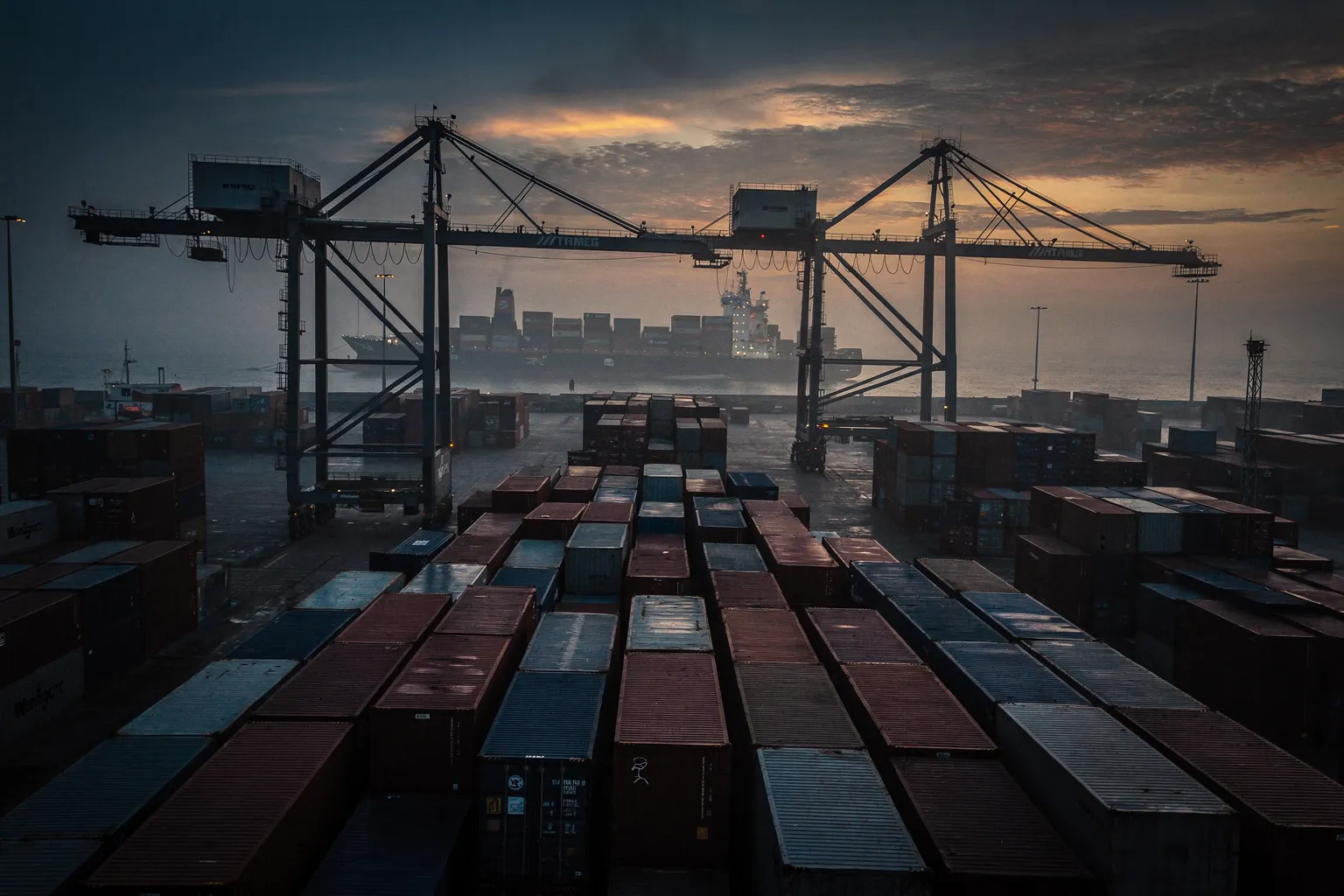
Port Klang's Westport posted Q1 2026 throughput up 5.2 percent year on year. January exports came in at plus 12.6 percent. The ringgit is sitting at its strongest level against the US dollar in 18 years. If you only read the front page of the trade press, the Malaysian logistics story for 2026 looks like a quiet win.
It is not. It is a lag. The International Monetary Fund's most recent working paper on shipping costs and inflation pins the curve at roughly 12 months from container cost shock to consumer shelf prices, with the steepest acceleration in months 4 through 9. The current shock began on 28 February 2026, when Houthi attacks resumed in the Bab el-Mandeb and Operation Epic Fury escalated the US-Israel-Iran conflict, followed by Iran's effective closure of the Strait of Hormuz on 4 March. This article was first published on 19 May 2026, twelve weeks into that curve, and forecast the bite landing between July and October. As of August 2026 we are roughly six months in — squarely inside the months 4 to 9 acceleration band the IMF measured, with the forecast window now open rather than approaching. The scorecard section below marks the thesis to market: the freight leg has confirmed harder than forecast and the feedstock leg has confirmed; the consumer leg has not arrived; and Hormuz did something the May version of this article did not anticipate.
The surface story: why everything looks fine
The headline indicators every CFO checks all read positive, and through the first half of 2026 they got stronger, not weaker. Malaysian exports printed plus 12.6 percent in January and Q1 came in at plus 10.4 percent overall. The Department of Statistics Malaysia then reported June 2026 total trade at a record RM340.9 billion, up 44.7 percent year on year, with exports at RM177.9 billion (plus 45.4 percent) and imports at RM163.0 billion (plus 43.9 percent); first-half trade reached RM1.8 trillion, up 22.4 percent, on a trade surplus of RM147.1 billion (DOSM monthly external trade release, 20 July 2026). Consumer prices stayed quiet alongside it: headline inflation was 1.9 percent in April and had eased to 1.8 percent by July 2026, with the CPI at 137.1 points (DOSM, reported 17 August 2026). The ringgit sat at 3.97 to the dollar in May, its strongest reading since June 2018, giving every USD-denominated importer a built-in cushion. MITI and BNM forecasts still sit on growth tracks.
That is the picture a finance director walked into the boardroom with on 20 May 2026, and — on the trade and inflation prints — it is still broadly the picture in August 2026. It was accurate to the moment then and it is accurate to the moment now. It was also misleading about the two quarters that followed, and the same reading is misleading about the two quarters ahead, for the reason set out below.
The story underneath: what the lag is hiding
Three things have already happened that have not yet shown up in the average Malaysian importer's invoice stack.
- Hormuz has now reopened once and closed again. Pre-conflict the Strait moved roughly 130 to 138 vessels per day; on 3 to 4 May 2026 that number was 5 to 6. A US-Iran memorandum of understanding signed on 17 June 2026 lifted the naval blockade and provided for safe passage of commercial vessels for a stated 60 days, and traffic did recover for a time: Lloyd's List Intelligence counted 84 transits in the week of 27 July to 2 August 2026, up from 45 the week before, of which 52 were not Iranian-linked. It did not hold. The parties spent early August still disputing which lane ships may use — Iran pressing for a northern lane under its own control and fees, the US for unrestricted passage — with vessels that took the Omani southern route being targeted; Al Jazeera reported commercial traffic back down to 8 vessels on a single monitored day as of 5 August 2026, against roughly 130 a day before the conflict. The Strait still carries roughly 20 percent of global oil, 20 percent of global LNG, and the feedstock chain for half of Asia's petrochemical production. About 50 percent of Malaysia's crude oil supply transits Hormuz.
- Container spot rates have ripped, and then kept going. Drewry's World Container Index jumped 12 percent in a single week on 14 May 2026 to USD 2,553 per 40-foot equivalent — the reading this article originally flagged. On 13 August 2026 the same index stood at USD 4,339 per 40-foot container, up another 1 percent on the week and roughly 70 percent above that May level. The route detail has become lopsided: Shanghai to New York USD 8,706 (plus 10 percent on the week) and Shanghai to Los Angeles USD 6,244 (plus 6 percent), while Shanghai to Genoa eased to USD 5,080 (minus 8 percent) and Shanghai to Rotterdam to USD 4,425 (minus 5 percent). For a Malaysian importer the closer benchmark is Drewry's Intra-Asia Container Index, which rose 6 percent to USD 1,028 per 40-foot container in the same 13 August 2026 assessment, a six-week high, with Shanghai to Singapore at USD 1,096.
- Carrier war-risk surcharges are live. Hapag-Lloyd levied USD 1,500 per TEU as a War Risk Surcharge on dry containers ex Upper Gulf, Arabian Gulf, and Persian Gulf, and USD 3,500 per reefer TEU, effective 2 March 2026. CMA CGM and MSC followed in mid-March with Emergency Bunker and Fuel Surcharges of similar magnitude. Marine insurance war-risk premiums on Hormuz transits jumped to roughly 0.8 percent of hull value, up from a pre-conflict baseline of 0.10 to 0.15 percent. That is up to an 8x rise.
The Federation of Malaysian Manufacturers (FMM) ran a member survey in April 2026. The numbers were unambiguous. 90.5 percent of respondents reported being either already disrupted by the Middle East conflict or expecting disruption within four weeks. 72 percent reported worsening business conditions since early April. 28 percent said they were already planning workforce reductions. And critically: 40 percent of Malaysian manufacturers reported holding less than two months of critical raw materials on hand. The buffer expires in June and July for two out of every five factories the FMM speaks for.
Why your P&L still looks calm: the FAK contract bridge
The reason the surface and the underneath diverge so sharply right now comes down to one piece of trade plumbing: the annual FAK (Freight All Kinds) contract.
Most Malaysian importers with meaningful volume signed their annual FAK contracts with carriers and forwarders in October, November, and December 2025. At that point in the calendar, the consensus 2026 outlook from Drewry, MDS, and the major liner shipping analysts was an overcapacity story. 2026 through 2028 was expected to bring a wave of ultra-large container ship newbuilds (around 65 to 70 percent of the orderbook is at or above 23,000 TEU). The base case had contract rates falling 30 to 35 percent year on year on the Asia-Europe and Asia-Mediterranean lanes. Shippers signed accordingly.
If your FAK contract runs from January to December 2026, you are sailing 2026 cargo on a rate sheet that was written before the Houthi attacks resumed, before Hormuz closed, before naphtha priced at USD 916 per tonne on its way to USD 986, and before Hapag-Lloyd's USD 1,500 surcharge existed. Carriers cannot tear up an in-force contract without good reason. So they cannot touch your rate until renewal.
This is the bridge keeping your P&L calm. It expires the moment your FAK contract renews. For most Malaysian importers, that renewal window falls between July 2026 (mid-year contracts) and January 2027 (calendar-year contracts), with the heaviest concentration in October to December.
The IMF curve: how a freight shock actually reaches Malaysian shelves
The IMF's working paper "From Ports to Prices: The Inflationary Effects of Global Supply Chain Disruptions" (Working Paper 2026/22, published February 2026 as an update to the 2022 baseline study) measured the lag from container freight rate shocks to headline consumer prices across emerging and advanced economies. The curve is not linear.
- Months 1 to 3: Spot rates spike. Contracted shippers absorb almost none of the cost. Only smaller importers who buy on spot, or those with very short FAK durations, feel anything. Headline CPI moves about 0.02 to 0.04 percentage points.
- Months 4 to 9: Contract renewals kick in. New contracts are priced at the higher level. Importers either renegotiate downstream prices or absorb the gap. Inventory built before the shock works its way through the system. Headline CPI moves 0.08 to 0.15 percentage points cumulatively per one-standard-deviation freight shock.
- Months 10 to 14: The full pass-through is visible at the consumer shelf. Manufacturers that locked early bridge contracts or hedged feedstock outperform peers by roughly the size of the shock.
Apply that to today's calendar. The shock started 28 February 2026. Month 4 lands on or about 28 June 2026. Month 9 lands on 28 November 2026. The window from late June through November is when the average Malaysian importer's landed cost starts to move regardless of what their CFO did back in May — and as of August 2026 we are inside it.
Marking the thesis to market: where the curve actually is in August 2026
This article was written twelve weeks into the shock and forecast the bite landing between July and October 2026. That window is now open, which makes a scorecard more useful than a restated forecast. Three of the four legs have moved. The one that matters most to a consumer-facing importer has not — and that is the reading most likely to be misinterpreted.
| Leg of the thesis | Where it stands (August 2026) | Verdict |
|---|---|---|
| Freight cost | Drewry WCI USD 2,553 on 14 May to USD 4,339 on 13 August 2026, roughly plus 70 percent; Intra-Asia index USD 1,028, a six-week high | Confirmed, and larger than forecast |
| Petrochemical feedstock | CFR Japan naphtha USD 916.80/T in May to USD 986/T on 23 July 2026 | Confirmed |
| Hormuz normalisation | Blockade lifted under the 17 June 2026 memorandum and traffic recovered, then fell back to a reported 8 transits on a monitored day by 5 August 2026 amid a dispute over lane control and transit fees | Not anticipated — one false dawn, then re-restriction |
| Consumer pass-through | Malaysian CPI 1.9 percent in April to 1.8 percent in July 2026; June trade a record RM340.9 billion, up 44.7 percent | Not yet — which is exactly what months 4 to 9 predicts |
The last row is the one importers misread. A calm August CPI print is not evidence that the shock passed. On the IMF curve it is the expected reading at month six, when the cost is sitting in carrier invoices and renewal quotations rather than on a shelf. Month 9 lands on or about 28 November 2026 and month 14 in late April 2027, so the pass-through window this article described has not closed — it has barely started.
What has changed is the price of acting. In May, a six-month bridge contract could be negotiated against a USD 2,553 spot market. In August the same bridge is negotiated against USD 4,339, so the importers who moved early have already banked most of the available saving. For everyone else the cheapest remaining lever is no longer the inbound freight rate at all — it is Play 3 below, the customer-contract side, which costs nothing to change and is the only one of the three plays that gets harder, not easier, once the first invoice shock lands.
The petrochemical feedstock leg: a separate, faster timer
There is one category that does not wait for FAK renewal. Petrochemical feedstocks are bought on spot, on monthly index, or on quarterly tenders, not annual contracts. Naphtha, which is the feedstock for roughly 70 percent of Asian polyethylene and polypropylene production, has already moved.
| Feedstock | Move (May 2026 vs May 2025, updated to August 2026) | Downstream exposure for Malaysia |
|---|---|---|
| Naphtha | +66 percent YoY in May 2026 (USD 916.80/T); CFR Japan open-spec naphtha reached USD 986/T on 23 July 2026, a two-month high | Plastic packaging, FMCG, food packaging, automotive plastics, halal packaging |
| LPG / ammonia | Tightening, sufficient stock to mid-2026 per FMM | Urea, compound fertilisers, ammonia for palm oil refining |
| Ethylene / propylene | Margin compression at MY crackers | Automotive parts, electronics housings, consumer durables |
| Sulphur | Supply tight, sourced via Hormuz | Palm oil refining, fertiliser blending |
The Malaysian Communications Minister already publicly warned that the petrochemical shortage may affect food packaging if it persists. That is the early end of the curve, not the late end. If your business buys plastic resin, packaging film, or any HS 39 (plastics in primary form) product, you are likely already paying more in your supplier's quotation, even before your shipping rate moves. The squeeze carries one step downstream, where resin becomes parts — see our lane notes for automotive parts importers and electronics manufacturers, the two Malaysian sectors in the table above with the most polymer in their bill of materials.
The October cliff: what FAK renewal looks like in Q3-Q4 2026
When the renewal email lands, three things will be different from October 2025.
First, the base case is dead. Drewry's pre-war forecast of contract rates down 30 to 35 percent was built on Suez Canal normalisation. Suez transits are still running roughly 60 percent below pre-2024 baseline because the Houthis resumed targeting on 28 February. The diversion around the Cape of Good Hope adds 8 to 12 days and roughly 15 to 25 percent to the operational cost on the lane. That cost cannot be unwound by capacity discipline alone.
Second, war-risk surcharges are now a structural line item, not an emergency. Hapag-Lloyd, CMA CGM, MSC, Maersk, and Yang Ming have all repriced bunker fuel and emergency surcharges within the last 10 weeks. The trade press is already reporting carrier moves to fold these into base FAK pricing rather than letting them sit as removable add-ons. Once a surcharge is in the FAK, it is no longer a "temporary" measure.
Third, equipment imbalance will favour carriers in negotiation. Petrochemical supply pressure pulls reefer and tank-style equipment into different rotations than the standard dry container fleet. Carriers heading into the late-2026 renewal window will have less spare capacity to give back than they would have had in a no-conflict 2026.
The plausible replacement scenario for FAK contracts renewing between July and December 2026 is flat to plus 25 percent on Asia-Europe, flat to plus 15 percent on intra-Asia, and plus 10 to plus 20 percent on Asia-Mediterranean, with war-risk surcharges baked in rather than tacked on.
The contrarian counter, and why it does not save you
It is worth naming the bear case on this thesis. The 2026 to 2028 newbuild orderbook is enormous, and most of those ships still need to be filled. The ringgit at 3.97 to the dollar is a real cushion for any USD-denominated freight bill. Malaysia's direct import exposure to the Middle East is under 4 percent of total imports. And as a net LNG exporter, Malaysia partly benefits from higher Brent. Q1 throughput was genuinely up.
All of that is true and none of it changes the fact that the petrochemical leg has already broken (naphtha plus 66 percent) and the FAK leg is locked until renewal. The ringgit can offset 5 to 7 percent of a USD freight bill. It does not offset a 25 percent contracted rate increase plus a 30 to 60 percent feedstock cost rise. The newbuild oversupply is the medium-term ceiling, not a short-term release.
What to do Monday morning: three plays
This is the practical part. None of it requires capital. All of it can be done in the next 30 days. The Malaysian importers who do these three things will outperform on landed cost across the second half of 2026 by enough to be visible at the EBITDA line.
Play 1 — Model the rate cliff before it lands
Ask your forwarding agent to run a plus 15 percent and a plus 25 percent rate scenario on your top three lanes for the next four quarters. Layer in the live war-risk surcharge (Hapag USD 1,500 per TEU ex Gulf is the benchmark today) and the Cape-via diversion cost where applicable. The output is a single number: how much extra cost lands on your P&L between July 2026 and March 2027 if you do nothing. Most CFOs have not seen this number yet. They cannot react to a number they have not been shown.
Play 2 — Lock a 6-month bridge on at least one critical lane
Do not wait for the annual renewal window if you can avoid it. Negotiate a 6-month bridge contract on your single highest-volume or most-critical lane right now, using the current spot environment as the upper bound. A bridge contract starting June 2026 and ending December 2026 lets you reprice once in May or June 2026 and once at year-end, instead of being locked into a single high-rate annual renewal in October. Carriers will sometimes prefer this because it gives them visibility on rebid timing. Make sure the bridge has a force majeure carve-out and a surcharge cap, not a pass-through.
Play 3 — Re-quote your customer contracts before the rate moves
This is the one most importers miss. Even if your inbound freight stays calm until October, your customer contracts are the place where margin gets crushed. Add a force majeure clause that includes regional conflict and waterway closure. Add a surcharge passthrough clause that lets you index a percentage of any war-risk or emergency bunker surcharge directly into the next invoice. Customers will accept this language now, while the macro story is still abstract. They will not accept it after the first invoice shock lands.
How DNE Forwarding helps importers prepare for the Q3-Q4 rate cliff
At DNE we have spent the last 25 years moving cargo through Port Klang for Malaysian manufacturers, importers, and exporters. The current cycle is not the first time a geopolitical shock has rerouted Asia trade lanes, and the pattern from 2021 COVID, 2022 Russia-Ukraine, and 2024 Red Sea repeats: the operators who modelled the renewal cliff early outperformed the ones who waited. Here is how we are helping clients prepare right now:
- Rate scenario modelling on your top lanes: We will produce a plus 15 and plus 25 percent landed-cost scenario for your top three lanes in 48 hours, including current war-risk surcharge levels and Cape diversion impact.
- Bridge contract negotiation: We negotiate 6-month bridge contracts with major carriers (Maersk, MSC, CMA CGM, COSCO, Hapag-Lloyd, ONE) on behalf of clients, with surcharge caps and force majeure carve-outs written in.
- Petrochemical feedstock routing: For clients buying HS 27, 29, and 39 raw materials, we audit your current source mix and identify alternative origin lanes that bypass Hormuz exposure where commercially viable.
- Customer contract language review: We share a clause library covering force majeure, surcharge passthrough, and rate-adjustment triggers that you can drop into your customer agreements before renewal.
- Q3 outlook briefing: Once a quarter we publish a private outlook briefing for our customers covering rate forecasts, carrier surcharge moves, and Port Klang capacity. The next one drops in July 2026.
The Malaysian importers who get bled in the second half of 2026 will be the ones who never renegotiated the sell side. The ones who run the three plays above this month will be the ones whose P&L still looks calm when everyone else's stops looking calm.
Part of a guide: this article is part of our complete guide to Freight Forwarder Port Klang.
Frequently asked questions
Why do Q1 2026 trade numbers look strong if the Middle East war is hitting global freight?
Most Malaysian importers signed annual FAK contracts in October to December 2025, before the Hormuz closure. They are still sailing 2026 cargo on 2025 contracted rates while spot rates run hot: Drewry's World Container Index reached USD 4,339 per 40-foot container on 13 August 2026, about 70 percent above its mid-May level. The lag from a container cost shock to consumer prices is roughly 12 months per the IMF's Working Paper 2026/22, so at roughly six months in we sit inside the months 4 to 9 acceleration band — freight and feedstock costs have confirmed higher, while Malaysian consumer inflation (1.8 percent in July 2026) has not moved yet.
What is a FAK contract and why does it matter for the 2026 freight outlook?
A FAK (Freight All Kinds) contract is an annual or multi-year rate agreement between a shipper and a carrier covering most cargo. Malaysian importers with FAK contracts signed in Q4 2025 are insulated from the current rate surge until those contracts renew, typically Q3 or Q4 2026. At renewal, carriers will price in war risk surcharges, Cape diversions, and petrochemical equipment imbalance, which Drewry's pre-war base case did not include.
Which Malaysian imports are most exposed to the 2026 Middle East disruption?
Petrochemical feedstocks first: HS 27 (mineral fuels), HS 29 (organic chemicals), HS 39 (plastics in primary form). Naphtha, the feedstock for 70 percent of Asian polyethylene, is up 66 percent year on year. Downstream, this hits food packaging, FMCG, automotive plastics, electronics housings, and glove industry inputs. Fertiliser (HS 31) has a separate mid-2026 cliff.
What can a Malaysian importer do this month to protect against the Q3-Q4 2026 rate cliff?
Three plays: model a plus 15 percent and plus 25 percent rate scenario on your top three lanes; lock a 6-month bridge contract on at least one critical lane now instead of waiting for annual renewal; re-quote your customer contracts with force majeure and surcharge passthrough clauses baked in so a future rate hike does not eat your margin.