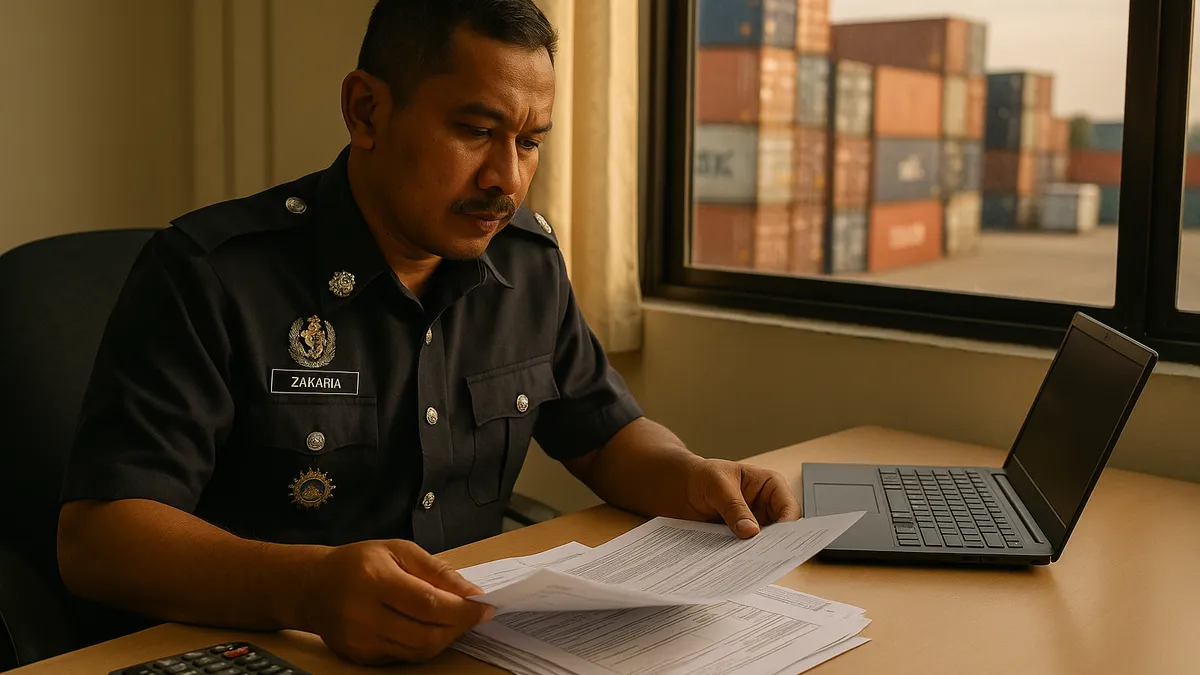
Customs clearance is where most shipments get stuck. Wrong HS code, missing permit, SST exposure your accountant didn't know about — and your container sits at Westport racking up storage charges. DNE has filed over 1,000 declarations a month through Port Klang since 1999. We make the friction your supplier created disappear.
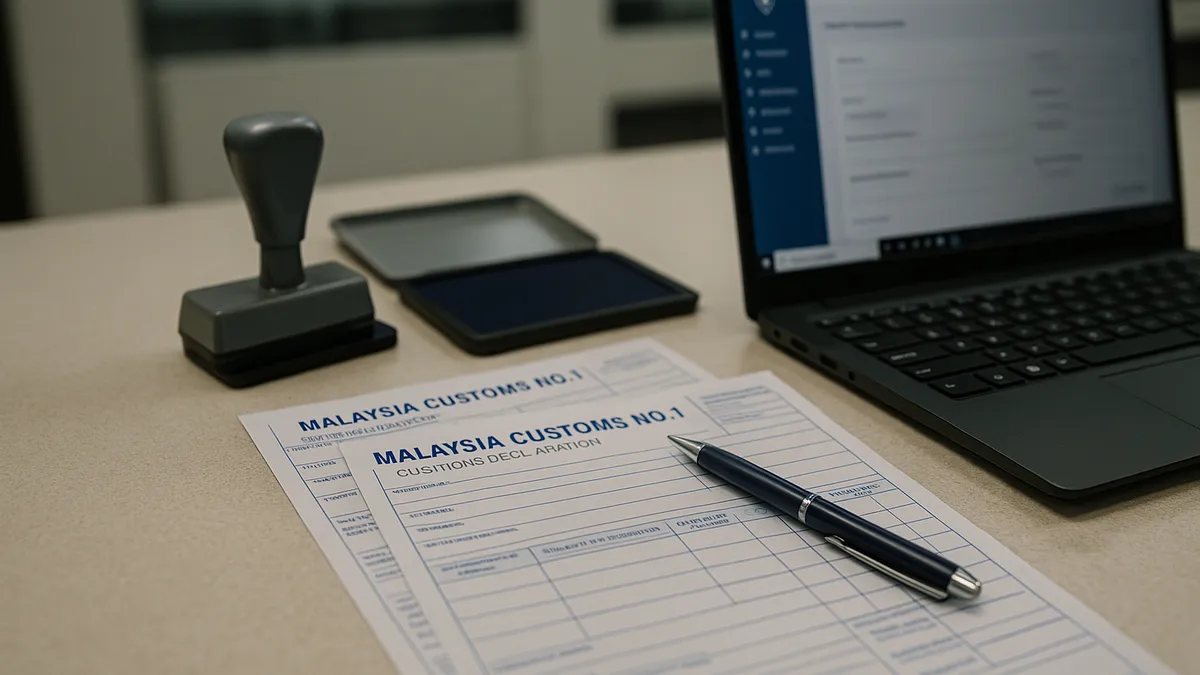
Import and export customs clearance at Port Klang and KLIA is filed under the Royal Malaysian Customs Department (JKDM) using the K1, K2, K8, and K9 declaration forms — submitted electronically through SMK (the customs declaration system, via the National Single Window), with the supporting documents lodged through MyCIEDS. DNE is a licensed customs broker (Co. Reg. 538624-W) with brokers on staff who have cleared every category of cargo through Port Klang's terminals.
What we file, and when
Customs declarations are not generic. Each cargo movement requires the right form, the right HS code classification, and the right supporting documents. We handle all four major declaration types every working day:
- K1 — Import declaration. For dutiable and non-dutiable goods entering Malaysia for home consumption. Includes SST 5-10% where applicable, customs duty per the AHTN tariff, and any preferential FTA duty rate (RCEP, CPTPP, ACFTA, AANZFTA, AMSFTA, AKFTA).
- K2 — Export declaration. For Malaysian goods leaving the country. Includes Certificate of Origin support and VGM (Verified Gross Mass) compliance for sea exports.
- K8 — Transit declaration. For cargo moving through Malaysia without entering domestic commerce. Common for transshipment through Port Klang.
- K9 — Bonded warehouse declaration. For duty-deferred storage in Licensed Manufacturing Warehouses (LMW), bonded warehouses, or Free Trade Zones.
SST compliance, built in
Since 1 July 2025, Malaysia's expanded Sales Tax has widened the 5% and 10% bands — pulling goods that had been exempt into scope and re-rating goods that were already taxable. The Ministry of Finance’s own framing is Sales Tax “at rates of 5% or 10%” on discretionary and non-essential goods, with essential goods left as they were (MOF press release, 9 June 2025). That expansion was gazetted as the Sales Tax (Rate Of Sales Tax) (Amendment) Order 2025 and the Sales Tax (Goods Exempted From Sales Tax) (Amendment) Order 2025, both published 1 July 2025. Both have since been amended: the instruments to check line by line today are the Sales Tax (Rate Of Sales Tax) (Amendment) Order 2026 and the Sales Tax (Goods Exempted From Sales Tax) (Amendment) Order 2026, both published 31 July 2026, together with the Sales Tax (Persons Exempted From Sales Tax) (Amendment) (No. 2) Order 2026, published 28 August 2026 — all listed on Customs' MySST portal. Every import declaration must reflect the correct SST category — and Schedule C exemptions (for raw materials, packaging, and certain components used in registered manufacturing) require pre-approved applications.
What changed for 2026: the grace period is gone. When the expansion took effect, MOF said it would provide a grace period until December 2025 and not impose penalties on companies that had genuinely made the effort to comply (MOF clarification, 11 June 2025). That window has closed. As of September 2026 a wrong SST band on a K1 is an ordinary, penalisable declaration error — not a transition-period slip. In practice this means an HS code you classified before July 2025 and have been repeating ever since is now the most expensive line on your declaration to get wrong; we re-check the band against the current orders rather than carrying last year's coding forward.
DNE handles SST exposure on every declaration:
- HS code review to confirm SST rate (zero, 5%, or 10%)
- Schedule C exemption applications and timing alignment with cargo arrival
- FTA preferential duty claims with Form D / Form AANZ / Form E / Form RCEP
- SST coding into the K1 declaration filed through SMK
See our complete guide on SST on imports: how it applies (2026) and the step-by-step duty + SST calculation with worked HS codes for the full methodology.
Why DNE clears faster than most
How customs clearance flows
Standard cargo with complete documents clears in 24-48 hours from declaration filing. Both Port Klang terminals allow an import laden container 96 hours — four days — of free storage before storage charges start: Westports' container tariff effective 1 February 2026 charges from hour 97, and Northport's tariff updated 1 March 2026 charges from the 5th day (both as published, September 2026). Clearing inside 24-48 hours leaves real margin before that clock runs out. For the stage-by-stage timeline, see how long customs clearance actually takes in Malaysia.
1. Pre-arrival document review
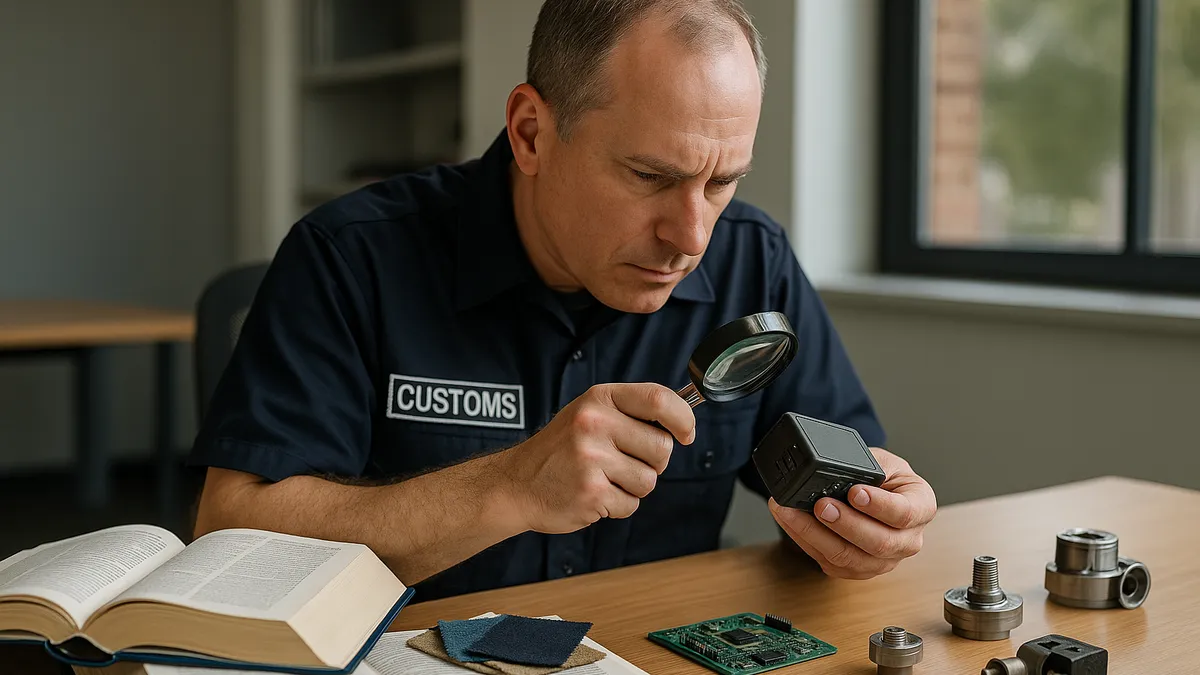
The moment we receive your Bill of Lading, commercial invoice, packing list, and Certificate of Origin, we review every line. HS codes are verified against the AHTN tariff. SST exposure is computed. Permit requirements are flagged. If anything is missing, we tell you 5-7 days before the vessel arrives — not when the cargo is sitting on the wharf. Our 2026 import documents checklist sets out exactly what to send and what each document has to match.
2. K1 declaration filed via SMK
For most importers, K1 declaration is filed 24-48 hours before vessel berthing. The declaration goes to JKDM through SMK (via the National Single Window) electronically, and the supporting documents are uploaded through MyCIEDS. We pay the duty, SST, and customs charges on your behalf via our agent account, then invoice you with full documentation.
3. Customs assessment and release
Most declarations clear at the green-lane (no exam) or yellow-lane (document check) level — typically within hours of filing. Red-lane (physical inspection) cargo takes longer; we coordinate the inspection slot directly with the customs officer assigned to your declaration.
4. Container release and haulage
Once customs releases the cargo, we coordinate with the terminal (Westport or Northport) for container release, then our own GPS-tracked haulage fleet collects the container and delivers to your destination — typically same-day or next-day for Selangor and Klang Valley.
5. Post-clearance documentation
Your release order, customs duty receipts, SST payment evidence, and final itemised invoice are uploaded to the WizForwarding portal the same day. The invoice is LHDN-compliant e-invoice from day one, ready for your MyInvois system.
Common clearance scenarios we handle
Westport vs Northport — does the terminal matter?
From a customs clearance perspective, no — JKDM clears containers identically at both Westport and Northport. The difference is operational: Westport handles deeper-draft vessels and faster productivity, so most main-line carriers berth there. Northport handles a major share of conventional cargo, smaller liners, dry bulk, and certain specialised services. DNE clears containers at both terminals routinely. Read our complete Westport vs Northport guide for the operational comparison.
What customs clearance costs
DNE quotes customs clearance itemised — broker fee, declaration fee, port handling, customs duty, SST, and any disbursements (DG fees, inspection charges). Typical clearance fees for a single FCL declaration at Port Klang range RM 350-800 in broker + handling depending on cargo complexity and permit requirements. Duty and SST depend entirely on cargo HS code and value.
For a precise quote, WhatsApp +6012 231 1393 with your Bill of Lading, commercial invoice, and packing list. We'll respond with itemised charges within 5 minutes during business hours.