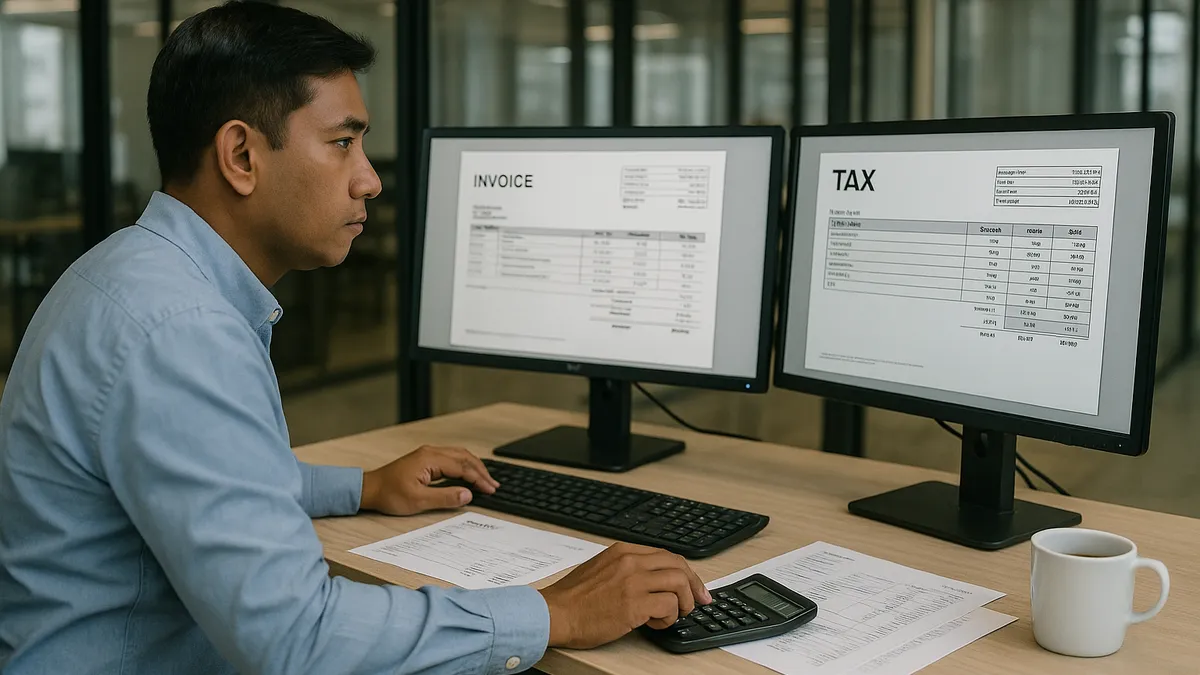
Since 1 September 2026, Malaysia's e-invoicing mandate covers importers and exporters with annual turnover of RM3 million or more, plus smaller firms tied to a larger group. In-scope traders must issue, receive and validate electronic invoices through the Inland Revenue Board's (LHDN) MyInvois platform, including self-billed e-invoices for goods bought from foreign suppliers, due by the end of the second month after customs clearance.
Malaysia's e-invoicing mandate is no longer a future concern — it is here. Whether you are a manufacturer bringing in raw materials through customs clearance at Port Klang, or an exporter shipping finished products to ASEAN markets, if your business is in scope you are now required to issue, receive, and validate electronic invoices through the Inland Revenue Board's (LHDN) MyInvois platform. As of October 2026, "in scope" means annual turnover of RM3 million or more: the exemption threshold was raised from RM1 million on 1 September 2026, so many smaller traders who started e-invoicing this year are now exempt.
For importers and exporters specifically, e-invoicing introduces a layer of complexity that goes beyond standard domestic transactions. Self-billed e-invoices for foreign supplier purchases, cross-border documentation requirements, and the need to reconcile e-invoices with customs declaration forms (K1 and K2) make this one of the most significant compliance shifts in recent Malaysian trade history.
This guide explains everything Malaysian traders need to know — from the mandate's origins and rollout timeline, through to the specific rules for import and export transactions, and the practical steps you must take to stay compliant.
What Is Malaysia's E-Invoicing Mandate?
Malaysia's e-invoicing mandate requires in-scope businesses (broadly, those with annual turnover of RM3 million or more since 1 September 2026) to issue invoices in a structured digital format — either XML or JSON — and submit them to LHDN's MyInvois platform for real-time validation before the invoice is considered legally valid. This is not simply about sending PDF invoices by email. The system operates on a Continuous Transaction Controls (CTC) clearance model, meaning every invoice must be validated by the tax authority before it can be shared with the recipient.
The mandate was introduced by the Inland Revenue Board of Malaysia (Lembaga Hasil Dalam Negeri, or LHDN) as part of the government's broader digital transformation and tax compliance agenda. The objectives are straightforward: reduce tax leakage, eliminate fraudulent invoices, improve audit trails, and modernise Malaysia's business documentation infrastructure.
Once an invoice is submitted to MyInvois and passes validation, LHDN assigns three critical elements:
- Unique Identifier Number (UUID): A system-generated reference that uniquely identifies every validated e-invoice in the national database.
- QR Code: Embedded in the validated e-invoice, this QR code allows any party — buyer, seller, auditor, or customs officer — to verify the invoice's authenticity by scanning and checking against LHDN's records.
- Validation Timestamp: The exact date and time LHDN validated the document, creating an immutable audit trail.
Without these three elements, an invoice is not legally valid under the new regime. Once your business falls within the mandate's scope, paper invoices, PDF invoices, and manually generated documents are no longer acceptable as the invoices you issue.
The Rollout Timeline: Five Phases by Turnover
LHDN rolled out the e-invoicing mandate in phases based on annual turnover, giving larger businesses a head start and smaller businesses more time to prepare. Here is the complete timeline:
| Phase | Effective Date | Annual Turnover | Status |
|---|---|---|---|
| Phase 1 | 1 August 2024 | Above RM100 million | Live |
| Phase 2 | 1 January 2025 | RM25 million to RM100 million | Live |
| Phase 3 | 1 July 2025 | RM5 million to RM25 million | Live |
| Phase 4 | 1 January 2026 | Up to RM5 million (RM3 million and above since 1 September 2026) | Current phase — interim relaxation until 31 December 2027 |
| Phase 5 | Withdrawn | Below RM3 million (below RM1 million until 31 August 2026) | Exempt, subject to group conditions |
Important update (December 2025): The Malaysian Cabinet approved raising the minimum threshold from RM500,000 to RM1 million, effectively withdrawing the fifth phase that was originally scheduled for 1 July 2026. Businesses with annual turnover of RM1 million or below are exempt from e-invoicing until further notice. That threshold has since been raised again; see the next update.
Latest update (September 2026): Following the Prime Minister's National Day address on 30 August 2026, the exemption threshold rose again, from RM1 million to RM3 million, effective 1 September 2026; LHDN says more than 1.1 million businesses now qualify for the exemption (Bernama, 30 August 2026). The exemption does not apply where a business has a corporate shareholder, a holding company, or a related company or joint venture with annual turnover of at least RM3 million (e-Invoice Guideline, updated 30 August 2026). LHDN's General FAQ of 4 September 2026 confirms that a business under the new threshold needs no application or approval from IRBM, may stop issuing e-invoices immediately (or carry on voluntarily), and is also exempt from the self-billed e-invoice requirement on its imports.
Each phase has an interim relaxation period. For Phases 1 to 3 it lasted six months. For the up-to-RM5 million group, whether its implementation date was 1 January or 1 July 2026, LHDN has extended it to 31 December 2027 (e-Invoice Specific Guideline Version 4.7, 20 April 2026, Table 16.1). During that window taxpayers may issue monthly consolidated e-invoices and consolidated self-billed e-invoices, and IRBM will not prosecute under Section 120 of the Income Tax Act 1967 provided they do (paragraphs 16.2 and 16.3). However, this grace period is for adjustment — not for ignoring the requirement entirely. Businesses are expected to be actively working towards compliance during this window.
Key Threshold for Traders
- As of October 2026, businesses with annual turnover of RM3 million or more must issue e-invoices; the exemption threshold was RM1 million until 31 August 2026
- From 1 January 2026, any single transaction above RM10,000 needs its own individual e-invoice and cannot go into a consolidated e-invoice, although taxpayers still inside their interim relaxation period may consolidate
- The relaxation period for the up-to-RM5 million group now runs until 31 December 2027, not the 30 June 2026 date first announced; use it to finalise your systems
How E-Invoicing Affects Importers
The most significant impact of e-invoicing on importers is the requirement to issue self-billed e-invoices for purchases from foreign suppliers. This is a fundamental change in how import transactions are documented for tax purposes.
Why Self-Billed E-Invoices Are Required
When you purchase goods from a foreign supplier — a factory in China, a component manufacturer in Vietnam, a raw material producer in Indonesia — that supplier does not use Malaysia's MyInvois system. They cannot issue a Malaysian e-invoice to you. Therefore, the responsibility falls on you, the Malaysian buyer, to issue a self-billed e-invoice on behalf of the foreign supplier.
This self-billed e-invoice serves as the tax-compliant record of the purchase and must be submitted to MyInvois for validation, just like any other e-invoice.
Operational Requirements for Import Self-Billing
Here is how the self-billed e-invoice process works for imported goods:
- Timing: The self-billed e-invoice must be issued by the end of the second month following the month in which customs clearance is obtained (e-Invoice Specific Guideline, paragraph 10.4.8). If your goods clear customs in April, the self-billed e-invoice must be issued by 30 June. The deadline used to be the end of the following month; LHDN extended it in its February 2025 guideline update, so older guides that still say "next month" are out of date.
- Supplier identification: You must enter the foreign supplier's name and business registration number. If the foreign supplier does not have a Malaysian Tax Identification Number (TIN), use the general TIN provided by LHDN: EI00000000030.
- One invoice per clearance: If a foreign supplier issues one commercial invoice but you clear the goods in multiple shipments, you issue one self-billed e-invoice for the first shipment clearance. No additional self-billed e-invoices are required for subsequent shipments under the same commercial invoice.
- Value and customs reference: Enter the actual transaction value stated on the foreign supplier's invoice; where the agreed Incoterms add charges, they go in the "Details of other charges" field. Enter the customs form reference number from your K1 customs declaration form (Customs Form No. 1) as well (LHDN General FAQ, September 2026).
If you import using your company name via full container (FCL), you receive a K1 form in your company's name, and the self-billed e-invoice references that K1. However, if you use a freight forwarder for consolidated shipments (LCL), the K1 may be under the forwarder's name — work with your forwarder to ensure the documentation chain is correct.
Data Fields That Must Align with Trade Documents
Malaysia's e-invoicing system requires 55 mandatory fields for every e-invoice, with additional conditionally mandatory fields depending on transaction type. For import self-billed e-invoices, several of these fields must align precisely with your commercial invoice, packing list, and customs declaration (our customs clearance documents checklist lists each one):
- Supplier details: Foreign supplier name, address, country, and registration number
- Item descriptions: Must match the goods description on your commercial invoice and K1 declaration
- HS tariff codes: The tariff classification used in your customs declaration should be consistent with the product description in the e-invoice
- Values and quantities: The e-invoice carries the transaction value and quantities from the foreign supplier's invoice; keep the freight, insurance and other charge documents that link that figure to the value declared on your K1
- Tax information: Import duty and sales tax levied by Customs at clearance do not have to be included in the self-billed e-invoice (LHDN General FAQ, September 2026)
- K1 reference number: The customs form reference number must be entered in the self-billed e-invoice, which also gives you the audit trail. The exceptions: LHDN lets importers of loose container load (LCL) shipments leave it out, and makes it optional for a buyer located in a bonded warehouse (LHDN General FAQ, September 2026)
The alignment between e-invoice data and customs declaration data is not merely a best practice — it is an area LHDN and the Royal Malaysian Customs Department (JKDM) can cross-reference during audits, including a post-clearance customs audit. Unexplained discrepancies between your declared customs value and your e-invoice value will raise red flags.
How E-Invoicing Affects Exporters
For Malaysian exporters, the requirement is more straightforward but still significant. When you sell goods or provide services to a customer outside Malaysia, you must issue a standard e-invoice to the foreign buyer through MyInvois.
Handling Foreign Buyers Without Malaysian TIN
Since most foreign buyers will not have a Malaysian Tax Identification Number, LHDN provides specific general TINs for use in export e-invoices. For an export where the foreign buyer's TIN is not available, the buyer's TIN field takes EI00000000020, the general "Foreign Buyer's TIN" (e-Invoice Specific Guideline, Appendix 1). This allows the e-invoice to pass MyInvois validation without requiring the foreign buyer to register in the Malaysian tax system.
Export e-invoices must still contain accurate buyer details — company name, registration number (in their home country), address, and country code. The goods description, quantities, values, and K2 export declaration references should be consistent across all documentation.
Cross-Border Considerations
Exporters should note several specific requirements:
- Free zone transactions: Goods moving through free zones (such as the Port Klang Free Zone) may have specific e-invoicing treatment depending on whether the transaction is classified as domestic or export
- Re-exports: Goods imported into Malaysia and subsequently re-exported require both a self-billed e-invoice (for the import leg) and a standard e-invoice (for the export leg)
- Multimodal shipments: If goods transit through Malaysia with separate billing arrangements at each stage, each billable leg requires its own e-invoice
Integration with Customs Declarations
One of the most important — and most overlooked — aspects of e-invoicing for traders is how e-invoices relate to customs declarations. While MyInvois (LHDN) and the customs declaration system (JKDM) are technically separate platforms, the data they contain must be consistent.
K1 Forms and Import E-Invoices
Your K1 customs declaration form contains the declared value of imported goods, the HS tariff classification, duties payable, and SST amounts. Your self-billed e-invoice for the same transaction must be consistent with it, though the two documents do not record value in the same way. Key reconciliation points include:
- Value: The self-billed e-invoice records the actual transaction value from the foreign supplier's invoice, with any Incoterms charges under "Details of other charges", while the K1 records the customs value. Where the two figures differ, the freight and insurance documents on file should explain the gap
- Goods description: While exact wording need not be identical, the substance must be consistent — you cannot declare "electronic components" on the K1 and "finished consumer electronics" on the e-invoice
- Tax amounts: LHDN does not require the import duty or sales tax paid at clearance to appear on the self-billed e-invoice, so the duty and SST trail sits with your K1 and customs payment records rather than in the e-invoice's tax fields
K2 Forms and Export E-Invoices
Similarly, K2 export declaration values must align with the corresponding e-invoice issued to the foreign buyer. JKDM uses K2 data for trade statistics and export control compliance, while LHDN uses the e-invoice for income tax purposes. Inconsistencies between the two will invite scrutiny from both agencies.
The Path Toward Automated Reconciliation
While LHDN and JKDM systems do not yet share data automatically in real time, the Malaysian government's broader digitalisation agenda envisions eventual integration. Forward-thinking businesses should structure their data management now to enable seamless reconciliation between customs declarations and e-invoices, rather than treating them as separate compliance exercises.
Impact on Freight Forwarding and Logistics Services
E-invoicing does not only affect importers and exporters directly — it has significant implications for every service provider in the supply chain. Freight forwarders, haulage companies, warehouse operators, and customs clearance agents must all issue e-invoices for their services.
Services That Require E-Invoices
If your forwarding agent or logistics provider has annual turnover of RM3 million or more (as many established forwarding companies in Port Klang do), or belongs to a group that does, they must issue e-invoices for:
- Freight charges: Ocean freight, airfreight, and any freight-related surcharges
- Haulage fees: Container transport between port, warehouse, and factory
- Customs clearance fees: Charges for customs declaration preparation and lodgement
- Warehousing charges: Storage, handling, and inventory management fees
- Permit and documentation fees: Charges related to obtaining import/export permits, certificates of origin, and other trade documents
- Disbursement recovery: Duties, taxes, and port charges paid on behalf of the client and subsequently recovered
For importers and exporters, this means that every invoice you receive from an in-scope forwarding agent should now be a validated e-invoice with a UUID and QR code. Since the threshold rose to RM3 million on 1 September 2026, more small hauliers and agents are legitimately exempt and may go back to ordinary invoices, so a paper or PDF invoice is no longer automatically a sign of non-compliance. It is worth confirming which side of the threshold each of your providers sits on.
Why Your Forwarding Agent's Compliance Matters to You
Will a missing e-invoice cost you the tax deduction? Not today: LHDN's General FAQ (updated 4 September 2026) states that taxpayers can continue to claim tax deductions using existing documentation "until such time the legislation has been amended." That is a transitional position, not a permanent one. And an in-scope provider that fails to issue e-invoices is committing an offence of its own, which leaves gaps in the records your business relies on. This makes your choice of forwarding partner a tax compliance decision, not just an operational one.
Compliance Requirements: What Makes an E-Invoice Valid
Understanding the technical requirements for a valid e-invoice helps traders ensure their systems and processes meet the standard. Every e-invoice must include:
Digital Signature
The issuer must electronically sign every e-invoice using a valid digital certificate issued in their name. LHDN accepts both Soft certificates (installed on a local machine) and Roaming certificates (installed on a server or Hardware Security Module). The digital signature ensures the authenticity and integrity of the document — any tampering after signing will invalidate the e-invoice.
The 55+ Mandatory Fields
Every e-invoice must contain at least 55 mandatory data fields, covering:
Mandatory Field Categories
- Seller information: TIN, BRN, SST registration, name, address, contact details, MSIC code
- Buyer information: TIN (or general TIN for foreign parties), BRN, name, address, contact details
- Invoice details: Invoice number, date and time, invoice type, currency code
- Line items: Description, unit price, quantity, discount, tax type, tax rate, tax amount, subtotal
- Totals: Total excluding tax, total tax amount, total payable, rounding adjustment
- Payment information: Payment mode, payment terms, prepayment details where applicable
Additional conditionally mandatory fields apply depending on the transaction type — self-billed invoices, cross-border transactions, SST-applicable sales, and credit/debit notes each have specific additional requirements.
Real-Time Validation via MyInvois API
Businesses can submit e-invoices to MyInvois through two channels:
- API integration: For businesses with ERP systems or accounting software that can connect directly to the MyInvois API, this is the recommended approach. The API accepts XML or JSON documents and returns validation results — including the UUID and QR code — in near real-time.
- MyInvois portal: For smaller businesses without API capability, LHDN provides a web portal where e-invoices can be created and submitted manually. This is functional but impractical for businesses processing high volumes of invoices.
Validation is typically near-instantaneous if all data fields are correctly populated. Rejections occur when mandatory fields are missing, data formats are incorrect, or the digital signature cannot be verified.
Penalties for Non-Compliance
The penalties for failing to comply with e-invoicing requirements are substantial and apply per transaction, not per month or per audit period. Section 82C of the Income Tax Act 1967 is the provision that requires e-invoices; failing to issue one is an offence under Section 120(1)(d), punishable for each non-compliance by (LHDN General FAQ):
- Fine: RM200 to RM20,000 per invoice for failure to issue a valid e-invoice
- Imprisonment: Up to 6 months
- Both: Fine and imprisonment can be imposed simultaneously
For a busy importer processing 50 shipments per month, the potential exposure is significant. At RM20,000 per invoice, a single month of non-compliance could result in fines of up to RM1 million. While LHDN is unlikely to impose maximum fines during the initial enforcement period, the per-transaction structure means the financial risk scales rapidly with transaction volume.
The interim relaxation period (six months for the early phases, and until 31 December 2027 for the up-to-RM5 million group) provides breathing room, but it is not a penalty holiday for deliberate non-compliance. IRBM's undertaking not to prosecute applies only to taxpayers who at least issue the consolidated e-invoices and consolidated self-billed e-invoices the relaxation allows.
Beyond direct penalties, non-compliance creates secondary risks:
- Tax deduction risk: LHDN currently accepts existing documentation for deductions until the legislation is amended, so build your records now for the day e-invoices become the only accepted proof
- Audit triggers: Businesses not appearing in the MyInvois system despite exceeding the turnover threshold will be flagged for investigation
- Supply chain disruption: Business partners may refuse to transact with non-compliant suppliers, as they need valid e-invoices for their own tax records
Practical Steps to Comply: A Checklist for Importers and Exporters
Whether you are already in the mandate's scope or preparing for the current phase, here are the concrete steps you should take:
1. Register on the MyInvois Platform
If you have not already done so, register your business on LHDN's MyInvois portal. You will need your company's Tax Identification Number (TIN), business registration number (BRN), and an authorised representative with a valid digital certificate.
2. Assess Your System Readiness
Review your current accounting and ERP systems. Key questions to answer:
- Can your system generate invoices in XML or JSON format?
- Does your software vendor offer a MyInvois API integration module?
- Can your system handle self-billed e-invoices for foreign supplier transactions?
- Are all 55+ mandatory fields captured in your current invoice templates?
Major accounting software providers in Malaysia — including SQL, AutoCount, and others — have released MyInvois-compatible updates. If your system does not support e-invoicing natively, you may need a middleware solution or a switch to compliant software.
3. Map Your Import and Export Workflows
For every type of import and export transaction your business handles, document the e-invoicing requirement:
- Direct imports (FCL): Self-billed e-invoice required, referencing your K1 form
- Consolidated imports (LCL): Clarify with your forwarding agent whose name appears on the K1 and how the self-billed e-invoice should be structured
- Exports: Standard e-invoice to foreign buyer, with general TIN if buyer has no Malaysian TIN
- Re-exports: Both self-billed (import leg) and standard (export leg) e-invoices required
- Service purchases from forwarders: Expect to receive e-invoices from your forwarding agent for all charges
4. Obtain a Digital Certificate
You need a valid digital certificate to sign your e-invoices. Certificates can be obtained from LHDN-approved certificate authorities. Decide whether a Soft certificate (suitable for single-machine operations) or a Roaming certificate (suitable for server-based or multi-user environments) fits your business.
5. Test with the MyInvois Sandbox
LHDN provides a sandbox (testing) environment for MyInvois. Use it to test your API integration, validate sample invoices, and identify data mapping issues before going live. This is especially important for self-billed import invoices, which have additional conditional fields.
6. Work with E-Invoice Compliant Partners
Ensure your forwarding agent, haulage provider, and warehouse operator are e-invoice compliant. Ask them directly:
- Are they registered on MyInvois?
- Do they issue validated e-invoices with UUID and QR codes?
- Can they provide K1/K2 reference numbers that align with their e-invoiced charges?
If an in-scope logistics partner is not e-invoice compliant, you end up relying on records from a supplier that is breaking the rules, and LHDN's acceptance of ordinary invoices for deductions is a transitional position rather than a permanent one. This is a practical reason to choose partners who have invested in compliance.
7. Train Your Team
Your accounts team, procurement staff, and anyone involved in import/export documentation needs to understand the new workflow. Key training areas include:
- When and how to issue self-billed e-invoices for imports
- How to verify received e-invoices from suppliers and service providers
- The deadline for issuing self-billed e-invoices (end of the second month following the month of customs clearance)
- How to handle rejections and resubmissions via MyInvois
How DNE Forwarding Supports Your E-Invoice Compliance
At DNE Forwarding, we have been handling freight forwarding, customs clearance, haulage, and warehousing at Port Klang for over 25 years. We recognised early that e-invoicing would transform how logistics documentation works, and we have invested in making the transition seamless for our clients.
Here is what we bring to the table:
- E-invoice compliant operations: All invoices issued by DNE Forwarding — for customs clearance fees, haulage charges, warehousing, and freight — are validated e-invoices issued through MyInvois with proper UUID and QR codes. Your tax deductions are fully supported.
- K1/K2 documentation alignment: Our customs declarations and e-invoices are prepared by the same team, ensuring consistency between your K1/K2 declaration values and the corresponding invoice data. No discrepancies, no audit surprises.
- Self-billed e-invoice guidance: We help importers understand when and how to issue self-billed e-invoices for their foreign supplier purchases, including the correct use of general TINs and the deadline requirements.
- ISO-certified processes: Our ISO-certified quality management system ensures that every document — from customs declaration to e-invoice — follows standardised procedures with built-in checks.
- Single point of contact: Customs clearance, haulage, warehousing, and documentation under one roof means fewer invoices from fewer parties, simpler reconciliation, and a cleaner audit trail for your business.
The e-invoicing mandate rewards businesses that have their documentation house in order and penalises those who do not. Having a forwarding partner who issues proper e-invoices and maintains consistent customs documentation is no longer a nice-to-have — it is a compliance requirement that directly affects your tax position.
Need Help with E-Invoicing Compliance?
- Not sure how self-billed e-invoices work for your imports? We can walk you through it.
- Want to confirm your forwarding agent's e-invoice compliance? Ask us for a validated sample invoice.
- Moving goods through Port Klang? Get a quote for fully e-invoice compliant freight forwarding, customs clearance, and haulage services.
Part of a guide: this article is part of DNE's complete guide to importing into Malaysia.
Frequently asked questions
What is Malaysia's e-invoicing mandate?
Malaysia's e-invoicing mandate requires in-scope businesses (broadly, those with annual turnover of RM3 million or more since 1 September 2026) to issue invoices in a structured digital format (XML or JSON) and submit them to LHDN's MyInvois platform for real-time validation before the invoice is considered legally valid. The system operates on a Continuous Transaction Controls (CTC) clearance model, meaning every invoice must be validated by the tax authority before it can be shared with the recipient.
How does e-invoicing affect importers?
The most significant impact of e-invoicing on importers is the requirement to issue self-billed e-invoices for purchases from foreign suppliers. Because the foreign supplier does not use Malaysia's MyInvois system, the responsibility falls on the Malaysian buyer to issue a self-billed e-invoice on behalf of the foreign supplier, which must be submitted to MyInvois for validation.
How does e-invoicing affect exporters?
When you sell goods or provide services to a customer outside Malaysia, you must issue a standard e-invoice to the foreign buyer through MyInvois. Since most foreign buyers will not have a Malaysian Tax Identification Number, LHDN provides specific general TINs for use in export e-invoices, allowing the e-invoice to pass MyInvois validation without requiring the foreign buyer to register in the Malaysian tax system.
What makes an e-invoice valid in Malaysia?
Every e-invoice must be electronically signed using a valid digital certificate, contain at least 55 mandatory data fields, and be submitted to MyInvois for real-time validation. Once validated, LHDN assigns a Unique Identifier Number (UUID), a QR code, and a validation timestamp. Without these three elements, an invoice is not legally valid under the new regime.
What are the penalties for non-compliance with e-invoicing?
Section 82C of the Income Tax Act 1967 requires e-invoices, and failing to issue one is an offence under Section 120(1)(d), carrying a fine of RM200 to RM20,000, imprisonment of up to 6 months, or both, for each non-compliance. The penalties apply per transaction, not per month or per audit period, so the financial risk scales rapidly with transaction volume.
When must a self-billed e-invoice be issued for imported goods?
The self-billed e-invoice must be issued by the end of the second month following the month in which customs clearance is obtained (e-Invoice Specific Guideline, paragraph 10.4.8). For example, if your goods clear customs in April, the self-billed e-invoice must be issued by 30 June. The earlier one-month deadline was extended in February 2025.
Which businesses are exempt from e-invoicing in Malaysia?
Since 1 September 2026, businesses with annual turnover below RM3 million are exempt, up from RM1 million. The exemption does not apply if the business has a corporate shareholder, a holding company, or a related company or joint venture with turnover of RM3 million or more. Exempt businesses need no approval from IRBM, may stop issuing e-invoices immediately, and are also exempt from self-billed e-invoices on imports.
When does the e-invoicing relaxation period end for smaller businesses?
For businesses with annual turnover of up to RM5 million, the interim relaxation period now runs until 31 December 2027, after LHDN extended it in e-Invoice Specific Guideline Version 4.7 (20 April 2026). Until then they may issue monthly consolidated e-invoices, and IRBM will not prosecute under Section 120 of the Income Tax Act 1967 provided they do.