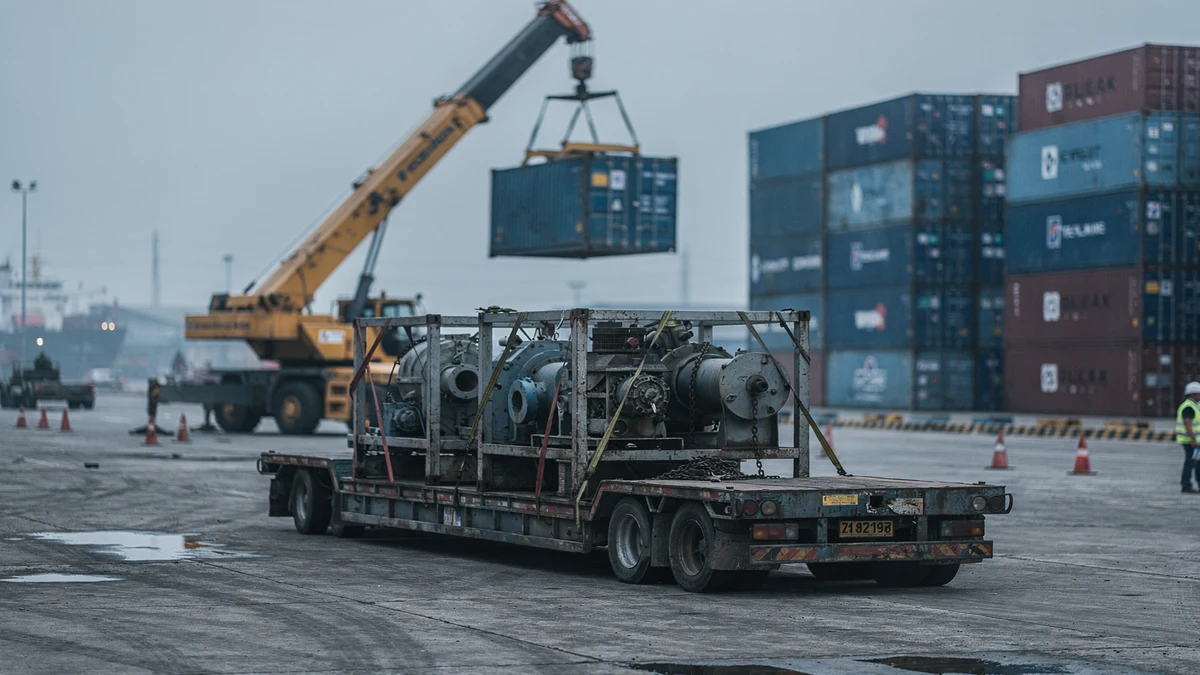
Malaysia's machinery and equipment importers need a freight forwarder that handles three things together: correct HS-code classification for capital goods, the import permits some categories legally require — SIRIM's Certificate of Approval for regulated electrical and communications-enabled equipment, DOSH's PMT/PMD/PMA registration for pressure vessels and lifting gear — and container haulage from Port Klang to the factory floor. DNE Forwarding, a JKDM-licensed freight forwarder in Klang handling customs clearance and haulage, manages all three under one roof.
Key takeaways
- Malaysia's capital-goods imports — mostly machinery and equipment — rose 15.4% in 2025, against 0.8% for intermediate goods and 1.5% for consumption goods, according to an analysis of official trade data.
- Manufacturers, hotel operators, haulage companies and aerospace MRO firms can apply for a MIDA-endorsed import duty and sales tax exemption on machinery via a Surat Pengesahan MIDA (SPM) confirmation letter.
- Regulated electrical, communications, pressure-vessel and lifting equipment needs a SIRIM Certificate of Approval or DOSH PMT/PMD/PMA registration before it clears Customs — and DOSH's process alone involves multiple steps, so it's worth starting early.
- The wrong HS-code chapter (84 vs. 85) or sub-heading is one of the most common reasons a machinery shipment gets held for review or wrongly duty-assessed at Port Klang.
- DNE clears and hauls 1,000+ containers a month at 99%+ documentation compliance — the team that classifies your shipment is the same one that delivers it.
Scope noteThis guide is educational. DNE Forwarding does not obtain, process or advise on import permits. We lodge customs declarations and haul containers once your permit is already in hand. To apply for a permit, deal directly with the issuing agency — MITI, SIRIM, MAQIS, DOSH or DOE — or appoint a licensed permit agent.
Why are machinery imports into Malaysia accelerating in 2026?
Malaysian factories are buying capital equipment faster than almost anything else they import. Capital-goods imports — the category that covers industrial machinery, production-line equipment and processing plant — rose 15.4% in 2025, compared with just 0.8% growth for intermediate goods and 1.5% for consumption goods.
"Capital-goods imports rose 15.4%, against 0.8% for intermediate goods and 1.5% for consumption goods" — the divergence implies factories are expanding installed capacity, not just restocking existing lines.
That gap matters for how an import gets planned. A restock of raw materials is routine and forgiving of small delays. A machinery order usually has a hard install date — a production line waiting on one missing part, a factory opening pushed back a quarter — so the customs and haulage side has to be right the first time, not fixed after the container is already sitting at the port racking up storage charges.
What does a freight forwarder actually do for a machinery importer?
A freight forwarder handling a standard containerised or palletised machinery shipment moves it through six linked stages — classification and permit requirements, booking and documentation, the customs declaration on arrival, any permit-linked release, duty or exemption settlement, and haulage to the factory — ideally under one team rather than three separate vendors handing off paperwork between them:
- Pre-shipment classification & permit flag — confirm the HS code and flag whether the item needs a SIRIM Certificate of Approval, DOSH design verification, or another agency's sign-off before it's booked.
- Booking & documentation — commercial invoice, packing list, bill of lading and (where relevant) the manufacturer's compliance certificates are assembled ahead of arrival.
- Arrival & customs declaration — the K1 import declaration is lodged with the correct HS code and duty/SST treatment.
- Permit-linked release — where a SIRIM or DOSH certificate applies, clearance can't complete until that approval is on file with Customs.
- Duty & SST settlement, or exemption — standard duty/SST is paid, or a MIDA-endorsed exemption is applied where the importer qualifies.
- Haulage to the factory — the cleared container or flatbed load moves from Westport or Northport straight to the installation site.
A gap at any single stage — a missing certificate, a mismatched HS code, an exemption letter that hasn't been lodged — stalls every stage after it, which is what turns a routine machinery import into a demurrage bill.
What HS code chapter does industrial machinery fall under?
Most industrial machinery and equipment imported into Malaysia falls under two Harmonized System chapters: Chapter 84 (nuclear reactors, boilers, mechanical machinery and appliances) and Chapter 85 (electrical machinery, equipment and parts). The chapter and sub-heading you declare under determines the duty rate, whether SST applies, and which permits — if any — are triggered.
A CNC milling machine, an industrial compressor and a packaging line motor can all look similar on a packing list but sit in different sub-headings with different duty treatment. Getting this wrong either overpays duty on goods that qualified for a lower rate or exemption, or under-declares and exposes the shipment to a customs audit later. See our guide on how to find the right HS code and on how Malaysian customs sets duty value for the mechanics behind both numbers.
Which import permit does your machinery need?
Not every machinery import needs a permit beyond the standard customs declaration — but a meaningful share does, and finding out after the container has landed is the expensive way to learn it. The table below maps the most common categories.
| Equipment type | Likely trigger | Agency & permit |
|---|---|---|
| Communications-enabled or electrical equipment (PLCs, networked controllers, wireless modules) | Radio/telecom & electrical safety compliance | SIRIM Certificate of Approval (registered via SIRIM QAS + Dagang Net's E-Permit system) |
| Unfired pressure vessels, industrial boilers | Workplace safety | DOSH PMT (vessels) / PMD (boilers) design verification & Certificate of Fitness |
| Cranes, hoists, forklifts, lifting attachments | Workplace safety | DOSH PMA registration |
| Standard mechanical machinery (CNC, presses, conveyors) with no electrical/telecom module | None beyond standard declaration | Customs K1 declaration with correct HS code |
For pressure vessels, boilers and lifting equipment, design verification is the required first step in DOSH's registration process, ahead of the inspections and load testing that lead to a Certificate of Fitness — which is why this check needs to start early, not once the equipment has already landed at Port Klang. For SIRIM-regulated electrical and communications equipment, the importer (or its agent) first registers as an E-Permit user with SIRIM QAS and Dagang Net Technologies, then applies for the Certificate of Approval; document-only applications typically clear in 2–5 working days, rising to 2–4 weeks where the equipment also needs product testing. Our import permit guide (MITI AP, SIRIM, MAQIS) covers the wider permit landscape beyond machinery.
What duty and sales tax relief is available for machinery imports?
Malaysia's pro-investment stance extends real relief to machinery buyers. Manufacturers operating in the Principal Customs Area, hotel operators, haulage companies and aerospace MRO firms can apply for import duty and/or sales tax exemption on qualifying machinery, equipment, spare parts, prime movers and specialised tools.
The path runs through MIDA rather than Customs directly: the company first applies to MIDA for a Surat Pengesahan MIDA (SPM) — a confirmation letter — then submits that letter, together with a list of the machinery, equipment or spare parts to be imported, to the Royal Malaysian Customs Department to claim the exemption. Getting this sequencing right — MIDA confirmation applied for and on file before the shipment clears, not scrambled together after — is exactly where a broker who handles both the classification and the declaration earns its keep.
"At MIDA, our focus goes beyond attracting investments, it is about ensuring that approved projects are implemented efficiently and successfully on the ground." — Datuk Sikh Shamsul Ibrahim Sikh Abdul Majid, Chief Executive Officer, MIDA.
That implementation focus is exactly why the SPM sequencing matters in practice: an exemption approved on paper only saves money if the confirmation letter is actually on file with Customs by the time the machinery lands.
How does machinery move from Port Klang to your factory floor?
Clearing the shipment is only half the job for machinery — it still has to reach the installation site intact and on schedule. Port Klang (Westport and Northport combined) handled 15.14 million TEUs in 2025, up from 14.64 million TEUs in 2024, and every one of those extra containers still needs a truck out of the gate. DNE's own fleet operates under a KA (Perkhidmatan Kontena) haulage licence for container movement across Peninsular Malaysia, which matters for machinery arriving in standard 20ft/40ft containers or on flatbed trailers into Klang Valley industrial parks. Where a piece of equipment is oversized, needs a flat-rack or breakbulk booking, or requires special permits for abnormal loads, that's a different shipping method — see our guide to project cargo and out-of-gauge shipping for that scenario specifically.
Sources
- TradeInt, Malaysia Trade Data 2025 — capital-goods vs. intermediate/consumption goods import growth.
- MIDA, Duty Exemption guidelines — machinery/equipment import duty & sales tax exemption.
- MIDA, Malaysia Breaks Investment Record with RM426.7 Billion in 2025 — CEO statement on approved-project implementation.
- Advanced HSE Solutions, DOSH Registration: PMT, PMD & PMA — pressure vessel, boiler and lifting-equipment certification.
- Global Track Lines, SIRIM Import Permit Application Guide — SIRIM QAS / Dagang Net E-Permit process and timelines.
- The Star, Port Klang, PTP set new container handling records in 2025 — Port Klang TEU throughput.
Frequently asked questions
What HS code do machinery and industrial equipment imports fall under in Malaysia?
Most sit under Chapter 84 (mechanical machinery, boilers, engines) or Chapter 85 (electrical machinery and equipment). The specific sub-heading — not just the chapter — determines the duty rate and whether SST or a permit applies, so classification needs to go down to the full HS code, not a general category.
Does my machinery import need a SIRIM or DOSH permit?
If it has an electrical, wireless or communications component, it may need a SIRIM Certificate of Approval. If it's a pressure vessel, boiler, crane, hoist or other lifting equipment, it likely needs DOSH PMT/PMD/PMA design verification and registration. Standard mechanical equipment with no electrical or lifting function usually clears on the standard customs declaration alone.
Can I get import duty or sales tax exemption on machinery for my factory?
Manufacturers in the Principal Customs Area, hotel operators, haulage companies and aerospace MRO firms can apply through MIDA for a Surat Pengesahan MIDA confirmation letter, which is then submitted to Customs to claim the exemption. Eligibility depends on your business activity and the machinery's use — this is worth confirming before the shipment is booked, not after.
How long does customs clearance take for machinery that needs SIRIM or DOSH approval?
Where only documentation is required, SIRIM applications typically clear in 2–5 working days. Where the equipment also needs product testing, that stretches to 2–4 weeks. DOSH's design verification, inspection and Certificate of Fitness process for pressure vessels and lifting equipment is a multi-step registration, not a same-week approval, so it's worth starting as early as possible.
Can DNE handle oversized or breakbulk machinery, not just containerised equipment?
Standard containerised and palletised machinery moves through the process described above. Oversized, flat-rack or breakbulk loads follow a different booking and permit path — see our project cargo & out-of-gauge shipping guide for how that's handled.
Does DNE Forwarding obtain or apply for import permits?
No. DNE Forwarding does not obtain, process or advise on import permits. Permits are applied for by the importer, the supplier, or a licensed permit agent. DNE's role begins once the permit is in hand: we classify the goods, lodge the K1/K2 declaration through SMK, and haul the container from Port Klang. During document review we will flag whether a permit appears to be required, but confirming and securing it remains the importer's responsibility.
Part of a guide: this article is part of our complete guide to Freight Forwarder Port Klang.