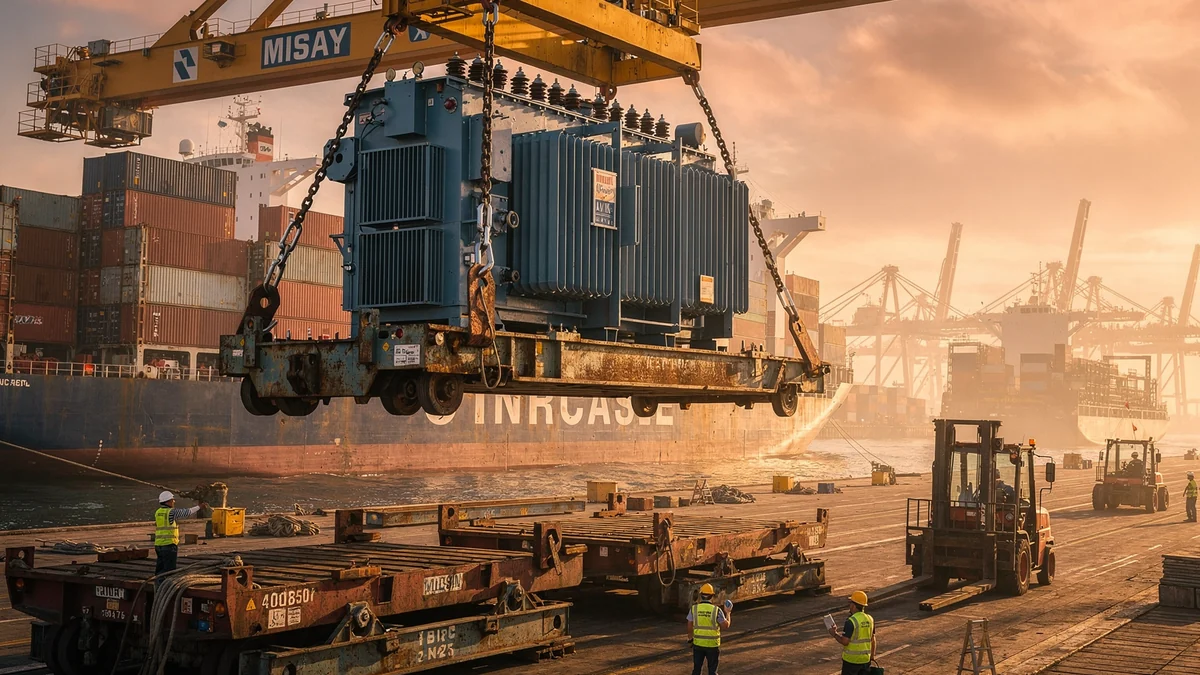
To ship project, out-of-gauge (OOG) or breakbulk cargo through Malaysia, first size the load against a standard container and pick the right equipment — flat-rack, open-top, breakbulk vessel or RoRo. Then plan the inland leg: OOG surcharges, JKR/JPJ road permits, PDRM escorts, a route survey, lashing to the IMO CSS Code, crane coordination and customs clearance via SMK.
A transformer, a 30-tonne press, a boiler module or a yacht does not fit a box and cannot be rushed. Moving it through Port Klang is half ocean engineering and half a Peninsular Malaysia road-permit exercise — and the two halves have to be planned together, weeks ahead. This guide is the operator's view from freight forwarding in Malaysia: how OOG is measured and surcharged, when to use a flat-rack versus breakbulk or RoRo, what JKR, JPJ and the police actually require for an abnormal load, and how to build a timeline that does not collapse at the port gate.
Scope noteThis guide is educational. DNE Forwarding does not obtain, process or advise on import permits. We lodge customs declarations and haul containers once your permit is already in hand. To apply for a permit, deal directly with the issuing agency — MITI, SIRIM, MAQIS, DOSH or DOE — or appoint a licensed permit agent.
Key takeaways
- OOG = anything outside the box. Cargo over a standard container's footprint, height or door opening (over ~2.43 m wide or 2.59 m high) is out-of-gauge and moves on a flat-rack, open-top, breakbulk vessel or RoRo — never a normal container.
- Surcharges pay for lost space. A wide load reserves the empty slots beside it; carriers bill those "lost slots" on top of freight, and most allow only 30–40 cm overhang per side before extra charges or refusal (Hansatic).
- The Malaysian road leg needs permits. Loads beyond legal vehicle limits require JKR/JPJ approval under the Road Transport Act 1987 (Act 333), often with a route survey and PDRM (police) escort.
- Asia leads the market. The global project logistics market was worth USD 468.40 billion in 2025, with Asia Pacific holding the largest 41.4% share (Fortune Business Insights, May 2026).
- DNE's role is coordination. As a JKDM-licensed forwarder with 25+ years in Port Klang, DNE Forwarding arranges the freight, customs clearance and inland haulage — and sub-contracts the cranes and specialist heavy-haulage trailers; it does not own lifting gear.
What is project cargo, out-of-gauge and breakbulk — and how do they differ?
Project cargo is a complete, often one-off shipment of oversized or heavy items for an industrial project. Out-of-gauge (OOG) is any single piece that exceeds a standard container's dimensions. Breakbulk is non-containerised cargo lifted aboard piece by piece. They overlap: a project shipment usually contains OOG pieces, some of which move as breakbulk.
Out-of-gauge cargo, in Marine Insight's words, is cargo that is "extremely large or has unwieldy booms and protrusions that do not fit into standard shipping containers" — also called AILs, abnormally shaped indivisible loads (Marine Insight). Project cargo is the wider job: planning, transporting and managing the equipment for one industrial project — power plants, oil and gas, mining, infrastructure — usually across several transport modes. Breakbulk is a method, not a cargo type: each item is "lifted, secured, and stowed separately according to its dimensions and weight" rather than loaded in a sealed box.
The demand sits squarely in this region. The global project logistics market was valued at USD 468.40 billion in 2025 and is forecast to reach USD 744.63 billion by 2034; Fortune Business Insights puts Asia Pacific as the largest region, with a 41.4% share worth USD 194.15 billion in 2025 (Fortune Business Insights, May 2026). That growth is being pulled by the energy transition.
"The global breakbulk and project cargo market in 2026 will be defined less by a single macro trend and more by regional opportunity shaped by the energy transition, infrastructure reinvestment and nearshoring." — Felix Schoeller, Chief Commercial Officer, AAL Shipping (Breakbulk, Global Outlook 2026)
How is out-of-gauge cargo measured, and when does it become OOG?
Cargo becomes out-of-gauge the moment it exceeds a standard container's internal limits — roughly 12.03 m long, 2.35 m wide and 2.39 m high for a 40-foot box, or it cannot pass the door opening. Over-width starts beyond about 2.43 m (8 ft); over-height above 2.59 m (8 ft 6 in), the collapsed end-wall of the unit. Over-length, over-width and over-height are each measured and surcharged separately.
Carriers measure the cargo against the equipment. A standard 40-foot container has internal limits of about 12.03 m L × 2.35 m W × 2.39 m H with a payload near 26.7 MT (Hansatic OOG guide). Anything past that footprint, height or the door opening is OOG. Shipa Freight sets the trigger plainly: cargo exceeding "eight feet of width or a height of eight feet, six inches" is out-of-gauge regardless of length — that is, over roughly 2.43 m wide or 2.59 m high (Shipa Freight). An error of a few centimetres can see the carrier refuse the booking at the terminal — so accurate dimensions and weight, ideally taken from a drawing, are the first deliverable on any project enquiry.
Flat-rack vs open-top vs breakbulk vs RoRo: which equipment fits?
Use an open-top for cargo that is over-height but fits the floor; a flat-rack for over-width or side-loaded machinery; breakbulk for pieces too big or heavy for any container; and RoRo for anything on wheels or tracks. The choice is driven by dimensions, weight, how the piece is lifted, and what the receiving port can handle.
Open-top and flat-rack containers still ride the normal container service, which keeps schedules tight and customs straightforward. Once a piece outgrows a flat-rack's payload or platform, it moves as breakbulk on a multipurpose vessel, lifted by ship's gear or shore cranes. Wheeled or tracked units roll aboard a RoRo. The table below compares the four against the figures carriers actually quote.
| Option | Best for | Typical max payload | How it's loaded |
|---|---|---|---|
| Open-top container | Over-height cargo that fits the floor (machinery, tall crates) | ~26.5 MT (40 ft) | Crane-loaded through the open roof, tarpaulin cover |
| Flat-rack container | Over-width or side-loaded loads (reels, large machinery, vehicles) | ~40 MT (40 ft) | Crane or forklift from top or side; lashed to the deck |
| Breakbulk | Pieces too large/heavy for any container (transformers, modules) | Vessel / crane limited | Lifted piece-by-piece by ship's gear or shore crane |
| RoRo | Anything wheeled or tracked (trucks, excavators, buses) | Ramp / deck limited | Driven or towed up the vessel ramp |
Flat-rack and open-top payloads come from the carrier specifications compiled by Hansatic: a 40-foot flat-rack carries up to ≈40,000 kg and a 40-foot open-top up to ≈26,500 kg (Hansatic). Shipa Freight frames the same trade-off operationally: a flat-rack "can load from the side with forklift" for wide machinery, while breakbulk suits "generators, turbines, large timber, pipes, and steel," and RoRo is "the most common method for shipping vehicles" (Shipa Freight).
What do OOG surcharges cost, and why?
OOG cargo is surcharged because it sterilises space the carrier cannot sell. A wide load reserves the empty slots beside it; the carrier bills those "lost slots" on top of freight. Most ports allow only 30–40 cm of overhang per side before extra charges, stowage restrictions or outright refusal, and over-width, over-height and over-length each carry their own surcharge.
The logic is space, not weight. As Marine Insight explains, OOG surcharges exist because "containers cannot be placed adjacent to or atop OOG cargo," creating lost slots the carrier still has to recover (Marine Insight). Shipa Freight gives the worst case: a wide piece can be charged for "three spaces: the space it actually occupies and the two lost slots on either side" (Shipa Freight). On overhang, Hansatic notes carriers allow "a maximum of 30–40cm overhang on each side of a flat rack before additional surcharges, stowage restrictions, or outright refusal apply," with charges rising sharply per extra 30 cm (Hansatic). The lesson for shippers: a piece that is 50 mm narrower can fall into a cheaper surcharge band, so it is worth checking whether protrusions can be removed and shipped separately.
What road permits and police escorts does an abnormal load need in Peninsular Malaysia?
Once a project piece leaves the wharf it becomes a road problem. Vehicles and loads that exceed the legal limits set under the Road Transport Act 1987 (Act 333) and the Weight Restriction Order need special approval — JPJ for dimensions, JKR for weight on the road and bridge structures — and an abnormal load typically requires a PDRM (police) escort and a route survey before it can move.
Three authorities share the inland leg. JPJ (the Road Transport Department) administers the Road Transport Act 1987 (Act 333), the law governing the construction, weight and dimensions of motor vehicles on Malaysian roads (JPJ, Act 333). The Public Works Department (JKR) sets the Weight Restriction Order limits that protect road pavements and bridges — for example a single axle is capped at 6 tonnes and a tandem axle at 19 tonnes in Peninsular Malaysia under the Weight Restriction (Amendment) Order 2003 (Weight Restriction (Amendment) Order 2003, via GEM). Any vehicle or load that exceeds these prescribed weight and dimension limits crosses into abnormal-load territory and cannot move legally without a special permit.
An abnormal-load move in Malaysia therefore usually involves:
- A route survey — checking bridge load ratings and clearances, overhead cables, roundabout and junction radii, road width at pinch points and any height-restricted structures along the planned path.
- JPJ / JKR permits — approval for the over-dimension or over-weight movement, often specifying the exact route, the dates and the permitted travel hours.
- A PDRM escort — police outriders for the convoy on public roads, frequently with movement confined to off-peak or night hours to limit disruption.
These steps run in sequence and take time to clear, which is why the permit and escort timeline — not the ocean transit — is usually the critical path on a Malaysian project move.
How is project cargo lashed, secured and lifted safely?
Project and breakbulk cargo is secured to the international Code of Safe Practice for Cargo Stowage and Securing (the IMO CSS Code) and the related CTU Code. Each piece is lifted by ship's gear or a shore crane, set on the flat-rack or deck, then lashed with chains, wires and welded stoppers calculated for the vessel's motion at sea.
Securing is a calculated engineering task, not a guess. Flat-rack and breakbulk lashings are designed so the "overall system complies with the requirements of the IMO CSS Code," and for boxed items the CTU Code (Code of Practice for Packing of Cargo Transport Units) applies (Hansatic). For heavy or high-value pieces a lift plan and, where needed, 3D modelling demonstrate the handling, stowage and lashing arrangement before the cargo ever reaches the quay. DNE Forwarding — a JKDM-licensed forwarder and FIATA and FMFF member with 25+ years moving cargo through Port Klang — arranges the cranes and specialist heavy-haulage trailers through vetted partners and coordinates the lashing surveyor. It coordinates these specialists rather than owning lifting equipment itself, which keeps each job matched to the right gear.
How is project cargo cleared through Malaysian customs?
Project and OOG cargo clears Malaysian customs the same way as any import — a declaration lodged electronically through SMK on Dagang Net's National Single Window — but with extra attention to HS classification, duty and tax exemptions on project equipment, and the supporting documents that justify the values and the abnormal handling.
Malaysian customs declarations are submitted via the SMK (Sistem Maklumat Kastam) system on Dagang Net's National Single Window, with MyCIEDS used for lodging supporting documents; the newer uCustoms platform is not yet live nationally. For project cargo the classification and exemption work matters more than usual, because heavy machinery and plant equipment can attract import duty and sales tax that may be reduced or exempted under specific incentives — so the HS codes and the project documentation have to be right before the goods land. Where the cargo also carries hazard classification, the rules in our guide to shipping dangerous goods through Port Klang under the IMDG Code apply on top of the OOG handling.
How do you plan the timeline for a project-cargo move through Port Klang?
Plan backwards from the in-service date and start early — six to twelve weeks ahead for a significant move. The long-lead items are not the sea voyage but the OOG equipment booking, the carrier's stowage approval, and especially the JKR/JPJ road permits, route survey and PDRM escort, which must all clear before the inland leg can run.
Port Klang itself is built for this work: Northport handles "break bulk cargoes" alongside containers and conventional cargo (MMC Port, Northport), and both Northport and Westports take conventional and breakbulk cargo, so the maritime side is rarely the bottleneck. The constraint is the choreography. A workable sequence:
- Weeks 8–12 out: confirm exact dimensions and weight from drawings; choose equipment; book OOG space and request the carrier's stowage approval.
- Weeks 4–8 out: commission the route survey; lodge JPJ/JKR permit applications; arrange the lashing surveyor and lift plan.
- Weeks 1–4 out: finalise the PDRM escort and movement window; prepare the customs declaration and HS classification.
- Arrival: discharge, customs clearance via SMK, then the permitted, escorted inland haul to site.
For the wider container picture this fits into, see our complete guide to Westports and Northport; and if your project ships automotive or assembly-line equipment, our notes on being a freight forwarder for automotive parts cover the related clearance and haulage detail.
Got a transformer, a press, a module or any over-dimension piece bound for or leaving Port Klang? Send DNE Forwarding the dimensions, weight and delivery point and we will scope the equipment, the OOG surcharges, the JKR/JPJ permit and escort plan, and the customs clearance — then give you a realistic timeline before you commit. Message our project-cargo desk on WhatsApp using the button below to start.
Frequently asked questions
What exactly counts as out-of-gauge cargo?
Out-of-gauge cargo is any single piece that exceeds a standard container's internal dimensions or door opening — over roughly 2.43 m (8 ft) wide or 2.59 m (8 ft 6 in) high, the unit's collapsed end-wall height. It then moves on a flat-rack, open-top, breakbulk vessel or RoRo instead of a sealed container (Shipa Freight; Marine Insight).
How much do OOG surcharges add?
Surcharges cover the "lost slots" a wide or tall piece sterilises — the empty space beside or above it that the carrier cannot sell. A wide load can be charged for the slot it occupies plus the two beside it, and most carriers allow only 30–40 cm of overhang per side before charges rise or the booking is refused (Marine Insight; Shipa Freight; Hansatic).
Do I need a police escort to move an abnormal load in Malaysia?
Usually yes. A load exceeding the legal vehicle limits under the Road Transport Act 1987 (Act 333) and the JKR Weight Restriction Order needs JPJ/JKR approval, typically a route survey, and a PDRM police escort, often with movement confined to off-peak or night hours on a specified route.
Does DNE own cranes and heavy-haulage trailers?
No. DNE Forwarding arranges and coordinates the freight, customs clearance and inland haulage for project and OOG cargo, and sub-contracts cranes, specialist low-loaders and lashing surveyors through vetted partners. This lets each job be matched to the right specialist gear rather than to whatever a single fleet happens to own.
Should I ship breakbulk or use flat-racks?
Use flat-racks or open-tops while the piece still fits the equipment's payload and platform — they keep the cargo on the regular container service and simplify scheduling and customs. Move to breakbulk only when the piece is too large or heavy for any container, since breakbulk relies on multipurpose vessels and crane availability.
Does DNE Forwarding obtain or apply for import permits?
No. DNE Forwarding does not obtain, process or advise on import permits. Permits are applied for by the importer, the supplier, or a licensed permit agent. DNE's role begins once the permit is in hand: we classify the goods, lodge the K1/K2 declaration through SMK, and haul the container from Port Klang. During document review we will flag whether a permit appears to be required, but confirming and securing it remains the importer's responsibility.
Sources
- Fortune Business Insights — Project Logistics Market (May 2026): fortunebusinessinsights.com
- Breakbulk — Global Outlook 2026 (Felix Schoeller, AAL Shipping): breakbulk.com
- Hansatic — OOG (Out of Gauge) Cargo Guide: hansatic.com
- Shipa Freight — Out-of-Gauge Cargo: shipafreight.com
- Marine Insight — What is OOG or Out of Gauge Cargo: marineinsight.com
- JPJ — Road Transport Act 1987 (Act 333): jpj.gov.my
- Weight Restriction (Amendment) Order 2003 — Malaysian axle/weight limits (via GEM, Load and Weight Restrictions for Vehicles in Malaysia): gemcarrental.com.my
- MMC Port — Northport: mmcports.com.my
Part of a guide: this article is part of our complete guide to Sea Freight Malaysia 2026: Complete Port Klang Guide.