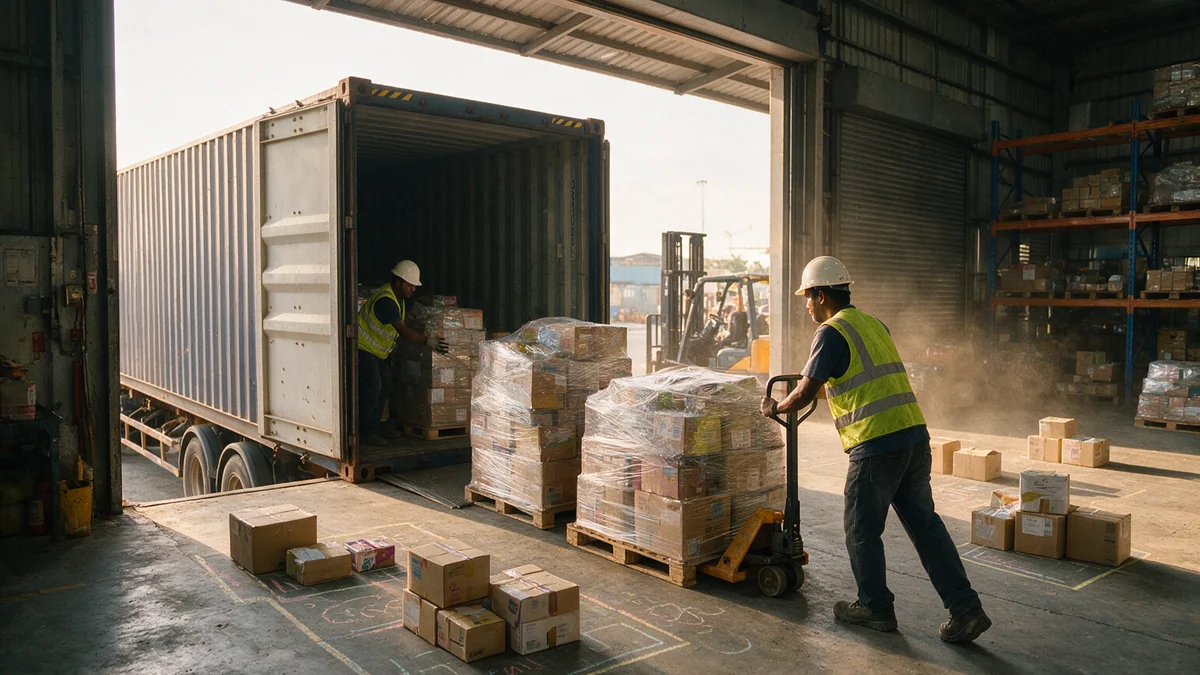
LCL consolidation at Port Klang is a warehouse operation, not a quay operation: your pallets go to a container freight station, are stuffed into a shared box, and on arrival the whole container is unstuffed there. You do not collect against your bill of lading — you exchange it for an Integrated Import Document, and pay charges partly fixed by Port Klang Authority by-law.
Key takeaways
- The Fuel Adjustment Factor on LCL cargo is RM3.50 per ton from 27 March 2026 (FMM circular, 31 March 2026) — set by Port Klang Authority by-law, reviewed fortnightly, not by your warehouse.
- Northport's tariff gives warehouse activities 96 hours of free storage — but its general cargo-storage scale charges from the 73rd hour.
- Groupage cargo is released by the Integrated Import Document, which your forwarder gets for its House Bill of Lading.
- MyCC fined seven Port Klang warehouse operators RM1,043,012.52 in 2021 for fixing long-length and heavy-lift handling surcharges — ask who sets each line on your invoice.
How does LCL consolidation work at Port Klang, step by step?
Nothing distinctive about an LCL import happens at the wharf. Port Klang moved 15.14 million TEU in 2025 against 14.64 million in 2024 (The Star, January 2026), and a groupage box joins that flow as an ordinary full container; the "less than container load" part appears only at the warehouse. MITI's Lesser Container Load process flow sets out the sequence:
- The shipping agent files the ocean manifest with Customs and the port operator within 24 hours of the vessel arriving (section 52, Customs Act).
- The main freight forwarder — the consolidator owning the whole box — swaps the Ocean Bill of Lading for the Delivery Order.
- The CFS files a separate drayage request; the port operator approves it and moves the box to the warehouse.
- The CFS or warehouse operator unstuffs the container and breaks the cargo down consignment by consignment.
- Form ZB1 is declared to the Free Zone Authority; each consignment is then verified as released by Customs, endorsed and gated out.
LCL consolidation happens at a container freight station at one of Port Klang's two terminals, Westports or Northport. The storage and survey figures quoted below are Northport's own. Northport handled 3.8 million TEU of that total, up from 3.67 million (The Star, January 2026).
Which document actually releases your LCL cargo?
On an LCL import your House Bill of Lading releases nothing. MITI's flow is explicit: the individual freight forwarder submits House BL to Main Freight Forwarder to exchange for Integrated Import Document. The main forwarder holds the Ocean Bill of Lading and Delivery Order; the Integrated Import Document turns your claim on one consignment into collectable cargo.
Exports mirror it: the forwarder prepares an Integrated Export Document for the forwarding agent, the CFS operator and the shipping agent. That is why LCL carries two bills of lading (house vs master bill of lading) and free-zone paperwork (ZB1 to ZB4). Your K1 or K2 declaration itself is unchanged (K-forms).
What charges appear on an LCL bill at Port Klang, and who sets them?
A shared container generates charges a full one does not: someone must move the box, open it, count and store it. The question is not whether a line is fair, but who set it — some are fixed by Port Klang Authority by-law and identical everywhere, others are commercial.
| Charge line | What it pays for | Who sets it |
|---|---|---|
| Fuel Adjustment Factor | RM3.50 per ton on LCL cargo from 27 March 2026 | Port Klang Authority by-law; every warehouse operator must charge it |
| Extra movement (drayage) | Moving the box off the terminal to the CFS | Port operator, per MITI's documented flow |
| LCL survey | RM15 per inward or outward survey report | Northport tariff |
| Handling, storage, packing | Unstuffing, counting, palletising, storage beyond free time | Terminal tariff, several lines marked non-gazetted |
The Fuel Adjustment Factor is the clearest case. Charged under section 37o of the Port Klang Authority By-Laws (Scale of Rates, Dues and Charges) (Amendment) 2025, it was RM2.50 per ton, based on a fuel price of RM3.50 per litre, and rose by RM1.00 per ton after market fuel prices rose by more than 50 per cent. Port Klang Authority reviews it fortnightly, and the FMM circular is blunt: all warehouse operators are required to impose the revised Fuel Adjustment Factor. On a three-tonne consignment that line alone is RM10.50 — so ask your consolidator how a CBM quotation converts. Haulage runs a separate mechanism (FAF on haulage).
Several warehouse and container lines are marked non-gazetted tariff — commercial rates, where a quotation is won or lost. The same list for a whole box is in the true cost of importing a container to Port Klang.
How long can LCL cargo sit at Port Klang before storage charges start?
Northport's tariff, updated 1 March 2026, gives warehouse activities 96 hours of free storage, but its general cargo-storage scale is free only for the first 72 hours and charges from the 73rd. Confirm which scale applies, because none of the drayage, the unstuffing or the consignment-by-consignment release is under your control.
It is a different clock from the line's demurrage and detention, which runs against the box and is billed by another party. On export, the forwarder files its house manifest within seven days of departure, and your lorry must reach the CFS before the consolidator's stuffing cut-off, not the vessel's.
Why is a Port Klang warehouse charge not always a market rate?
Because at least once it was not one. In 2021 MyCC fined seven Port Klang warehouse operators RM1,043,012.52 in total for fixing the surcharges they charged to handle long-length and heavy-lift import and export cargo. The Competition Appeal Tribunal upheld it, and the Shah Alam High Court dismissed five operators' judicial review on 11 September 2024.
The penalties ran from RM26,363.03 to RM336,369.13 each. The evidence included a WhatsApp group and a Surcharge Memorandum dated 22 May 2017 fixing agreed rates from 1 June 2017. MyCC put it this way:
The same judgment emphasized that there was no illegality, irrationality, or procedural impropriety that would justify overturning the MyCC decision.
MyCC on the Shah Alam High Court judgment, 12 September 2024
MyCC directed the operators to set future handling charges independently. The lesson is narrow: a by-law charge is identical everywhere and not worth negotiating; a non-gazetted line is one operator's own price.
When is LCL the wrong answer for a Malaysian shipper?
LCL stops paying when the fixed per-consignment charges outgrow the freight you save. Every groupage shipment carries the drayage, survey, handling and fuel lines above whether it holds one pallet or ten, and spends days at a CFS. The FCL versus LCL comparison works the break-even in cubic metres; the sea freight guide sets both in the routing decision.
What does DNE handle on an LCL shipment through Port Klang?
DNE Forwarding (M) Sdn Bhd is a JKDM-licensed forwarding agent founded in 1999, clearing at Westport, Northport and KLIA and moving over 1,000 containers a month on its own KA-licensed fleet. On a consolidated shipment that means the K1 or K2 declaration, the documentation chain with the consolidator and the CFS, and the lorry legs at either end.
That work sits behind a documentation compliance rate above 99 per cent across 25 years and ISO 9001 certification. DNE does not operate a container freight station, and does not apply for or advise on import or export licensing.
Frequently asked questions
What is a container freight station at Port Klang?
A container freight station is the warehouse where a shared container is stuffed before export or unstuffed after import. MITI's Port Klang flow assigns the unstuffing to the CFS or warehouse operator, not the terminal, which is why LCL cargo is collected from a warehouse, not the quay.
How much is the Fuel Adjustment Factor on LCL cargo at Port Klang?
RM3.50 per ton with effect from 27 March 2026, charged under the Port Klang Authority By-Laws (Scale of Rates, Dues and Charges) (Amendment) 2025. It replaced an earlier RM2.50 per ton and is reviewed fortnightly. Every warehouse operator at Port Klang is required to impose it.
Which document do I need to collect LCL cargo in Malaysia?
The Integrated Import Document. Your forwarder submits its House Bill of Lading to the main freight forwarder in exchange for it, while the main forwarder holds the Ocean Bill of Lading and Delivery Order for the whole container. Customs release of your own K1 declaration is what makes that document actionable.
Sources
- FMM, Fuel Adjustment Factor for LCL Cargo at Port Klang, 31 March 2026
- MITI, Lesser Container Load Process Flows (Port Klang)
- Northport (Malaysia) Bhd, Tariff, updated 1 March 2026
- MyCC, Court Upheld Decision Against Warehouse Cartel, 12 September 2024
- ASEAN Competition (AEGC), MyCC infringement decision against seven warehouse operators
- The Star, Port Klang container handling records, 2 January 2026