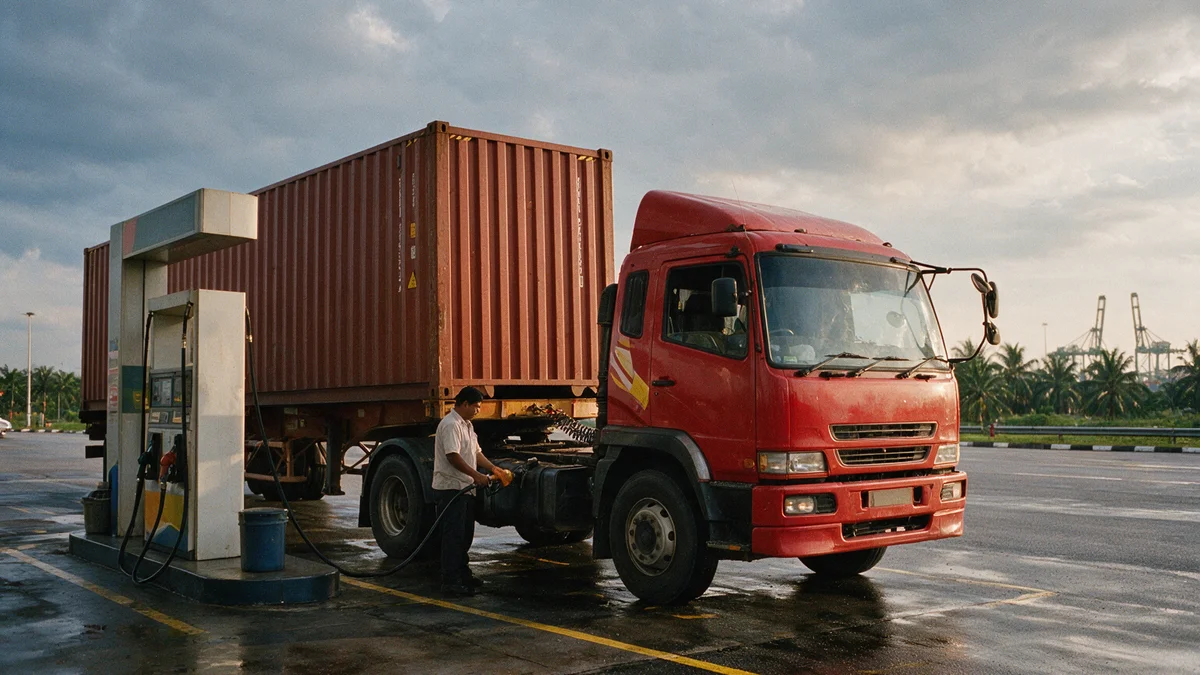
FAF, the fuel adjustment factor, is the part of a Malaysian container haulage charge that follows the diesel price. It is usually a percentage billed as its own line on top of the trip rate. The Association of Malaysian Hauliers stopped issuing FAF guidelines in 2011, so each haulier now sets its own, which is why two quotes for the same trip can carry different fuel charges.
Diesel more than doubled in five weeks this year, and a fuel charge built to track it follows that price. Here is what the charge is, who decides it, and how to check it before you accept a quote.
Key takeaways
- FAF is one of four haulier charges. The Malaysia Competition Commission (MyCC) lists haulage tariffs, the fuel adjustment factor, toll rates and the depot gate charge.
- No association sets it any more. AMH stopped issuing FAF guidelines in 2011; each haulier determines its own rate.
- Diesel moved hard in 2026. Peninsular diesel rose from RM3.12 a litre in the week of 5 March to RM6.72 in the week of 9 April, and is RM4.92 in the week of 10 September.
- Subsidised diesel does not remove the charge. SKDS goods-transport diesel costs RM2.15 a litre, but operators pay the pump price first and receive the subsidy later.
- Port Klang's LCL FAF is a different charge. It is billed per ton, at RM3.50 per ton since 27 March 2026.
What is FAF on a Malaysian haulage invoice?
FAF is a fuel charge that sits on top of the haulage tariff. In its market review of the transportation sector, MyCC names four charges hauliers pass on to shippers: haulage tariffs, the fuel adjustment factor, toll rates and the depot gate charge. It described the FAF percentage as "calculated weekly and is usually charged as a separate line item in invoices to recover fuel price movements."
MyCC estimated that FAF adds roughly 15 to 20% to haulage tariffs, with tolls adding another 2 to 5%. That range came from desk research carried out before the 2026 diesel spike, so read it as a historical guide rather than today's rate. For how the base trip rate itself is built, see container haulage rates and routes from Port Klang.
Who sets the FAF rate in Malaysia?
Each haulier sets its own. MyCC records that since 2011, "in compliance to anti-competition regulations, AMH had ceased to issue FAF guidelines to their members", and that individual haulage companies should determine their FAF rates based on the market factors that apply to them.
The old system still circulates online. In 2010 the Container Hauliers Association of Malaysia (CHAM) and AMH set FAF at 10.15% of the 40-foot container rate in the CHAM tariff, based on the average diesel price for the quarter compared with the diesel cost built into CHAM's 1974 tariff. MIDA's cost-of-doing-business guide still shows FAF at 19.71%, but its own footnote says those are average indicative rates obtained in 2011, before the competition act.
A shared formula today would be a competition problem. MyCC notes that if hauliers "collectively use the same formulas to determine FAF rates, there are potential anti-competitive issues", and recommended a further inquiry into how FAF charges are imposed. That is a recommendation to look, not a finding against anyone. The hauliers' association says the same from its side:
"As an association, we are guided by the Competition Act 2010 (MyCC), which prohibits us from advising members on pricing or tariff matters."
— Association of Malaysian Hauliers, statement of 2 April 2026
What did 2026 diesel prices do to FAF?
They put it under pressure. Malaysia has set retail fuel prices weekly since April 2017, and the official data.gov.my series shows Peninsular diesel more than doubling in five weeks this year, from RM3.12 a litre in the week of 5 March to RM6.72 in the week of 9 April. A fuel charge built on the pump price is designed to follow it. SKDS goods-transport diesel has stayed at RM2.15 all year, so how far a subsidised haulier's FAF should move depends on which diesel price it is built on.
| Week | Peninsular diesel, per litre | What it marks |
|---|---|---|
| 10 June 2024 | RM3.35 | Diesel subsidy removed in Peninsular Malaysia; the price jumps from RM2.15 |
| 5 March 2026 | RM3.12 | Before the 2026 spike |
| 9 April 2026 | RM6.72 | Highest weekly price of 2026 so far |
| 10 September 2026 | RM4.92 | Latest week at publication; SKDS goods-transport diesel stays at RM2.15 |
Source: data.gov.my, Price of Petroleum & Diesel (official weekly series).
AMH said in April that "some operators have adjusted their service rates to reflect increased costs." A container trailer uses about 3,000 to 5,000 litres of diesel a month, The Star reported, which at early-April prices meant an upfront fuel bill of RM18,000 to RM30,000 per truck. After 193 days of conflict in West Asia, the Finance Ministry said petroleum flows through the Strait of Hormuz have yet to return to normal. The same crisis hit sea freight: see the Strait of Hormuz crisis for Port Klang shippers and April 2026's freight rate surge.
Hauliers get subsidised diesel, so why is there still a fuel charge?
Because the subsidy is narrower and slower than it looks. Under the Subsidised Diesel Control System (SKDS), goods-transport diesel is priced at RM2.15 a litre, against RM4.92 at the pump in the week of 10 September 2026, a gap of RM2.77. But operators "must first pay the full pump price before receiving the subsidy later", The Star reports, and fuel credit is sized on the pump price, not the subsidy.
"Credit limits are typically based on the pump price rather than the subsidised price."
— Mohamad Azuan Masud, secretary-general, Association of Malaysian Hauliers, quoted by the New Straits Times, April 2026
The Association of Malaysian Hauliers adds that tyre suppliers and breakdown services get no diesel subsidy, so hauliers may need slight rate adjustments for those costs too. For a buyer, the useful question is not whether a haulier is subsidised, but which diesel price its FAF follows.
Is Port Klang's LCL FAF the same charge?
No. Port Klang's LCL FAF is a separate, per-ton charge on less-than-container-load cargo, imposed by warehouse operators under the Port Klang Authority by-laws. It was RM2.50 per ton, set against a fuel price of RM3.50 a litre. After market fuel prices rose more than 50%, it was raised to RM3.50 per ton from 27 March 2026, and the Port Klang Authority will review it fortnightly, FMM reported.
Part loads carry this line on the warehouse side of the bill, not the haulage side; the FCL versus LCL comparison covers when a part load still makes sense.
How do you check the FAF on a haulage quote?
Itemise the charge, find out which diesel price it follows, and check that price against the official weekly figure. Because each haulier sets its own FAF, compare the total trip cost across quotes rather than the FAF line alone. Five checks cover it:
- Get the four charges on separate lines: haulage tariff, FAF, tolls and depot gate charge.
- Ask what the FAF is based on: a percentage of which rate or a fixed amount per trip, tied to the SKDS or pump diesel price, reviewed how often.
- Check that diesel price yourself. The weekly series is public on data.gov.my, so a fuel charge still built on RM6.72 diesel stands out in a week when the price is RM4.92.
- Ask how it comes down. Diesel has fallen from its April peak; an FAF that only ever resets upward is worth raising.
- Compare the total, not the surcharge. A low FAF on a high base rate can cost more than the reverse.
Haulage is one line in a larger bill: the true cost of importing a container to Port Klang sets it beside every other charge, and cutting logistics costs in Malaysia covers where manufacturers find savings.
Where DNE fits
DNE Forwarding, founded in Port Klang in 1999, runs KA-licensed container haulage and moves more than 1,000 containers a month. Send us the route and container size for a haulage quote, and ask any haulier, us included, to show you what their FAF is based on.
Frequently asked questions
What does FAF mean in container haulage?
FAF stands for fuel adjustment factor. In Malaysian container haulage it is the charge that recovers fuel price movements, usually a percentage calculated weekly and shown as its own invoice line, alongside the haulage tariff, tolls and the depot gate charge.
Is FAF set by the government or a haulage association in Malaysia?
Neither, for container haulage. The Association of Malaysian Hauliers stopped issuing FAF guidelines in 2011 to comply with competition rules, and MyCC says each haulage company should set its own FAF. Port Klang's LCL FAF is different: the Port Klang Authority revises that one.
Why do hauliers charge FAF if they get subsidised diesel?
SKDS goods-transport diesel costs RM2.15 a litre, but operators pay the full pump price first and receive the subsidy later, and fuel credit limits follow the pump price. Support costs such as tyres and breakdown services get no diesel subsidy.
How often does FAF change?
It depends on the haulier and the contract. MyCC described the container haulage FAF percentage as calculated weekly, in step with Malaysia's weekly fuel pricing, while the Port Klang Authority reviews the LCL FAF fortnightly. Ask your haulier for its review period in writing.
Sources
- Malaysia Competition Commission — Market Review on Transportation Sector under the Competition Act 2010, draft final report (PDF)
- data.gov.my — Price of Petroleum & Diesel (weekly series)
- FMM — Implementation of FAF for LCL cargo at Port Klang
- Bernama — Finance Ministry statement on weekly fuel prices
- The Star — Added load of pay-first system
- paultan.org — Diesel price taking its toll on Malaysian hauliers
- Asian Trucker — AMH responds: current fuel price hikes
- paultan.org — SKDS subsidised diesel coverage expanded
- Trade and Logistics Malaysia — Hauliers to impose fuel surcharge (repost of 2010 report)
- MIDA — Cost of Doing Business in Malaysia (PDF)