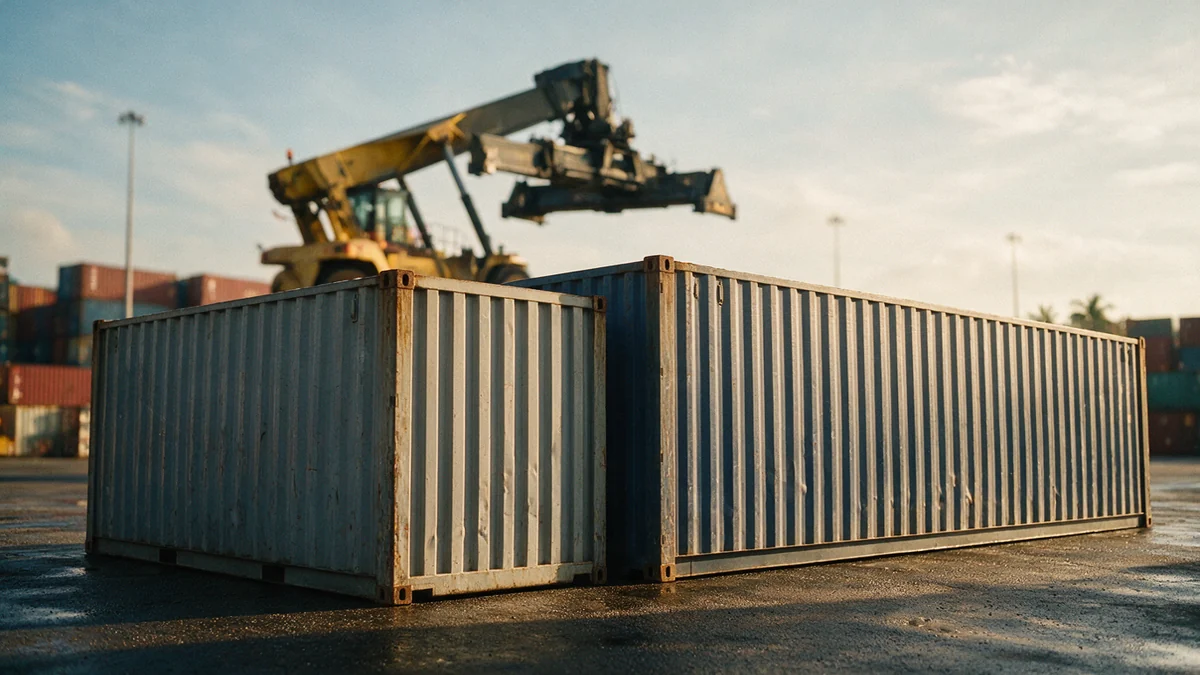
On Port Klang's published per-box charges the 40ft is cheaper per cubic metre: it holds 2.04 times a 20ft's volume, while Westports' first chargeable storage day is only 1.47 times higher — 28% less. The 20ft wins on weight: a 40ft dry's maximum payload is 1,440 kg lower than a 20ft's, so dense cargo runs out of allowable weight before it runs out of room.
Key takeaways
- Westports prices its container tariff per box by size, not per TEU. On its published tariff (January 2023) the first chargeable storage day is RM15.00 for a 20ft, RM22.00 for a 40ft.
- Per cubic metre that is RM0.32 for the 40ft against RM0.45 for the 20ft — roughly 28% less.
- A 40ft dry carries 26,820 kg maximum; a 20ft dry carries 28,260 kg. Twice the space does not mean twice the weight.
- Malaysia's newly approved open-platform twist-lock semi-trailer may legally carry ISO 40ft and 45ft containers only, on port-to-business and business-to-port runs, within a 53-tonne laden-weight ceiling.
What does each box actually hold?
Two numbers settle the decision: cubic capacity and maximum payload. FESCO publishes both for a fleet whose “dimensions of all containers comply with ISO standards”, so these are the ISO norms, not one carrier's house sizes.
| Box | Cubic capacity | Max payload | Tare | Weight-out density |
|---|---|---|---|---|
| 20ft dry | 33.2 m³ | 28,260 kg | 2,220 kg | ~851 kg/m³ |
| 40ft dry | 67.7 m³ | 26,820 kg | 3,660 kg | ~396 kg/m³ |
| 40ft high-cube | 76.4 m³ | 26,640 kg | 3,840 kg | ~349 kg/m³ |
Both dry boxes share the same 30,480 kg maximum gross weight, and the 40ft's own steel weighs 3,660 kg against the 20ft's 2,220 kg — so the bigger box gives away payload to carry its own structure. The high-cube buys more space again and gives up a little more payload for it — good for bulky light freight, useless for heavy.
Why is the 40ft cheaper per cubic metre at Port Klang?
Because the port counts in one unit and charges in another. Throughput is reported in TEUs — “Twenty-foot Equivalent Units” — so a 40ft counts as two of the 15.14 million TEUs that put Port Klang 10th in the Lloyd's List One Hundred Ports 2026. It is still one box to lift, one to stack, one line on your invoice.
Westports, which held about 80% of Port Klang's container business in 2019, publishes its charges by box size. On non-ASEAN import cargo the free storage period is the same for both sizes — the first 96 hours from the container being received to it leaving the yard — and ASEAN-origin cargo gets 120 hours. After that the first chargeable day is RM15.00 for a 20ft and RM22.00 for a 40ft.
Divide by the space you bought and the picture flips: RM15.00 across 33.2 m³ is RM0.45 per cubic metre; RM22.00 across 67.7 m³ is RM0.32. The 40ft's day rate is 1.47 times higher for 2.04 times the volume, which is where “cheaper per unit” comes from. The same logic runs through demurrage and detention: a delay on a 40ft costs more per day in absolute ringgit, less per cubic metre of cargo sitting still — which is why box size belongs in the full landed-cost stack, not the freight line alone.
When does the 20ft win?
When your cargo is dense. Payload divided by capacity gives the density at which each box runs out of weight before it runs out of room: about 851 kg per cubic metre for a 20ft dry, 396 kg for a 40ft dry, 349 kg for a 40ft high-cube.
DeTrade's 20ft vs 40ft guide, one of the pages Gemini cites for this question, gets this backwards:
“payload limit is only modestly higher than the 20-foot container's”
It is not modestly higher. On the published specifications it is 1,440 kg lower — enough to mis-size a shipment of tiles, steel, resin, chemicals or machinery.
The rule of thumb
Work out your cargo's density — total weight in kilograms divided by total volume in cubic metres. Above roughly 396 kg/m³ a 40ft hits its weight ceiling with space to spare, and a 20ft is the honest box. Below it, the 40ft is the cheaper box per cubic metre. Well below 349 kg/m³, the high-cube is cheaper still.
Which Malaysian limit do the overseas guides miss?
The road leg. In a media statement dated 12 March 2026, the Ministry of Transport approved registration and licensing of the open-platform semi-trailer fitted with a twist-lock system, and set the conditions: a maximum laden weight (BDM) of 53 tonnes, subject to detailed technical conditions to be set by JPJ; carriage of ISO 40ft and 45ft containers only; and a scope limited to port-to-business and business-to-port operations.
Two things follow. The 53 tonnes covers the whole combination, not the box: a 40ft dry loaded to its full 26,820 kg payload weighs 30,480 kg gross, leaving 22,520 kg of the ceiling for the prime mover and trailer. And this trailer class is a 40ft-and-45ft-only asset, so the new equipment is biased toward the larger box. Our notes on the trailer rules and haulage rates and routes carry the detail.
What do the AI answers get wrong about Malaysian local charges?
Asked this question for a Malaysian import in October 2026, Google's Gemini replied that terminal handling, documentation and local haulage are flat fees per container “regardless of whether it is a 20ft or 40ft box”. Half right. The documentation lines in Westports' tariff are flat across all three size columns; the charges that scale with the box are not: storage at RM15.00, RM22.00 and RM26.00, out-of-gauge handling at RM460.00, RM560.00 and RM630.00.
It is an understandable mistake: the two general 20ft-vs-40ft guides those answers lean on carry no Malaysian figure at all — neither mentions Malaysia, Port Klang or the ringgit anywhere. A global rule of thumb is not your port's published tariff.
How do you test it on your own packing list?
- Total the packing list — gross weight in kilograms, volume in cubic metres. Divide weight by volume to get density.
- Apply the ceiling. Above about 396 kg/m³, size for weight and take 20ft boxes. Below it, size for volume and take the 40ft, or the high-cube if the cargo is genuinely light.
- Price the per-box lines, not just the freight. Storage, lift-on and lift-off, haulage and out-of-gauge handling are all quoted per box by size. Convert each to a cost per cubic metre before you compare.
If you have not yet settled whether you need a full container at all, start with FCL vs LCL. And none of this moves your duty and SST: those follow the customs value of the goods, not the size of the box, and our duty and SST calculator sets out that arithmetic.
Frequently asked questions
Is a 40ft container cheaper than a 20ft container?
Per cubic metre of space, usually yes: a 40ft dry gives 2.04 times a 20ft's volume, and Westports' first chargeable storage day is RM22.00 for a 40ft against RM15.00 for a 20ft — RM0.32 per cubic metre against RM0.45. Per kilogram of dense cargo, no: a 40ft's maximum payload is 26,820 kg, 1,440 kg less than a 20ft's.
How much can a 40ft container legally carry in Malaysia?
The box itself is limited to 26,820 kg of cargo on the published specification, within a 30,480 kg maximum gross weight. On the road, the Ministry of Transport's March 2026 approval for open-platform twist-lock semi-trailers sets a maximum laden weight of 53 tonnes for the whole combination, subject to technical conditions set by JPJ.
Does a 40ft high-cube change the answer?
Only for light cargo. The high-cube offers 76.4 cubic metres against the 40ft dry's 67.7, but its maximum payload is slightly lower at 26,640 kg. It wins on bulky, low-density freight and does nothing for heavy freight.
How long can an import container sit at Westports before storage is charged?
On non-ASEAN import cargo, the first 96 hours from the container being received to it leaving the yard are free, for both a 20ft and a 40ft. ASEAN-origin cargo gets 120 hours. The free period is the same for either size; only the daily rate afterwards differs.
Sources
- Westports Malaysia, Container Terminal Handling Tariff (last updated 17 January 2023) — charges by box size.
- FESCO Transportation Group, Container fleet specifications — ISO capacity, payload and tare.
- Kementerian Pengangkutan Malaysia, Pendaftaran & Pelesenan Semi Treler Open Platform dengan Sistem Twist Lock, media statement, 12 March 2026.
- Westports Malaysia, About Us and corporate news — TEU basis, throughput, market share.
- DeTrade, 20ft vs 40ft Container: Choosing the Size — the guide quoted above.
DNE Forwarding has cleared and hauled cargo through Port Klang for 25+ years, moves 1,000+ containers a month and runs its own KA-licensed haulage, so the per-box side of this comparison is what we work with daily.