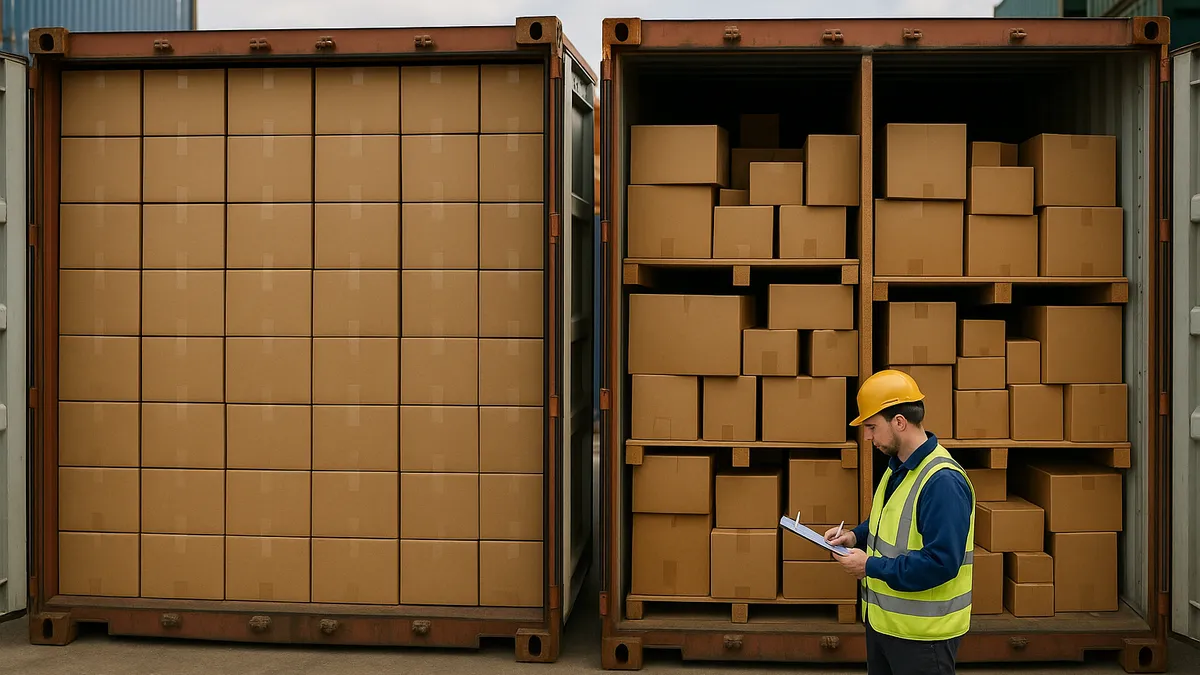
When importing into Malaysia, FCL means booking an entire container at a flat rate, while LCL means sharing container space and paying per cubic metre. As a rule of thumb, once your shipment exceeds 12-15 CBM, FCL almost always costs less than LCL; below 10 CBM, LCL usually wins.
Watch: FCL vs LCL Shipping to Malaysia: Which Saves You More? (2026)
FCL costs less once your shipment passes roughly 10-12 CBM; below that, LCL usually saves you more on shipping into Malaysia. This video breaks down FCL (Full Container Load) versus LCL (Less than Container Load) shipping to Port Klang, Malaysia, with real cost numbers instead of rules of thumb.
Read the video transcript
FCL vs LCL: which one actually saves you more?
FCL vs LCL shipping to Malaysia — which one actually saves you more money? Here's the direct answer. Once your shipment crosses roughly ten to twelve cubic metres on the main China-to-Malaysia lanes, FCL — a full container booked just for you — almost always costs less than LCL, where you share a container and pay by the cubic metre. Below that volume, LCL usually wins.
I'm Dan Duar, director at DNE Forwarding. We move both FCL and LCL cargo through Port Klang every single day, and this is the exact math we walk every new importer through before we ever send a quote. Here's the full breakdown: what each mode actually is, what they really cost, how much longer LCL takes, and exactly when to switch.
What is FCL, and what is LCL?
So what is FCL, and what is LCL, really? FCL, or Full Container Load, means you book an entire shipping container exclusively for your cargo. It doesn't matter if you fill it to the brim or ship it half-empty — you pay one flat rate for the whole box. It's sealed at the factory, loaded once, and only opened again at your warehouse. One container, one bill of lading, one customs declaration.
LCL, or Less than Container Load, means your cargo shares space with other importers' shipments inside the same container. A consolidator combines several smaller shipments together, and you pay only for the cubic metres you actually use. That means four extra steps compared to FCL: your goods get consolidated at an origin freight station, shipped, deconsolidated at a station near Port Klang, and then cleared through customs as your own individual declaration — separate from everyone else sharing that box.
Container sizes: know your numbers
Before you can compare costs, you need to know what a container actually holds. A standard twenty-foot container gives you twenty-eight to thirty usable cubic metres and caps out at twenty-one thousand six hundred kilograms. A forty-foot container gives you fifty-six to fifty-eight usable cubic metres, at a twenty-six thousand five hundred kilogram limit.
Here's the trap importers fall into: LCL is charged on whichever is bigger — your actual volume, or your weight converted at one tonne per cubic metre. If you're shipping something dense, like tiles, steel parts, or canned food, you'll hit the weight limit long before you fill the space. Light cargo, like textiles or plastics, fills the space first. Get that wrong, and your LCL bill can come in double what you budgeted.
The real cost comparison and the break-even point
Now let's put real numbers on it. On the Shanghai-to-Port Klang lane, a twenty-foot FCL container runs around one thousand US dollars, all-in ocean freight. LCL runs about sixty dollars per cubic metre, plus roughly three hundred fifty dollars in origin and destination handling charges.
Run the math and the pattern is unmistakable. At five cubic metres, LCL costs six hundred fifty dollars — LCL wins easily. At ten cubic metres, LCL is nine hundred fifty dollars — still cheaper, but only barely. Cross twelve cubic metres, and LCL jumps to one thousand seventy dollars — FCL is now the cheaper option. By twenty cubic metres, FCL is saving you five hundred fifty dollars over LCL, on that one shipment alone.
Here's a quick rule of thumb you can run on your own numbers. Take your FCL quote and divide it by your LCL rate per cubic metre — that tells you roughly how many cubic metres you need before FCL starts saving you money. And remember: once you cross that line, any empty space left in your container is effectively free, because you pay the same flat rate whether you load twelve cubic metres or twenty-eight.
Why FCL gets there faster
Why does FCL arrive faster, when both modes ride the exact same ship? The ocean voyage itself takes identical time either way — the difference is everything that happens before and after the vessel sails. FCL typically runs eleven to fourteen days door-to-door. LCL runs sixteen to twenty-five days — five to eleven days longer.
That extra time comes from consolidation delays waiting for enough cargo to fill a container at origin, and from deconsolidation and sorting once it lands near Port Klang. On busy China lanes, consolidation windows run almost daily, so the delay stays small. On quieter routes, you could be waiting several extra days just for your container to leave the origin port.
Risk and customs: what changes when cargo is shared?
Does sharing a container actually increase your risk? Yes — and it's worth knowing before you book. An FCL container is sealed at origin and only opened at your destination — handled twice, total, start to finish. An LCL shipment gets handled at least four times: loaded into the origin station, stuffed into the container, destuffed at the destination station, then sorted for collection. Every one of those touch points adds risk of damage, loss, or a mix-up with someone else's goods.
Customs clearance splits the same way. An FCL container clears as one unit, under one declaration. LCL cargo can't clear until the whole container is deconsolidated, and if another shipper's goods in that same box get flagged for inspection, your cargo can get held up too — typically adding one to three working days versus FCL. And if your cargo needs temperature control, that decision is already made for you: reefer containers only exist as FCL — there's no LCL option for anything that has to stay cold.
FCL or LCL: which should you book?
So which one should you actually book? Choose FCL when your shipment is over twelve to fifteen cubic metres, when you ship regularly, when your cargo is high-value or fragile, when timing is critical, or when you need temperature control.
Choose LCL when you're under ten cubic metres, when you're a first-time importer testing a new supplier or market, when your orders come in irregularly, or when preserving cash flow matters more to you than speed.
And don't treat it as strictly either-or. If you're sourcing from two or three suppliers in the same region, you can consolidate all of their cargo into one FCL container instead of paying LCL rates three separate times — that alone can turn several small, expensive LCL shipments into one efficient full container.
Recap: the direct answer again
So, to recap: FCL means one container, one flat rate, all to yourself. LCL means shared space, paid by the cubic metre. The crossover sits around ten to twelve cubic metres — below it, LCL saves you money; above it, FCL almost always wins on cost, speed, and risk, all at once.
At DNE Forwarding, we handle both FCL and LCL through Port Klang every day, and we'll tell you honestly which mode saves you more before we ever send a quote — not whichever one is easier for us to sell. If you want the full cost tables and every worked example, the complete guide is on dnelogistics.com.my. And if you've got a shipment you're not sure about, send us the volume and weight on WhatsApp — we'll run the numbers for you.
If you are importing goods into Malaysia, one of the first decisions you will face is whether to ship FCL or LCL. The answer can mean the difference between overpaying by hundreds of dollars or leaving money on the table with every shipment. Yet many importers — especially those new to international trade — choose one mode out of habit without ever running the numbers.
This guide breaks down everything you need to know about FCL and LCL shipping to Malaysia: how each works operationally, what they actually cost on key trade lanes into Port Klang, and the exact volume threshold where switching modes saves you money.
What Is FCL? Full Container Load Explained
FCL (Full Container Load) means you book an entire shipping container exclusively for your cargo. It does not matter whether you fill the container to capacity or ship it half-empty — you pay a flat rate for the whole unit. The container is sealed at the origin warehouse or factory, loaded onto a vessel, and only opened again at the destination.
The key operational characteristics of FCL are:
- Exclusive use: No other shipper's cargo shares your container. The container is sealed with a unique seal number at origin and remains sealed until it reaches the destination port or warehouse.
- Door-to-door integrity: Your goods are loaded once and unloaded once. There is no intermediate handling, sorting, or repacking at any freight station.
- Flat-rate pricing: You pay a fixed price per container regardless of how much space you actually use. Whether you load 10 CBM or 28 CBM into a 20-foot container, the ocean freight charge is the same.
- Faster customs clearance: At the destination port, the entire container clears customs as a single unit under one bill of lading and one customs declaration.
What Is LCL? Less Than Container Load Explained
LCL (Less than Container Load) means your cargo shares container space with shipments from other importers. A freight consolidator combines multiple smaller shipments into one container, and each shipper pays only for the space they use — measured in cubic metres (CBM).
The LCL process involves several additional steps compared to FCL:
- Origin consolidation: Your cargo is delivered to a Container Freight Station (CFS) at the origin port. The CFS operator receives shipments from multiple shippers, inspects and measures each consignment, and loads them together into a single container.
- Ocean transit: The consolidated container travels on the same vessel and the same route as an FCL container. The ocean transit time itself is identical.
- Destination deconsolidation: When the container arrives at Port Klang, it is transported to a destination CFS. There, the container is opened, and each shipper's cargo is separated, sorted, and made available for individual collection or delivery.
- Individual customs clearance: Each shipper's consignment must be cleared through customs separately, each with its own declaration and documentation.
This consolidation and deconsolidation process is what drives both the cost advantage and the time disadvantage of LCL shipping. If your cargo is coming through Port Klang, our walkthrough of how LCL consolidation works at Port Klang follows a single groupage shipment from the destination CFS to cargo release, including which document actually releases the goods and when storage charges start.
Container Sizes and Capacity: Know Your Numbers
Understanding container dimensions is essential for calculating whether FCL or LCL makes financial sense for your shipment. Here are the three standard dry container types used on trade lanes into Malaysia:
| Container Type | Total Volume | Usable Volume | Max Payload |
|---|---|---|---|
| 20ft (1 TEU) | 33 CBM | 28-30 CBM | 21,600 kg |
| 40ft (1 FEU) | 67 CBM | 56-58 CBM | 26,500 kg |
| 40ft HC | 76 CBM | 66-68 CBM | 26,500 kg |
Why "usable volume" is lower than total volume: In practice, stacking patterns, air gaps between cartons, uneven cargo shapes, and the need for load-securing materials reduce what you can actually fit inside. Always plan with usable volume figures, not theoretical maximums.
Weight limits matter too. A 20ft container can hold approximately 28 CBM of space, but its maximum payload is 21,600 kg. If you are shipping dense goods like tiles, steel parts, or canned food, you will hit the weight limit long before you fill the volume. Conversely, lightweight goods like plastic products or textiles will fill the space before reaching weight limits. This distinction directly affects whether FCL or LCL is the better choice for your specific cargo. Once FCL is settled, the same weight-against-volume test decides the box size: see 20ft vs 40ft container costs in Malaysia for the per-cubic-metre comparison and the 53-tonne laden-weight ceiling that limits a 40ft on a Malaysian road.
Cost Comparison: Real Numbers on Key Trade Lanes
Let us look at rate ranges for shipping to Port Klang, Malaysia's busiest port. The China lane below was re-priced in October 2026; the other lanes were last checked in June 2026 and should be read as older indications. These figures represent ocean freight charges and do not include local charges, customs duties, or haulage — but they illustrate the economics clearly. (For the full landed picture, our complete guide to sea freight into Port Klang walks through every charge line in order.)
One thing to know about any freight rate table, including this one: the numbers move every month. Spot rates on the China–Port Klang lane swung by double digits month to month through 2026 — a published forwarder rate guide showed the 20ft band fall about 14% into September 2026 and then recover roughly 10% into October. Use the table for the shape of the decision and your own live quote for the arithmetic; the break-even formula further down is written so you can plug your own numbers into it.
FCL Rates to Port Klang (Indicative Range)
| Origin | 20ft Container | 40ft Container | Transit Time |
|---|---|---|---|
| Shanghai, China (Oct 2026) | USD 675 - 825 | USD 1,350 - 1,650 | 6-8 days |
| Shenzhen, China | USD 700 - 1,100 | USD 1,100 - 1,600 | 5-7 days |
| Nhava Sheva, India | USD 900 - 1,400 | USD 1,400 - 2,200 | 8-12 days |
| Rotterdam, Europe | USD 1,500 - 2,500 | USD 2,500 - 3,500 | 22-28 days |
The Shanghai row reflects indicative China-to-Port Klang quotes published in October 2026 by a forwarder rate guide, which labels its own figures indicative; the Shenzhen, Nhava Sheva and Rotterdam rows were last verified in June 2026 and have not been re-priced since. Rates fluctuate with season, carrier and market conditions, and peak-season surcharges, fuel surcharges (BAF/LSS) and equipment availability all land on the final invoice. Always request a current quotation.
LCL Rates to Port Klang (Indicative Range)
LCL is priced per cubic metre (CBM), with a minimum charge typically applied for shipments under 1 CBM. Current indicative rates:
- China to Port Klang: about USD 18 per CBM in October 2026 for the ocean freight component — well below the USD 40 - 80 band that held earlier in 2026, when consolidation space was tight. The ocean leg is the smallest part of an LCL bill; the fixed charges below are what decide the comparison.
- India to Port Klang: USD 50 - 100 per CBM
- Europe to Port Klang: USD 80 - 150 per CBM
However, the per-CBM ocean freight rate is only part of the LCL cost. You must also factor in:
- Origin CFS charges: USD 150 - 400 for consolidation handling, documentation, and container stuffing
- Destination CFS charges: USD 150 - 350 for deconsolidation, sorting, and storage. These are billed in ringgit in Malaysia and the components are published: one Port Klang LCL import tariff lists warehouse handling at RM12.00 per W/M (weight or measure, whichever is greater), CFS removal at RM4.00 per W/M, CFS storage at RM7.50 per W/M per day after three free days, and dangerous-goods handling at RM250 per shipment.
- Bill of lading fee: USD 30 - 75 per shipment
- Fuel and currency surcharges: Typically 10-20% on top of the base rate
The Break-Even Point: Where FCL Beats LCL
This is the most important calculation for any importer. Let us work through a real example on the China-to-Port Klang route:
Do it as a formula rather than a memorised number, because the answer moves with the market:
The break-even formula
Break-even volume (CBM) = (FCL all-in rate − LCL fixed charges) ÷ LCL rate per CBM
“LCL fixed charges” means everything you pay per shipment whatever the volume — origin and destination CFS, bill of lading, documentation. “LCL rate per CBM” is the all-in per-cubic-metre charge your forwarder quotes, not the ocean leg on its own. Below the break-even volume LCL is cheaper; above it, FCL is.
Example: Shanghai to Port Klang, October 2026 rates
- FCL 20ft rate: USD 750 — the middle of the October 2026 indicative band, flat ocean freight
- LCL rate: USD 50 per CBM all-in + USD 350 in CFS, documentation and handling charges — your own quote will differ, so substitute it
- Break-even: (750 − 350) ÷ 50 = 8 CBM
- LCL total for 5 CBM: (5 x 50) + 350 = USD 600 — LCL wins
- LCL total for 8 CBM: (8 x 50) + 350 = USD 750 — line ball
- LCL total for 10 CBM: (10 x 50) + 350 = USD 850 — FCL is now cheaper
- LCL total for 15 CBM: (15 x 50) + 350 = USD 1,100 — FCL saves USD 350
- LCL total for 20 CBM: (20 x 50) + 350 = USD 1,350 — FCL saves USD 600
The rule of thumb most importers carry in their heads — “FCL wins past 12 to 15 CBM” — was formed when a 20ft from China cost USD 1,000 or more. Run the same arithmetic at the softer rates of late 2026 and the crossover falls to roughly 8 to 10 CBM. When FCL rates drop, the break-even drops with them: the cheaper the box, the smaller the shipment that justifies taking the whole box.
The sensitivity cuts both ways. At a USD 825 FCL rate the break-even is 9.5 CBM; at USD 675 it is 6.5 CBM. Which is why the only honest answer to “at what volume should I switch to FCL?” is: get both quotes on the same shipment, this month, and run the two lines above.
Remember: even if your FCL container ships with empty space, you are not wasting money once you cross the break-even threshold. You are paying the same flat rate whether you load 12 CBM or 28 CBM into that 20-footer. That "empty" space is effectively free. (For more strategies on reducing your landed cost, see our guide on cutting logistics costs in Malaysia.)
The Free-Time Clock Is Not the Same for FCL and LCL
Almost every FCL-versus-LCL comparison stops at the freight rate. The charge that actually surprises importers at Port Klang is what happens after arrival — and the two modes run on completely different clocks.
FCL: the terminal’s clock, then the line’s. On Westports’ published container tariff (the scale last updated 30 October 2025), a laden import container gets 96 hours of free storage in the yard when the cargo is non-ASEAN, 120 hours for ASEAN-origin cargo, and 168 hours if it arrived from another Malaysian port. After that, storage runs on a published escalating scale — cumulatively RM17.30 after a 20ft’s first chargeable day, RM103.50 by the sixth, RM147.20 by the seventh and RM380.70 by the seventeenth, after which each further day adds RM57.80. A 40ft runs RM25.30, RM155.30, RM222.00 and RM570.40 at the same points, then RM86.60 a day. Separately, your shipping line charges combined demurrage and detention once its own three to five free days are gone. All of it is still rising: the Port Klang tariff revision gazetted on 13 June 2025 (P.U. (A) 180/2025) is being phased in at about 15% from 15 July 2025, 10% from 1 January 2026 and 5% from 1 January 2027.
LCL: a shorter clock, priced by the cubic metre. Your cargo is not in a yard, it is in a container freight station being broken down. One published Port Klang LCL import tariff gives three free days — weekends and public holidays included — and then charges RM7.50 per W/M per day, chargeable from day one, plus RM4.00 per W/M to remove the cargo and RM12.00 per W/M in warehouse handling. Three days is tight for a declaration that hits a query.
So the exposure is shaped differently: LCL’s dwell clock is shorter but its daily penalty is small and proportional to your volume, while FCL’s clock is longer but the daily penalty is per box and escalates steeply once the first week is gone. A 10-CBM LCL shipment held five extra days costs tens of ringgit a day; a 40ft container held five extra days past free time costs hundreds. Our guide to demurrage and detention at Port Klang works through the free-day allowances and a full cost example.
Transit Time: Why FCL Gets There Faster
The ocean voyage itself takes the same number of days regardless of whether your cargo travels FCL or LCL — both ride on the same ships. The difference lies in what happens before and after the vessel voyage.
FCL Timeline
- Cargo loaded at factory or warehouse (Day 1)
- Container sealed and transported to port (Day 1-2)
- Vessel departure (Day 3)
- Ocean transit — e.g., Shanghai to Port Klang (6-8 days)
- Arrival and customs clearance as single unit (1-2 days)
- Haulage to your warehouse (same day or next day)
Total: approximately 11-14 days door-to-door
LCL Timeline
- Cargo delivered to origin CFS (Day 1)
- Wait for consolidation window — CFS accumulates enough cargo to fill a container (1-5 days)
- Container stuffed and transported to port (Day 2-7)
- Vessel departure (Day 3-8)
- Ocean transit — same route, same duration (6-8 days)
- Container moved to destination CFS for deconsolidation (1-2 days)
- Deconsolidation, sorting, and individual cargo release (2-4 days)
- Individual customs clearance for your consignment (1-2 days)
- Haulage to your warehouse (same day or next day)
Total: approximately 16-25 days door-to-door
The difference of 5-11 additional days for LCL comes from consolidation delays at origin, deconsolidation processing at destination, and the fact that the CFS may need to wait for enough cargo to justify stuffing a container. On busy trade lanes like China to Malaysia, consolidation windows are frequent — often daily. On less popular routes, you could wait several days.
Cargo Risk: Handling, Damage, and Security
The risk profile of FCL and LCL differs significantly, and this is a factor many importers underestimate.
FCL Risk Profile
- Minimal handling: Your cargo is loaded once at origin and unloaded once at destination. It is not touched, moved, or sorted at any intermediate point.
- Sealed container: The container seal is applied at origin and only broken at the final destination. You can verify the seal number against your bill of lading to confirm no tampering occurred.
- No co-loading risk: Your goods are not mixed with other shippers' cargo, eliminating the risk of cross-contamination, accidental swaps, or damage from incompatible goods.
- Damage rate: FCL shipments have significantly lower damage and loss rates compared to LCL, precisely because of reduced handling.
LCL Risk Profile
- Multiple handling points: Your cargo is handled at least four additional times — loaded into origin CFS, stuffed into the container with other cargo, destuffed at destination CFS, and sorted for collection. Each handling point introduces risk.
- Shared space: Your goods travel alongside cargo from other shippers. If another shipper's goods leak, shift, or are improperly secured, your cargo can be affected.
- Higher damage/loss rates: Industry data consistently shows that LCL shipments experience higher rates of damage, pilferage, and misdelivery compared to FCL.
- Cargo insurance recommendation: If shipping LCL, cargo insurance is strongly advisable. The increased handling and shared-space risks make it a worthwhile investment.
For high-value goods, fragile items, or cargo that is sensitive to contamination (food products, chemicals, electronics), the security advantages of FCL often justify the cost premium even when volumes are below the break-even point.
Customs Clearance Differences at Port Klang
The customs clearance process differs between FCL and LCL, and the difference directly affects how quickly you get your goods. (For a deeper look at the customs clearance process in Malaysia, see our dedicated guide.)
FCL Customs Clearance
An FCL container clears customs as a single unit. Your forwarding agent submits one customs declaration covering all goods in the container. If the container is selected for inspection, it is examined as a whole. Once cleared, the container is released for haulage to your warehouse, where you unstuff it at your own facility.
LCL Customs Clearance
An LCL shipment cannot clear customs until the container has been deconsolidated at the destination CFS. The process works like this:
- The consolidated container arrives at port and is moved to the CFS
- The CFS operator breaks down the container and separates each shipper's cargo
- Each consignment is individually declared to customs under its own bill of lading
- If any consignment in the same container triggers an inspection, it can delay the release of the entire container — including your cargo
- Once cleared, your cargo is available for collection from the CFS or delivery to your warehouse
This process typically adds 1-3 working days compared to FCL clearance. The additional time comes from the physical deconsolidation process and the sequential nature of individual customs declarations.
When to Choose FCL
FCL is the better choice when:
- Your shipment exceeds 12-15 CBM: Beyond this volume, you are almost certainly paying more for LCL than you would for a full container.
- You ship regularly: If you import monthly or fortnightly, FCL gives you predictable costs, faster turnaround, and simpler documentation.
- Your cargo is high-value: The sealed, single-shipper environment of FCL dramatically reduces theft and damage risk.
- Time is critical: If your production line depends on timely material delivery, the 5-11 day advantage of FCL can be decisive.
- Your goods are fragile or sensitive: Fewer handling points mean fewer opportunities for damage. Electronics, glass, precision machinery, and perishables all benefit from FCL.
- You need temperature control: Reefer (refrigerated) containers are only available as FCL. There is no LCL option for temperature-controlled cargo.
- You want simpler documentation: One container, one bill of lading, one customs declaration. The administrative burden is lighter.
When to Choose LCL
LCL is the better choice when:
- Your shipment is under 10 CBM: For small volumes, paying per CBM is significantly cheaper than booking an entire container.
- You are a first-time importer: LCL lets you test a new supplier, a new product, or a new market without committing to a full container.
- You are importing samples: Product samples, trial orders, and prototype shipments are ideal for LCL.
- Your orders are irregular: If you import only occasionally or unpredictably, LCL gives you flexibility without the fixed cost of FCL.
- Cash flow is a priority: LCL requires less upfront capital because you are paying for only the space you use, making it easier to manage working capital.
- Transit time is not critical: If your inventory planning accommodates longer lead times, the cost savings of LCL below the break-even point outweigh the speed advantage of FCL.
Hybrid Strategies: The Best of Both Worlds
Experienced importers do not treat FCL and LCL as an either-or decision. They use hybrid strategies to optimise costs across their entire supply chain.
Buyer's Consolidation
If you source from multiple suppliers in the same region — say three different factories in Guangdong — you can consolidate all three orders into a single FCL container. Instead of shipping three separate LCL consignments (paying per-CBM rates plus CFS charges three times), you arrange for all three suppliers to deliver to a single warehouse or CFS, where the goods are loaded into one container under your control.
This strategy works best when:
- Your individual orders are 3-8 CBM each, but combined they exceed 12-15 CBM
- Your suppliers are in the same geographic region
- The orders can be timed to arrive at the consolidation point within a reasonable window
Order Timing Optimisation
Rather than placing small orders monthly, consider placing larger orders less frequently. If you currently import 8 CBM per month via LCL, shifting to a 16 CBM order every two months via FCL could save 20-40% on freight costs — even after accounting for the additional warehousing costs of holding more inventory. (Our logistics cost-cutting guide covers inventory-freight trade-offs in detail.)
Mixed-Mode Shipping
For businesses with both regular bulk orders and occasional small top-up orders, use FCL for planned replenishment shipments and LCL for urgent, small-quantity top-ups. This gives you cost efficiency on your core volumes while maintaining flexibility for demand spikes.
Common Mistakes to Avoid
In our 25 years of handling freight at Port Klang, we see importers make these errors repeatedly:
- Never comparing total landed cost: Importers compare ocean freight rates alone and ignore CFS charges, handling fees, and the cost of additional transit days (warehouse rent, production delays). Always compare total cost, door to door.
- Shipping 14 CBM via LCL: This is the most expensive mistake. At 14 CBM, you are paying almost as much as FCL in freight charges, plus CFS charges on top. Switch to FCL and save immediately.
- Ignoring weight-based pricing: LCL is charged on whichever is greater: actual volume or weight-converted volume (1 tonne = 1 CBM). If your cargo is dense, your LCL cost could be double what you expected.
- Not insuring LCL shipments: The additional handling in LCL increases damage risk. Skipping cargo insurance to save a few dollars is false economy.
- Choosing based on habit: Market conditions change. FCL rates that were high during peak season may drop significantly during quieter months. Review your shipping mode every quarter.
FCL vs LCL: Quick Comparison Summary
| Factor | FCL | LCL |
|---|---|---|
| Pricing | Flat rate per container | Per CBM + CFS charges |
| Best for | 12+ CBM shipments | Under 10 CBM shipments |
| Transit time | Faster (no CFS delays) | 5-11 days longer |
| Cargo security | High (sealed, exclusive) | Moderate (shared, more handling) |
| Customs clearance | Single unit, faster | Individual, after deconsolidation |
| Damage risk | Lower | Higher |
| Flexibility | Requires volume commitment | Ship any quantity |
| Documentation | Simpler (one BL) | More complex |
How DNE Forwarding Helps You Choose — and Save
At DNE Forwarding, we handle both FCL and LCL shipments through Port Klang every day. We do not push one mode over the other — we recommend whichever option genuinely saves you money based on your specific cargo profile.
Here is what we bring to every shipment:
- Mode advisory: We analyse your cargo volume, weight, value, and frequency to recommend FCL, LCL, or a hybrid strategy. If switching modes saves you money, we will tell you.
- Consolidation services: For importers sourcing from multiple suppliers, we coordinate buyer's consolidation to help you reach FCL volumes and avoid per-CBM LCL charges.
- Competitive rates on both modes: Our long-standing relationships with shipping lines and consolidators mean we secure rates that individual importers cannot access on their own.
- End-to-end handling: From origin coordination to customs clearance at Port Klang to haulage to your warehouse — we manage the entire chain so nothing falls through the cracks.
- Transparent costing: We provide complete cost breakdowns including all surcharges, CFS charges, and local fees. No hidden charges, no surprises at destination.
Whether you are shipping 3 CBM of samples or 60 CBM of production materials, the right shipping mode is the one that matches your cargo, your timeline, and your budget. We help you find that match — every shipment, every time.
Part of a guide: this article is part of DNE's complete guide to freight forwarding in Malaysia.
Frequently asked questions
What is FCL (Full Container Load) shipping?
FCL (Full Container Load) means you book an entire shipping container exclusively for your cargo. It does not matter whether you fill the container to capacity or ship it half-empty — you pay a flat rate for the whole unit. The container is sealed at the origin warehouse or factory, loaded onto a vessel, and only opened again at the destination.
What is LCL (Less than Container Load) shipping?
LCL (Less than Container Load) means your cargo shares container space with shipments from other importers. A freight consolidator combines multiple smaller shipments into one container, and each shipper pays only for the space they use — measured in cubic metres (CBM).
At what volume does FCL become cheaper than LCL?
It depends on the rates of the month, so run it as a formula: break-even CBM = (FCL all-in rate minus LCL fixed charges) divided by the LCL rate per CBM. The old rule of thumb of 12-15 CBM was formed when a 20ft from China cost USD 1,000 or more. At the softer October 2026 rates - an indicative USD 675-825 for a 20ft Shanghai to Port Klang - and USD 50 per CBM all-in with USD 350 of fixed charges, the crossover falls to about 8 CBM, and to 6.5 CBM at the bottom of that band. The cheaper the box, the smaller the shipment that justifies taking the whole box.
Why does FCL get there faster than LCL?
The ocean voyage itself takes the same number of days regardless of whether your cargo travels FCL or LCL — both ride on the same ships. The difference lies in what happens before and after the vessel voyage: LCL adds roughly 5-11 days from consolidation delays at origin, deconsolidation processing at destination, and waiting for enough cargo to fill a container.
When should you choose FCL over LCL?
FCL is the better choice when your shipment exceeds 12-15 CBM, when you ship regularly, when your cargo is high-value, when time is critical, when your goods are fragile or sensitive, when you need temperature control (reefer containers are only available as FCL), or when you want simpler documentation with one container, one bill of lading and one customs declaration.
When should you choose LCL over FCL?
LCL is the better choice when your shipment is under 10 CBM, when you are a first-time importer testing a new supplier or market, when you are importing samples, when your orders are irregular, when cash flow is a priority because you pay only for the space you use, or when transit time is not critical.
Part of a guide: this article is part of our complete guide to Sea Freight Malaysia 2026: Complete Port Klang Guide.