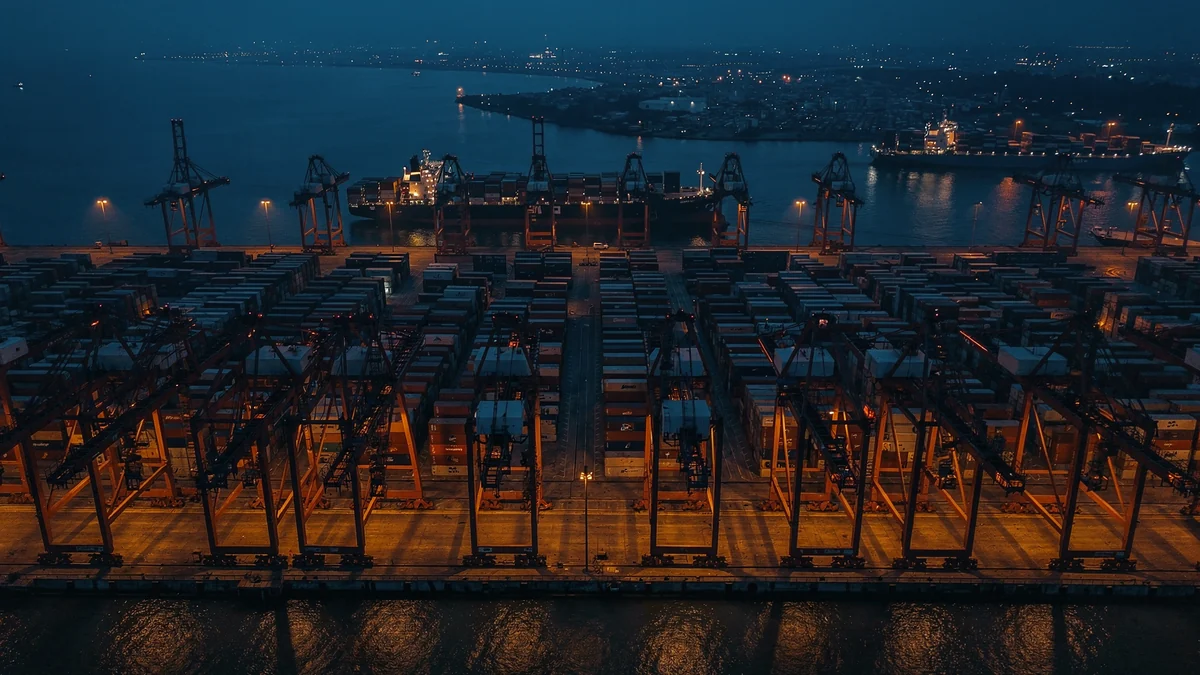
Sea freight in Malaysia moves a container through eight stages: booking, cargo pickup, export customs clearance, port gate-in, vessel loading, ocean transit, import customs clearance at Port Klang, and inland haulage to the door. Around 90% of Malaysia's trade travels by ship, and most of it passes through Port Klang, which handled a record 15.14 million TEUs in 2025.
Almost every guide to sea freight lists the same seven bullet points — book, pack, clear, load, sail, clear again, deliver. What none of them tell a Malaysian importer is which of those steps carries a hard deadline, which one JKDM will hold the box over, and which one quietly generates the invoice line that eats the margin. This is the operator's version: the eight stages and who owns each, the cut-offs that decide whether a container sails, what it costs in 2026, and exactly how many free days you have before storage charges start compounding.
Key takeaways
- Around 90% of Malaysia's trade moves by ship, and more than 80% of global trade by volume does the same (IMO MEPSEAS; IMO).
- Port Klang handled a record 15.14 million TEUs in 2025, up 3.4% on 2024 — but 8.41 million of those were transhipment boxes that never entered Malaysia.
- Three cut-offs govern every booking: shipping instruction, VGM, and container yard gate-in. Miss one and the container rolls to the next vessel.
- The VGM is a legal duty on the shipper, not a carrier preference — SOLAS regulation VI/2 has required it worldwide since 1 July 2016.
- An import container gets 7 free storage days at Northport, after which charges accrue daily and step up sharply past day 21.
- Port Klang terminal handling charges are mid-way through a phased 30% revision, the first since the 2015–2018 cycle. Any budget built on pre-2025 rates is already wrong.
How does sea freight actually work in Malaysia?
A Malaysian sea freight shipment runs through eight stages, each with a different owner. The shipper books space and packs the cargo, a licensed forwarding agent files the customs declaration, the haulier moves the box to and from the terminal, the carrier operates the vessel, and the terminal controls gate and yard. Knowing who owns each stage is what lets you chase the right party when something stalls.
The scale is not marginal. Malaysia's total trade reached RM3.061 trillion in 2025, up 6.3% year on year, according to the Ministry of Investment, Trade and Industry (MITI via The Star) — and around 90% of it moved on a ship. The table below maps an import container arriving at Port Klang; an export shipment runs the same sequence in reverse, with the declaration filed on a K2 rather than a K1.
| Stage | Who owns it | What it produces |
|---|---|---|
| 1. Booking | Shipper / forwarder | Booking confirmation, container release |
| 2. Cargo pickup and stuffing | Shipper / haulier | Packing list, container seal number |
| 3. Export customs clearance | Licensed forwarding agent | Cleared export declaration |
| 4. Gate-in and loading | Haulier / terminal | VGM lodged, container on the stowage plan |
| 5. Ocean transit | Carrier | Bill of lading issued, vessel sails |
| 6. Arrival and discharge | Carrier / terminal | Container discharged to yard, free time starts |
| 7. Import customs clearance | Licensed forwarding agent | Cleared K1, duty and SST paid |
| 8. Delivery and container return | Haulier | Cargo delivered, empty returned |
The most common misreading of this sequence is treating stage 7 as something that begins when the vessel berths. It does not. A competent agent pre-lodges the declaration against the arrival notice before the vessel docks, so customs release and terminal release land close together. That timing difference is routinely worth several free days — and free days, as the cost section below shows, are money.
Should you book FCL or LCL?
Book FCL when your cargo fills enough of a container to beat the per-cubic-metre rate, and LCL when it does not. The practical crossover for Malaysian importers sits around 12–15 CBM: above it, a full 20-foot container almost always costs less in total than the same volume shipped loose. Below roughly 10 CBM, LCL usually wins on landed cost.
The comparison is not purely arithmetic. LCL cargo is consolidated and deconsolidated at container freight stations, which adds handling touches, days, and risk of damage or misdelivery, while FCL cargo is sealed once at origin and opened once at destination. For fragile, high-value or time-critical goods the FCL threshold is effectively lower than the maths suggests — our breakdown of FCL vs LCL shipping to Malaysia works the comparison lane by lane.
Container size also carries a cost tail that quotations rarely show. At Northport, storage on a 40-foot import container accrues at roughly RM28 per day once free time lapses, against roughly RM18.75 per day for a 20-foot box (Northport Tariff 2026). Booking the larger box to be safe is not free if the shipment then sits.
Special cargo overrides the rule entirely: temperature-controlled goods need reefer containers, and anything outside standard box dimensions moves as project or out-of-gauge cargo. Where speed matters more than freight cost, re-examine the mode itself — see air freight vs sea freight and when to switch modes.
Which documents does every Malaysian sea freight shipment need?
Every sea freight shipment into Malaysia needs, at minimum, a commercial invoice, a packing list, a bill of lading, and a customs declaration filed through the national system. Preferential duty claims, controlled goods and certain commodities add further documents. Missing or inconsistent paperwork is the most common cause of a container sitting in the yard while the storage meter runs.
The declaration is not a formality either — it is a statutory duty. Section 78(1) of the Customs Act 1967 requires every importer of dutiable goods to declare them "personally or by his agent, in the form and manner as determined by the Director General" (Laws of Malaysia, Act 235). That single clause is why appointing a competent agent is a compliance decision rather than an administrative one.
| Document | Issued by | What it does |
|---|---|---|
| Commercial invoice | Supplier | Establishes transaction value for duty and SST |
| Packing list | Supplier | Describes contents, weights and marks for inspection |
| Bill of lading | Carrier or forwarder | Title document and contract of carriage |
Customs declaration (K1 import / K2 export) | Licensed forwarding agent | Declares goods to JKDM and assesses duty |
| Certificate of origin | Chamber or authorised body | Unlocks preferential FTA duty rates |
| Insurance certificate | Insurer | Covers loss or damage in transit |
The bill of lading deserves particular attention because it is the one document that is also title to the goods. A house bill issued by a forwarder and a master bill issued by the carrier serve different parties and behave differently when something goes wrong — see HBL vs MBL in Malaysia. How that title is released matters just as much: the choice between telex release, original bill of lading and seaway bill routinely decides whether cargo can be collected on the day it becomes available.
Duty savings usually hinge on two documents. The certificate of origin converts an FTA entitlement into an actual lower rate, and the HS code on the declaration determines that rate in the first place — importers sourcing regionally should check eligibility under RCEP, CPTPP or another FTA first. Carrier liability under a bill of lading is capped by convention and is not equivalent to cover for the value of the goods, which is why marine cargo insurance belongs in the booking decision rather than the claims conversation.
What are the cut-offs that decide whether your container sails?
Three deadlines govern every sea freight booking: the shipping instruction cut-off, the VGM cut-off, and the container yard gate-in cut-off. All three fall before the vessel's estimated departure, typically by one to three days depending on carrier and terminal. Missing any one rolls the container to the next available sailing, which on a weekly service means a seven-day delay.
The VGM is the deadline most often underestimated, because shippers treat it as carrier paperwork rather than a legal duty. It is not paperwork. Under SOLAS regulation VI/2, amended by IMO Resolution MSC.380(94) and in force worldwide since 1 July 2016, the shipper is responsible for obtaining the verified gross mass of a packed container, stating it in the shipping document, and submitting it to the master and the terminal representative sufficiently in advance (IMO).
The IMO permits exactly two verification methods: weighing the packed container directly, or weighing the individual packages, pallets, dunnage and securing material and adding the container's tare mass by a method approved by the competent authority. Estimating the weight is not one of the two options. Our guide to VGM at Port Klang covers how Malaysian exporters declare and submit it in practice.
The other two cut-offs are commercial rather than statutory, but they bind just as hard. The shipping instruction cut-off is when the carrier stops accepting bill of lading details; miss it and the container may sail against an uncorrectable document. The gate-in cut-off is when the terminal stops accepting laden boxes for that vessel; miss it and the container is physically not on the ship, whatever the paperwork says.
How does customs clearance fit into the sea freight timeline?
Customs clearance runs in parallel with the physical shipment, not after it. The declaration is filed electronically through SMK, the Royal Malaysian Customs Department's declaration system accessed via the National Single Window, and supporting invoices, packing lists and permits are uploaded through MyCIEDS. A licensed forwarding agent normally files on the importer's behalf, although the legal obligation rests with the consignee named on the bill of lading.
Sea freight carries its own statutory clock. Under section 81(1) of the Customs Act 1967, an importer of non-dutiable goods arriving by sea must declare them before taking delivery and "in any case not later than ten days after the arrival of the vessel" (Laws of Malaysia, Act 235). Section 81(2) additionally bars the carrier or its agent from releasing inward cargo until customs has authorised it — so a container is not collectable on the strength of a paid invoice alone.
The form depends on the movement: a standard import uses the K1 and a standard export the K2, while dutiable goods under customs control and warehouse transactions use other forms in the same family. Our reference on the K1, K2, K8 and K9 customs forms explains which applies where, and the step-by-step clearance guide walks the sequence from arrival notice to release order.
Two things reliably lengthen a clearance. The first is a classification dispute: where the declared HS code does not match what the officer sees, the shipment is held pending re-classification and the duty difference can be substantial. The second is document mismatch — an invoice value that disagrees with the declaration, or a packing list that disagrees with the physical count. Malaysia's shift to MyCIEDS digital document submission has made this stricter rather than looser, because inconsistencies are visible to the officer before the container is opened.
Duty and sales tax are assessed on the CIF value, so the freight and insurance you pay sit inside the taxable base — read our 2026 guide to SST on imports alongside the import duty and SST calculator rather than assuming the supplier's invoice value is what gets taxed.
What does sea freight to Port Klang cost in 2026?
Ocean freight is only one line on a sea freight invoice, and rarely the largest. A landed container also carries terminal handling, documentation, customs agency, haulage, duty and SST, plus any storage or detention incurred after free time expires. Importers who budget only for the freight rate quoted by a supplier routinely understate total landed cost by a wide margin.
Ocean rates themselves are volatile. Drewry's World Container Index stood at US$4,374 per 40-foot container on 23 July 2026, a 4% fall week on week (Drewry). A rate quoted three weeks ago is a historical fact, not a current price — which is why any spot quotation should carry a validity date.
Port costs, by contrast, move in one direction. The Ministry of Transport approved a phased revision of Port Klang tariffs in June 2025 — the first since the 2015–2018 cycle — taking terminal handling charges from RM300 to RM345, then RM375 on 1 January 2026 and RM390 on 1 January 2027, a cumulative 30% increase (The Edge Malaysia). A cost model built on pre-2025 THC assumptions understates the port line by roughly a third.
| Cost line | Charged by | Driven by |
|---|---|---|
| Ocean freight | Carrier | Lane, container size, market rate |
| Terminal handling charge | Terminal | Published tariff, container size |
| Documentation and B/L fees | Carrier / forwarder | Per bill of lading |
| Customs agency fee | Forwarding agent | Per declaration, complexity |
| Import duty and SST | JKDM | HS code and CIF value |
| Haulage | Haulier | Distance, container size, waiting time |
| Storage / demurrage / detention | Terminal and carrier | Days beyond free time |
For a line-by-line walkthrough with worked figures see the true cost of importing a container to Port Klang; lane-specific numbers for the busiest corridor are in importing from China to Port Klang, and inland movement in Port Klang haulage rates and routes.
One structural point deserves stating plainly: the Incoterm on the purchase order decides which of these lines you pay and which the supplier absorbs. An importer buying FOB pays everything from the origin port onward; an importer buying CIF has freight and insurance bundled into the goods price but still pays every Malaysian-side charge. Our guide to Incoterms for Malaysian importers maps the split term by term.
How many free days do you get before storage charges start?
An import FCL or LCL container at Northport gets seven free storage days, after which charges accrue for every further day or part of a day. Dangerous-goods containers and empty containers get only three. The clock runs on the terminal's schedule rather than on your customs release, which is why a clearance delay and a storage bill are usually the same event seen from two angles.
The rates are published and they escalate. Northport's 2026 tariff shows cumulative storage payable on a standard import container as follows (Northport Tariff 2026, updated 1 March 2026):
| Day of storage | 20-foot | 40-foot |
|---|---|---|
| Days 1–7 | Free | Free |
| Day 8 | RM 18.80 | RM 27.50 |
| Day 10 | RM 56.30 | RM 83.80 |
| Day 14 | RM 131.30 | RM 196.30 |
| Day 21 | RM 262.50 | RM 393.80 |
| Each day after day 21 | RM 48.30 / day | RM 72.40 / day |
Two features of that table matter operationally. Charges are levied per day or part thereof, so a container collected three hours into a new day pays for the whole day. And the daily increment more than doubles past day 21, from roughly RM18.75 to RM48.30 on a 20-foot box — the tariff is deliberately designed to clear the yard, not to earn rent.
Storage is only half the exposure. Demurrage is charged by the terminal for occupying the yard beyond free time, while detention is charged by the carrier for holding the container itself beyond the allowed period; the two accrue independently and are rarely negotiable after the fact. Our guide to avoiding demurrage and detention at Port Klang sets out the seven controls that actually work.
Ocean transit, by comparison, is the predictable part of the journey. Intra-Asia sailings into Port Klang run days rather than weeks while long-haul services run several weeks, and vessel rerouting around geopolitical disruption has repeatedly stretched effective transit on lanes serving Malaysia — examined in our analysis of the Strait of Hormuz crisis. Plan buffer into inventory, not into the freight quotation.
Why does Port Klang's transhipment mix matter to your container?
Port Klang is not primarily a gateway port for Malaysian cargo — it is a regional transhipment hub that also handles Malaysian cargo. Of the record 15.14 million TEUs handled in 2025, 8.41 million were transhipment boxes, up 6.2% year on year. That is roughly 55% of total volume moving through the terminals without ever entering the Malaysian economy.
This matters to an importer in two practical ways. Berth and yard capacity is shared with transhipment volume, so congestion on the transhipment side can slow gateway boxes that have nothing to do with it. And carrier service patterns are built around transhipment economics, which is why some direct-sounding services relay a container at a hub before it reaches Port Klang.
“With this achievement, Port Klang has again made history by recording the highest container handling since operations began in 1973.” — Anthony Loke Siew Fook, Transport Minister, on Port Klang's 2025 volume (Malay Mail, 16 March 2026)
The two terminals are not interchangeable for planning purposes. Westports handled 11.33 million TEUs in 2025, up 3.2% from 10.98 million, while Northport handled 3.8 million, up 3.8% from 3.67 million; Port of Tanjung Pelepas handled 14.03 million, a 14% jump and the first time a single Malaysian terminal has passed 14 million (The Star, 2 January 2026). Which terminal a container lands at changes haulage distance, gate procedure, turnaround and, as the tariff above shows, the storage schedule that applies. Our Westport and Northport guide covers the operational differences and transhipment through Port Klang explains the hub model.
How do you choose a sea freight forwarder in Malaysia?
Choose a forwarder on customs capability first and freight rate second, because the rate is the part of the invoice you can compare and the clearance is the part that determines whether the container moves at all. The right questions concern JKDM licensing, declaration accuracy, pre-arrival filing practice and what happens operationally when a shipment is held — not the headline quotation.
A forwarder and a customs broker are not the same function, though many firms hold both capabilities — the distinction is set out in customs broker vs freight forwarder in Malaysia, and the scope of the role in what a freight forwarder actually does. For smaller consignments the prior question is whether you need a forwarder at all — courier vs freight forwarder for Malaysian SMEs sets out where the economics flip. Before appointing anyone, run the Port Klang forwarding agent checklist.
DNE Forwarding has operated from Port Klang since 1999. We clear and move over 1,000 containers a month, hold JKDM forwarding and KA haulage licences, are ISO 9001 certified, and maintain a documentation compliance rate above 99% across those declarations — the figure that matters most here, because a rejected declaration is what turns a two-day clearance into a two-week storage bill. Sea freight, customs clearance and container haulage sit under one roof, which is what closes the handoff gaps this guide keeps returning to.
Frequently asked questions
How does sea freight work in Malaysia?
A Malaysian sea freight shipment runs through eight stages: booking, cargo pickup and stuffing, export customs clearance, gate-in and vessel loading, ocean transit, arrival and discharge, import customs clearance, and delivery with empty container return. The shipper, forwarding agent, haulier, carrier and terminal each own different stages.
How many free storage days does a container get at Port Klang?
At Northport, an import FCL or LCL container gets seven free storage days under the 2026 tariff. Dangerous-goods containers and empty containers get three. After that, storage is charged for every further day or part of a day, and the daily rate steps up sharply after day 21.
What documents do I need for sea freight into Malaysia?
At minimum: a commercial invoice, a packing list, a bill of lading, and a customs declaration (K1 for imports, K2 for exports) filed through SMK via the National Single Window. A certificate of origin is needed to claim preferential FTA duty rates, and an insurance certificate covers loss or damage in transit.
What is VGM and who is responsible for it?
VGM is the verified gross mass of a packed container. Under SOLAS regulation VI/2, in force worldwide since 1 July 2016, the shipper is legally responsible for obtaining it, stating it in the shipping document and submitting it to the master and terminal in advance. Without a valid VGM the container is not loaded.
How long do I have to declare a sea shipment to Malaysian customs?
Under section 81(1) of the Customs Act 1967, an importer of non-dutiable goods arriving by sea must declare them before taking delivery and in any case not later than ten days after the vessel arrives. The carrier may not release inward cargo until customs has authorised it.
Should I ship FCL or LCL to Malaysia?
Book FCL once your cargo exceeds roughly 12 to 15 CBM, where a full container usually beats the per-cubic-metre LCL rate on total landed cost. Below about 10 CBM, LCL normally wins. For fragile, high-value or time-critical goods the FCL threshold is effectively lower because LCL adds handling touches and days.
Sources
- Malay Mail — Port Klang hits record 15.14 million TEUs in 2025 (16 March 2026)
- The Star — Port Klang, PTP set new container handling records in 2025 (2 January 2026)
- The Star / MITI — Malaysia's total trade in 2025 tops RM3 trillion (20 January 2026)
- Northport (Malaysia) Bhd — Tariff 2026 (updated 1 March 2026)
- The Edge Malaysia — Port Klang tariff revision approved by the Ministry of Transport (16 June 2025)
- Drewry — World Container Index (assessment of 23 July 2026)
- Laws of Malaysia, Act 235 — Customs Act 1967 (sections 78 and 81, declaration of imported goods)
- IMO — Verification of the gross mass of a packed container (SOLAS VI/2)
- IMO — Introduction to IMO (share of global trade carried by sea)
- IMO MEPSEAS — Malaysia country profile (share of Malaysian trade carried by ship)
In this guide
- Port Klang vs Tanjung Pelepas vs Singapore (2026)
- HBL vs MBL: House & Master Bill of Lading in Malaysia
- Certificate of Origin Malaysia: Exporter's Guide (2026)
- Project Cargo & Out-of-Gauge Shipping in Malaysia: Flat-Rack, Breakbulk, Permits & Port Klang
- Reefer Container Shipping in Malaysia: Cold-Chain Guide (2026)
- VGM at Port Klang: How Malaysian Exporters Declare Container Weight (2026)
- Importing from Vietnam to Malaysia: Cost, Time & Duty (2026)
- Telex Release vs Original Bill of Lading vs Seaway Bill (Malaysia)
- Sea Up 22%, Air Down 44%: When Malaysian Importers Should Actually Switch Modes (Updated August 2026)
- How a Metal Box Quietly Built the Modern World: The Story Behind the Shipping Container
- Air Freight vs Sea Freight for Malaysian Importers: Cost, Speed & When to Use Each
- FCL vs LCL Shipping to Malaysia: Which Saves You More? (With Real Cost Comparisons)
- Importing from China to Port Klang: Costs, Timelines & Common Mistakes
- Incoterms for Malaysian Importers: FOB, CIF, or DDP — Which Should You Choose?