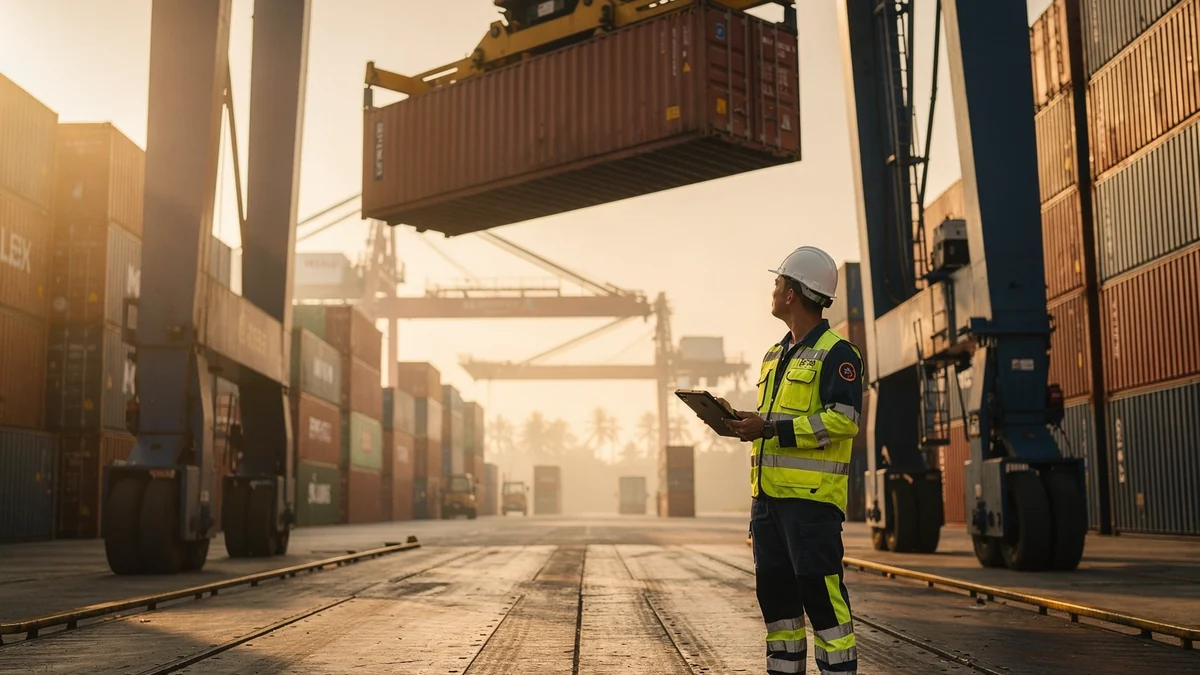
To declare VGM (Verified Gross Mass) for an export container at Port Klang, the shipper registers with the Marine Department of Malaysia, weighs the packed container by one of two approved methods, and submits the weight to the terminal and shipping line at least 10 hours before the vessel's ETA. No VGM, no loading.
Since 1 July 2016 a single rule has governed every loaded export container leaving a Malaysian port: it cannot go on the ship until its weight has been verified and declared. The rule comes from the International Maritime Organization's SOLAS convention, and at Port Klang it is enforced through a chain of registration, weighing and a strict submission cut-off. Get it right and it is a five-minute formality. Miss it and your container sits on the dock while the vessel sails without it.
This guide walks a Malaysian exporter through the whole VGM process at Port Klang, with the actual deadlines, tolerances and consequences, so the box makes the sailing it was booked on.
Last updated: 12 June 2026.
Key takeaways
- It is the law, not a carrier preference. SOLAS Chapter VI, regulations 2.4 to 2.6 has prohibited loading a packed container without a Verified Gross Mass worldwide since 1 July 2016 (IMO).
- Register first. Every shipper sending containers from a Malaysian port must register with the Marine Department of Malaysia (Jabatan Laut Malaysia) and declare which weighing method they will use.
- Two legal methods. Method 1 weighs the whole packed container; Method 2 adds up cargo, packing and the container's tare weight. Estimation is not allowed.
- 10 hours before ETA. Port Klang's VGM submission cut-off is 10 hours before the vessel's estimated arrival, aligned with the container-yard cut-off.
- Plus or minus 5% tolerance. Port Klang accepts a 5% variance between your declared VGM and its own weighing before the discrepancy becomes a problem.
- The shipper on the bill of lading is always responsible, even when a forwarder files the VGM for you.
What is VGM and why does Port Klang require it?
VGM (Verified Gross Mass) is the total verified weight of a packed container, including its cargo, all packing materials and the empty container's tare weight. Under the SOLAS convention, a terminal may not load a packed container onto a vessel unless the shipper has declared its VGM in advance.
The rule was a response to ships being loaded on guessed or under-declared weights, which caused container stack collapses, lost boxes and serious vessel-stability incidents. The International Maritime Organization amended SOLAS Chapter VI, regulations 2.4 to 2.6, and the requirement took effect on 1 July 2016 (IMO). It applies to every signatory country, Malaysia included.
The principle is simple and absolute. As logistics platform GoFreight puts it in its SOLAS explainer:
"If the carrier and terminal do not receive a valid VGM, the container does not get loaded."
That single sentence is why VGM is not optional paperwork. Port Klang is the country's busiest container gateway and one of Southeast Asia's largest container ports, and its terminals enforce VGM on every export booking, full-container-load and consolidated alike.
Do I need to register with the Marine Department of Malaysia?
Yes. Before submitting any VGM, a shipper must register with the Marine Department of Malaysia (Jabatan Laut Malaysia) and nominate the weighing method they will use. This is a one-time registration; once approved, the shipper, or a forwarder acting for them, can file VGM declarations for every subsequent shipment.
This is the step most first-time exporters miss, because the global SOLAS guides do not mention it. Malaysia added a national registration layer: the Marine Department maintains an online shipper registration system, and only a registered shipper (or its appointed agent) may declare VGM for cargo loading at Malaysian ports (Marine Department of Malaysia, Shipper Registration System).
If you weigh containers yourself under Method 1 or Method 2, the weighing instrument must also be legally fit for trade use. In Malaysia, weighing and measuring instruments used for trade must be verified by Metrology Corporation Malaysia (MCM), which the company describes as having "the sole objective of providing the verification and re-verification services for all weighing and all measuring instruments use for trade in Malaysia" under the Weights and Measures Act 1972 (Metrology Corporation Malaysia). In practice, this is why most exporters use a certified public weighbridge rather than maintaining their own.
What are the two methods for determining VGM?
SOLAS allows two methods. Method 1 weighs the entire packed and sealed container on a calibrated weighbridge. Method 2 weighs every item, pallet, package and piece of dunnage, then adds the container's tare weight, which is stencilled on its door. Both must use verified equipment; estimating the weight is never permitted.
| Aspect | Method 1 — weigh the packed box | Method 2 — weigh and add up |
|---|---|---|
| How it works | Drive the fully packed, sealed container over a calibrated weighbridge | Weigh all cargo, pallets, dunnage and packing, then add the container tare |
| Best for | Most FCL shippers; fastest at a port weighbridge | Cargo weighed during production, or where a weighbridge is far |
| Equipment | One certified weighbridge weighing | Certified scales for every component |
| Tare weight | Included automatically | Read the actual stencilled tare off the container door, e.g. about 3,750 kg for a 40ft |
| Main risk | Queue time at the weighbridge near cut-off | Forgetting dunnage or under-counting items |
The definitions are consistent across carriers. Method 1 is to "weigh the entire container after it is fully packed and sealed, using a calibrated weighbridge or scale," while Method 2 is to "weigh every item, pallet, package, dunnage, and securing material, then add the container tare weight" (GoFreight). For most Port Klang exporters, Method 1 over a public weighbridge near the port is the simplest, and is what DNE arranges by default.
How and when do I submit VGM at Port Klang?
At Port Klang, the VGM must reach the loading terminal and the shipping line at least 10 hours before the vessel's ETA, aligned with the container-yard cut-off. It is submitted through the terminal's portal and to the carrier electronically (for example via INTTRA or the line's own system) or by email, with the booking number, container number, weight, method and an authorised signatory.
The mandatory fields on a Port Klang VGM declaration are the booking or bill-of-lading number, the container number, the Verified Gross Mass itself, the weighing method, the weighing party, the responsible party and the authorised person's signature (MSC Malaysia, SOLAS VGM information). The submission goes to two places at once: the port-of-loading terminal portal, and the carrier via its nominated channel such as INTTRA, the line's e-platform, or manual email.
The deadline is the part exporters underestimate. Port Klang's VGM cut-off is 10 hours before the vessel's ETA, the same window as the container-yard cut-off (MSC Malaysia, SOLAS VGM information). Because that clock runs against the vessel schedule rather than your packing schedule, the safe practice is to weigh and submit the moment the container is sealed, not to wait. A late VGM behaves exactly like a late container, and the box is rolled.
What is the weight tolerance at Port Klang?
Port Klang accepts a variance of plus or minus 5% between your declared VGM and the terminal's own weighing. If the difference exceeds 5% but the weight is still within the container's CSC safety-plate limit, the terminal will usually still load it, though a large gap can trigger re-weighing and delay.
This tolerance matters because the terminal weighs many boxes again on the way through, and a declaration that does not match invites a query right at the cut-off. The widely applied Port Klang and Penang rule is a plus-or-minus 5% variance; beyond that, the container is checked against its CSC weight (the maximum gross weight stamped on the safety-approval plate) before a load decision (MSC Malaysia, SOLAS VGM information). Declaring an honest, weighbridge-backed figure is the cleanest way to stay inside the band.
What does a missed or wrong VGM actually cost?
A container with no valid VGM by the cut-off is rolled to a later vessel. The shipper then absorbs rebooking and amendment fees, port storage and demurrage while the box waits, any re-weighing charge, and the commercial cost of late delivery to the buyer. There is no override; the rule is no VGM, no load.
Freight forwarder Kuehne+Nagel states the consequence plainly: "Failure to provide the VGM can result in your containers not being loaded onto vessels, leading to costly delays and potential penalties" (Kuehne+Nagel). When a box is rolled at Port Klang, the costs stack quickly: rebooking and amendment fees, daily port storage and demurrage while it waits for the next sailing, possible re-weighing, and per-diem on the empty container if the booking is cancelled. For perishable or time-sensitive cargo, the lost sailing is often the most expensive part.
Those storage and demurrage charges compound in exactly the way we cover in our guide to avoiding demurrage and detention at Port Klang, which is why VGM discipline is really cost discipline.
Who is responsible, and how does a forwarder help?
The shipper named on the bill of lading is always legally responsible for the VGM, even when someone else weighs the box or files the declaration. A freight forwarder can register with the Marine Department, arrange a certified weighbridge, file the VGM before the cut-off and resolve any variance query, removing the operational risk while the shipper keeps the legal accountability.
The accountability rule is unambiguous. As the SOLAS guidance frames it, "the shipper named on the carrier's bill of lading is legally responsible for the VGM," and delegating the work to a forwarder or weighing party does not move that responsibility (GoFreight). What a forwarder removes is the execution risk: the registration, the weighbridge slot, the on-time submission and the variance handling.
This is everyday work for a Port Klang forwarder. DNE Forwarding has cleared and shipped through Westport and Northport since 1999 and handles 1,000+ containers a month, so VGM submission is built into our standard export process rather than a separate scramble. We register the shipper, route the box over a certified weighbridge, file the VGM to both the terminal and the line ahead of the 10-hour cut-off, and flag any tolerance issue before it reaches the gate. It folds neatly into the wider Malaysian export documentation process we manage end to end.
Frequently asked questions
Do I need to register with the Marine Department of Malaysia to declare VGM?
Yes. Every shipper sending packed export containers from a Malaysian port must register with the Marine Department of Malaysia (Jabatan Laut Malaysia) and declare which weighing method they will use before submitting a VGM. Your forwarder can register and file on your behalf, but legal responsibility stays with the shipper named on the bill of lading.
What is the VGM cut-off time at Port Klang?
At Port Klang the VGM submission cut-off is 10 hours before the vessel's ETA, aligned with the container-yard (CY) cut-off. Miss it and your container is rolled to a later sailing, so most forwarders submit VGM the moment the box is weighed rather than waiting for the deadline.
How much weight variance does Port Klang allow on a VGM?
Port Klang accepts a variance of plus or minus 5% between your declared VGM and the terminal's own weighing. If the difference is greater than 5% but still within the container's CSC safety plate limit, the terminal will normally still load it. A large discrepancy can trigger re-weighing charges and delay.
What happens if I do not submit a VGM?
Under the SOLAS rule, a packed container with no valid VGM cannot be loaded onto the vessel. It is rolled to a later sailing, and the shipper absorbs rebooking fees, port storage and demurrage while the box waits, plus any re-weighing or amendment charge. The cargo also reaches the buyer late.
Can my freight forwarder declare VGM for me?
Yes. A freight forwarder, container freight station or third-party logistics provider can weigh the container and file the VGM on the shipper's behalf, and most Port Klang exporters do exactly this. Delegating the task does not transfer the legal responsibility, which always remains with the shipper on the bill of lading.
Sources
- International Maritime Organization — Verification of gross mass of packed containers (SOLAS Ch. VI, reg. 2.4–2.6, effective 1 July 2016)
- MSC Malaysia — SOLAS VGM information (Port Klang cut-off, tolerance and mandatory declaration fields)
- Marine Department of Malaysia (Jabatan Laut Malaysia) — Shipper Registration System for VGM
- GoFreight — VGM (Verified Gross Mass): SOLAS Container Weight Rules Explained
- Kuehne+Nagel Malaysia — Guiding you through SOLAS and VGM regulations
- Metrology Corporation Malaysia — verification of weighing instruments for trade (Weights and Measures Act 1972)
Part of a guide: this article is part of DNE's complete guide to freight forwarding in Malaysia.
Part of a guide: this article is part of our complete guide to Sea Freight Malaysia 2026: Complete Port Klang Guide.