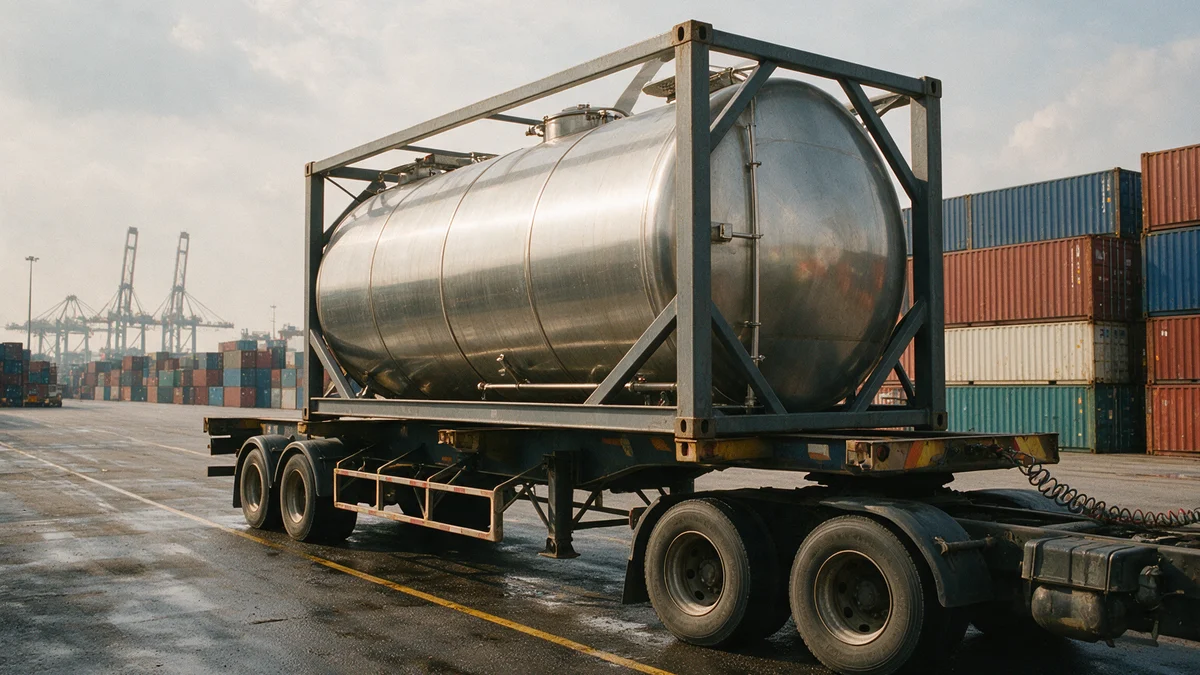
A liquid may travel in a flexitank only if it is not classified as dangerous goods: the flexitank is a bladder fitted inside an ordinary 20-foot container, single-trip in over 95% of cases. A flexitank is not approved packaging for dangerous goods, so a regulated liquid moving in bulk goes in an ISO tank container instead. The classification decides the equipment, and at Westports it also decides the free-storage clock.
Key takeaways
- A flexitank turns a standard 20-foot box into a non-hazardous bulk liquid unit of typically 10,000 to 24,000 litres; over 95% are single-trip (UK P&I Club).
- A bulk dangerous goods liquid needs an ISO tank container instead, re-tested on a 5-year and 2.5-year cycle; smaller quantities move in UN-approved drums or IBCs.
- The bigger cost swing at Westports is the classification, not the equipment: the tariff in force since 1 February 2026 gives a dangerous goods import box 72 free hours against 96 for an ordinary one.
Can your liquid legally travel in a flexitank?
A liquid may travel in a flexitank only if it is not dangerous goods. A flexitank is a bladder designed to fit inside a 20-foot general freight container, converting it into a non-hazardous bulk liquid transportation unit. A regulated liquid in bulk moves in an ISO tank container instead — the trade calls it a tank container.
“Flexitanks are not an approved form of packaging for the carriage by sea of dangerous goods classified under the International Maritime Dangerous Goods Code (IMDG Code)”
— UK P&I Club, Carefully to Carry (Consolidated Edition 2023), Chapter 34
The tank container exists for the cargo the flexitank cannot take: a standard ISO tank is built and certified to the IMDG Code among other standards, which is what lets it carry a regulated liquid at all. A shipper moving a bulk liquid into or out of Malaysia therefore settles the classification before comparing any rate. The liquids that routinely move in flexitanks are the unregulated ones: wine, fruit concentrate, animal fat, base oil, detergents, non-hazardous chemicals, lubricants, latex and potable water.
Not sure which side of that line your product sits on? Send us the product, the volume and the port pair and we will go through the classification on your safety data sheet with you, then price the clearance and the road leg.
Flexitank vs ISO tank container: how the two compare
A flexitank is product-dedicated and leaves no equipment to send back. An ISO tank container is reusable, carries dangerous goods and can hold more product, but has to be returned and cleaned. The flexitank saves the return leg and the positioning cost; the tank container is the only option for regulated bulk cargo, and often the better economics on a heavy or repeating lane.
| Factor | Flexitank in a 20-foot box | ISO tank container |
|---|---|---|
| Cargo allowed | Non-hazardous liquids only | Dangerous and non-dangerous liquids |
| Capacity | Typically 10,000–24,000 litres; practice caps the liquid at 24,000 kg | Depends on the unit: OEG rates its 20ft standard tank at 25,880 kg payload and its 24,000-litre model at 32,400 kg |
| Reuse | Single-trip for over 95% of the market; product-dedicated, so no cross-contamination risk, but it needs more preparation than a tank | Multi-trip, but needs substantial cleaning, particularly in food applications |
| Return leg | None, though the used bladder must be disposed of | The empty goes back; 100 empty flexitanks position for the cost of one tank container |
| Certification | A CSC plate and a valid PES or ACEP programme on the container | A 5-year periodic test plus a 2.5-year intermediate test on the tank |
What drives the cost on each?
Three drivers, not a rate card. Positioning: in some areas 100 empty flexitanks can be positioned for the cost of one tank container (UK P&I Club). Turnaround: the flexitank has no return load but its bladder must be disposed of; the tank container goes back and needs substantial cleaning. Payload: UK P&I puts a flexitank of up to 24,000 litres in a 20-foot box at about 40% more cargo than a drummed consignment and about 15% more payload than IBCs.
Where both are legal, the rule of thumb follows those drivers. A non-hazardous liquid moving one way, inside the weight line, goes in a flexitank. A regulated liquid, a payload above the flexitank practice cap, or a lane that runs often enough to re-use the equipment goes in a tank container.
What does a dangerous goods box cost you at Westports?
A dangerous goods box costs more at Westports in time before it costs more in money. Under the tariff in force since 1 February 2026, a dangerous goods import FCL container gets its first 72 hours of yard storage free, against 96 hours for an ordinary import container: 24 fewer hours to clear customs and collect it.
The rates behind the two clocks
Past its free period, under the same Westports container tariff, a 20-foot laden dangerous goods import container is charged RM31.30 for the 72-to-96-hour band, where an ordinary 20-foot laden box pays RM18.80 at 96 to 120 hours. Handling is dearer too: an ordinary 20-foot laden import or export move is RM375.00, a dangerous goods move RM425.00 for Group 3 rising to RM562.50 for Group 1. Those handling lines sit under the booklet's “Operator's / Ship Agent A/C” heading, so they reach you through the carrier's charges rather than a port invoice. These are Westports figures; Northport publishes its own tariff and free period.
One distinction is where most quotes go wrong: the classification moves a container onto the 72-hour schedule, not the equipment. Westports heads that schedule “Dangerous Goods”, so a tank container carrying a non-hazardous food-grade liquid sits on the ordinary 96-hour schedule like any other box. The classes and documents behind that line are in our guide to shipping dangerous goods through Port Klang.
What has to be right before a flexitank is loaded?
The container, not the bladder, is where flexitank shipments usually fail. A 20-foot container used for a flexitank should be rated to at least 30,480 kg, carry a valid CSC plate, and be clean and structurally sound inside. Current practice caps the liquid at 24,000 kg in a 20-foot box.
- Read the rating plate. Minimum 30,480 kg irrespective of the flexitank's size, because sidewall strength follows the permitted payload (UK P&I Club).
- Check the certification. The container must display a CSC plate and be part of a valid PES (periodic examination scheme) or ACEP (approved continual examination programme).
- Inspect inside. It must be structurally undamaged and free from sharp projections on the internal side and end wall panels and floor.
- Hold the weight line. Practice is not to load more than 24,000 kg of liquid in a 20-foot box, and some operators consider even that too high.
- Ask which list the supplier is on. The Container Owners Association published its flexitank Code of Practice in 2011 and compliance is not mandatory, so its Flexitank Quality Management List of certified manufacturers is the check worth making.
That checklist is the claims record, not pedantry. A large number of claims have arisen where pressure from the flexitank bulged a container's sidewall panels beyond accepted ISO dimensions and tolerances, causing permanent deformation; the ISO/IICL limit is 10 mm beyond the plane of the corner casting fittings. Rejecting a doubtful box is cheaper than arguing after discharge.
What does moving a tank container through Port Klang take?
Moving a tank container takes a chassis with four functioning twist locks on all four corners and a truck rated to tow the combined weight of chassis, tank and product. Where the cargo is dangerous goods, the driver should also be trained in international dangerous goods legislation such as the IMDG Code. Those are haulage requirements, not shipping-line ones.
On the paperwork side the roles are fixed: a licensed forwarding agent files the customs declaration for the consignee, and a licensed haulier moves the box between terminal and delivery point. DNE Forwarding does both at Port Klang — a JKDM-licensed forwarding agent and KA-licensed container haulier, ISO 9001 certified, moving 1,000+ containers a month since 1999. On a liquid shipment DNE clears the cargo and moves the box on its own licensed haulage, so the declaration and the collection run against the same clock; the tank itself belongs to the tank operator or the leasing company. See our guides to container haulage in Port Klang, customs clearance for chemicals importers and sea freight through Port Klang.
Frequently asked questions
Why must a flexitank be filled right up to its nominal capacity?
Because a part-filled bladder moves. If a flexitank is not filled to near its nominal capacity, a marked free surface effect and hydraulic surging of the liquid may occur, often damaging the container. Use a flow meter to confirm the fill is within 500 litres of nominal capacity; a visual check is unlikely to be enough.
How often does a tank container have to be re-tested?
The IMDG Code sets a 5-year periodic inspection and test plus a 2.5-year intermediate test, which may be performed within 3 months of the specified date. ITCO's TG07 adds that an intermediate test delayed beyond that window is replaced by a full 5-year periodic test — so an out-of-date tank is a scheduling problem, not a paperwork one.
Single-layer or multilayer flexitank — which does my cargo need?
The choice of flexitank is based on the cargo carried and factors such as the duration of the voyage and the temperature difference between the load and discharge ports. Cargoes needing a barrier against taint contamination use a four-layer multilayer flexitank. Give your supplier the product, the transit time and both port temperatures, and let them specify the construction.
Sources
- UK P&I Club, Carefully to Carry, Consolidated Edition 2023, Chapter 34 — Flexitanks.
- ITCO (International Tank Container Organisation), TG07 — 2.5 Year Intermediate Inspection and Test, March 2021.
- ITCO, TG11 — Acceptable Trucking Standards (For Tank Containers), August 2025.
- OEG, ISO tanks product datasheet.
- Westports Malaysia, Container Terminal Handling Tariff, with effect from 1 February 2026.
Dan Duar is Director of DNE Forwarding (M) Sdn Bhd, a JKDM-licensed forwarding agent and KA-licensed container haulier at Port Klang, founded in 1999.