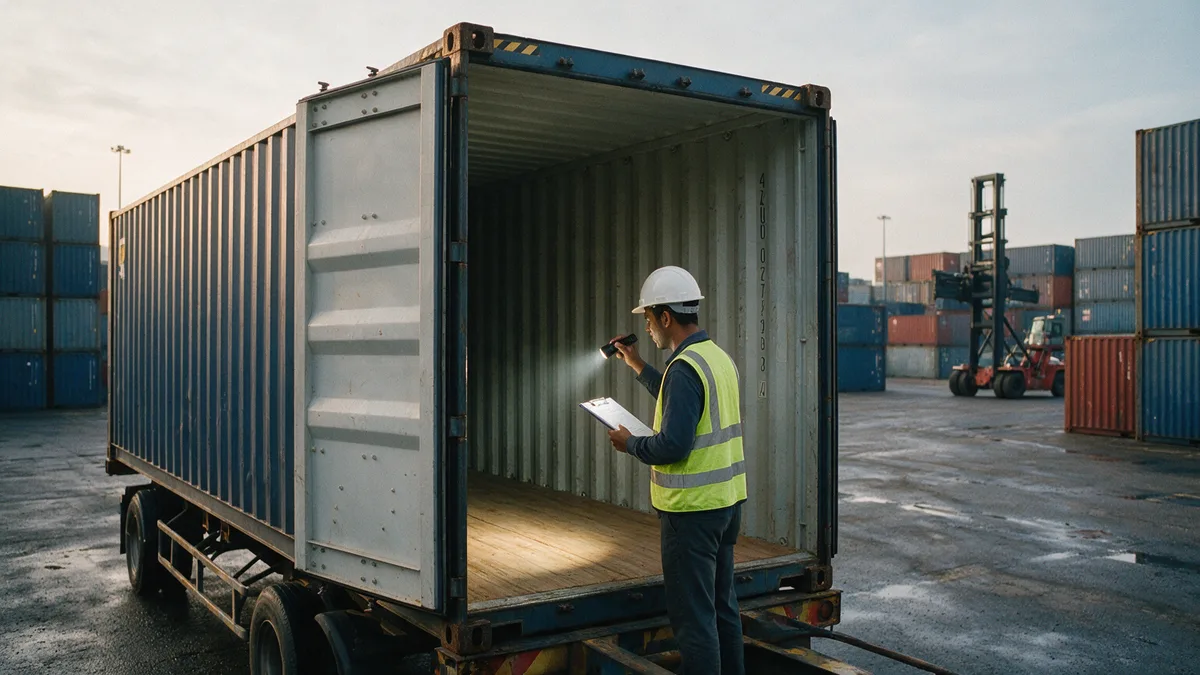
A container deposit comes back in full when the empty returns clean, undamaged and within free time. A Malaysian shipping line can ask an importer or its forwarding agent for one before it releases the delivery order, unless they subscribe to an approved alternative such as CLA or the SFFLA scheme. RCL, for example, lists MYR 500 for a 20ft and MYR 1,000 for a 40ft at Port Klang.
Key takeaways
- The 2020 settlement did not abolish deposits. The Port Klang Authority's circular of 21 February 2020 lets shipping lines collect a container deposit from forwarding agents who do not subscribe to NCD or CLA.
- One published rate: RCL's Malaysia import local charges list a container deposit of MYR 500 (20ft) and MYR 1,000 (40ft) at Port Klang, and normal washing at MYR 30 and MYR 60.
- Three ways round it: the SFFLA non-cheque deposit (NCD), the Container Ledger Account (CLA) and iCARGO+, adopted by the National Logistics Task Force in December 2019.
- The refund is decided at the depot. Washing, repairs and detention beyond free time are what eat into it, and the return EIR is the evidence.
What is a container deposit, and why do shipping lines ask for one?
A container deposit is money a shipping line holds against the empty box it lends you. The Port Klang Authority describes it as a payment assurance against empty containers not being returned promptly, or against damage caused while the containers were in the merchant's custody. The shippers' council noted in 2018 that lines ask for it by bank transfer before releasing the delivery order.
Shippers dispute that the deposit is needed at all:
“The Bill of Lading, an agreement between the shipping carrier and the shipper, already provides sufficient liability clauses that safeguard shipping lines against container damages and losses.” — Datuk Andy Seo, chairman, Malaysian National Shippers' Council, February 2020
In 2018 the Malaysian National Shippers' Council estimated that lines would hold more than RM2.1 billion of shippers' money in container deposits at Port Klang alone, based on 2,175,055 TEU of 2017 imports.
How much is a container deposit at Port Klang?
RCL is one shipping line that publishes its deposit. Its Malaysia import local charges list a container deposit of MYR 500 for a 20ft and MYR 1,000 for a 40ft at Port Klang and Tanjung Bruas, and MYR 400 and MYR 800 at Penang and Pasir Gudang.
| RCL import charge | Ports | 20ft | 40ft |
|---|---|---|---|
| Container deposit | Port Klang, Tanjung Bruas | MYR 500 | MYR 1,000 |
| Container deposit | Penang, Pasir Gudang | MYR 400 | MYR 800 |
| Normal washing | Penang, Pasir Gudang, Port Klang, Tanjung Bruas | MYR 30 | MYR 60 |
Source: RCL Malaysia Import Local Charges, updated 15 April 2024 and subject to change, so ask your line for its current figure. One cost guide puts deposits at MYR 500-1,000 per container. The deposit is a refundable hold, separate from the fees in our guides to freight forwarder charges and the true cost of importing a container.
Can you release a container without paying a deposit?
Yes, if you or your forwarding agent subscribe to one of the alternatives endorsed in 2020. The National Logistics Task Force, chaired by the Minister of Transport, agreed in December 2019 to adopt three schemes in place of container deposits, and the Port Klang Authority's SOPs took effect on 1 March 2020.
The Port Klang Authority circular of 21 February 2020 says shipping lines, agents, NVOCCs and box operators "shall subscribe to either Non-Cheque Deposit (NCD) Scheme managed by Selangor Freight Forwarders and Logistics Association (SFFLA) or Container Ledger Account (CLA) by D&D Control (M) Sdn Bhd". It also notes that lines may collect a container deposit from forwarding agents who are non-subscribers.
| Option | Managed by | What the record says |
|---|---|---|
| Non-cheque deposit (NCD) | SFFLA | About 38 carriers signed up; 272 of SFFLA's 648 members had accepted it, per Shipping Association Malaysia in 2020 |
| Container Ledger Account (CLA) | D&D Control (M) Sdn Bhd | A cash or credit security limit lets the delivery order be released without a deposit; 86 principals and 2,274 members by July 2024 |
| iCARGO+ | — | Named with NCD and CLA in the PKA circular's terms-of-reference clause; described in 2020 as marine cover extended to demurrage, detention and container damage recoveries |
The CLA figures come from D&D Control's circular of 9 July 2024. Some consignees need no scheme: a shipping line representative said in 2020 that lines grant exemptions to consignees with a good track record and good credit lines.
What can be taken out of your container deposit?
The deposit covers what the line can recover from you once the box is back: detention beyond your free time, washing a dirty container, and repairing damage your cargo operations caused. All three fall on you as the merchant; damage the haulier causes in transit, such as a road accident, is the haulier's.
- Detention. Days out past free time are chargeable, and a dirty container can be rejected at return, adding more (eContainers); our demurrage and detention guide for Port Klang explains how free time is counted.
- Washing. Depots charge a washing fee for dirty containers. On import, the consignee or its agent must clean out all traces of the cargo, especially loose powders, grains and fumigants, unless otherwise agreed with the line (Haulio).
- Damage. Repairs for damage from your cargo operations are recovered from you.
Washing and damage are often settled on the spot. Haulio says the driver usually pays these charges first, in cash, because the depot will not accept the container until payment is made; the haulier then bills the customer.
How do you get a container deposit refunded in full?
A full refund comes from evidence collected at two gates: when the container leaves full and when it comes back empty. The Equipment Interchange Receipt (EIR) is issued every time responsibility for the container changes hands and records its condition at that moment. Damage on the return EIR that is not on the delivery EIR is attributed to whoever had the container in between (eContainers).
- Read the pickup EIR. Check that existing damage is recorded; whatever it does not show will be attributed to you at return.
- Photograph the box inside and out, before and after unstuffing.
- Unstuff on time. If your premises cannot take a container, compare unstuffing at Port Klang with container delivery.
- Sweep and clean out every trace of cargo and loose material.
- Return to the line's designated depot, in the condition the box was released.
- Keep the return EIR, the record of the box's condition when responsibility passes back to the line.
If the depot alleges damage you dispute, both parties can hold a joint survey, with a surveyor for each side or one surveyor both accept. Haulio says such disputes last from 2 days to weeks. On a disputed refund, the two EIRs are the evidence.
DNE Forwarding moves 1,000+ containers a month through Port Klang with its own KA-licensed haulage (see container haulage at Port Klang).
What changed for CLA users in 2026?
Two CLA circulars this year change the deposit-free route. A circular of 5 February 2026 introduced an East Malaysia module that lets users submit Electronic Delivery Order (EDO) release requests through the CLA Portal, with CLA exempting the container deposit for a fee of RM10 per container. From 1 September 2026, an account with an overdue invoice enters a two-week cooling-off period.
The East Malaysia circular is addressed to Sabah and Sarawak; under the new account process, an account in cooling-off must use the e-Assure facility on the CLA Portal.
Frequently asked questions
Is a container deposit refundable in Malaysia?
Yes. A container deposit is a refundable security held by the shipping line against late return of the empty or damage caused while the box was in your custody. What comes back depends on the return: charges for washing, repairs your cargo operations caused and detention beyond free time can be recovered from it. A clean return EIR inside free time is what secures the full amount.
Did the government ban container deposits in 2020?
No. Transport Minister Anthony Loke said on 13 February 2020 that shipping lines would no longer be permitted to collect cheque deposits, and the ministry allowed three alternatives: NCD, CLA and iCARGO+. But the Port Klang Authority circular of 21 February 2020 notes that lines may still collect a container deposit from forwarding agents who do not subscribe to NCD or CLA.
Does marine cargo insurance cover container damage recoveries?
In 2020 Shipping Association Malaysia's chairman described iCARGO+ as marine insurance with cover extended to demurrage, detention and container damage recoveries, at no extra cost to the marine cover. Check the current wording with the provider; our marine cargo insurance guide explains ICC A, B and C.
Sources
- Port Klang Authority statement, via Focus Malaysia — PKA: SOPs on alternative schemes to be effective on March 1 (18 February 2020)
- FMFF statement quoting the PKA circular of 21 February 2020, via Focus Malaysia — Let authorities clarify on shipping issues
- Focus Malaysia — Shipping lines can no longer collect cheque deposits from shippers (13 February 2020) and Confusion over container deposits collection (14 February 2020)
- AMCHAM Malaysia — Alternatives for Collection of Container Deposits in Malaysia
- Malaysian National Shippers' Council — Container Deposit Collection Affecting Ease of Doing Business (17 December 2018)
- D&D Control (M) Sdn Bhd — CLA Limit circular (9 July 2024), East Malaysia deposit exemption (5 February 2026), CLA service management (6 August 2026) and CLA Portal FAQ
- RCL — Malaysia Import Local Charges (15 April 2024)
- Haulio — Container Washing/Cleaning and Damage Charges; eContainers — Container Return
- Yellowbees — Cost of Logistics in Malaysia for Importers