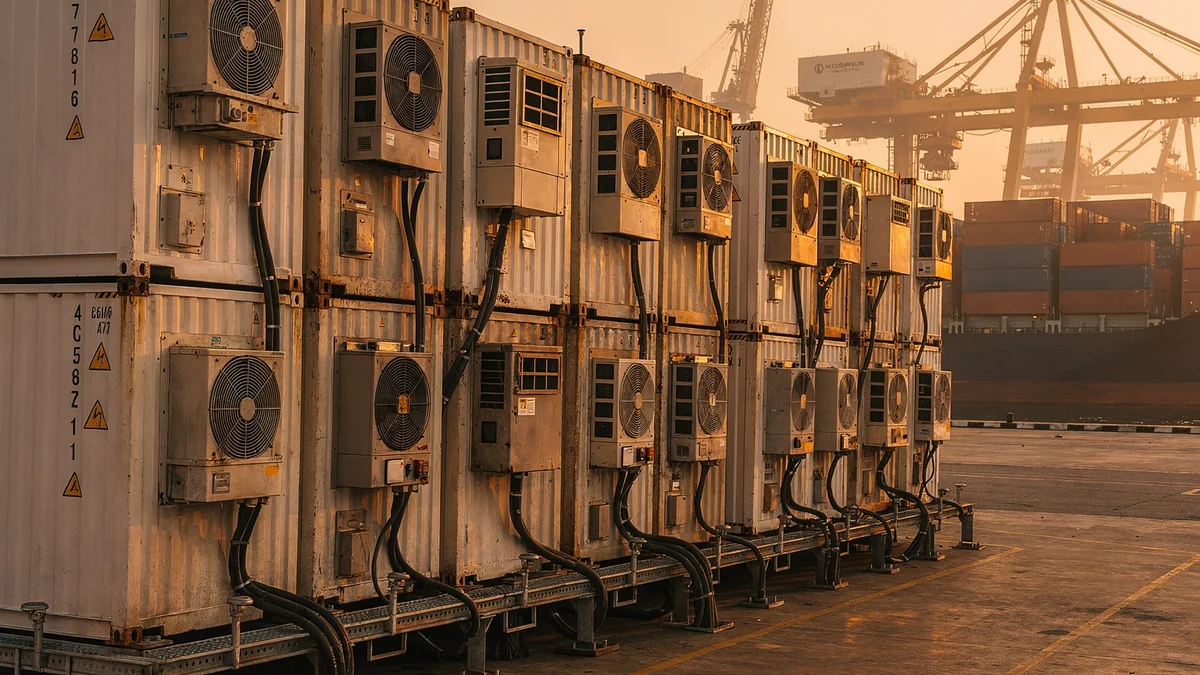
Reefer FCL ocean freight ships temperature-sensitive cargo to Port Klang in a refrigerated container that holds a set temperature (typically -25°C to +25°C, super-freezers lower), powered the whole way. Success depends on an unbroken cold chain: a passed pre-trip inspection, the correct setpoint, prompt plug-in at port, and fast customs plus cold-capable haulage on arrival.
For Malaysian importers of frozen food, fresh produce, pharmaceuticals and temperature-sensitive chemicals, the container is only half the job. The other half is keeping the cargo inside its temperature band at every handoff — ship to quay, quay to reefer stack, stack to truck, truck to your cold room. This guide explains how reefer FCL ocean freight works through Port Klang, the settings each commodity needs, the permits Malaysian Customs and MAQIS demand, and where cold chains actually break. It sits under our complete guide to freight forwarding in Malaysia, which covers the wider sea-freight picture; for the on-arrival road leg, see our companion guide to container haulage for food distributors.
Key takeaways
- Standard reefer containers hold a set temperature between -25°C and +25°C (Kuehne+Nagel); Westports also lists super-freezer probe handling at Port Klang for deep-frozen cargo such as tuna (Westports Holdings).
- Reefer-related issues now account for about 37% of all cargo claims, a figure the broker says has risen since COVID (Marlin Blue, citing reefer expert Diego Alonso).
- TT Club attributes nearly 30% of temperature-controlled cargo incidents to miscommunicated operating instructions and a further 23% to temperature-setting errors — so on those figures, the majority of cold-chain failures are human, not mechanical.
- Westports operates 4,132 reefer plug points with 24-hour technician monitoring and a Reefer Monitoring System launched in February 2023 for real-time temperature, humidity and CO₂ alerts (Westports Holdings).
- Reefer FCL costs more than dry — as an illustrative benchmark, the reefer-to-dry rate spread on the Far East–US West Coast trade was about USD 1,330 per 40ft box in March 2024 (Xeneta), and frozen food needs a MAQIS import permit for every consignment under the Food Act 1983 (USDA FAS).
How does reefer container shipping work in Malaysia?
A reefer FCL shipment loads pre-cooled cargo into a refrigerated container set to the required temperature, then keeps that container powered — on the vessel, at the terminal, and during haulage. At Port Klang the box is plugged into a reefer point and monitored until customs releases it and a cold-capable haulier delivers it to the importer's cold store.
A reefer (refrigerated container) is a steel box with an integrated refrigeration unit at one end. Unlike a dry container, it must draw power continuously from the vessel, a terminal reefer point, or a diesel genset during road transport. The unit circulates chilled air through T-bar floors and up the sides, holding the cargo within a tight band. Kuehne+Nagel notes that standard reefers are built to maintain temperatures between -25°C and +25°C for chilled and frozen cargo, while Westports offers super-freezer probe handling at Port Klang for deep-frozen cargo such as sashimi-grade tuna.
The journey runs in stages: the shipper pre-cools the cargo to its carriage temperature, loads the reefer, and the line records the setpoint on the bill of lading. The container is powered on the vessel, then transferred to a reefer stack on arrival. As a JKDM-licensed forwarder clearing 1,000+ containers a month through Port Klang, DNE Forwarding coordinates the plug-in, the K1 import declaration, and the cold haulage so the box is never sitting unpowered while paperwork catches up.
What temperature, humidity and ventilation settings does reefer cargo need?
Settings depend on the commodity. Frozen meat and seafood travel at -18°C to -25°C; chilled pharmaceuticals at 2°C to 8°C; many fresh fruits and vegetables at 0°C to 13°C with active ventilation. Living produce also needs fresh-air exchange to vent CO₂ and ethylene, while controlled-atmosphere units adjust oxygen and CO₂ to extend shelf life.
Three controls matter: temperature, ventilation and humidity. Temperature is the headline setting. Ventilation matters because fruit and vegetables keep respiring after harvest — Kuehne+Nagel notes fresh air must flow through the cargo to remove ripening heat, CO₂ and ethylene and refresh oxygen. Humidity is managed because the evaporator coil strips moisture from circulating air, so shippers of moisture-sensitive produce specify a target relative-humidity band.
Controlled-atmosphere (CA) reefers go further: per Kuehne+Nagel, CA technology uses computer systems to regulate the container's atmospheric composition and can keep post-harvest perishables fresh for up to two to three times longer than other methods, by slowing respiration in climacteric fruit such as bananas and avocados. The table below shows typical industry carriage ranges — they are indicative only, and you should always set the temperature to your supplier's product specification.
| Commodity | Typical setting | Notes |
|---|---|---|
| Frozen meat, poultry, seafood, ice cream | -18°C to -25°C | Deep-frozen; no ventilation |
| Sashimi-grade tuna (super-freezer) | below -25°C | Specialised super-freezer units |
| Chilled meat, dairy, fresh fish | 0°C to +4°C | Tight tolerance |
| Chilled pharmaceuticals, vaccines | +2°C to +8°C | Data-logger required |
| Bananas, tropical fruit | +12°C to +14°C | Ventilation + optional CA |
| Leafy vegetables, apples | 0°C to +4°C | Fresh-air exchange |
Which goods actually need a reefer — food, pharma or chemicals?
Any cargo that degrades outside a temperature band needs a reefer: frozen and chilled food (meat, seafood, dairy, produce), temperature-sensitive pharmaceuticals and vaccines, and certain chemicals that must stay cool or warm to remain stable. Perishable food is the largest segment of reefer demand, followed by pharmaceutical logistics.
The global reefer container fleet is built around these cargoes. Perishable food makes up the bulk of reefer demand, with pharmaceutical logistics and frozen seafood and meat the other major segments (IndexBox). For a Klang Valley importer, the practical test is simple: if your product carries a "store at" instruction on its label or specification, it almost certainly needs reefer ocean freight rather than a dry container with insulation blankets.
Chemicals are a special case. Some — latex, certain resins, organic peroxides — must be temperature-controlled in transit, and Westports lists organic-peroxide reefer handling among its services. These often overlap with dangerous-goods rules, so they need both a temperature setpoint and IMDG compliance. We cover the hazardous side in shipping dangerous goods through Port Klang.
How do reefer plug points and monitoring work at Port Klang?
At Port Klang, discharged reefers are moved to dedicated reefer stacks and plugged into electrical points that keep the unit running. Westports operates 4,132 reefer plug points with 24-hour technician monitoring and a Reefer Monitoring System that streams real-time temperature, humidity and CO₂ alerts, so a failing unit is caught before the cargo is lost.
This terminal infrastructure is the most under-appreciated link in a Malaysian cold chain. A reefer that sits unplugged on the quay for hours will drift out of its band. Westports' own facilities page lists 4,132 reefer points and "dedicated trained technicians to support and monitor the reefer boxes 24 hours a day," along with customised power-off duration, controlled-atmosphere boxes and super-freezer probe readings.
"The RMS allows Westports to establish round-the-clock remote management of refrigerated containers with real-time visibility, accuracy and alerts from reefer containers related to temperature changes, container monitoring and well-controlled operating conditions such as humidity and CO2 levels." — Westports Holdings, on its Reefer Monitoring System launched 14 February 2023.
Both Westports and Northport, the two terminals that make up Port Klang, operate reefer stacks; Westports lets customers check reefer status through its E-Terminal Plus (ETP) system. A forwarder's job is to ensure the box is plugged in promptly at the terminal and that customs release does not leave it stranded — which is where speed of clearance directly protects cargo value. The next link, keeping the reefer powered on the road from the stack to your cold room, is the on-road cold haulage leg we detail separately.
What permits do reefer imports need — MAQIS and food rules?
Frozen and chilled food imports need an import permit from MAQIS for every consignment, plus a health certificate from the exporting country, under the Food Act 1983. Meat and poultry also require Department of Veterinary Services approval and, for the Malaysian market, JAKIM halal certification. MAQIS inspects at the Port Klang border before release.
Reefer cargo carries a heavier permit load than dry cargo because most of it is regulated food, animal product or pharmaceutical. The USDA Foreign Agricultural Service confirms that for meat and seafood "each shipment requires an import permit from MAQIS and a health certificate from the exporting country," and that the permit "shall be obtained for every consignment." Frozen and processed fish additionally need a licence from LKIM (the Fisheries Development Authority).
Enforcement is real. As Malay Mail reported, MAQIS seized around 40 tonnes of frozen prawns from Iran at West Port, Port Klang, in April 2021 because they were imported without a valid permit. Customs declarations for these goods are filed via the SMK system on Dagang Net's National Single Window, with supporting documents uploaded through MyCIEDS (MyCIEDS handles supporting documents, not the declaration itself). The full food-specific permit and labelling process — and the post-clearance road leg to your facility — is covered in our companion guides to importing food into Malaysia and container haulage for food distributors.
What is a pre-trip inspection and why does it matter?
A pre-trip inspection (PTI) is a mandatory check of an empty reefer before it is released to a shipper, verifying the cooling unit, temperature controls and recorders work and the box is structurally sound and clean. No shipping line will release a reefer without a valid PTI, because skipping it sharply raises the risk of a temperature-deviation claim.
PTI is the single cheapest insurance against a cold-chain break. As Shipping and Freight Resource explains, a PTI is "an inspection conducted on an empty reefer container before release, to ensure the correct functioning of the cooling unit, temperature control and recording devices," and "in the interest of avoiding a claim, no shipping line will release a reefer container without a valid PTI." Validity runs from 30 to 180 days depending on the line.
One common misconception: pre-cooling is not the same as PTI. Pre-cooling relates to the cargo; PTI relates to the container. Both matter. A correctly PTI-passed container loaded with cargo that was never pre-cooled to its carriage temperature can still arrive warm, because a reefer unit is designed to hold temperature, not to pull a large warm load down quickly.
How much more does a reefer cost than a dry container?
Reefer FCL costs more than dry FCL on the same lane, and the gap swings with the market. As an illustrative benchmark — not a Port Klang rate — Xeneta put the reefer-to-dry spread on the Far East–US West Coast trade at about USD 1,330 per 40ft box in March 2024. The premium pays for the machinery, the power, the pre-trip inspection and reefer-point charges.
The cost gap comes from several layers absent in dry shipping: the reefer machinery and its maintenance, the electricity consumed on the vessel and at the terminal, mandatory PTI, reefer-point connection and monitoring charges, and a smaller pool of equipment that tightens supply in peak season. According to Xeneta, that spread is volatile — the difference widens sharply when reefer demand outpaces equipment availability. The reefer container market itself reflects this value: IndexBox projects it growing at roughly 4.8% a year through 2035, anchored in rising demand for temperature-sensitive food and pharmaceuticals.
For a precise landed cost, the reefer premium should be added to the full charge stack we itemise in the true cost of importing a container to Port Klang. As a rule, never compare a reefer quote against a dry quote line-for-line: the right comparison is total cold-chain cost versus the value of the cargo you would lose if the chain breaks. For a reefer FCL, customs and cold-haulage quote on your exact lane, send us the route and commodity on WhatsApp and we will price the whole chain.
How do you avoid a cold-chain break?
Avoid cold-chain breaks by treating every handoff as a risk point: pre-cool the cargo, confirm a valid PTI and the correct setpoint, fit a data logger, ensure prompt plug-in at Port Klang, clear customs fast, and use a haulier with genset-capable trailers so the box stays powered to the cold store door. Most failures are human, not mechanical.
This is the operator's discipline that separates an arrived cargo from a written-off one. TT Club's three-year claims analysis is blunt about the leading causes: nearly 30% of temperature-controlled incidents stem from miscommunication of operating instructions, a further 23% from temperature-setting errors, and about a quarter from reefer equipment failure or damage. On those figures, the first two causes alone come to roughly 53% — more than half — meaning the majority of these losses trace back to paperwork and process rather than broken machinery. That is exactly what a careful forwarder controls.
- Pre-cool the cargo to its carriage temperature before loading — don't expect the reefer to do it.
- Confirm the setpoint in writing on the booking and the bill of lading; a single mistyped figure is the classic claim.
- Fit a data logger inside the container so any excursion is evidenced, not disputed.
- Plan for fast customs release so the box is not stranded unpowered — this is where a JKDM-licensed forwarder with a 99%+ documentation-compliance record protects the chain.
- Book genset-capable cold haulage so the reefer stays powered from the reefer stack to your cold room.
DNE Forwarding arranges reefer FCL ocean freight, customs clearance and cold-capable container haulage as one coordinated chain through Port Klang. We do not operate cold-storage warehouses ourselves — our role is to keep your box powered, compliant and moving from the vessel to your door. If you are planning a temperature-sensitive shipment into Malaysia, message us on WhatsApp with your origin, commodity and required temperature for a same-day reefer quote.
Frequently asked questions
Can a reefer container keep cargo frozen during customs delays?
Only while it stays powered. At Port Klang the container must be plugged into a reefer point; Westports provides 4,132 such points with 24-hour monitoring. If clearance drags and the box is moved off power, the cargo will drift out of its band — which is why fast customs release is part of protecting the cold chain, not just the schedule.
What is the difference between a reefer and a controlled-atmosphere container?
A standard reefer holds a set temperature. A controlled-atmosphere (CA) reefer additionally adjusts oxygen and carbon dioxide levels to slow the respiration of living produce. Per Kuehne+Nagel, CA can keep post-harvest perishables fresh for up to two to three times longer than other methods, which is why it suits fruit such as bananas and avocados.
Do I need a permit to import frozen food into Malaysia?
Yes. Frozen and chilled food generally requires an import permit from MAQIS for every consignment plus a health certificate from the exporting country under the Food Act 1983; meat and poultry also need Department of Veterinary Services approval and JAKIM halal certification for the local market. MAQIS inspects at the Port Klang border.
Does DNE provide cold storage or only reefer transport?
DNE Forwarding arranges reefer ocean freight, customs clearance and cold-capable haulage — the moving links of the chain. We are a JKDM-licensed forwarder and KA-licensed haulage operator clearing 1,000+ containers a month, but we do not operate our own cold-storage warehouses; we coordinate the powered movement from vessel to your facility.
Sources
- Kuehne+Nagel — Shipping your goods in reefer containers (-25°C to +25°C range; ventilation; controlled atmosphere)
- Marlin Blue — Reefer cargo claims: what claims handlers need to know (37% of cargo claims, Diego Alonso)
- TT Club via Shipping and Freight Resource — TT Club focuses on temperature-controlled cargo losses
- Westports Holdings — Our Port (4,132 reefer points) and Reefer Monitoring System launch
- Shipping and Freight Resource — Reefer container pre-trip inspection (PTI)
- Xeneta — Reefer rates: trade-by-trade analysis (reefer-to-dry spread, Mar 2024)
- IndexBox — Reefer container market outlook to 2035
- USDA Foreign Agricultural Service — Malaysia Food and Agricultural Import Regulations
- MAQIS / Malay Mail — MAQIS seizes frozen prawns at West Port (headline reads 48t; article body states ~40t)
Part of a guide: this article is part of our complete guide to Sea Freight Malaysia 2026: Complete Port Klang Guide.