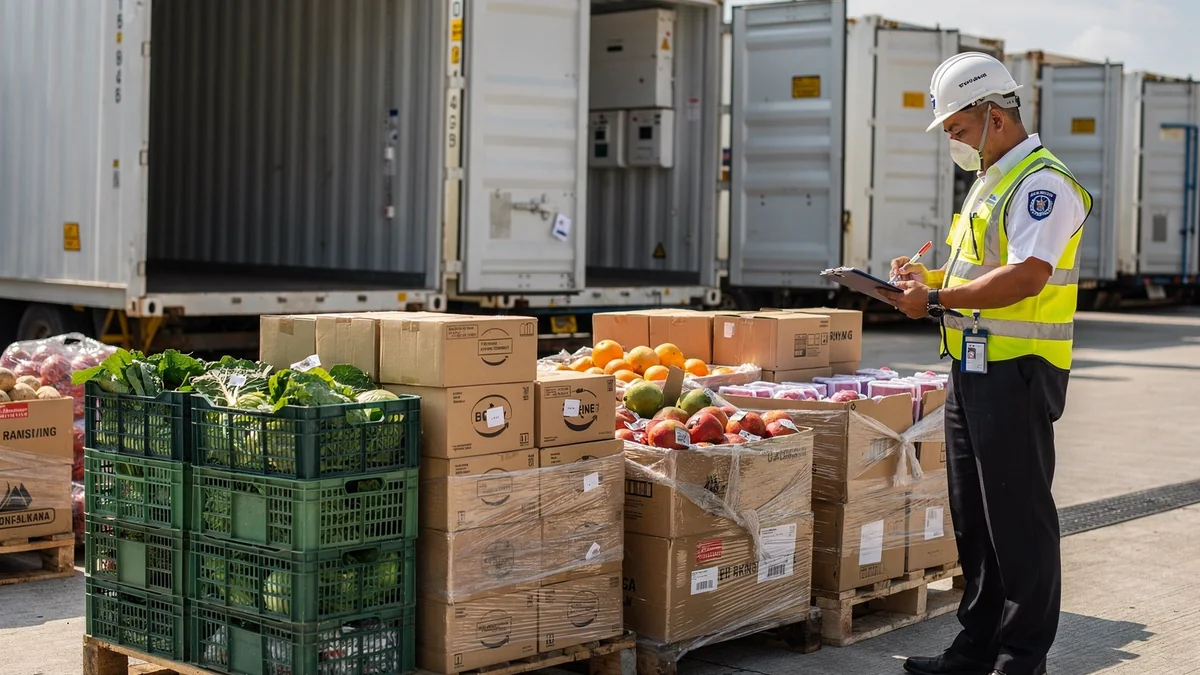
To import food into Malaysia, register on FOSIM, confirm which agency governs your product (MOH/FSQD, MAQIS, DVS or JAKIM), obtain any required permit or approval, label to the Food Regulations 1985, then pass risk-based border inspection under the Food Act 1983 before customs release.
Getting the agency map wrong is the top reason consignments are held. For broader context, see when you need an import permit.
Scope noteThis guide is educational. DNE Forwarding does not obtain, process or advise on import permits. We lodge customs declarations and haul containers once your permit is already in hand. To apply for a permit, deal directly with the issuing agency — MITI, SIRIM, MAQIS, DOSH or DOE — or appoint a licensed permit agent.
What approvals do you need to import food into Malaysia?
Every food importer must register on FOSIM, the Ministry of Health's Food Safety Information System. General packaged food then clears on risk-based inspection, but meat, poultry, dairy, eggs, live produce and special-purpose foods need a prior permit or written approval from MAQIS, DVS or FSQD.
Per Azmi & Associates, importers “must register themselves with the Food Safety Information System of Malaysia (FOSIM) before importing food products.” Requirements then turn on commodity:
| Food category | Lead agency | Pre-arrival approval needed? |
|---|---|---|
| General packaged / processed food, beverages | MOH – FSQD | FOSIM registration; risk-based inspection on arrival |
| Meat, poultry, eggs, dairy | DVS + MAQIS + JAKIM | Yes — DVS-approved source, MAQIS import permit, halal |
| Fresh produce, plants, plant products | MAQIS | Yes — phytosanitary import permit |
| Infant formula & special-purpose food | MOH – FSQD | Yes — prior written approval of the Director |
| Fish & fishery products | MAQIS (with DOF) | Permit / health certificate per commodity |
What is MAQIS and what does it control?
MAQIS is the Malaysian Quarantine and Inspection Services department under the Ministry of Agriculture. Under the MAQIS Act 2011, it runs integrated quarantine, inspection and enforcement at entry points for plants, animals, carcasses, fish, agricultural produce, soil and microorganisms — issuing import permits and policing what crosses the border.
The MAQIS Act 2011 (Act 728) tasks it with “quarantine, inspection and enforcement at the entry points.” MAQIS gatekeeps biosecurity-sensitive food alongside MOH, so knowing which “owns” your product before booking prevents a hold; some are also prohibited or restricted imports.
Fish and fishery products add a layer: per the Department of Fisheries Malaysia (DOF), they need DOF import approval and health certification (with risk analysis for non-native or live species), which MAQIS then enforces.
Which foods need an import permit or special approval?
Meat, poultry, eggs, dairy and other animal products need a MAQIS import permit for every consignment, sourced only from DVS-registered, JAKIM-recognised establishments. Special-purpose foods such as infant formula need prior written approval of the Director of Food Safety and Quality before import or sale.
Animal products: DVS first, then MAQIS
Per the WTO Import Licensing portal, applications go through the E-Permit system, with DVS (“the competent veterinary authority in Malaysia”) approving first and a permit needed each consignment. The DVS procedure, on the DVS Import and Export portal, requires meat, poultry, pork, egg and dairy only from DVS-registered facilities.
Special-purpose foods need written approval
Under the Food Regulations 1985, per ChemLinked, no person may import or sell special-purpose food (infant and follow-up formula, baby food, low-energy and dietary foods, Reg. 389–393) “without the prior written approval of the Director.”
How does food inspection at the border work? (FOSIM, Food Act 1983)
On arrival, food is screened through FOSIM on a risk basis by MOH or MAQIS officers under the Food Act 1983. High-risk items may be held, sampled and lab-tested; low-risk items pass on documentary checks. Section 29 of the Act prohibits importing any food that does not comply with the law.
Per Azmi & Associates, Section 29 of the Food Act 1983 prohibits “the importation of any food which does not comply with the provisions of the Food Act or any regulation made thereunder,” with a maximum fine of RM10,000 or two years' imprisonment. Imported food is “first inspected by MOH officers or MAQIS officers through a risk-based approach assisted by FOSIM.”
What are Malaysia's food labelling requirements?
Under Part IV of the Food Regulations 1985, imported pre-packed food must be labelled in Bahasa Malaysia or English and carry the name of the food, full ingredient list in descending order, net content, country of origin, date marking, and the name and business address of the importer.
These elements sit in Part IV of the Food Regulations 1985, per MalaysianLaw.my. Non-conforming labels are a leading cause of holds.
Food import document checklist (Port Klang)
- FOSIM importer registration (active)
- MAQIS import permit / DVS approval (meat, poultry, dairy, egg, produce)
- FSQD prior written approval (special-purpose food)
- Veterinary / phytosanitary health certificate from origin authority
- JAKIM-recognised halal certificate (where applicable)
- Commercial invoice, packing list, Bill of Lading / Air Waybill
- Compliant Bahasa Malaysia / English label artwork
- Certificate of origin (for preferential duty / FTA)
Do imported foods need halal certification?
Halal certification is not mandatory for all food, but all imported meat (except pork) and livestock products — beef, poultry, dairy and eggs — must be halal-certified and come from establishments recognised by JAKIM, the Department of Islamic Development Malaysia, audited jointly with DVS.
Per the DVS import procedure (and the DVS Import and Export portal), plants exporting meat (excluding pork), poultry, milk and eggs may supply only if approved by both authorities and jointly audited: JAKIM on halal, DVS on animal health and food safety. For general packaged food, halal is a commercial advantage in this Muslim-majority market, not an import gate.
What duty and SST applies to imported food?
Imported food may attract import duty plus Sales Tax (SST). The standard SST sales-tax rate is 10%, with 5% on selected items. Essential staples — rice, chicken, beef, vegetables and eggs — are exempt or zero-rated, and from 1 July 2025 selected imported fruits were added to the exempt list.
Per ClearTax Malaysia, the fruits exempted from 1 July 2025 are apples, oranges, mandarin oranges and dates. Duty is ad valorem, so HS-code classification drives landed cost. Declarations go to SMK via Dagang Net (the National Single Window); see how customs clearance works in Malaysia.
How DNE clears your food shipment at Port Klang
DNE Forwarding is a JKDM-licensed forwarder and customs broker at Port Klang. We do not issue or apply for permits — your FOSIM registration, MAQIS/DVS approval and FSQD written approval are arranged directly between you (or your supplier) and those agencies. We verify those documents are in place before the vessel arrives, lodge the SMK declaration, and move perishables on reefer-capable haulage so the cold chain holds from quay to door.
DNE Forwarding (M) Sdn Bhd (Co. Reg. 538624-W), founded in 1999 in Klang, Selangor, handles 1,000+ containers a month at 99%+ documentation compliance across 25+ years, ISO 9001 certified and a FIATA / FMFF member. We flag halal and special-purpose gaps before the vessel sails and run clearance at Port Klang on reefer-capable haulage for food distributors, so a sampling hold never becomes demurrage.
Frequently Asked Questions
Do I need an import permit to bring food into Malaysia?
Not for all food. General packaged food only needs FOSIM registration and clears on risk-based inspection. But meat, poultry, eggs, dairy, fresh produce and special-purpose foods like infant formula need a permit or prior written approval from MAQIS, DVS or FSQD before arrival.
Which agency controls food imports — MOH or MAQIS?
Both, by product. The Ministry of Health's FSQD leads on food safety under the Food Act 1983 and runs FOSIM. MAQIS leads at the border on biosecurity-sensitive food — animals, fresh produce, fish — under the MAQIS Act 2011. Many shipments are screened by either.
Does imported meat have to be halal-certified?
Yes. All imported meat except pork, plus poultry, dairy and eggs, must be halal-certified from establishments recognised by JAKIM. The overseas plant is jointly audited by JAKIM (halal) and DVS (animal health) before it may supply Malaysia.
What language must imported food labels be in?
Under the Food Regulations 1985, imported pre-packed food may be labelled in Bahasa Malaysia or English, showing the food name, ingredients in descending order, net content, country of origin, date marking, and the importer's name and Malaysian business address.
Is imported food taxed in Malaysia?
It can be. Import duty applies on an ad valorem basis by HS code, plus Sales Tax of 10% standard or 5% on selected items. Essential staples — rice, chicken, beef, vegetables, eggs — are exempt, and selected imported fruits were exempted from 1 July 2025.
Does DNE Forwarding obtain or apply for import permits?
No. DNE Forwarding does not obtain, process or advise on import permits. Permits are applied for by the importer, the supplier, or a licensed permit agent. DNE's role begins once the permit is in hand: we classify the goods, lodge the K1/K2 declaration through SMK, and haul the container from Port Klang. During document review we will flag whether a permit appears to be required, but confirming and securing it remains the importer's responsibility.
Sources
- Malaysian Quarantine and Inspection Services Act 2011 (Act 728) — FAOLEX / ECOLEX
- Azmi & Associates — Importing Manufactured Food Products in Malaysia (Food Act 1983 s.29, FOSIM)
- WTO Import Licensing Portal — Animal and Animal Products (E-Permit, DVS approval)
- DVS — General Procedure for Import of Meat, Poultry, Milk and Egg Products (DVS + JAKIM joint audit)
- DVS — Import and Export portal (requirements, approved establishments, ePermit)
- Department of Fisheries Malaysia (DOF) — Import & Export services (fishery-product approval, health certificates)
- ChemLinked — Malaysia Special Purpose Food Regulation (Reg. 389–393, written approval of the Director)
- MalaysianLaw.my — Food Act 1983 & Food Regulations 1985 (Part IV labelling requirements)
- ClearTax Malaysia — SST: Rates & Exemptions (staples; imported fruits from 1 July 2025)
Part of a guide: this article is part of DNE's complete guide to customs clearance in Malaysia.