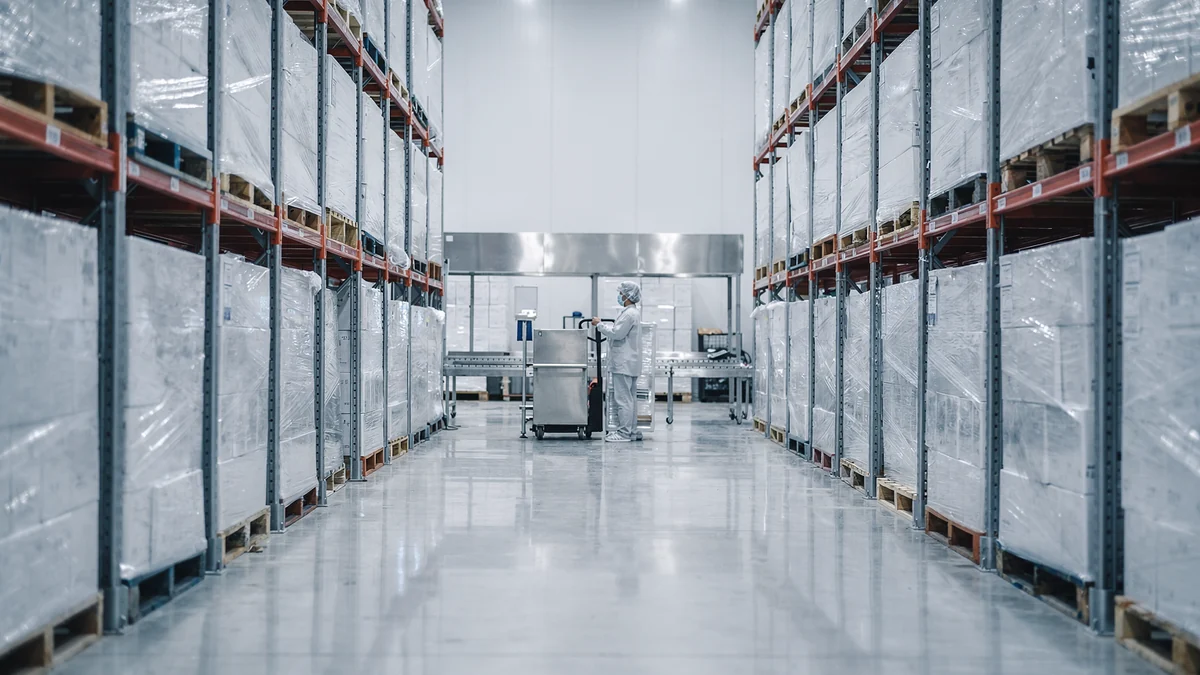
Halal goods do not stop being a Shariah-compliance question the moment they leave the factory. Under Malaysia's halal framework, the cargo's halal status can be broken in the truck, in the warehouse, or on the shelf — and once broken, it can be lost. For importers and exporters of halal products moving cargo through Port Klang, that turns freight forwarding, haulage and storage into part of the compliance chain, not just a transport cost.
Halal logistics in Malaysia is the transporting, storing and handling of goods so their halal status is preserved end to end under Shariah law. It is governed by the MS2400 halal supply-chain standard, certified by JAKIM, and turns on three things: physical segregation of halal and non-halal cargo, contamination control, and documented traceability.
This guide is for the importer or exporter of halal food, ingredients, pharmaceuticals or cosmetics who needs to understand what "halal-compliant logistics" actually requires before signing a shipping or haulage contract. It is part of our wider series on importing into Malaysia, and sits alongside our guides on food import permits and MAQIS and container haulage for food distributors.
Key takeaways
- The standard is the MS2400:2019 series, a three-part Malaysian Standard published by the Department of Standards Malaysia covering transportation (MS2400-1), warehousing (MS2400-2) and retailing (MS2400-3).
- JAKIM is the certifying authority. A logistics provider is certified under one or more parts of MS2400; certification is per facility and per activity, not a blanket company label.
- Segregation is the core rule. Halal and non-halal cargo must be physically separated in storage, in vehicles and during handling to prevent cross-contamination.
- Demand is real and growing. Malaysia's halal exports reached RM68.52 billion in 2025, up 10.9% year on year (HDC), and Malaysia again topped the State of the Global Islamic Economy Indicator (DinarStandard, 2024/25).
- A forwarder need not be halal-certified to help you ship halal goods compliantly — but you must understand who certifies what, and where your halal liability sits.
What is halal logistics and what does it require?
Halal logistics is the management of moving, storing and handling goods so they comply with Shariah (Islamic) law at every stage. The objective is to preserve halal integrity — the assurance that goods remain permissible — from origin to consumer, through segregation, contamination control and traceable documentation.
The principle behind it is custodianship, or amanah: each party that touches the cargo is responsible for handing it on uncontaminated. Halal logistics began in food and beverages but now covers pharmaceuticals, cosmetics, ingredients and even raw materials like palm oil. The reason it matters operationally is simple: a single breach anywhere in the chain can invalidate a product's halal status entirely, even if the product itself was manufactured to a flawless halal standard.
That is why halal-conscious buyers increasingly ask not only "is the product halal?" but "was it kept halal in transit?" A study of food-based logistics players in Malaysia published in Procedia – Social and Behavioral Sciences, drawing on interviews with 156 managers across Peninsular Malaysia, found that the perceived benefits of halal-logistics certification, customer loyalty and market-driven factors were among the influences on providers' readiness to adopt halal logistics — a reminder that much of the demand is pulled through by the supply chain's own customers.
What is the MS2400 halal supply-chain standard?
MS2400 is Malaysia's halal supply-chain management standard, published by the Department of Standards Malaysia. The current 2019 edition has three parts: MS2400-1 (transportation), MS2400-2 (warehousing and related activities) and MS2400-3 (retailing). Together they define how halal integrity is maintained at every handover point.
Malaysia was an early mover here. The MS2400:2019 series, first issued in 2010 and revised in 2019, is widely described as the world's first set of standards dedicated to halal supply-chain management rather than just halal production. It complements the broader MS1500 food-production standard by governing what happens after the product is made.
| Standard | Scope | What it governs | Typically certified party |
|---|---|---|---|
MS2400-1:2019 | Transportation | Movement of halal goods by road, sea and air; dedicated and cleanable transport units; chain of custody during transit | Hauliers, carriers, freight operators |
MS2400-2:2019 | Warehousing | Storage and handling inside facilities; segregated halal, non-halal and quarantine zones; integrity during static phases | Warehouse and distribution-centre operators |
MS2400-3:2019 | Retailing | The final touchpoint; preserving halal status from receipt through to the consumer purchase, across supermarkets and digital platforms | Retailers, supermarkets, e-commerce sellers |
The standards align Shariah principles with conventional quality-management discipline, which is why they read like a familiar logistics SOP with halal-specific controls layered on top: documented procedures, defined responsibilities, internal audits and corrective action.
How are halal and non-halal cargo segregated?
Segregation under MS2400 means halal and non-halal goods are physically separated at every stage — receiving, storage, transport and handling — so they never share space, contact surfaces or risk of cross-contamination. In a warehouse this means defined halal, non-halal and quarantine zones; in transport it means dedicated, cleanable units.
Segregation is the operational heart of halal logistics and, by most accounts, the hardest part to enforce in practice. The controls work at three levels:
- Storage: warehouses define and physically separate areas for halal, non-halal and quarantine stock, with procedures to isolate and dispose of contaminated, affected or doubtful products.
- Transport: halal cargo moves in dedicated units that are cleanable and free from prior non-halal contaminants; where mixed loads are unavoidable, strict procedures govern separation of halal from non-halal or hazardous cargo.
- Handling and people: processing, packing and handling steps keep halal and non-halal flows apart, supported by trained staff who follow halal SOPs.
Researchers consistently flag segregation as a real cost and complexity barrier. Academic work on halal-retail governance through MS2400-3:2019 notes that adoption "remains constrained by operational hurdles, a shortage of skilled personnel, and ambiguity surrounding return on investment" — segregation across storage, vehicles and handling being chief among those hurdles.
How is contamination controlled, and what is sertu cleansing?
Contamination control keeps halal cargo away from najs (ritual impurities). If equipment or a vehicle is contaminated by najs mughallazah — severe impurity from pigs or dogs — MS2400 requires sertu, a prescribed ritual cleansing using water and earth (clay), before that unit can carry halal goods again.
This is the requirement that most clearly separates halal logistics from ordinary food-grade hygiene. A conventional clean is not enough once najs mughallazah is involved: the standard mandates the correct ritual cleansing process before the asset re-enters halal service. Contamination control also covers halal-certified cleaning agents, pest control, and keeping halal cargo clear of any source of impurity throughout storage and transit.
For an importer, the practical takeaway is that "we washed the truck" is not the same as a halal-compliant cleaning regime. If your cargo demands strict halal handling, you need a provider whose cleaning and sertu protocols are documented and, where required, certified.
What documentation proves halal status in transit?
Halal status in transit is proven by an unbroken paper trail: the product's halal certificate, transport and warehouse records showing dedicated or cleaned units, proof of delivery, cleaning and sertu logs, and a Halal Assurance Management System tying it together. Traceability is what lets an auditor confirm integrity was never broken.
MS2400 leans heavily on a verifiable chain of custody. Transport documents, proof of delivery and cleaning records together demonstrate that a unit carrying halal cargo was dedicated or properly cleaned. Inside the warehouse, records show which zone held the stock and how doubtful product was isolated. Above all of this sits a Halal Assurance Management System (HAMS): a documented halal policy, a responsible halal team or internal committee, defined SOPs, and regular internal audits.
The destinations for that documentation discipline are increasingly the highest-value segments. As the Halal Development Corporation (HDC) said of Malaysia's 2025 export mix:
"This composition shows Malaysia's strength in core halal consumption sectors, while highlighting ongoing opportunities to expand higher value-added segments such as pharmaceuticals and halal ingredients."
That points to where documentation rigour matters most: pharmaceuticals and ingredients, where buyers demand the tightest traceability and where a documentation gap can stop a shipment at the border or the buyer's gate.
Who certifies halal logistics, and what does certification actually mean?
JAKIM (Jabatan Kemajuan Islam Malaysia) is the national authority that certifies halal logistics in Malaysia, using standards developed with the Department of Standards Malaysia. A provider is certified against a specific MS2400 part — transportation, warehousing or retailing — for a specific facility or fleet, not as a vague company-wide claim.
This distinction matters when you read marketing. Malaysian logistics companies have been certified by JAKIM under Part 1, Part 2 or Part 3 of MS2400 individually — warehousing and transport operators typically hold certification scoped to a named facility or fleet, not the whole company. The certification path runs in four broad steps:
- Gap assessment — comparing current operations against the relevant MS2400 part to find non-conformities.
- Documentation — submitting layout plans, halal SOPs, cleaning and sertu routines, and the Halal Assurance Management System.
- JAKIM audit — an on-site assessment of the facility or fleet against the standard.
- Surveillance — ongoing audits to keep the certificate valid.
So "halal-certified logistics" is a precise, scope-limited claim. As the guidance behind MS2400 frames it, the standard exists to ensure custodianship — amanah — "is maintained at every handover point." A provider certified for halal warehousing at one site is not automatically certified for halal transport, and a forwarder that arranges your shipment is not the same entity as the certified warehouse or carrier that physically holds your goods.
Why do importers and exporters of halal goods care?
Importers and exporters care because halal status is a commercial asset that breaks easily. A contamination event or a documentation gap in transit can void halal certification, trigger rejection by a buyer or border authority, and cut off access to halal markets — destroying value that was built in production.
The market size makes the stakes concrete. Malaysia's halal exports reached RM68.52 billion in 2025, a 10.9% year-on-year rise, contributing 4.3% of total exports, according to HDC data reported by Bernama. Food and beverages led at RM36.86 billion (53.8%), followed by halal ingredients at RM21.39 billion (31.2%). China was the largest destination market at RM9.00 billion (13.2%), ahead of Singapore at RM7.11 billion (10.4%). Globally, the halal logistics market alone is projected by Grand View Research to reach USD 686.83 billion by 2030, growing at a 9.7% compound annual rate.
For a Malaysian exporter, halal integrity in logistics is often the difference between qualifying for a buyer's halal supply chain and being shut out of it. For an importer of halal ingredients or finished goods, it protects the halal claim made to your own customers downstream. Either way, the logistics leg is where a perfectly halal product is most quietly at risk.
How does Malaysia's halal-hub status shape demand?
Malaysia is positioned as a leading global halal hub, which concentrates halal cargo flows through its ports and pushes compliance expectations up the supply chain. Malaysia again topped the State of the Global Islamic Economy Indicator, scoring 165.1 in DinarStandard's 2024/25 report and leading in halal food, Islamic finance, and pharmaceuticals and cosmetics.
That leadership is not only reputational. It means more halal cargo transits Port Klang and KLIA, more buyers in destination markets treat Malaysian halal certification as a benchmark, and more multinational logistics operators have built halal-certified warehousing and transport in Malaysia to serve the trade. The effect compounds: as halal becomes a default requirement rather than a niche, the expectation that the logistics behind a product is also compliant moves from "nice to have" toward "table stakes" for serious halal exporters.
For businesses moving cargo through Port Klang, the practical consequence is that halal-aware handling — correct segregation, clean documentation, the right MAQIS and JAKIM approvals on regulated goods — is increasingly part of what a competent logistics partner is expected to coordinate.
Where does a freight forwarder fit if it is not halal-certified?
A freight forwarder, haulier and customs agent that is not itself halal-certified can still help you ship halal goods compliantly — by understanding halal supply-chain requirements, arranging certified handling where you need it, and clearing your cargo correctly. The forwarder coordinates the move; the certified facility or carrier holds the halal certification.
It is important to be honest about this division of responsibility. DNE Forwarding is a JKDM-licensed freight forwarder, customs agent and container haulier; we are not a JAKIM-certified halal logistics operator and we do not operate a certified halal warehouse. What we do is move and clear your cargo — and we understand exactly where halal compliance lives in that chain, so we can plan a movement that respects it rather than quietly breaking it.
In practice, for a halal importer or exporter that means: routing your shipment to halal-certified warehousing or transport when your buyer requires it; keeping the halal certificate, MAQIS permits and customs documents aligned so nothing stalls at clearance; declaring correctly through SMK on Dagang Net's National Single Window (with supporting documents via MyCIEDS); and getting your containers from Port Klang to your facility without the kind of handling that would compromise the cargo. Our verified track record — over 1,000 containers cleared and moved every month, 25+ years at Port Klang, and 99%+ documentation compliance — is the operational backbone we bring to that coordination. If your goods also fall under food-import rules, our guides on MAQIS food permits and restricted imports show what else needs to line up.
If you import or export halal goods through Port Klang and want a forwarding, clearance and haulage partner who understands where halal compliance sits in the chain — and will be straight with you about what we can certify and what we coordinate — send us the shipment details and we will map it out with you.
Frequently asked questions
Is halal logistics only for food?
No. Halal logistics began in food and beverages but now extends to pharmaceuticals, cosmetics, halal ingredients and even raw materials such as palm oil. Any product that carries a halal claim can have that claim broken in transit, so the same segregation, contamination-control and documentation principles apply across all halal-sensitive cargo.
Does my freight forwarder need to be JAKIM halal-certified?
Not necessarily. JAKIM certification under MS2400 is scoped to specific facilities and activities — warehousing, transport or retail. A forwarder or customs agent that is not itself certified can still coordinate a compliant movement and arrange certified warehousing or transport where your buyer or product requires it. What matters is that the parties physically holding your halal cargo meet the standard your supply chain demands.
What is sertu and when is it required?
Sertu is the prescribed ritual cleansing for equipment or vehicles contaminated by najs mughallazah — severe impurity from pigs or dogs. It uses water and earth (clay) and is required under MS2400 before a contaminated transport unit or piece of equipment can be returned to halal service. An ordinary wash does not satisfy the requirement.
What happens to halal status if cargo is contaminated in transit?
If halal cargo is cross-contaminated with non-halal substances during transport or storage, its halal status can be invalidated entirely, regardless of how the product was made. That can mean rejection by the buyer or border authority and loss of access to halal markets, which is why segregation and a documented chain of custody are treated as non-negotiable in halal logistics.
How big is Malaysia's halal trade?
Malaysia's halal exports reached RM68.52 billion in 2025, up 10.9% year on year and contributing 4.3% of total exports, according to Halal Development Corporation data reported by Bernama. Food and beverages accounted for RM36.86 billion (53.8%). Malaysia also retained the top position in DinarStandard's State of the Global Islamic Economy Indicator for 2024/25.
Sources
- Department of Standards Malaysia (JSM) — MS 2400:2019, Halal supply chain management system (Parts 1–3, Transportation / Warehousing / Retailing): mysol.jsm.gov.my
- Bernama — "Malaysia's Halal Exports Hit RM68.52 Bln In 2025, Up 10.9 Pct Y-O-Y — HDC" (export values, segment and destination mix, HDC quote): bernama.com
- The Rakyat Post / DinarStandard — State of the Global Islamic Economy Report 2024/25 (GIEI ranking, score 165.1): therakyatpost.com
- Grand View Research — Global Halal Logistics Market (USD 686.83 billion by 2030, 9.7% CAGR): grandviewresearch.com
- Al-Barakah — Halal Logistics & Supply Chain in Malaysia: The Complete MS2400 Guide (MS2400 structure, sertu, segregation, chain of custody): al-barakah.com.my
- Tan et al., "Factors Influencing Readiness towards Halal Logistics among Food-based Logistics Players in Malaysia," Procedia – Social and Behavioral Sciences (156-manager study), ScienceDirect: sciencedirect.com
- "Halal Retail Governance through MS2400-3:2019," International Journal of Humanities, Technology and Civilization (UMP) — adoption constraints, skilled-personnel shortage: journal.ump.edu.my