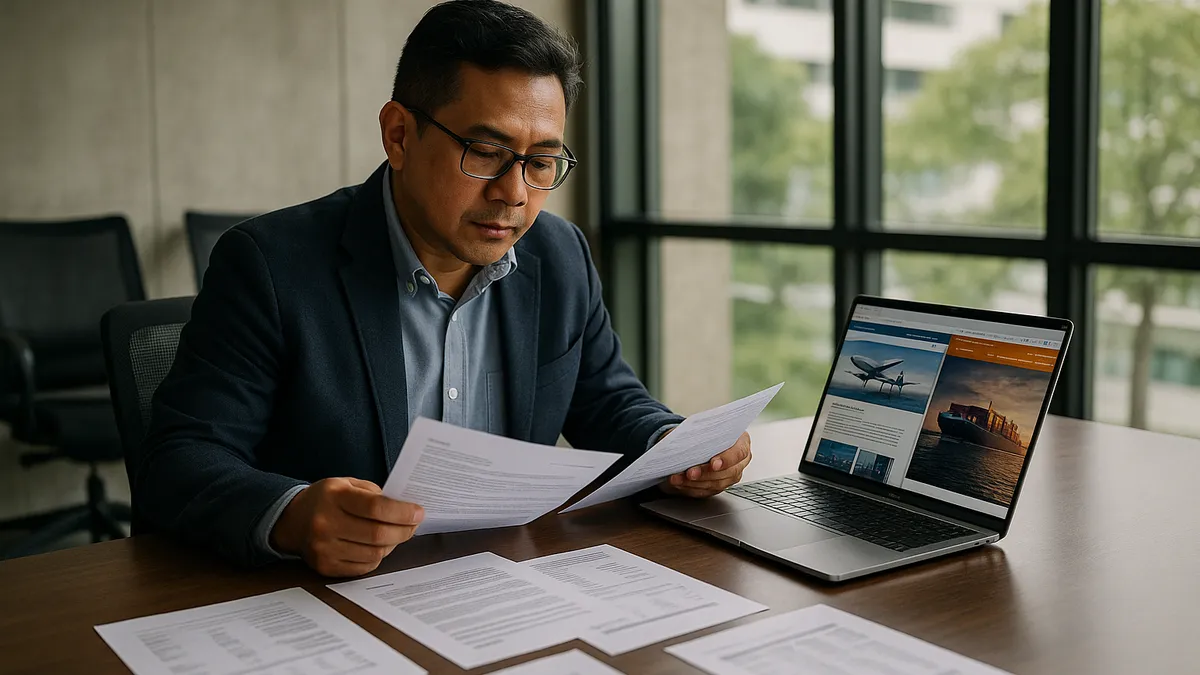
Port Klang handles over 13 million TEUs of cargo annually, making it Malaysia's busiest port and one of the top 15 container ports in the world. Behind every container that clears customs on time, reaches its warehouse without damage, and arrives at the right cost, there is a competent forwarding agent making it happen. Behind every container that sits in demurrage, faces penalties for compliance failures, or disappears into a documentation black hole, there is usually a poor choice of forwarding agent.
Choosing the right forwarding agent in Port Klang is not a decision you make once and forget about. It is one of the most consequential decisions in your supply chain, affecting your landed costs, your clearance speed, your compliance risk, and ultimately your ability to serve your own customers reliably. This guide gives you a structured checklist to evaluate forwarding agents, the red flags to watch for, and the questions you should ask before signing any agreement.
Why Your Choice of Forwarding Agent Matters
A forwarding agent is not just a middleman who files paperwork. In the Malaysian logistics ecosystem, your forwarding agent is your licensed customs representative, your cargo coordinator, your compliance buffer, and often your first line of defence against costly mistakes. Here is what is at stake:
- Cost impact: An experienced forwarding agent in Port Klang can save you thousands of ringgit per shipment through correct tariff classification, timely exemption applications, and efficient routing. A poor one will cost you in demurrage charges, storage fees, re-examination costs, and penalties you never saw coming.
- Clearance speed: At Westport and Northport, the difference between a same-day clearance and a three-day delay often comes down to how well your forwarding agent manages documentation and navigates the customs process. Every day your container sits at the port, you are paying for it.
- Compliance risk: Malaysian customs regulations are complex and change frequently. Your forwarding agent files declarations under your company's name. If those declarations contain errors — wrong HS codes, incorrect values, missing permits — it is your company that faces penalties, not the agent. (See our guide on customs clearance for more on compliance requirements.)
- Supply chain reliability: When your forwarding agent drops the ball, the ripple effects travel through your entire supply chain. Production lines stop. Customer orders are delayed. Container demurrage charges pile up. Your reputation with your own clients takes the hit.
The Complete Forwarding Agent Checklist: 12 Criteria to Evaluate
Use this checklist when evaluating any forwarding agent in Port Klang. No single factor should be the deciding one — you need to assess the complete picture.
1. JKDM Customs Agent Licence
This is non-negotiable. Every forwarding agent handling customs clearance in Malaysia must hold a valid customs agent licence issued by Jabatan Kastam Diraja Malaysia (JKDM — the Royal Malaysian Customs Department). This licence confirms that the agent has met the department's requirements for knowledge, financial standing, and operational capability.
Ask to see the licence. Verify the licence number. Check that it is current and not suspended. An unlicensed agent cannot legally file customs declarations on your behalf, and any declarations filed without proper licensing expose your company to serious legal consequences.
2. Years of Experience at Port Klang
Port Klang is not the same as other Malaysian ports. It has its own operational rhythms, its own congestion patterns, its own relationships between terminal operators, customs officers, and haulage companies. A forwarding agent with 20 years of experience at Penang Port does not automatically know how to navigate Westport's container yard or Northport's conventional cargo operations.
Look for agents with a substantial track record specifically at Port Klang. Ask how many years they have been operating here, how many declarations they process monthly, and what types of cargo they handle regularly at this port.
3. ISO Certification
ISO certification — particularly ISO 9001 for quality management systems — demonstrates that a forwarding agent has formalised its processes and submits to regular external audits. This matters because logistics is a process-driven business. An agent with ISO certification has documented procedures for declaration filing, document management, exception handling, and customer communication.
It is not a guarantee of good service, but it is a reliable indicator that the company takes process discipline seriously. Ask for a copy of the certificate and check the certification body.
4. Range of Services
The best forwarding agents offer integrated services: customs clearance, haulage, warehousing, and documentation — all under one roof. This matters because every handoff between different service providers is a potential point of failure. When your forwarding agent subcontracts your haulage to a third party and your warehousing to another, coordination becomes more complex and accountability becomes diluted.
Evaluate whether the agent can handle your complete logistics chain or whether you will need to manage multiple service providers yourself. For most importers, a single integrated forwarding agent significantly reduces operational complexity.
5. Technology and Tracking Systems
In 2026, any forwarding agent worth hiring should offer digital documentation, online shipment tracking, and real-time status updates. The days of calling your agent to ask "where is my container?" and waiting hours for a callback are over.
Ask specifically about: real-time container tracking, digital documentation portals, automated status notifications, and MyCIEDS integration for customs documents. A forwarding agent that still relies on manual processes and phone calls for status updates is operating with yesterday's tools.
6. Financial Stability
Your forwarding agent handles significant sums of money on your behalf — paying duties, port charges, haulage fees, and other costs that they invoice back to you. If the agent is financially unstable, you face risks: duties paid late (resulting in penalties attributed to your company), customs bonds that lapse, or in the worst case, an agent that disappears with your money.
Check the company's SSM registration, ask how long they have been in business, look for signs of financial health (own office, own fleet, permanent staff), and ask for trade references from other importers they serve.
7. Industry Specialisation
Different types of cargo require different expertise. Dangerous goods (DG cargo) require specific licences, documentation, and handling procedures. Food products require MAQIS clearance. Electronics may require SIRIM certification. Chemical imports need JKKP (Department of Occupational Safety and Health) approvals.
If your cargo falls into a specialised category, your forwarding agent must have demonstrated experience in clearing that type of goods. Ask for examples of similar cargo they have handled, and how they manage the specific permit and compliance requirements for your product type.
8. Response Time and Communication
Logistics problems do not happen during business hours only. Vessels arrive at 3 AM. Customs queries come at odd hours. Container detention clocks do not pause for weekends. Your forwarding agent's responsiveness directly affects how quickly issues get resolved and how much those issues cost you.
Test the agent's responsiveness before committing. Call their office. Send a WhatsApp message. Email a query. See how quickly and how substantively they respond. A good forwarding agent in Port Klang should have operations staff available during extended hours and a clear escalation path for urgent matters.
9. References and Track Record
Ask for references — and actually call them. Speak to other importers who use this forwarding agent. Ask about clearance times, error rates, communication quality, and how the agent handles problems when they arise. The best forwarding agents will readily provide references because they know their clients are satisfied.
Also check with industry associations. The Federation of Malaysian Freight Forwarders (FMFF) and the Selangor Freight Forwarders and Logistics Association are useful resources for verifying an agent's standing in the industry.
10. Transparency in Pricing
Forwarding charges are notoriously opaque. Many agents quote a low headline rate for customs clearance and then load the invoice with miscellaneous charges: documentation fees, system charges, handling fees, communication charges, and a dozen other line items that were never discussed upfront.
A reputable forwarding agent provides a clear, itemised quote that covers all charges — customs clearance fees, haulage rates, port charges, government duties and taxes (as pass-through costs), and any other applicable fees. Ask for a sample invoice. Compare the quoted charges against what actually appears on past invoices. Transparency in pricing is one of the strongest indicators of a trustworthy forwarding agent.
11. Customs Compliance Record
Ask about the agent's compliance history with JKDM. Have they ever had their licence suspended? Have they been penalised for incorrect declarations? How do they handle HS code classification disputes? A forwarding agent with a clean compliance record protects your company by association.
Agents who cut corners on compliance — under-declaring values, using incorrect HS codes to reduce duties, or filing incomplete documentation — may save you money in the short term, but they expose your company to audits, penalties, and potential criminal prosecution.
12. Scalability and Peak Season Capacity
Your logistics needs are not constant. Seasonal demand, promotional campaigns, and supply chain disruptions all create volume spikes. Your forwarding agent must have the capacity to handle these peaks without a proportional decline in service quality.
Ask how the agent manages peak periods — Chinese New Year, pre-Hari Raya demand surges, and year-end inventory buildups. Do they have enough licensed staff to handle increased declaration volumes? Do they have access to sufficient haulage capacity? A forwarding agent that performs well at 50 containers per month but collapses at 150 is not the right long-term partner.
Quick-Reference Checklist
- Valid JKDM customs agent licence (verified and current)
- 10+ years of operations at Port Klang specifically
- ISO 9001 certification or equivalent quality system
- Integrated services: customs, haulage, warehousing, documentation
- Digital tracking and MyCIEDS integration
- Financially stable with own office and permanent staff
- Proven experience with your specific cargo type
- Responsive communication (test before committing)
- Verifiable references from current clients
- Transparent, itemised pricing with no hidden charges
- Clean compliance record with JKDM
- Demonstrated peak season capacity
Red Flags: When to Walk Away
Some warning signs should immediately disqualify a forwarding agent from consideration. If you encounter any of the following, proceed with extreme caution — or better yet, walk away entirely.
Warning Signs
- No customs agent licence: Operating without a valid JKDM licence is illegal. No licence, no consideration — full stop.
- No physical office near the port: A forwarding agent in Port Klang should have a physical presence in Klang, Port Klang, or the immediate surrounding area. An agent operating remotely from Kuala Lumpur or elsewhere cannot provide the on-the-ground responsiveness that port operations demand.
- Opaque or "all-in" pricing: If an agent cannot or will not break down their charges into clear line items, they are hiding something. "All-in" pricing sounds convenient but makes it impossible to verify whether you are being overcharged.
- No tracking capability: In 2026, if a forwarding agent cannot tell you where your container is without making phone calls, they are not keeping up with industry standards.
- Poor communication during the sales process: If the agent is slow to respond, vague in their answers, or difficult to reach before you have signed an agreement, their service will only get worse once they have your business.
- Pressure to under-declare or misclassify: Any agent who suggests declaring lower values or using incorrect HS codes to reduce duties is inviting you to commit customs fraud. The short-term savings are not worth the risk of penalties, seizure, and criminal prosecution.
- No insurance or bonding: A forwarding agent that does not carry professional indemnity insurance or maintain adequate customs bonds is a risk you cannot afford.
- High staff turnover: If the people handling your account change every few months, institutional knowledge about your shipments is constantly being lost. Ask about staff tenure.
Questions to Ask Before Hiring a Forwarding Agent
Before committing to any forwarding agent in Port Klang, have a detailed conversation that covers these questions. The quality of the answers — and the agent's willingness to answer them at all — will tell you a great deal.
Licensing and Credentials
- What is your JKDM customs agent licence number, and when does it expire?
- Are you ISO certified? Which certification body issued it, and when was the last audit?
- Are you a member of the Federation of Malaysian Freight Forwarders (FMFF) or any other industry association?
Operations and Capability
- How many customs declarations do you process per month at Port Klang?
- What is your average clearance time for standard import shipments (green lane)?
- Do you own your haulage fleet, or do you subcontract? If subcontracted, who are your haulage partners?
- Do you have your own warehouse facilities? Where are they located relative to the port?
- How do you handle peak season demand surges? Do you have enough licensed staff?
Technology and Tracking
- Do you offer real-time shipment tracking? How do I access it?
- Are your systems integrated with MyCIEDS for digital document submission?
- How do you send status updates — automated notifications, email, WhatsApp, or phone calls?
Specialised Cargo
- Do you have experience handling dangerous goods (DG cargo)? What classes?
- Can you manage MAQIS, SIRIM, DOE, and other agency permits?
- Have you handled cargo in my specific industry before? Can you provide references?
Pricing and Commercial Terms
- Can you provide an itemised quote that separates your service fees from government charges and third-party costs?
- What are your payment terms? Do you require upfront deposits for duties?
- Are there any minimum volume commitments or contract lock-in periods?
- How do you handle rate changes — are they communicated in advance?
Risk and Compliance
- Have you ever had your customs licence suspended or received penalties from JKDM?
- Do you carry professional indemnity insurance? What is the coverage limit?
- How do you handle a situation where customs queries or disputes arise on my shipment?
Local Forwarding Agent vs International Forwarder: Which Is Right for You?
Malaysian importers often face a choice between a local forwarding agent based in Port Klang and a large international logistics company. Both have legitimate advantages, and the right choice depends on your specific situation.
The Case for a Local Forwarding Agent
- Deep Port Klang expertise: Local agents know the port intimately — the customs officers, the terminal operations, the haulage routes, and the unwritten rules that affect how quickly your cargo moves.
- Faster response times: A local agent with an office in Klang can physically be at the port within minutes when issues arise. International companies often route problems through regional offices in KL or Singapore before action is taken.
- Personal relationships: In Malaysian business culture, relationships matter. A local agent who has been operating at Port Klang for decades has built trust and credibility with customs officers, terminal operators, and haulage companies that translates into smoother operations.
- Cost efficiency: Local agents typically have lower overhead than multinational logistics companies and pass those savings on to clients. You pay for the service, not the global brand.
- Flexibility: Local agents can adapt to your specific needs more readily. Need a Saturday clearance? An urgent amendment? A same-day haulage arrangement? A local agent can make it happen without going through layers of corporate approval.
The Case for an International Forwarder
- Global network: If your supply chain spans multiple countries, an international forwarder can coordinate origin-to-destination logistics across borders.
- Standardised systems: Large international forwarders often have sophisticated IT platforms that provide end-to-end visibility across multiple shipments and trade lanes.
- Corporate compliance: For publicly listed companies or those with strict vendor management policies, an international forwarder may tick more boxes on a procurement checklist.
The Reality for Most Malaysian Importers
For the majority of Malaysian importers whose goods arrive at Port Klang, a competent local forwarding agent delivers better value. The international forwarder's global network adds cost but limited value if your cargo's journey ends (or begins) at Port Klang. The local agent's intimate knowledge of Port Klang operations, their direct relationships with customs and terminal operators, and their ability to act fast when problems arise are advantages that matter every single day.
The best approach for many importers is a local forwarding agent who handles Port Klang operations, combined with an international freight partner for the sea or air freight leg. This gives you the best of both worlds — global reach for the shipping lane and local expertise at the port.
The Cost of Choosing Wrong
Choosing the wrong forwarding agent is not an abstract risk. It has real, quantifiable consequences that Malaysian importers deal with every day. Here are the most common outcomes of a poor forwarding agent choice:
Demurrage and Detention Charges
When your forwarding agent files incorrect documentation or misses the clearance window, your container sits at the port accumulating charges. At Port Klang, container demurrage can cost RM150-RM400 per container per day depending on the terminal and container size. A three-day delay on a 40-foot container can cost RM600-RM1,200 in demurrage alone — before you add storage charges, re-examination fees, and the cost of your disrupted production schedule.
Customs Penalties
Incorrect HS code classification, under-declared values, or missing permits can result in customs penalties ranging from double the duty shortfall to RM500,000 or more for serious offences. These penalties are assessed against the importer — your company — not the forwarding agent. A single misclassification on a high-value shipment can cost tens of thousands of ringgit in penalties.
Seized or Detained Cargo
If your forwarding agent files a declaration for goods that require permits they failed to obtain — MAQIS permits for food products, SIRIM approvals for electronics, DOE permits for controlled substances — your cargo will be detained. Detained cargo incurs storage charges while the permit issue is resolved, and in some cases, goods may be seized permanently or required to be re-exported at your expense.
Supply Chain Disruption
The downstream impact of a forwarding agent failure is often worse than the direct costs. A manufacturer waiting for raw materials that are stuck at port due to clearance delays faces production downtime. A retailer waiting for seasonal inventory misses the selling window. An exporter whose outbound shipment is delayed faces penalties from overseas buyers and damaged trade relationships.
Invisible Overcharging
Perhaps the most insidious cost of a poor forwarding agent is the money you never know you are losing. Agents who pad invoices with vague charges, fail to apply for available duty exemptions, or use inefficient routing cost their clients money on every single shipment. Over the course of a year and hundreds of shipments, these inefficiencies can add up to tens of thousands of ringgit in unnecessary costs.
Real-World Cost Example
- 3-day clearance delay: RM1,200 in demurrage + RM800 storage = RM2,000
- HS code misclassification penalty: RM5,000-RM50,000 per incident
- Missed Schedule C exemption: Full duty payment of 5-10% on cargo value
- Production downtime from delayed raw materials: RM10,000-RM100,000+ per day
- Annual hidden overcharges from non-transparent pricing: RM12,000-RM60,000
How DNE Forwarding Meets Every Criterion on This Checklist
We wrote this checklist because we know what good looks like — and because we built our business to meet every one of these standards. Here is how DNE Forwarding measures up:
- JKDM Licensed: DNE Forwarding holds a valid customs agent licence issued by JKDM. Our licensed customs agents file declarations daily at both Westport and Northport.
- 25+ years at Port Klang: We have been operating at Port Klang since our founding. This is not just our office location — it is where we have built our expertise, our relationships, and our reputation over more than two decades.
- ISO Certified: Our quality management system is ISO certified, with regular external audits ensuring our processes meet international standards.
- Integrated services: We provide customs clearance, haulage (with our own fleet), warehousing, and full documentation services under one roof. One point of contact, one invoice, complete accountability.
- Digital tracking: Our systems provide real-time shipment tracking and automated status updates. We are fully integrated with MyCIEDS for digital customs document submission.
- Financially stable: We own our office in Klang, operate our own haulage fleet, and maintain a team of permanent, experienced staff. We are not going anywhere.
- Industry expertise: From general cargo to dangerous goods, food products to electronics, we have the experience and permits to handle specialised cargo requirements.
- Responsive communication: Our operations team is available during extended hours. We communicate via WhatsApp, email, and phone — whichever works best for you. Try us: message us on WhatsApp and see how fast we respond.
- Proven track record: We serve manufacturers, trading companies, and SMEs across Selangor and the Klang Valley. Our client references are available on request.
- Transparent pricing: Every quote from DNE is fully itemised. We separate our service fees from government charges and third-party costs. No hidden fees, no vague line items, no surprises on your invoice.
- Clean compliance record: We maintain a strong compliance record with JKDM. We do not cut corners on declarations, and we do not advise clients to under-declare or misclassify goods.
- Peak season capacity: With our own fleet, our own warehouse, and a team of licensed customs agents, we have the capacity to scale during demand surges without compromising service quality.
Choosing a forwarding agent in Port Klang is a decision that will affect your costs, your compliance, and your supply chain reliability for years to come. Use this checklist, ask the hard questions, and choose a partner — not just a service provider. If you would like to see how DNE Forwarding stacks up against your current agent, reach out for a no-obligation conversation.