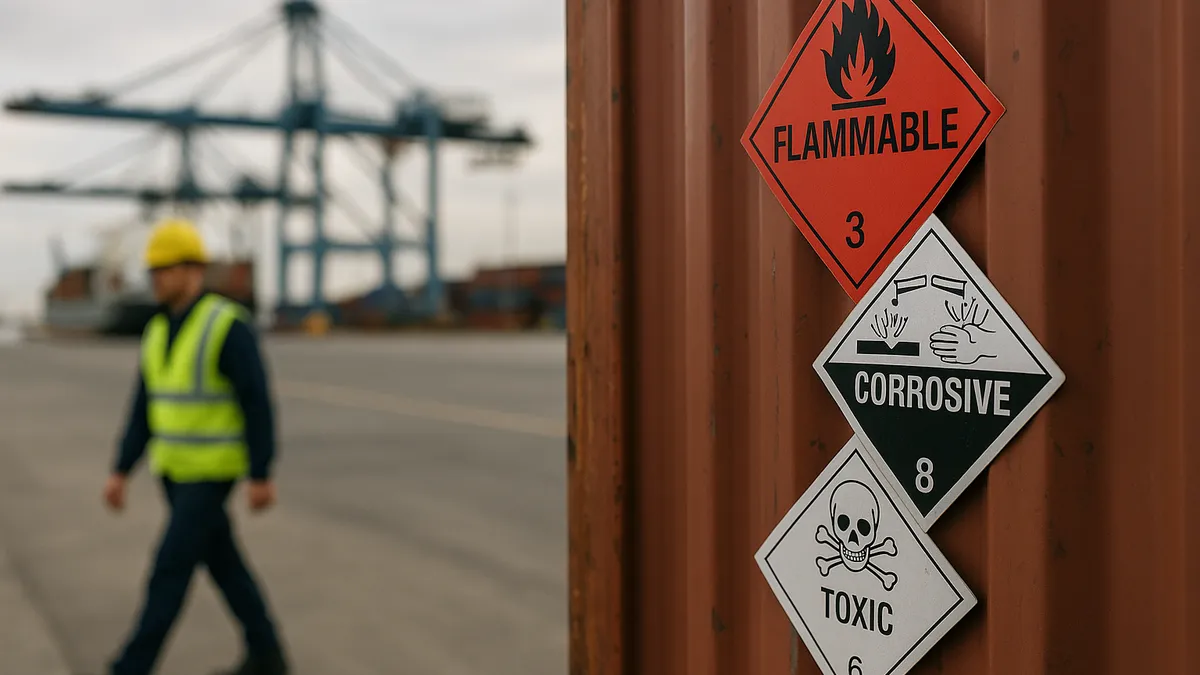
Malaysia is a manufacturing powerhouse for chemicals, electronics, petrochemicals, and palm oil derivatives — many of which are classified as dangerous goods under international shipping regulations. If your business exports paints, industrial solvents, lithium batteries, compressed gases, or any of hundreds of other regulated products through Port Klang, you need to understand the rules. Getting it wrong does not just mean delays. It can mean fines of up to RM500,000, criminal prosecution, and cargo that never reaches its destination.
This guide covers everything Malaysian manufacturers and traders need to know about shipping dangerous goods (DG) by sea — from IMDG Code classification to the specific permits, documentation, and procedures required at Port Klang.
What Are Dangerous Goods Under the IMDG Code?
The International Maritime Dangerous Goods (IMDG) Code is the globally accepted standard for transporting hazardous materials by sea. Developed by the International Maritime Organization (IMO), the Code classifies dangerous goods into nine classes based on their primary hazard. Malaysia, as an IMO member state, adopts the IMDG Code as the regulatory basis for all maritime DG shipments.
As of January 2026, Amendment 42-24 of the IMDG Code is mandatory, introducing updated risk management and documentation requirements. Every shipper, freight forwarder, and carrier handling DG cargo must comply with this latest version.
The Nine IMDG Classes
Here is a breakdown of all nine classes, with examples relevant to Malaysian manufacturers and exporters:
| Class | Hazard Type | Common Examples (Malaysian Context) |
|---|---|---|
| 1 | Explosives | Fireworks, ammunition, detonators, flares. Malaysia has a significant fireworks manufacturing sector in Perak. |
| 2 | Gases | Compressed gases (LPG, acetylene, nitrogen), aerosol cans, fire extinguishers. Divided into 2.1 (flammable), 2.2 (non-flammable/non-toxic), and 2.3 (toxic). |
| 3 | Flammable Liquids | Industrial solvents, paints, adhesives, petroleum products, alcohols, perfumery compounds. Extremely common in Malaysian chemical exports. |
| 4 | Flammable Solids | Metal powders, matches, sulphur, activated carbon. Divided into 4.1 (flammable solids), 4.2 (spontaneously combustible), 4.3 (dangerous when wet). |
| 5 | Oxidising Substances & Organic Peroxides | Hydrogen peroxide, sodium chlorate, ammonium nitrate fertilisers, bleaching agents. Common in palm oil processing and agriculture. |
| 6 | Toxic & Infectious Substances | Pesticides, herbicides, medical/clinical waste, biological samples. Divided into 6.1 (toxic) and 6.2 (infectious). |
| 7 | Radioactive Material | Industrial radiography sources, medical isotopes, smoke detectors containing americium. Regulated exclusively by AELB in Malaysia. |
| 8 | Corrosives | Sulphuric acid, hydrochloric acid, battery acid (electrolyte), sodium hydroxide, cleaning chemicals. Major exports from Pasir Gudang and Klang chemical zones. |
| 9 | Miscellaneous Dangerous Goods | Lithium batteries (lithium-ion and lithium-metal), dry ice, asbestos, environmentally hazardous substances, magnetised materials. Lithium batteries are one of Malaysia's fastest-growing DG export categories. |
Each class has specific sub-divisions, and many products carry secondary hazards. A single product — say, an industrial cleaning solvent — might be classified as Class 3 (flammable liquid) with a subsidiary risk of Class 8 (corrosive). Correct classification is the foundation of everything that follows: wrong class means wrong packaging, wrong labels, and a shipment that will be rejected or, worse, cause an incident at sea.
Malaysian Regulatory Framework for Dangerous Goods
Shipping DG cargo from Malaysia involves multiple regulatory bodies, each with specific jurisdiction. Understanding who regulates what — and when their approval is needed — is essential for avoiding delays at customs clearance.
Royal Malaysian Customs Department (JKDM)
JKDM oversees all import and export declarations, including DG cargo. Dangerous goods must be correctly declared in the customs declaration with accurate HS codes. Under the Customs Act 1967, making a false declaration or failing to declare restricted goods can result in fines of up to RM500,000 and imprisonment. JKDM also enforces the Customs (Prohibition of Imports) Order 2017 and the Customs (Prohibition of Exports) Order 2017, which restrict or prohibit certain dangerous substances.
Department of Occupational Safety and Health (DOSH)
DOSH regulates the handling, storage, and transport of hazardous chemicals under the Occupational Safety and Health Act 1994 (Act 514) and the Class I Environmental Quality (Scheduled Wastes) Regulations. Any company manufacturing, storing, or transporting dangerous chemicals in Malaysia must comply with DOSH's Classification, Labelling, and Safety Data Sheet of Hazardous Chemicals (CLASS) Regulations 2013. DOSH also requires facilities that handle DG to maintain a Chemical Health Risk Assessment (CHRA).
Atomic Energy Licensing Board (AELB)
For Class 7 (radioactive) materials, the Atomic Energy Licensing Board is the sole regulatory authority under the Atomic Energy Licensing Act 1984 (Act 304). All import, export, transport, and storage of radioactive materials requires an AELB licence. The Radiation Protection (Licensing) Regulations 1986 and the Atomic Energy Licensing (Transport of Radioactive Substances) Regulations 1988 prescribe specific packaging, labelling, and documentation requirements that go beyond the standard IMDG Code provisions.
Department of Environment (DOE)
The DOE regulates environmentally hazardous substances under the Environmental Quality Act 1974. Scheduled wastes — including chemical residues, spent solvents, and contaminated materials — require DOE approval for cross-border movement under the Basel Convention. This is especially relevant for Class 9 materials and hazardous waste shipments.
Marine Department Malaysia
The Marine Department enforces the Merchant Shipping Ordinance 1952 for maritime safety, including the carriage of dangerous goods on vessels. Port authorities at Port Klang implement these requirements at the operational level, including vessel approval, berth allocation, and cargo handling procedures for DG shipments.
Required Documentation for DG Shipments
Dangerous goods shipments require significantly more documentation than standard cargo. Missing or incorrect documents are the single most common reason for DG shipment rejections at Port Klang. Here is what you need:
Essential DG Documentation Checklist
- Dangerous Goods Declaration (DGD): The shipper's formal declaration of the cargo's classification, signed and submitted to the carrier. Must include the proper shipping name, UN number, class/division, packing group, and quantity.
- Safety Data Sheet (SDS/MSDS): A 16-section document detailing the chemical properties, hazards, handling precautions, and emergency response procedures for each substance. Must be current and in English.
- Container/Vehicle Packing Certificate: Certifies that the DG cargo has been packed into the container in accordance with IMDG Code requirements.
- Multimodal Dangerous Goods Form (IMO Form): Required for all international maritime DG shipments. Combines the DGD information with transport details.
- Emergency Response Procedures (EmS): The Emergency Schedule applicable to the specific DG class, referenced on the DGD using the EmS code (e.g., F-E, S-D).
- Approved Permits (AP): Required from relevant agencies — JKDM, DOSH, AELB, or DOE — depending on the substance type.
- Marine Insurance Certificate: Most carriers require evidence of DG-specific insurance coverage before accepting the booking.
Critical Data Points on Every DGD
Every Dangerous Goods Declaration must contain these elements, exactly as specified in the IMDG Code:
- UN Number: The four-digit identifier assigned to each dangerous substance or article (e.g., UN1263 for paint, UN3481 for lithium-ion batteries packed with equipment).
- Proper Shipping Name (PSN): The standardised name from the IMDG Dangerous Goods List — not your product's commercial name. "Nippon Weather Shield" is not a proper shipping name; "PAINT, UN1263, Class 3, PG II" is.
- Class and Division: The primary and any subsidiary hazard class.
- Packing Group: I (great danger), II (medium danger), or III (minor danger). Determines the packaging standard required.
- Flash Point: For flammable liquids (Class 3), the flash point in degrees Celsius must be stated if it is 60 degrees C or below.
- Net and Gross Weight/Volume: Accurate quantities of the dangerous substance.
- EmS Code: The Emergency Schedule codes for fire (F-codes) and spillage (S-codes).
Packing and Labelling Requirements
DG cargo must be packed in UN-approved packaging — containers that have been tested and certified to withstand the specific hazards of the goods they carry. This is not optional, and it is not something you can improvise. Using non-UN-approved packaging is one of the most common violations found during port inspections.
UN-Approved Packaging
UN packaging is marked with a standardised code that indicates the packaging type, material, performance level, and the packing group it is rated for. For example, a marking of 4G/Y25/S indicates a fibreboard box (4G), tested for Packing Group II and III (Y), with a maximum gross mass of 25 kg, for solid materials (S).
Malaysian manufacturers can source UN-certified packaging from licensed DG packaging suppliers. Companies like DG Packaging Malaysia provide certified drums, jerricans, boxes, and intermediate bulk containers (IBCs) rated for specific IMDG classes.
Labels, Placards, and Markings
Every DG package must display:
- Hazard labels: Diamond-shaped labels (minimum 100mm x 100mm) showing the class symbol and number. If the goods have subsidiary risks, both the primary and subsidiary labels must be displayed.
- UN number marking: The letters "UN" followed by the four-digit number, in characters at least 12mm high (65mm for containers and tanks).
- Proper Shipping Name: Displayed on the outer packaging.
- Orientation arrows: Required for liquid DG in combination packaging, indicating which way is "up".
- Container placards: Enlarged hazard labels (minimum 250mm x 250mm) on all four sides of the container, plus the UN number on orange panels.
Port Klang: DG Cargo Procedures and Terminal Requirements
Port Klang is Malaysia's largest port and handles significant volumes of dangerous goods, particularly chemical exports from the Klang Valley and Selangor industrial zones. Both Westport and Northport have designated DG handling areas, but the procedures and restrictions differ by class.
Westport DG Facilities
Westport operates a dedicated dangerous goods storage area with approximately 18,000 square metres of warehouse space, divided into seven independent chambers. Four chambers feature temperature-controlled environments maintained at 18-24 degrees C for temperature-sensitive DG cargo, while the remaining chambers provide ambient storage. The facility can handle Classes 2, 3, 4, 5, 6, 8, and 9, with over 26,500 pallet positions available.
All DG chambers are equipped with advanced fire protection systems including flame detectors, high-expansion foam generators, and ATEX-certified equipment. Westport also provides MSDS consultancy services for dangerous cargo handling, transportation, and storage.
IMO Class 1 Restrictions
Explosives (Class 1) face the strictest controls at Port Klang:
- Transhipment of IMO Class 1 cargo is not allowed
- Operations are restricted to daylight hours only
- Cargo must be delivered and received directly under the gantry crane — no storage in the port is permitted
- Prior approval from Port Klang Authority is required for the vessel to berth
- A full fire brigade must be on standby at the berth from vessel arrival to departure (charged at approximately USD 55 per hour)
- No bunkering or hot works are permitted at the berth
- Shippers and consignees must obtain all necessary permits from relevant authorities before delivery to or collection from the port
Pre-Notification Requirements
All DG shipments through Port Klang require advance notification to the port operator. The standard requirements are:
- 48-72 hours advance notice for standard DG classes (2, 3, 4, 5, 6, 8, 9)
- 5-7 working days for Class 1 (explosives) and Class 7 (radioactive), due to the additional approvals required from port authority, police, and AELB respectively
- Submission of DGD, SDS, and container packing certificate to the terminal operator prior to gate-in
- Carrier booking confirmation showing DG acceptance
Container Requirements and Segregation Rules
The IMDG Code prescribes strict rules about which DG classes can be stowed together in the same container, in adjacent containers, or on the same vessel. These segregation requirements are non-negotiable and directly affect your container planning and shipping costs.
Key Segregation Principles
- "Away from": Goods must be separated by at least one container space or 3 metres horizontally.
- "Separated from": Goods must be in different holds or compartments, or separated by a full container space both horizontally and vertically on deck.
- "Separated by a complete compartment from": A full structural separation is required — typically meaning different cargo holds with intervening compartments.
- "Separated longitudinally by an intervening complete compartment from": The strictest category, requiring separation by the full length of an intervening hold. Applied to the most incompatible combinations (e.g., acids and cyanides).
Container Types for DG Cargo
- Standard dry containers: Suitable for most DG classes, provided the goods are properly packed and secured. Container must be in good structural condition with no holes, cracks, or damaged door gaskets.
- Reefer containers: Required for temperature-sensitive DG, including certain organic peroxides (Class 5.2) that must be kept below specific temperature thresholds to prevent decomposition. Also used for certain pharmaceutical DG requiring cold chain.
- Open-top containers: May be required for certain oversized DG items or where ventilation is necessary. Subject to additional carrier approval.
- Tank containers (ISO tanks): Used for bulk liquid DG — acids, solvents, and other chemicals shipped in large volumes. Must be UN-approved and tested to the appropriate pressure rating for the cargo.
Common Mistakes That Cause Rejections and Penalties
After 25 years of handling DG shipments at Port Klang, we see the same mistakes repeatedly. Each one can result in cargo rejection, delays, fines, or worse. Here are the most common:
1. Incorrect or Missing Classification
The most dangerous mistake is the simplest: not knowing your product is classified as DG, or classifying it under the wrong UN number. This is especially common with products that have multiple components — a cleaning product might contain enough flammable solvent to classify it as Class 3, even though the manufacturer thinks of it as a "cleaning chemical." Similarly, lithium batteries have specific classification requirements (UN3480 for standalone batteries, UN3481 for batteries packed with or contained in equipment) that many electronics manufacturers get wrong.
2. Outdated or Missing Safety Data Sheets
The SDS must be current, complete (all 16 sections), and in English. Carriers and port authorities will reject shipments with SDS documents that are older than five years, missing sections, or only available in Mandarin or Bahasa Malaysia without an English translation.
3. Non-UN-Approved Packaging
Using standard commercial packaging instead of UN-certified packaging is a compliance failure. This includes reusing old UN packaging beyond its certification period, or using packaging rated for a lower packing group than the cargo requires.
4. Failure to Declare DG to the Carrier
Some shippers attempt to ship DG as general cargo — either to avoid surcharges or through genuine ignorance. This is not just a regulatory violation; it is a criminal offence. Carriers impose administrative penalties of USD 15,000 to USD 45,000 per container for misdeclared or undeclared DG. Under Malaysian law, penalties for false declarations can reach RM500,000 in fines and imprisonment of up to five years under the Customs Act 1967.
Undeclared dangerous goods are one of the leading causes of container fires at sea. Every year, misdeclared cargo results in vessel fires, environmental damage, and loss of life. Carriers and regulators treat this as an extremely serious offence.
5. Inadequate Securing Inside the Container
DG cargo that shifts during transport can breach packaging, mix incompatible substances, or create friction that ignites flammable materials. Proper blocking, bracing, and securing — documented in the Container Packing Certificate — is mandatory.
6. Ignoring Segregation Rules
Packing incompatible DG classes in the same container is a violation that can result in catastrophic chemical reactions. Even within the same class, certain substances must be segregated (e.g., different oxidisers that could react with each other).
Cost Implications of Shipping Dangerous Goods
DG shipments cost significantly more than standard cargo. Understanding the cost structure helps you budget accurately and avoid surprises. Here is what to expect:
Carrier DG Surcharges
Every ocean carrier charges a DG surcharge on top of the base freight rate. These surcharges vary by carrier, class, and route, but typical ranges are:
- Classes 2, 3, 8, 9: USD 100-250 per container (the most commonly shipped classes)
- Classes 4, 5, 6: USD 150-350 per container
- Class 1 (explosives) and Class 7 (radioactive): USD 300-500+ per container, subject to individual quotation
- Lithium batteries (UN3480/3481): USD 100-500 per container depending on quantity and state of charge
For high-risk classes or large volumes, DG surcharges can increase the base freight rate by 15-50%. Some carriers may double or triple the freight rate for certain DG classifications.
Additional Cost Factors
- UN-certified packaging: Typically 30-100% more expensive than standard commercial packaging. Budget RM 50-300 per drum/package depending on size and class rating.
- DG handling fees at terminal: Port Klang terminals charge additional handling fees for DG containers, including storage surcharges if containers exceed the free storage period.
- Fire brigade standby (Class 1): Approximately USD 55 per hour at Port Klang, from vessel arrival to departure.
- DG documentation services: Professional DG declaration preparation typically costs RM 200-500 per shipment, but the cost of getting it wrong is vastly higher.
- Insurance: Marine insurance premiums for DG cargo are 20-50% higher than standard cargo rates. Some underwriters require specialist DG insurance policies for high-risk classes.
- AELB licensing fees: For Class 7 materials, AELB charges RM 20 per permit, but the compliance process requires significant time and documentation.
Cost Planning Rule of Thumb
- Budget an additional 25-60% above standard freight costs for DG shipments
- Factor in packaging, documentation, and permit costs from the outset — not as an afterthought
- Compare carrier DG surcharges before booking, as they vary significantly between shipping lines
- For regular DG shippers, negotiate contract rates with carriers — spot rates for DG are always higher
How DNE Forwarding Handles Dangerous Goods Shipments
At DNE Forwarding, we have been managing DG cargo through Port Klang for over 25 years. Our team handles DG shipments across all nine IMDG classes, from routine chemical exports to complex multi-class consignments. Here is what we bring to every DG shipment:
- Correct classification from the start: We review your product's SDS and verify the correct UN number, proper shipping name, class, and packing group before anything else happens. Misclassification is the root cause of most DG problems — we catch it early.
- Complete documentation preparation: Our team prepares the DGD, Container Packing Certificate, and all supporting documents in full compliance with the current IMDG Code (Amendment 42-24). We ensure every data point is accurate and consistent across all documents.
- Carrier coordination: Not all carriers accept all DG classes on all routes. We maintain relationships with major shipping lines serving Port Klang and know which carriers accept your specific DG classification, their surcharge structures, and their booking lead times.
- Permit and customs clearance: We handle the full customs clearance process for DG shipments, including coordination with JKDM, DOSH, DOE, and AELB as required. Our licensed customs agents ensure declarations are accurate and compliant with current regulations.
- Port coordination: We manage pre-notification to Westport and Northport terminals, container gate-in scheduling, and DG storage arrangements. For Class 1 cargo, we coordinate fire brigade standby and Port Klang Authority approvals.
- ISO-certified processes: Our quality management system ensures consistent, auditable processes for every DG shipment. Documentation is archived for compliance trail requirements.
Dangerous goods shipping is not an area where you want to learn by trial and error. The regulatory requirements are complex, the penalties for non-compliance are severe, and the safety risks are real. Whether you are shipping your first container of lithium batteries or your thousandth drum of industrial solvent, having an experienced forwarding agent manage the process protects your cargo, your timeline, and your bottom line.