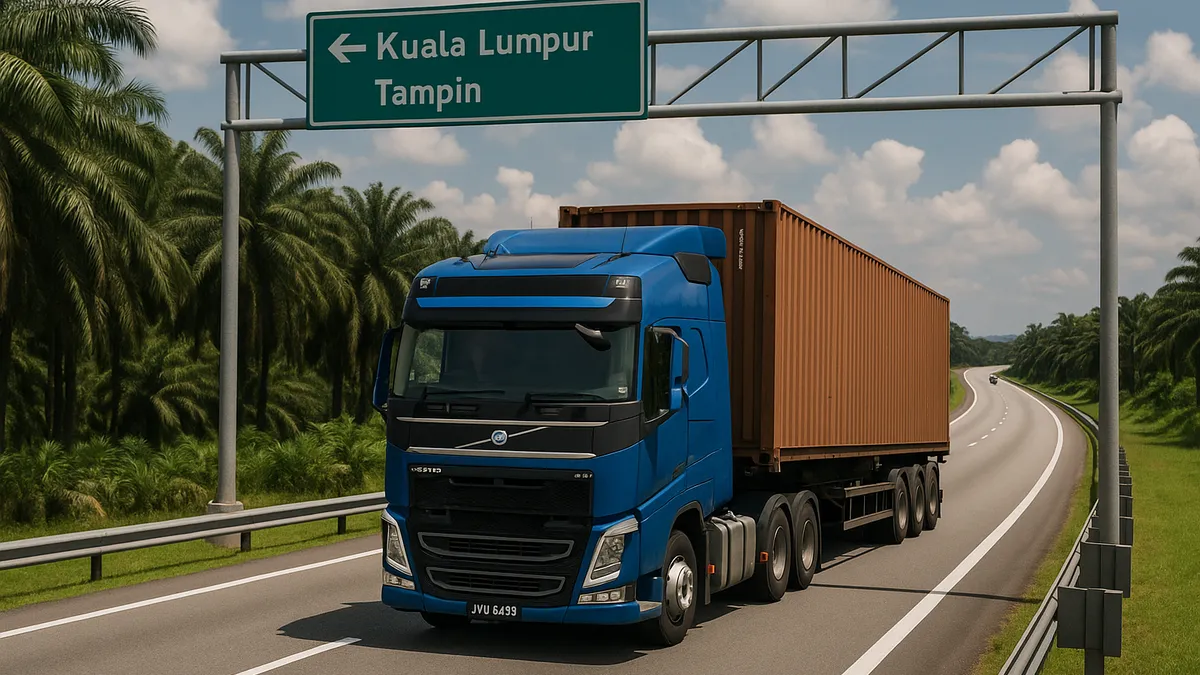
Container haulage is the critical last mile of any import shipment and the first mile of every export. It is the road transport leg that connects Port Klang's terminals to factories, warehouses, and distribution centres across the Klang Valley and beyond. Yet for many importers and manufacturers, haulage remains the least understood part of their supply chain — until something goes wrong. A missed delivery window, an unexpected waiting charge, or a truck shortage during peak season can cost thousands of ringgit and halt production lines.
This guide covers everything you need to know about container haulage in Port Klang: how the process works from vessel discharge to your factory door, how rates are structured, which routes matter most, what regulations apply, and how to avoid the delays that plague unprepared shippers.
How Container Haulage Works: Vessel to Factory Door
Understanding the haulage process starts at the port. When a container vessel berths at Westport or Northport in Port Klang, the sequence of events that leads to your container arriving at your premises involves multiple coordinated steps:
- Vessel discharge: Quay cranes lift containers from the vessel onto the terminal yard. This typically takes 12 to 48 hours depending on vessel size and the number of containers being discharged.
- Terminal storage: Containers are stacked in the yard, organised by shipping line, size, and discharge sequence. You typically have 3 to 5 free storage days before port storage charges begin accruing.
- Customs clearance: Your customs declaration must be submitted and approved before the container can leave the port. This involves document verification, duty and tax assessment, and — in some cases — physical inspection.
- Delivery order (DO) collection: Once customs clearance is obtained, a delivery order is collected from the shipping line's agent, authorising the release of the container.
- Gate-out: The prime mover enters the port terminal, locates the container in the yard, and proceeds through the gate-out checkpoint where documentation, container number, and seal integrity are verified.
- Road transport: The prime mover hauls the container via highway and local roads to the consignee's premises. Transit time depends on distance, traffic conditions, and any applicable road restrictions.
- Delivery and unstuffing: At the destination, the container is either unstuffed (devanned) at the loading bay or dropped off for the consignee to unload at their convenience.
- Empty container return: After unstuffing, the prime mover returns the empty container to a designated depot or back to the port terminal. Late returns incur container detention charges from the shipping line.
The entire cycle — from gate-out to empty return — typically takes one working day for destinations within the Klang Valley, though it can stretch to two days for longer-distance deliveries or when delays occur at the consignee's premises.
Types of Haulage Vehicles
Not all haulage jobs are the same, and the type of vehicle deployed depends on the container size, cargo weight, and delivery site conditions. Here are the main vehicle types used in Malaysian container haulage:
Prime Movers and Skeletal Trailers
The standard workhorse of container haulage is the prime mover (also called a tractor head) coupled with a skeletal trailer. The prime mover provides the engine power, while the skeletal trailer — a lightweight steel frame chassis — carries the container using twist-lock mechanisms. This combination handles the vast majority of port haulage in Malaysia.
- 20-foot trailer: Carries a single 20-foot container (TEU). Maximum payload is approximately 20 to 24 tonnes depending on the trailer and axle configuration. Suitable for most general cargo imports.
- 40-foot trailer: Carries a single 40-foot container (FEU) or 40-foot high-cube container. Maximum payload is approximately 26 to 28 tonnes. The most common configuration for full container load (FCL) shipments.
- 45-foot trailer: An extended trailer for 45-foot containers, which are increasingly used in intra-Asia shipping. Less common in Malaysia but available from larger haulage fleets.
Side Loaders
A side loader is a specialised trailer equipped with hydraulic cranes mounted on each side that can lift a container on and off the trailer without requiring a forklift, reach stacker, or overhead crane at the delivery site. Side loaders are essential for deliveries to premises that lack container handling equipment — which includes many smaller factories and warehouses in the Klang Valley. They can handle both 20-foot and 40-foot containers, with lifting capacities typically ranging from 30 to 37 tonnes.
Flatbed Trailers and Low Loaders
For out-of-gauge (OOG) cargo — oversized items that do not fit inside a standard container — flatbed trailers and low loaders are used. These include flat racks, open-top containers, and break-bulk cargo transported on flat platforms. OOG haulage requires special routing permits from JPJ (Road Transport Department) when the cargo exceeds standard width or height limits, and may need police escort for exceptionally large loads.
Port Klang Haulage Routes: Key Industrial Corridors
Port Klang sits at the western edge of the Klang Valley, connected to Malaysia's industrial heartland by a network of highways. The destination of your container determines the route, transit time, and toll costs. Here are the key corridors:
| Destination | Distance from Port Klang | Typical Transit Time | Key Highways |
|---|---|---|---|
| Shah Alam / Glenmarie | 20 – 25 km | 30 – 60 min | Federal Route 2, KESAS |
| Subang / USJ | 25 – 30 km | 40 – 70 min | NKVE, Federal Route 2 |
| Petaling Jaya / Sunway | 30 – 35 km | 45 – 80 min | NKVE, Federal Route 2, LDP |
| Puchong / Kinrara | 30 – 40 km | 45 – 90 min | KESAS, LDP, ELITE |
| Kuala Lumpur (city) | 35 – 45 km | 60 – 120 min | Federal Route 2, NKVE, DUKE |
| Rawang / Sungai Buloh | 50 – 60 km | 60 – 100 min | NKVE, Guthrie Corridor |
| Nilai / KLIA Vicinity | 70 – 85 km | 75 – 120 min | ELITE, PLUS (North-South) |
| Seremban | 90 – 110 km | 90 – 150 min | ELITE, PLUS (North-South) |
Important note on transit times: The ranges above assume normal traffic conditions. During peak hours (7:00 – 9:30 AM and 4:30 – 7:30 PM on weekdays), transit times can double or even triple for routes passing through the Klang Valley core. Heavy vehicle restrictions on major highways compound this further (see the regulations section below).
Haulage Rate Structure: How Pricing Works
Container haulage rates in Malaysia are not standardised by a regulatory body — they are market-driven and negotiated between hauliers and their clients. However, the rate structure follows a consistent pattern across the industry. Understanding these components helps you evaluate quotes and control your logistics costs.
Base Haulage Rate
The core charge is typically quoted per trip (one-way from port to destination) rather than per kilometre. Rates vary by container size and destination zone. As a general guide for 2026:
| Destination Zone | 20-foot Container | 40-foot Container |
|---|---|---|
| Zone 1: Klang / Shah Alam | RM350 – RM550 | RM500 – RM750 |
| Zone 2: PJ / Subang / Puchong | RM500 – RM700 | RM650 – RM950 |
| Zone 3: KL / Rawang / Sungai Buloh | RM600 – RM850 | RM800 – RM1,100 |
| Zone 4: Nilai / Seremban | RM750 – RM1,000 | RM950 – RM1,300 |
These ranges are indicative and fluctuate based on fuel prices, demand, and seasonal factors. Always request a current quote from your forwarding agent for exact pricing.
Additional Charges on Top of Base Rate
- Toll charges: Highway tolls are typically passed through at cost. A round trip from Port Klang to Shah Alam costs approximately RM15 – RM25 in tolls, while a trip to Nilai or Seremban can exceed RM60 – RM80.
- Fuel surcharge (FAF): Most hauliers apply a fuel adjustment factor that fluctuates with diesel prices. This is usually quoted as a fixed amount (e.g., RM30 – RM80) or a percentage of the base rate.
- Waiting charges: If the prime mover arrives at your premises and cannot begin unloading within the agreed free time (usually 2 to 3 hours), waiting charges apply. These range from RM50 to RM120 per hour. Excessive waiting is one of the most common sources of haulage cost overruns.
- Overnight charges: If the container cannot be unstuffed and the truck must stay overnight, charges of RM200 to RM400 typically apply.
- Side loader surcharge: Using a side loader instead of a standard skeletal trailer adds RM150 to RM350 to the trip cost, depending on the container size.
- Port charges: Terminal handling, gate processing, and other port-side fees may be bundled into the haulage quote or charged separately. Clarify this with your forwarding agent.
- Dangerous goods (DG) surcharge: Containers carrying hazardous materials require DG-certified drivers and equipment, adding RM100 to RM300 per trip.
Pro tip: Always ask your haulier for an all-inclusive quote that breaks down each component. A low base rate can be misleading if toll, fuel, and waiting charges are quoted separately and add up quickly.
Peak Season Challenges: When Trucks Disappear
The container haulage market in Malaysia experiences severe capacity constraints during several predictable periods each year. If you do not plan ahead, you may find yourself unable to secure a truck at any price.
Chinese New Year (January/February)
The most disruptive period for haulage. The pre-CNY rush begins 3 to 4 weeks before the holiday as importers scramble to clear cargo before factories shut down. Many truck drivers — a significant proportion of whom are from East Malaysia or neighbouring countries — return home for the holiday. JPJ also imposes heavy vehicle bans on major highways during the CNY period (typically the eve and the first two days). In 2026, JPJ banned heavy vehicles from all major roads on 14 – 15 February and 21 – 22 February, effectively removing trucks from the road for four days.
Hari Raya Aidilfitri (March/April)
Similar dynamics to CNY, with Malay drivers taking extended leave and JPJ imposing festive-period heavy vehicle bans. The 2026 Hari Raya ban was enforced over multiple days, further squeezing available truck capacity.
Year-End Rush (October – December)
The global shipping peak season drives higher import volumes into Port Klang. Combined with year-end stockpiling by retailers and manufacturers, this period sees truck demand outstrip supply. Spot haulage rates can increase by 20% to 40% above normal levels.
Month-End and Quarter-End Surges
A less obvious but very real pattern: many manufacturers schedule their import deliveries toward month-end to align with production cycles. This creates mini-peaks in haulage demand on the 25th through 31st of each month, particularly at quarter-end.
How to Secure Capacity During Peak Season
- Book your haulage at least 1 to 2 weeks in advance during CNY, Hari Raya, and year-end periods
- Confirm JPJ heavy vehicle ban dates early and adjust your clearance timeline accordingly
- Consider off-peak deliveries (early morning or late evening) when trucks are more available
- Work with a forwarding agent that operates its own fleet rather than relying solely on spot-market subcontractors
- Build buffer stock 4 to 6 weeks before major holidays to avoid the last-minute rush
Common Causes of Haulage Delays
Delays in container haulage cost money — not just in direct charges but in production downtime, missed delivery windows, and customer dissatisfaction. Here are the most common causes and what drives them:
1. Port Congestion
When vessel arrivals cluster — often after weather delays or schedule disruptions — the port terminal becomes congested. Container retrieval times increase, gate queues lengthen, and prime movers can spend 2 to 4 hours inside the terminal waiting to collect a single container. This is largely outside your control but can be mitigated by scheduling gate-in during off-peak hours (typically early morning or late afternoon).
2. Late Customs Clearance
This is the single most common reason for haulage delays. If your customs declaration is not approved before the haulage truck arrives at the port, the truck either waits (incurring waiting charges) or returns empty (wasting the trip). Coordinating clearance timing with haulage scheduling is essential.
3. Driver and Truck Shortage
Malaysia faces a chronic shortage of qualified heavy vehicle drivers. The trucking industry has long struggled to attract younger workers, and the licensing requirements (GDL — Goods Driving Licence) create a bottleneck. During peak periods, this structural shortage becomes acute.
4. Heavy Vehicle Road Restrictions
Since February 2025, heavy vehicles (Class 2 with 6 wheels and Class 3 with 3+ axles) are banned from major Klang Valley highways during peak commuter hours: 6:30 AM to 9:30 AM and 4:30 PM to 7:30 PM, Monday to Friday. The affected highways include PLUS (North-South Expressway), NKVE (New Klang Valley Expressway), ELITE (North-South Expressway Central Link), and DUKE (Duta-Ulu Kelang Expressway). This restriction effectively creates a dead zone in the middle of the business day when trucks must use alternative routes or wait out the ban period.
5. Delivery Site Issues
Narrow access roads, inadequate loading bays, no forklift or reach stacker on-site, insufficient labour for unstuffing — these consignee-side problems cause some of the longest delays. If your premises cannot accommodate a 40-foot prime mover and trailer (which requires approximately 18 metres of turning radius), you may need to arrange a side loader or tranship at a nearby warehouse.
6. Weather Disruptions
Malaysia's monsoon seasons (northeast monsoon from November to March, southwest monsoon from May to September) bring heavy rainfall that causes flash flooding on low-lying roads in the Klang Valley. The Federal Route 2 corridor between Port Klang and Shah Alam is particularly susceptible. Flooded roads can halt haulage operations entirely for several hours.
How to Avoid Delays: A Practical Checklist
Most haulage delays are preventable with proper planning. Here is what experienced importers and forwarding agents do differently:
- Coordinate customs clearance with haulage timing: Submit your customs declaration as soon as the vessel arrives (or even before, using pre-arrival processing). Only book the haulage truck once you have confirmation that clearance is approved or imminent. This avoids the costly scenario of a truck waiting at the port while paperwork is still being processed.
- Book haulage in advance, not on the day: Give your haulier at least 24 to 48 hours' notice for standard deliveries. During peak season, extend this to 5 to 7 working days. Last-minute bookings attract premium rates and may not be available at all.
- Schedule off-peak deliveries: Request gate-out from the port before 6:30 AM or after 9:30 AM, and plan arrivals at your premises outside the 4:30 – 7:30 PM highway restriction window. Early morning deliveries (arriving at premises by 8:00 – 9:00 AM) are ideal.
- Prepare your receiving site: Ensure your loading bay is clear, your unstuffing crew is ready, and your forklift or equipment is operational before the truck arrives. Every hour of waiting at your premises costs money.
- Track your container in real time: Work with a haulier that provides GPS tracking so you know exactly where your container is and when to expect arrival. This allows you to mobilise your receiving team at the right time.
- Have a backup plan for monsoon season: During the wet months, build an extra half-day buffer into your delivery timeline. Consider warehousing near the port as a staging point if your premises are flood-prone.
- Consolidate shipments where possible: If you import multiple containers per month, coordinate arrival dates to enable back-to-back haulage trips. Hauliers often offer better rates for multi-container bookings.
GPS Tracking and Fleet Visibility
Modern container haulage is no longer a black box. Leading haulage operators equip their prime movers with GPS tracking systems that provide real-time visibility into the location and status of every vehicle in the fleet. For importers, this means:
- Live location updates: Know exactly where your container is at any point between port gate-out and delivery.
- Estimated time of arrival (ETA): Receive accurate ETAs based on real-time traffic and route data, allowing you to prepare your receiving team accordingly.
- Proof of delivery: GPS logs provide time-stamped proof of arrival, departure, and route taken — useful for resolving disputes over waiting charges or delivery timing.
- Exception alerts: Receive notifications if a truck is delayed, diverted, or stationary for an extended period.
When evaluating haulage providers, ask whether they offer GPS tracking and whether you will have access to live tracking data or receive status updates. A haulier that cannot tell you where your container is in real time is operating with yesterday's technology.
Regulations Every Shipper Should Know
JPJ Road Weight Limits (BGK)
The Road Transport Department (JPJ) enforces strict gross vehicle weight limits, known as Berat Gabungan Kenderaan (BGK). For container haulage, the key limits are:
- 3-axle prime mover + 2-axle trailer: Maximum BGK of approximately 38 tonnes
- 3-axle prime mover + 3-axle trailer: Maximum BGK of approximately 45 to 50 tonnes
- Multi-axle combinations (for heavy cargo): Maximum BGK up to 60 tonnes with appropriate configuration
Since early 2026, enforcement has tightened significantly. Port Klang Authority (PKA) announced that from May 2026, haulage trucks exceeding their BGK limits will be fully restricted from entering and exiting the port. JPJ deploys weighbridge systems at strategic locations on highways and near port areas to catch overloaded trucks. Penalties include fines, vehicle impoundment, and potential suspension of the operator's licence.
The unladen weight of a typical prime mover and trailer combination is 15 to 17 tonnes, meaning a 38-tonne BGK allows only about 21 tonnes of actual cargo weight. Importers must ensure that their container's gross weight (cargo plus container tare weight) does not exceed the legal carrying capacity of the assigned vehicle.
APAD Licensing for Haulage Operators
In Peninsular Malaysia, all commercial goods vehicle operators must be licensed by APAD (Agensi Pengangkutan Awam Darat) under the Land Public Transport Act 2010 (Amendment 2018). In East Malaysia (Sabah and Sarawak), the equivalent authority is LPKP (Lembaga Pelesenan Kenderaan Perdagangan). Licensing requirements include:
- Valid SSM business registration
- Financial proof of solvency
- Driver training certifications and valid GDL (Goods Driving Licence)
- Vehicle safety inspection compliance (PUSPAKOM)
- Insurance coverage meeting minimum thresholds
- Adherence to approved routes and operational conditions
When choosing a haulage provider, verify that they hold a current APAD operator's licence. Unlicensed operators may offer lower rates but expose you to significant risk: if an unlicensed truck is involved in an accident or stopped at a roadblock, your cargo could be detained and your delivery timeline wrecked.
Heavy Vehicle Peak-Hour Bans
As mentioned earlier, the Lembaga Lebuhraya Malaysia (LLM) and JPJ enforce heavy vehicle bans on Klang Valley highways during peak commuter hours (6:30 – 9:30 AM and 4:30 – 7:30 PM on weekdays). The affected vehicle classes are Class 2 (two axles, six wheels) and Class 3 (three or more axles) — which includes all prime movers and trailers. Exemptions exist for emergency vehicles, highway maintenance, and waste disposal vehicles, but container haulage is not exempt.
Festive Period Road Bans
JPJ imposes complete bans on heavy vehicles during major public holiday periods, including Chinese New Year, Hari Raya Aidilfitri, Deepavali, and Christmas. These bans typically cover the eve and one to two days of the holiday itself, applying to all federal and state roads nationwide. The dates are announced by JPJ approximately 2 to 4 weeks before each holiday.
How DNE Forwarding Handles Your Haulage
At DNE Forwarding, haulage is not an afterthought — it is a core part of our end-to-end logistics service. As a Port Klang-based forwarding agent with over 25 years of experience, we understand that your container arriving at your factory on time is just as critical as getting it through customs.
Here is what sets our haulage service apart:
- Own VIP fleet with GPS tracking: We operate our own fleet of prime movers and trailers, equipped with real-time GPS tracking. This means guaranteed truck availability even during peak season, when spot-market hauliers are fully booked or charging premium rates. You get live tracking updates from port gate-out to delivery.
- Coordinated with customs clearance: Because we handle both customs clearance and haulage in-house, we synchronise the two processes. We dispatch the truck only when clearance is confirmed, eliminating the expensive scenario of a truck waiting idle at the port. This integrated approach saves you waiting charges and ensures the fastest possible turnaround.
- Full vehicle range: Our fleet includes skeletal trailers for 20-foot and 40-foot containers, side loaders for deliveries to sites without handling equipment, and access to flatbed trailers for out-of-gauge cargo. Whatever your cargo requires, we have the right equipment.
- Peak season reliability: Our own fleet means we do not rely entirely on the spot market during CNY, Hari Raya, or year-end peaks. We plan capacity weeks in advance and prioritise our regular clients, ensuring your deliveries are not disrupted by seasonal truck shortages.
- Transparent pricing: We provide all-inclusive haulage quotes that clearly break down the base rate, toll, fuel surcharge, and any applicable extras. No hidden charges, no surprises on the invoice.
- Regulatory compliance: Every vehicle in our fleet is APAD-licensed, PUSPAKOM-inspected, and BGK-compliant. Our drivers hold valid GDL licences and undergo regular safety training. We stay fully compliant so you never have to worry about regulatory issues affecting your delivery.
Why Integrated Haulage Matters
- Customs clearance and haulage under one roof eliminates coordination gaps between separate providers
- Single point of contact for your entire shipment — from vessel arrival to factory delivery
- Real-time visibility across the entire process, not just the road transport leg
- Faster turnaround: our average time from customs release to factory delivery within the Klang Valley is under 6 hours
Whether you are importing a single container or managing dozens of shipments per month, DNE Forwarding provides the haulage reliability and visibility that keeps your supply chain moving. Get in touch for a haulage quote tailored to your route and volume.