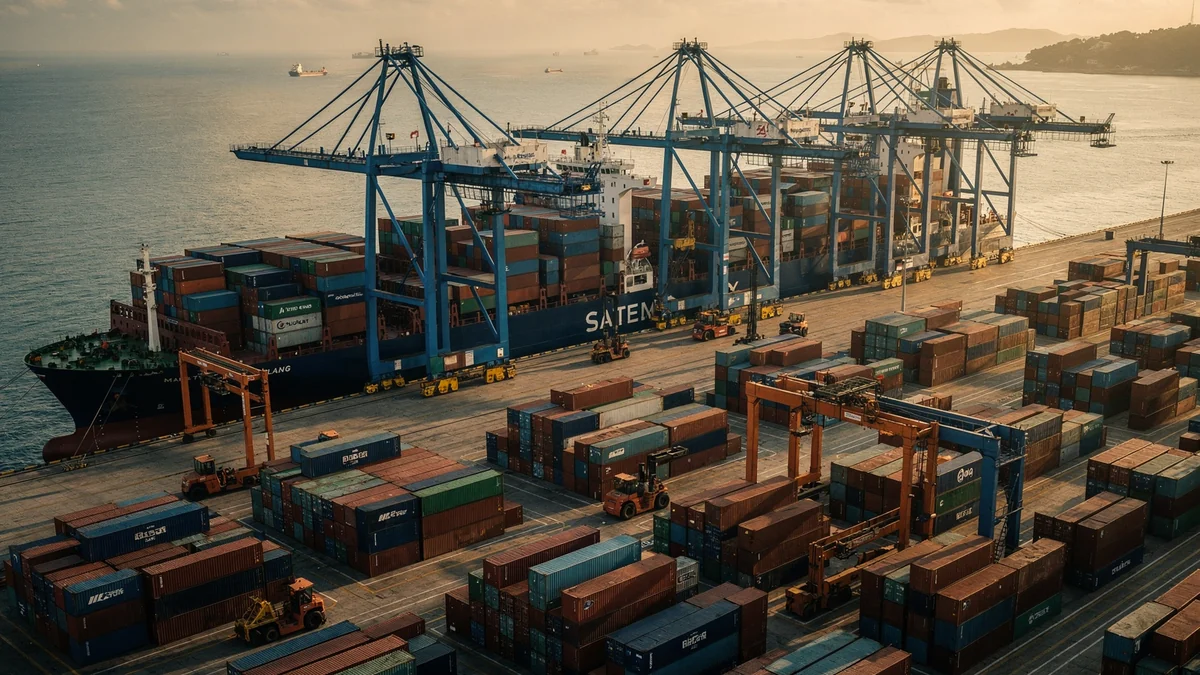
Transhipment at Port Klang is when a container is unloaded from one ship and reloaded onto another at the port without entering Malaysia's domestic market — it is simply changing vessels on its way to a final destination elsewhere. The cargo stays under customs control, no import duty is paid, and Port Klang acts purely as a connecting hub between shipping routes.
For Malaysian importers and exporters, transhipment is often invisible — yet it shapes your sailing schedules, your transit times and your freight rates. Port Klang is one of the world's great transhipment hubs, and understanding how transhipment cargo differs from your own gateway cargo helps you read carrier routings, avoid customs confusion, and decide when routing through a hub actually works in your favour. This guide is part of our wider explainer on freight forwarding in Malaysia, narrowed down to how transhipment works through Westports and Northport.
Key takeaways
- Port Klang handled 15.14 million TEU in 2025, and transhipment is a major share of that volume, outweighing its local gateway trade (The Star, Jan 2026).
- Transhipment cargo never clears import in Malaysia. It moves ship-to-ship under customs control on a Customs Form No. 8 (K8) and pays no Malaysian import duty or SST.
- Gateway (local) cargo is the opposite — it is your import or export, cleared through customs on a K1 or K2 declaration and released into or out of the Malaysian market.
- Westports is transhipment-led (transhipment was about 55.3% of its volume in 2024, rising to 57.6% in 2025), while Northport carries a larger share of local gateway trade.
- Port Klang's pull comes from geography: it sits on the Strait of Malacca, which carries over 30% of world trade and more than 94,000 vessels a year (World Economic Forum, via Ship4wd).
What is transhipment at Port Klang and how does it work?
Transhipment is the transfer of a container from one ship to another at an intermediate hub port before it reaches its final destination. At Port Klang, a vessel discharges boxes into the terminal yard, they wait for a connecting service, then they are loaded onto an onward ship — all without leaving customs control or entering Malaysia.
The reason hubs like Port Klang exist is that no carrier can sail every port-to-port pair directly. Instead, large mainline vessels carry boxes along trunk routes between major hubs, and smaller feeder ships fan the cargo out to regional ports. Port Klang is where those networks meet. The legal definition under Malaysia's framework is precise — as summarised by trade-law advisers at Baker McKenzie:
"Transhipment refers to the transfer of goods from one vessel or aircraft to another or the unloading of goods from a vessel or aircraft and depositing such goods in a customs or licensed warehouse, for shipment out of Malaysia."
In practice the lifecycle of a transhipment box at Port Klang runs through five stages:
- Arrival and discharge — the inbound vessel berths at Westports or Northport and the transhipment containers are lifted off into the yard.
- Yard dwell — boxes wait for their connecting service. Hub efficiency is measured by how short this dwell is.
- Customs control — the cargo is declared as transhipment (not import); it stays in-bond and is never cleared for the Malaysian market.
- Reloading — the container is loaded onto the onward mainline or feeder vessel.
- Departure — the connecting ship sails for the next leg, whether that is another Asian port or a long-haul service to Europe or the Americas.
The scale is significant. Port Klang handled 15.14 million twenty-foot equivalent units (TEU) in 2025, up from 14.64 million in 2024, and transhipment makes up a major share of that total — transhipment now outweighs the port's own gateway trade (The Star, January 2026).
Transhipment vs gateway (local) cargo: what is the difference?
The difference is destination and customs status. Gateway cargo is your local import or export — it clears Malaysian customs and enters or leaves the domestic market. Transhipment cargo only passes through Malaysia on its way somewhere else; it never clears import, pays no Malaysian duty, and moves under customs control from one ship to another.
Most Malaysian importers and exporters only ever deal with gateway cargo. Your container of machinery from Shanghai, or your pallets of gloves bound for Rotterdam, are gateway boxes: they are cleared into or out of Malaysia and counted as the country's own trade. Transhipment boxes belong to someone else's supply chain — they are routed through Port Klang because the carrier's network passes through here, not because the goods are wanted in Malaysia.
| Factor | Gateway (local) cargo | Transhipment cargo |
|---|---|---|
| Final destination | Inside Malaysia (import) or from Malaysia (export) | A third country — Malaysia is only a stopover |
| Customs status | Cleared for import/export | Stays in-bond, never cleared for domestic market |
| Declaration | Customs Form K1 (import) / K2 (export) | Customs Form No. 8 (K8 — transhipment/movement) |
| Malaysian duty & SST | Payable on dutiable goods | None — goods are not consumed in Malaysia |
| Who handles it | You and your forwarder/customs agent | The shipping line and the terminal |
The customs distinction is the one that trips people up. Transhipment is governed by the transit-and-transhipment provisions of the Customs Act 1967, and the 2019 overhaul of that Act tightened them: if the procedures are interrupted, "the owner of goods in transit or transhipment or his agent" becomes "immediately liable to pay duties leviable" (Baker McKenzie / Global Compliance News, 2019). In other words, the duty-free status of transhipment cargo only holds while it stays properly under customs control.
How is transhipment cargo treated by Malaysian customs?
Transhipment cargo is declared to Royal Malaysian Customs on a Customs Form No. 8 (K8) and moves in-bond — duty and SST are not paid because the goods are not released into the Malaysian market. The shipping line or its agent files the K8 at the port where the goods are unloaded, and the cargo stays under customs supervision throughout.
The K8 is the workhorse form for goods moving under customs control rather than being imported. According to DHL Malaysia's guide to the form and Royal Malaysian Customs procedures, it covers transhipment, movements within and between free zones, and transfers between bonded warehouses — including the common case of shifting a box between Westports and Northport without paying duty (DHL Malaysia). By contrast, gateway imports and exports use the K1 and K2 declarations, filed through SMK (Sistem Maklumat Kastam) on Dagang Net's National Single Window. We cover the full family of declarations in our guide to freight forwarding and the documents Malaysian traders file at customs; for transhipment, the key point is that no K1 import entry is ever raised.
Two practical consequences follow for shippers. First, because transhipment cargo is the carrier's and terminal's responsibility, you as the cargo owner usually have no customs paperwork to file when your box is transhipped en route — your declaration happens only at the true origin and destination. Second, the Customs Act 1967 attaches "heavy penalties for breach of the transit and transshipment procedures," so the discipline around keeping these boxes in-bond and accounted for is strict (Baker McKenzie / Global Compliance News, 2019). This is precisely why carriers route transhipment through well-run, compliant hubs.
Why is Port Klang such a strong transhipment hub?
Port Klang's strength is geography plus capacity. It sits on the Strait of Malacca — the world's busiest shipping lane, carrying over 30% of global trade and more than 94,000 vessels a year — so mainline services already pass its door. Deep berths, high crane productivity and connections to most major shipping alliances make it efficient to switch ships there.
The Strait of Malacca is the single most important reason. According to the World Economic Forum, "over 30% of the world's trade passes through the strait," with "an average of more than 94,000 vessels passing each year." A port positioned on that highway does not need to attract ships — they are already sailing past. Port Klang's job is to make stopping and switching vessels fast and reliable.
It has done that well enough to break into the global top tier. In Lloyd's List's ranking, Port Klang reached 10th among the world's busiest container ports, surpassing Hong Kong — a position the Ministry of Transport called confirmation of "Malaysia's strength as an emerging regional maritime powerhouse" (BERNAMA, 2025). For a hub, ranking is a function of transhipment density: you cannot move 15 million TEU on Malaysian gateway trade alone.
What roles do Westports and Northport play in transhipment?
Westports and Northport together make up Port Klang, but they lean different ways. Westports is transhipment-led — over half its boxes are ship-to-ship transfers — and handles the bulk of the port's volume. Northport carries a larger proportion of local gateway cargo serving Klang Valley industry, alongside conventional and bulk cargo.
Westports handled 11.33 million TEU in 2025, up from 10.98 million in 2024 (The Star, January 2026). Transhipment makes up the majority of that volume — about 55.3% in 2024, rising to 57.6% in 2025 (WorldCargo News, May 2026). That transhipment lean is why Westports is the name most often associated with Port Klang as a hub: its growth is driven by carrier networks switching boxes, not by Malaysian factories alone.
Northport recorded 3.8 million TEU in 2025, up 3.8% on the year (The Star, January 2026). It plays a complementary role: more local gateway trade, plus conventional, breakbulk and bulk handling. For a Malaysian importer or exporter, your box could clear through either terminal depending on the shipping line's berthing — which is exactly why moving cargo between the two on a K8 is a routine, duty-free operation. Our full comparison of Westport and Northport goes deeper into terminal differences, berths and services.
What does transhipment cost and how long does it take?
As a shipper, you rarely pay a separate transhipment fee — it is built into the ocean freight rate your carrier quotes for the full origin-to-destination journey. The cost is in time: a transhipment routing adds the connecting vessel's schedule gap, typically a few days of extra transit versus a direct service, in exchange for wider coverage and often a lower rate.
It helps to separate the two perspectives. For the shipping line, transhipment carries real handling costs — two lifts instead of one, yard storage and feeder slots — which is why carriers consolidate boxes through hubs to keep mainline ships full and unit costs down. For you, the cargo owner, those costs are already inside the all-in freight quote. What you actually trade is transit time: instead of a single direct sailing, your box waits at Port Klang for a connecting service.
| Routing | Typical transit profile | Best for |
|---|---|---|
| Direct service | Fastest; one vessel, no hub dwell | Time-critical cargo on high-volume lanes |
| Transhipment via hub | Adds the connecting-vessel schedule gap (often a few days) | Reaching ports with no direct call; lower rates |
The practical lesson is to read your carrier's routing before you book. A rate that looks cheap may route via one or two transhipment hubs and add a week; a slightly higher direct rate can be worth it for time-sensitive goods. When you import from major origins, this trade-off is central to the landed-cost picture we break down in our guide to importing from China to Port Klang.
When does routing through a transhipment hub help a shipper?
Transhipment helps when your origin or destination has no direct service, when consolidating through a hub unlocks more sailings and better rates, or when you ship less-than-container loads that need to be combined at a hub. It hurts when your cargo is time-critical and a direct sailing exists at an acceptable price.
Three situations where transhipment is genuinely an advantage:
- No direct call. If you are shipping to or from a smaller port that mainline carriers do not serve, transhipment at a hub like Port Klang is the only realistic way to connect — a feeder runs the short leg, a mainline ship does the ocean crossing.
- More choice and lower rates. Hub routings open up more weekly sailings and competitive pricing, because your box can join whichever mainline service has space rather than waiting for a single direct ship.
- LCL consolidation. If you move less-than-container-load freight, transhipment hubs are where consolidators combine and split cargo. The choice between full and shared containers is its own decision — see our breakdown of FCL versus LCL shipping to Malaysia.
And where it does not help: high-value or perishable cargo on a busy lane that already has direct services. Here the extra hub dwell and the small added risk of a missed connection usually outweigh any rate saving. The right call depends on your lane, your timeline and your tolerance for transit variability — which is the kind of routing decision a forwarder makes with you box by box.
How DNE works with transhipment
- As a JKDM-licensed freight forwarder and customs agent handling 1,000+ containers a month through Port Klang for 25+ years, DNE books carrier routings — direct or transhipment — to match each shipment's cost and timeline.
- We file your K1/K2 gateway declarations and, where boxes move in-bond between zones or terminals, the K8 — with the 99%+ documentation compliance that keeps cargo moving and avoids the heavy penalties attached to transit-and-transhipment breaches.
- We work across both Westports and Northport, so your container is handled wherever your line berths.
Frequently asked questions about transhipment at Port Klang
Is transhipment cargo imported into Malaysia?
No. Transhipment cargo never clears import in Malaysia. It is transferred from one ship to another at Port Klang under customs control and shipped onward to a third country. Because it is not consumed in Malaysia, no Malaysian import duty or SST is paid on it.
What is the difference between transhipment and gateway cargo?
Gateway (local) cargo is your own import or export — it clears Malaysian customs on a K1 or K2 declaration and enters or leaves the domestic market. Transhipment cargo only passes through Malaysia on its way elsewhere, staying in-bond under customs control and moving on a Customs Form No. 8 (K8).
What customs form is used for transhipment in Malaysia?
Transhipment is declared on Customs Form No. 8 (K8). The K8 covers goods moving under customs control without entering the domestic market — transhipment, free-zone movements and bonded-warehouse transfers, including shifting a container between Westports and Northport without paying duty.
Does transhipment cost the shipper extra?
Usually not as a separate line item. The handling cost of switching ships is built into the all-in ocean freight rate your carrier quotes for the full journey. What you trade for transhipment is time — the connecting vessel's schedule gap typically adds a few days versus a direct sailing.
When should I route a shipment through a transhipment hub?
Transhipment helps when your origin or destination has no direct service, when a hub routing unlocks more sailings and lower rates, or when you ship LCL that needs consolidating. It is less ideal for time-critical or perishable cargo on a busy lane where a direct sailing exists at an acceptable price.
Why is Port Klang a major transhipment hub?
Port Klang sits on the Strait of Malacca, the world's busiest shipping lane, which carries over 30% of global trade and more than 94,000 vessels a year. Combined with deep berths, high crane productivity and connections to most shipping alliances, that makes it efficient to switch ships there — transhipment makes up a large share of the port's throughput.
Sources
- The Star — "Port Klang, PTP set new container handling records in 2025" (2 January 2026) — Port Klang, Westports and Northport TEU volumes.
- WorldCargo News — "Westports sets a container record as restows rise" (May 2026) — Westports transhipment share 55.3% to 57.6%.
- BERNAMA — "Port Klang Ranks 10th Among World's Busiest Container Ports" (2025) — Lloyd's List ranking, surpassing Hong Kong.
- World Economic Forum, "These are the world's most vital waterways for global trade" (2024), as reported by Ship4wd: Strait of Malacca — Strait of Malacca carries over 30% of world trade and 94,000+ vessels a year.
- Baker McKenzie / Global Compliance News — "Malaysia: Revamp of the Customs Act 1967 Affecting Businesses" (2019) — transhipment definition and transit/transhipment liability.
- DHL Malaysia — "K8 Form in Malaysia: What It Is and How to Get One" — scope of the Customs Form No. 8 (K8).