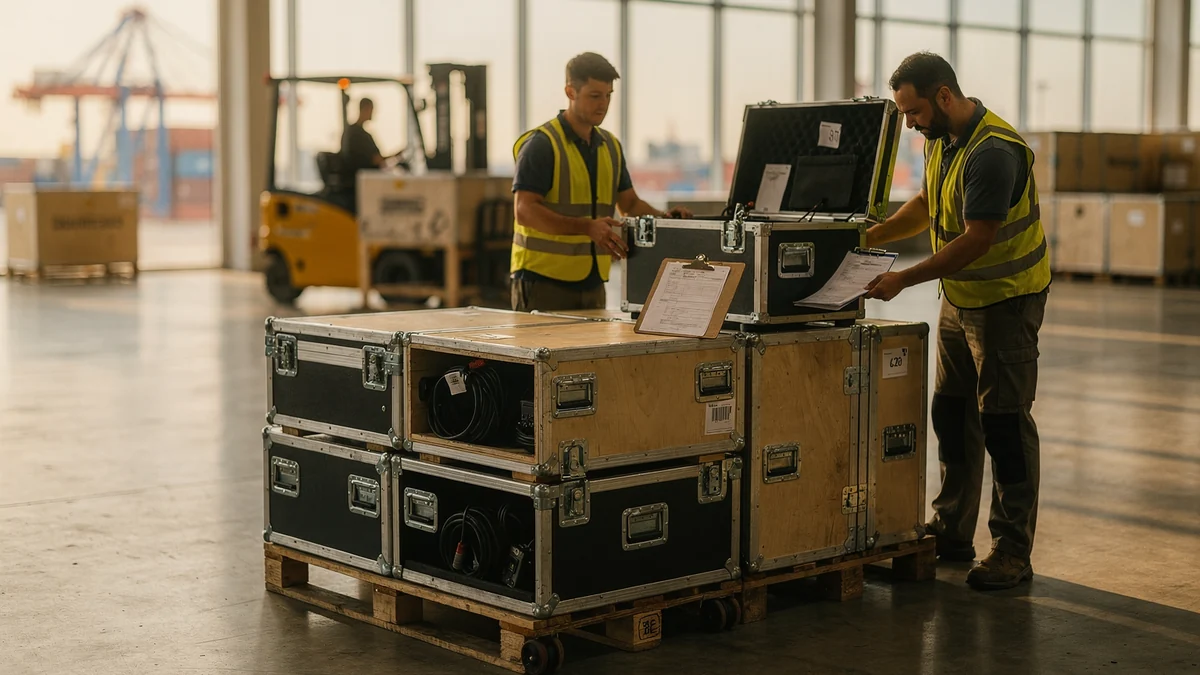
An ATA Carnet is an international customs document — the “passport for goods” — that lets you bring goods into Malaysia without paying import duty or tax, provided they are re-exported within the allowed time. For goods or destinations a carnet does not cover, Malaysia’s Section 97 temporary-import facility does the same job against a refundable deposit or bank guarantee. Either way: duty is suspended, not waived — the goods must leave again.
Exhibition stands, broadcast and film kit, surveying instruments, demo machines, racing equipment, musical instruments and commercial samples all share one problem: they enter Malaysia, do a job, and go home. Paying full import duty and Sales Tax (SST) on something you will ship out in a few weeks makes no commercial sense — and Malaysian customs law agrees. This guide explains the two legitimate routes to bring goods in temporarily duty-free, what qualifies, the deadlines that matter, and how this differs from claiming duty drawback after the fact. It sits within the wider process we cover in how customs clearance works in Malaysia.
Key takeaways
- An ATA Carnet covers temporary import into over 80 countries and customs territories; more than 180,000 carnets are issued a year for goods worth over US$21 billion (ICC World Chambers Federation).
- Malaysia acceded to the ATA Convention in 1988; carnets here are issued by MICCI, the guaranteeing association appointed by the Royal Malaysian Customs Department — not MATRADE.
- Temporary-import goods must be re-exported within 3 months (Royal Malaysian Customs), extendable by the entry-point customs office in further periods up to about 12 months in total.
- Without a carnet, the Section 97 Customs Act 1967 facility releases goods duty-free against a deposit or banker’s guarantee equal to the duty at risk; you reclaim it on re-export with proof on Customs Form No. 2.
- This is not duty drawback: temporary import suspends duty up front; drawback means you paid it and claim it back later (Section 93: 90%, Section 99: 100%).
What is an ATA Carnet, and why is it called a passport for goods?
An ATA Carnet is a single international customs document that lets a traveller or business temporarily import goods into a member country duty-free and tax-free, with no deposit at that country’s border, then re-export them — replacing separate import paperwork and security in each country. “ATA” combines the French and English for temporary admission.
The nickname fits: like a passport, one carnet is presented at each border and stamped in and out across the whole network. The system is administered by the ICC World Chambers Federation (ICC/WCF), with a national guaranteeing association in each member country backed by an international guaranteeing chain. The ICC describes the document as good for “duty-free and tax-free temporary import of goods for up to one year” across more than 80 countries and customs territories, with “0 deposits to give to Customs during temporary admission.”
“More than 180,000 Carnets are issued every year worldwide, for goods with a total value of over US$21 billion.” — ICC World Chambers Federation
That scale matters for a Malaysian importer or event organiser: because the carnet is a recognised international instrument, customs officers at Port Klang or KLIA know exactly what it is, which removes the friction and delay that ad-hoc temporary-import requests can create.
Who issues ATA Carnets in Malaysia?
In Malaysia, ATA Carnets are issued by the Malaysian International Chamber of Commerce and Industry (MICCI), the guaranteeing association appointed by the Royal Malaysian Customs Department. MICCI sits within the ICC World Chambers Federation’s international guaranteeing chain. Despite what some sources state, MATRADE does not issue carnets.
This is worth being precise about, because it is commonly got wrong. The Royal Malaysian Customs Department’s own ATA Carnet page names MICCI as the guarantor that provides the guarantee “to protect the duties involved,” and MICCI states it “is appointed by the Royal Malaysian Customs as the guaranteeing agency for the issuance of ATA Carnet documents.” Malaysia acceded to the Convention on Temporary Admission of Goods (the ATA Convention) in 1988, the legal foundation for the country accepting and issuing carnets.
What does a carnet cost in Malaysia?
Per MICCI’s published schedule (as of June 2026; figures subject to change — confirm before you apply), carnet charges include base processing of RM550 for members and RM700 for non-members (3-day service), an RM20 carnet form, and RM50 per additional entry. Separately, MICCI requires security from the applicant — per its schedule, “50% of the value of the goods covered by the Carnet or equal to the highest rate of duty and taxes applicable to the goods in any country of destination and transit, if applicable, an additional of 10% — whichever is higher.” That security protects MICCI’s guarantee; it is not a payment to Malaysian customs.
How do you temporarily import goods into Malaysia without an ATA Carnet?
Where a carnet is not used, Malaysia’s temporary-import facility under Section 97 of the Customs Act 1967 lets the Director General release goods without paying duty against security — a cash deposit at least equal to the duty otherwise payable, or a banker’s guarantee, bank draft, letter of guarantee or general bond. The goods must then be re-exported within the approved period.
The Royal Malaysian Customs Department describes the facility as “the temporary importation of goods without payment of customs duty/tax with a security being given to the satisfaction of the Director General of Customs and with a view to subsequent re-exportation,” consistent with Section 97. In practice the steps are:
- Apply before arrival. A written application goes to the State Customs Director (Pengarah Kastam Negeri) at the station of import, with the commercial invoice, packing list, Bill of Lading or Air Waybill, and any permits the goods require.
- Lodge the security. Customs sets a deposit at least equal to the duty and tax at risk, or accepts a banker’s guarantee, bank draft, letter of guarantee or general bond in that amount.
- Declare and clear. The import is declared through SMK (Sistem Maklumat Kastam) via Dagang Net’s National Single Window, with supporting documents lodged in MyCIEDS — the same backbone covered in our guide to the K1, K2, K8 and K9 customs forms.
- Re-export on time and lodge the re-export declaration; submit a copy of Customs Form No. 2 as proof to recover the deposit or release the guarantee.
One thing to budget for: the security itself is refundable in full on clean re-export, but the costs around it — banker’s-guarantee fees, forwarding and declaration charges — are not. So the Section 97 route is duty-neutral, not entirely cost-free; you get your deposit back, not the bank’s fee for issuing the guarantee.
Two documents do different jobs in this loop, and it pays not to confuse them. The K8 declaration (Borang Kastam No. 8) is the form lodged in SMK for movements such as transit, transhipment and re-export of goods under customs control — the declaration that records temporarily imported goods leaving again, as set out in our guide to the K1, K2, K8 and K9 forms. Customs Form No. 2 is the stamped proof of export you submit afterwards to release your deposit or guarantee. One declares the re-export; the other evidences it. Clean evidence on both is what unlocks the refund.
Which goods qualify for temporary import — and which are excluded?
ATA Carnets cover three categories: commercial samples, professional equipment (tools of the trade), and goods for display or use at events, fairs and exhibitions. Malaysia’s Section 97 facility additionally allows items for research, demonstration, evaluation, testing, performances and repair. Perishables, goods intended for sale, and goods for reprocessing are excluded.
Typical qualifying cargo includes exhibition stands and displays, broadcast and film production kit, photographic and surveying instruments, demonstration machinery, laboratory and medical equipment, musical instruments, sports and racing equipment, and commercial samples that are not for sale. The Royal Malaysian Customs Department lists qualifying purposes for the facility as research and demonstration; exhibitions and performances (drama, music, circus); events such as tourism, sports and conferences; evaluation and testing; and repair.
The same customs source is explicit about what carnets do not cover: perishable goods, goods that are sold or offered for sale, gems, goods imported for reprocessing or repair (these need a different treatment), vehicles, and postal traffic. If goods are sold while in Malaysia, the suspended duty and tax become payable immediately. And anything that is otherwise prohibited or restricted to import still needs its permit — temporary status does not override an import ban, as we explain in prohibited and restricted imports in Malaysia.
What is the re-export deadline, and what happens if you miss it?
Goods temporarily imported into Malaysia must be re-exported within 3 months of import. The entry-point customs office can approve extensions on application before the period expires — in further periods, up to about 12 months in total as a matter of general practice, with anything beyond requiring Director General approval. Miss the deadline and the suspended duty and tax fall due, and a carnet or guarantee can be claimed against.
The Royal Malaysian Customs Department states that temporarily imported goods “must be re-exported within 3 months from the import date,” with extensions granted by the entry-point customs office before the original approval lapses; for the Section 97 facility, extensions may run in further periods up to a total of about 12 months, with anything beyond requiring Director General approval through the State Customs Director. If re-export fails, customs requires the duty and tax to be declared and paid at a customs office — and under a carnet, MICCI’s guarantee answers to the foreign customs administration, then recovers from the holder. The practical lesson: treat the re-export date like a flight you cannot miss, and apply for any extension early.
ATA Carnet vs temporary import vs duty drawback: which should you use?
Use an ATA Carnet when goods travel internationally and the destination is in the carnet network — one document, no border deposit. Use the Section 97 facility when a carnet is unavailable but the goods are still leaving. Use duty drawback only when you have already imported and paid duty and later decide to re-export. They are three different tools.
The key distinction is timing of the money. Temporary import (carnet or Section 97) suspends duty up front because the goods were never meant to stay. Duty drawback is the opposite: you paid the duty in full on import, then claim a refund after re-exporting — under the Customs Act 1967, a re-exporter can recover 90% of the duty (Section 93) and a manufacturer who re-exports imported inputs can recover the full 100% (Section 99), the facility set out in MITI’s guidance on duty drawback under Section 99. The 2019 amendment cut the Section 93 re-export window from 12 months to 3 months and raised the minimum claim from RM50 to RM200, as reported by Baker McKenzie’s Global Compliance News. So drawback is the fallback when you did not plan a temporary import; it ties up cash and is capped at 90% for a straight re-export.
| Feature | ATA Carnet | Temporary import (Section 97) | Duty drawback |
|---|---|---|---|
| Pay duty on entry? | No | No (but post security) | Yes, in full |
| Security needed at MY border | None (MICCI guarantee) | Deposit or banker’s guarantee | Not applicable |
| Cash refunded? | Nothing to refund | Deposit returned on re-export | Refund claimed after re-export |
| How much you recover | 100% (no duty paid) | 100% of deposit | 90% (S.93) / 100% (S.99) |
| Re-export window | 3 months (MY), carnet valid 1 yr | 3 months, extendable to ~12 | 3 months (S.93) |
| Issued / governed by | MICCI / ICC WCF | Royal Malaysian Customs | Royal Malaysian Customs |
| Best when | Touring kit, multi-country events | One-off temporary import, no carnet | You already imported & paid |
For a typical Malaysian use case — a foreign exhibitor at a Kuala Lumpur trade show, or a film crew shooting in Selangor — the carnet is usually cleanest. For an importer who already paid duty before deciding to ship goods back out, drawback is the route. We help clients pick the right one before the goods move, because switching afterwards is expensive.
How DNE Forwarding handles temporary imports at Port Klang
DNE Forwarding files the customs declaration, arranges the deposit or banker’s guarantee, tracks the re-export deadline and lodges the re-export proof so your security is released. As a JKDM-licensed forwarder clearing over 1,000 containers a month at Port Klang, we keep temporary-import jobs on schedule and on the right form.
Temporary imports go wrong in predictable ways: the wrong declaration, security set higher than necessary, a missed re-export date that converts a duty-free entry into a tax bill, or re-export evidence that customs will not accept. DNE Forwarding — founded in 1999, Reg. 538624-W, with 25+ years in Port Klang and a 99%+ documentation-compliance record — manages the whole loop: validating whether a carnet or the Section 97 facility fits, declaring through SMK on the National Single Window, structuring the deposit or guarantee, and closing the file with clean Customs Form No. 2 re-export proof. If your goods are coming for a show, a shoot, a demo or a test, talk to us before they ship.
Frequently asked questions
What is an ATA Carnet and does Malaysia accept it?
An ATA Carnet is an international customs document — nicknamed the “passport for goods” — that lets you temporarily import goods into a country duty-free and tax-free, then re-export them, using one paper. Malaysia accepts ATA Carnets; it acceded to the ATA Convention in 1988 and carnets are issued locally by MICCI.
Who issues ATA Carnets in Malaysia?
The Malaysian International Chamber of Commerce and Industry (MICCI) is the guaranteeing association appointed by the Royal Malaysian Customs Department to issue ATA Carnets in Malaysia. MICCI is part of the international guaranteeing chain administered by the ICC World Chambers Federation. MATRADE does not issue carnets.
How long can goods stay in Malaysia under temporary import?
Goods temporarily imported into Malaysia — whether under an ATA Carnet or the Section 97 facility — must be re-exported within 3 months of import. Extensions may be approved by the entry-point customs office, generally in further periods up to a total of around 12 months, on application before the original period expires.
What goods qualify for temporary import into Malaysia?
ATA Carnets cover three categories: commercial samples, professional equipment (tools of the trade), and goods for display or use at events, fairs and exhibitions. The Section 97 facility also covers items for research, demonstration, evaluation, testing, performances and repair. Perishables, goods for sale, and goods for reprocessing are excluded.
Do I need a bank guarantee if I don’t use an ATA Carnet?
Yes. Under Section 97 of the Customs Act 1967, Customs releases temporarily imported goods without duty only against security — a cash deposit at least equal to the duty payable, or a banker’s guarantee, bank draft, letter of guarantee or general bond. The carnet replaces this with MICCI’s standing international guarantee, so you post no deposit at the Malaysian border.
Is temporary import the same as duty drawback?
No. Temporary import (carnet or Section 97) suspends duty up front because the goods were never meant to stay — you pay nothing or get a refundable deposit back on re-export. Duty drawback means you paid the duty in full on entry and later claim a refund after re-exporting, under Section 93 (90%) or Section 99 (100%) of the Customs Act 1967.
Sources
- ICC / ICC World Chambers Federation — ATA Carnet (validity, 80+ territories, no border deposit): iccwbo.org/business-solutions/ata-carnet
- ICC World Chambers Federation — 180,000+ carnets / US$21bn a year: iccwbo.org news
- Royal Malaysian Customs Department (JKDM) — ATA Carnet (MICCI guarantor, 3-month re-export, excluded goods): customs.gov.my ATA Carnet
- Royal Malaysian Customs Department (JKDM) — Temporary Import Facility (Section 97, security forms, extensions, Customs Form No. 2): customs.gov.my temporary import
- MICCI — ATA Carnet (issuing authority, fees, security): micci.com/ata-carnet
- U.S. International Trade Administration — Malaysia Temporary Entry (1988 accession): trade.gov
- MITI — Duty Drawback under Section 99 of the Customs Act 1967: miti.gov.my (PDF)
- Baker McKenzie / Global Compliance News — 2019 Customs Act amendment (Section 93 drawback window, minimum claim): globalcompliancenews.com
Part of a guide: this article is part of DNE's complete guide to customs clearance in Malaysia.
Part of a guide: this article is part of our complete guide to Do You Need an Import Permit? A Guide to MITI AP, SIRIM, MAQIS & Other Requirements.