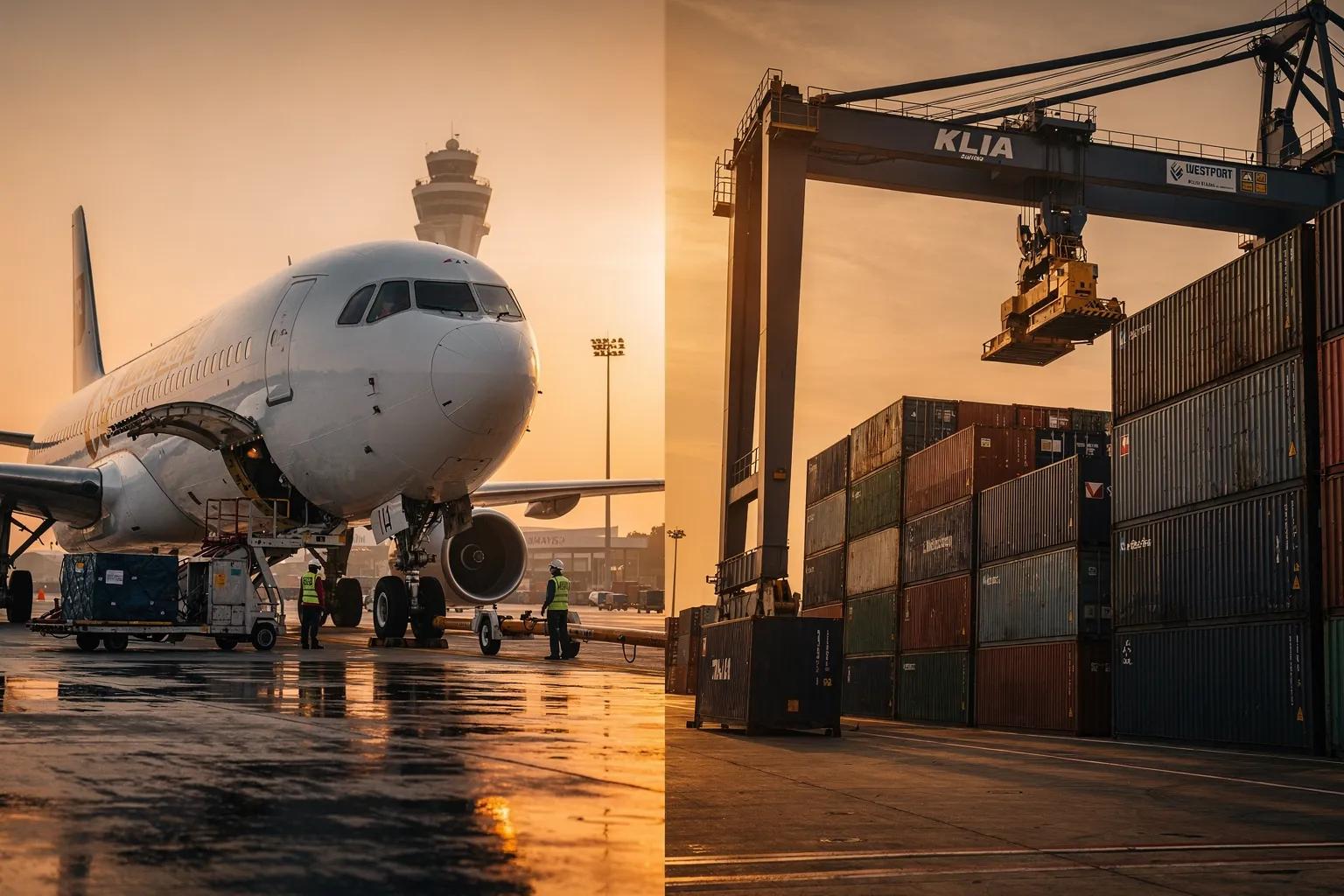
Sea freight rates out of Port Klang jumped 22 percent in May 2026 for 40-foot dry containers. Air freight collapsed 44 percent in the same window. The instinct most importers reach for is obvious: pivot to air while it is cheap. Most importers shouldn't.
This article walks through the per-kg math that makes that call, the weight bands where air actually wins, a worked example at five shipment sizes, and the hidden cost lines nobody puts in front of you when they quote air freight. If you ship more than 200 kg of dense cargo on any inbound lane, the answer for May and June 2026 is almost certainly to stay on sea, even at the higher rate, even with the air collapse. Here is why.
The two numbers everyone is reading
Two data points are driving the panic this month. The first: 40-foot dry container rates landed between USD 855 and USD 1,045 in early May 2026 on Asia inbound to Port Klang, up roughly 22 percent month on month from the April 700s. The second: belly-hold air freight collapsed to USD 1.57 per kg headline, down about 44 percent from where it was running in Q1 2026, on the back of weak westbound passenger demand and a glut of belly capacity returning to Asia routes.
If you read both in isolation, switching modes looks free. It is not, because the headline air rate is roughly half the real all-in air rate by the time your goods arrive at your warehouse in Shah Alam or Petaling Jaya.
The per-kg formula every CFO should know
Every mode decision should be made on landed cost per kg, not on the headline freight rate. The full formula for a Malaysian importer is:
Landed cost per kg = (base freight + carrier surcharges + handling at origin + handling at destination + customs clearance + duty + SST) divided by chargeable weight
Chargeable weight, not actual weight. For air freight that distinction matters because carriers bill the greater of actual weight or volumetric weight (the cargo volume in cubic centimetres divided by 6,000). A light, bulky shipment is billed on volume, not on the scale.
Once you run that formula, the sea-vs-air gap rarely closes the way the headline numbers suggest.
What the headline air rate leaves out
USD 1.57 per kg is the base rate for the airline main-deck or belly leg. By the time the box reaches your warehouse it has picked up:
- Fuel surcharge (FSC). Currently around USD 0.30 to USD 0.45 per kg on Asia-to-KUL routes, revised monthly.
- Security surcharge (SSC). USD 0.10 to USD 0.20 per kg, levied by IATA-registered carriers.
- Origin handling (terminal, X-ray, lift-on). USD 60 to USD 120 flat per shipment.
- KLIA Cargo Village handling. RM 0.40 to RM 0.60 per kg (about USD 0.09 to USD 0.13), plus a roughly RM 100 lodgement fee.
- Air customs clearance. Forwarder fees for air clearance run roughly 3x the cost of sea, because the K1 paperwork is the same but the timeline is compressed into a few hours and the clearance has to be inside the airport bonded zone.
- Trucking from KLIA to your warehouse. RM 350 to RM 600 per shipment for Klang Valley delivery.
- Demurrage if you cannot pick up within 48 hours. Air demurrage is steep: roughly RM 0.20 per kg per day after the free period at KLIA Cargo Village.
Add all of that, and a USD 1.57 per kg headline rate lands closer to USD 2.20 to USD 2.50 per kg on a 500 kg dense shipment from China to Port Klang. For lighter or smaller shipments, the per-kg all-in climbs even higher because the flat fees do not scale with weight.
What the headline sea rate also leaves out
To be fair to the air side, sea freight has its own hidden lines. For a 40-foot inbound container, the typical Port Klang line item stack looks like this:
| Line item | Typical range (May 2026) |
|---|---|
| Base ocean freight (Shanghai, Ningbo, Yantian to Port Klang) | USD 855 to USD 1,045 |
| Origin BAF / fuel adjustment | USD 80 to USD 150 |
| Origin terminal handling (THC) | USD 220 to USD 280 |
| Destination THC at Port Klang (Westport / Northport) | RM 700 to RM 850 |
| D/O fee and release | RM 250 to RM 400 |
| Customs clearance (K1) by your forwarding agent | RM 250 to RM 450 |
| Haulage from port to your warehouse (Klang Valley) | RM 850 to RM 1,400 |
| Lift-on / lift-off at warehouse | RM 100 to RM 180 |
Convert to a per-kg figure on a fully utilised 40-foot box (25 tonnes of dense cargo): the all-in lands at roughly USD 0.16 to USD 0.20 per kg. At half utilisation (12.5 tonnes), it doubles. At a quarter (6 tonnes), it doubles again to about USD 0.65 per kg. Sea freight is only cheap when the box is full or close to it.
The weight bands: where each mode actually wins
Here is the rule of thumb every importer should keep on a sticky note. These numbers assume an inbound lane from any major China origin port to Port Klang, May 2026 conditions.
| Shipment size (chargeable weight) | Cheapest mode in May 2026 | Why |
|---|---|---|
| Under 50 kg | Express courier (FedEx / DHL / UPS) | Forwarder minimum fees on both air and sea dwarf the freight cost. Express all-in flat rate wins. |
| 50 to 200 kg | Air freight | Sea LCL has minimum 1 cbm billing. Below 1 cbm of cargo (roughly 200 kg dense), LCL overpays for empty volume. |
| 200 to 800 kg, dense | Sea LCL (consolidation) | LCL at USD 18 per cbm beats air all-in on per-kg cost, even at the air collapse rate. The 18-day extra transit is the cost of being right. |
| 800 kg to 10 tonnes, dense | Sea LCL or shared 20-foot | Same per-kg logic. Sea wins by a wide margin. |
| 10 to 25 tonnes | Sea FCL (20-foot or 40-foot) | Even at +22 percent, the per-kg math is unbeatable. |
| Above 25 tonnes | Sea FCL (40-foot HC) or multiple boxes | Air capacity does not exist at this scale for most lanes outside of express bulk. |
The 200 kg threshold is the one to remember. Below 200 kg, air starts to make sense even at the headline figures. Above 200 kg, the math almost never flips, unless your stockout cost or shelf-life loss is severe enough to outrun the freight delta.
Worked example: 500 kg of consumer electronics from Guangzhou to Klang
Take a 500 kg shipment of consumer electronics, dense cargo, billed on weight not volume.
Sea LCL option (May 2026):
- Cargo volume: roughly 2.5 cbm
- LCL freight: 2.5 cbm x USD 18 = USD 45
- Origin handling, doc, port-of-loading fees: USD 80
- Port Klang LCL terminal handling, D/O, K1, trucking: RM 1,500 (about USD 320)
- Total landed freight: about USD 445, or USD 0.89 per kg.
Air freight option (May 2026, headline):
- Air freight: 500 kg x USD 1.57 = USD 785
- FSC + SSC: 500 kg x USD 0.45 = USD 225
- Origin handling + KLIA Cargo Village handling: USD 180
- Air clearance + trucking to warehouse: RM 1,200 (about USD 255)
- Total landed freight: about USD 1,445, or USD 2.89 per kg.
Air costs 3.2x as much for an 18-day saving. Unless your warehouse is genuinely running out and the stockout cost is more than USD 1,000 over 18 days, sea wins.
When the math actually flips
Air does beat sea in specific situations, and importers should know how to spot them.
- Sub-200 kg dense shipments. Already covered above.
- Time-critical electronics or fashion launches. If a missed launch costs more than the freight delta, air wins. Quantify the delta before deciding.
- High-value, theft-prone goods. Air handling chains are tighter. Pilferage risk at sea LCL terminals (especially LCL groupage) is higher than at airport bonded zones.
- Perishables and pharma. Cold chain is air-friendly in ways sea is not, even for non-reefer cargo with shorter shelf life.
- Single replenishment orders for low-stock SKUs. If you only need to top up a fast-mover by 200 to 400 kg and the next sea consolidation is two weeks out, air bridges the gap.
- Routes where capacity disappears. Some intra-Asia lanes (e.g. Hanoi to KUL) have very limited LCL frequency. Air is competitive on time-of-week availability.
The pattern: air wins on small, time-critical, fragile, or capacity-thin lanes. Sea wins on everything else, and "everything else" is roughly 85 percent of Malaysian inbound by tonnage.
The trap the May 2026 rate moves set for importers
Headline rate moves tempt the reactive importer to switch modes for a single shipment, lock in higher per-kg costs, and then forget to switch back when the rates normalise. Air rates will not stay at USD 1.57 per kg through the second half of 2026. The current collapse is driven by short-term belly capacity glut and weak passenger demand on certain Asia-Europe legs. Once peak season ramps in July and August, the per-kg air rate typically firms 25 to 40 percent.
An importer who switched in May and stayed switched will be paying air-rate-after-firming on cargo that should have moved sea. The damage compounds across each subsequent shipment.
What to do Monday morning: three plays
Play 1 - Run the per-kg landed cost on your top three SKUs
Pick the three SKUs that move the most volume on your inbound lane. Ask your forwarding agent to quote sea LCL/FCL and air for the same cargo, both with full all-in landed cost including handling, customs, and trucking. Compare per chargeable kg. Most importers will be surprised which lanes flip and which do not.
Play 2 - Set a 200 kg threshold rule for replenishment orders
Write the rule into your purchasing SOP: shipments under 200 kg may go air without further review. Shipments over 200 kg require sea unless explicitly overridden with a stockout-cost justification. This single line removes 70 percent of the modal-switching errors most importers make.
Play 3 - Renegotiate your LCL minimum-cbm-rate with your forwarder
If you are doing LCL volume out of Shanghai, Ningbo, Yantian, or Tanjung Pelepas transits, the May 2026 spot environment is a good moment to lock a 3-month LCL rate at slightly under spot, in exchange for predictable weekly volume. Forwarders will deal because containers are still moving below capacity. Lock it in May, ride the firming through August.
How DNE Forwarding helps importers run this decision
At DNE we have spent the last 25 years helping Malaysian importers and exporters make the per-kg landed cost call on real cargo. The May 2026 rate environment is exactly the kind of moment where the spread between a good and a bad mode-decision is widest. Here is what we are doing for clients right now:
- Mode comparison runs. Send us your top three inbound SKUs and origin port. We will run a full air-vs-sea-LCL-vs-sea-FCL landed cost comparison within 48 hours, with current war-risk and FSC overlays.
- LCL 3-month bridge negotiation. If you have stable monthly volume on a major China or intra-Asia origin, we negotiate a 3-month locked LCL rate with a surcharge cap on your behalf.
- Air-sea hybrid routing. For high-volume importers with mixed urgency, we structure a hybrid lane where 80 percent moves sea on a contract and 20 percent moves air for emergency replenishment, with shared documentation.
- Quarterly rate outlook briefings. We publish a private quarterly brief covering rate forecasts, peak-season capacity, and Port Klang operational notes for our customers. The next one is in July 2026.
The Malaysian importers who modally panic in May will pay for it through October. The ones who run the per-kg math, set the 200 kg rule, and lock a bridge contract will have a calmer second half on the freight line, regardless of which way the headlines move next.