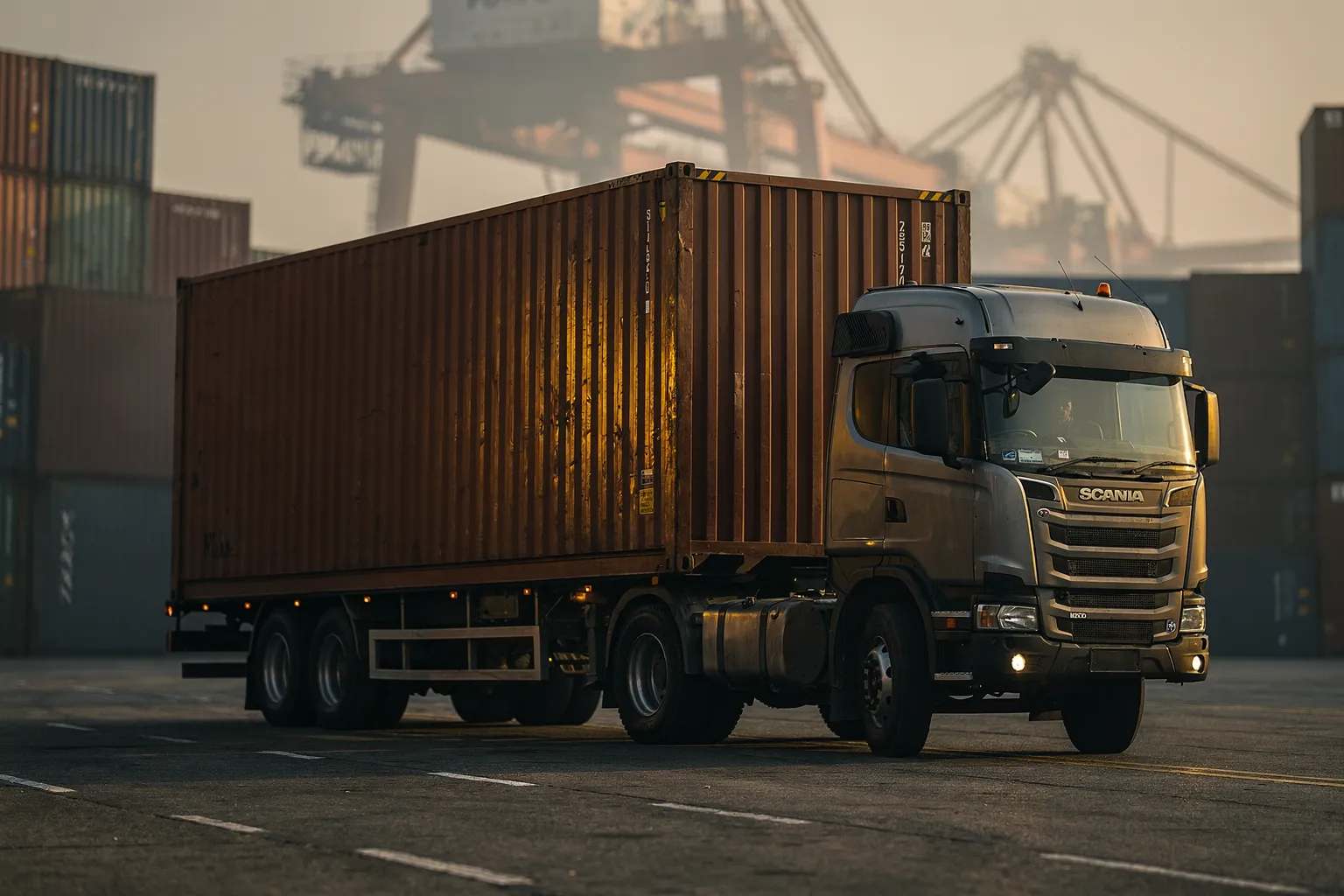
On 11 May 2026, the Ministry of Transport (MOT), the Land Public Transport Agency (APAD) and the Road Transport Department (JPJ) began joint enforcement of updated guidelines for open-platform semi-trailers carrying ISO containers. The new rules are short, specific, and operationally consequential — and they have already changed how compliant hauliers are quoting Port Klang routes this week.
If you are a Malaysian importer or exporter, the regulation does not sit on you. It sits on the haulier. But every operational consequence, from a stopped trailer to a missed delivery to a backed-up yard, lands directly on your customs clearance timeline and your factory's production calendar. This article unpacks exactly what changed, what to check with your haulier this week, and the lane-types most exposed at Port Klang.
The Six Conditions at a Glance
- Open-platform trailers must be capped at 45 feet in length
- Trailers must be fitted with integrated twist locks (no chain-only securing)
- The vehicle must be licensed under the KA (Perkhidmatan Kontena) category
- Use is restricted to Port-to-Business (P2B) and Business-to-Port (B2P) legs only
- Only 40-ft and 45-ft ISO containers may be carried on opens — no 20-ft
- Gross Vehicle Weight (GVW) must stay within JPJ BDM ceilings for the trailer class
What Changed on 11 May, and Why It Matters Now
Open-platform (flatbed) semi-trailers have been the workhorse of Malaysian container haulage for decades. They are cheaper to build than skeletal chassis, easier to repurpose for non-container loads, and form the backbone of mid-tier haulier fleets serving Port Klang, Pasir Gudang, and the inland industrial belts. For years, the regulatory line on how an open-platform trailer secures a container — and what classes of container it may carry — sat in a grey area that hauliers interpreted variably.
The 11 May guidelines close that grey area. The rules are not new tax policy or new tariffs. They are an enforcement framework, signalled long enough in advance that the larger national hauliers have had time to retrofit. The smaller and mid-tier operators, in many cases, have not. The point of enforcement is the roadside spot-check by APAD or JPJ; the point of cost is your supply chain.
What is genuinely new is that all three regulators are coordinating. Previously, JPJ might cite a weight breach while APAD let licensing slide, or vice versa. The 11 May framework gives APAD a clear mandate to stop non-KA-licensed trailers carrying containers on inland roads. That single change is enough to disrupt mid-tier haulier capacity at Port Klang during May and June, when DNE expects compliant capacity to be the binding constraint, not container availability.
Condition 1: The 45-Foot Length Cap
The first condition is the simplest. Any open-platform trailer carrying an ISO container must measure 45 feet or less from the kingpin to the rear of the deck. Historically, some hauliers ran 48-ft or even 53-ft trailers (more common in cross-border or specialty cargo) and used them opportunistically for container loads. Those trailers are now off the table for container work, regardless of how clean the rest of the paperwork is.
If your haulier's fleet includes longer trailers, ask them this week which trailers in their roster are compliant for your containers. A haulier with a mixed fleet does not have a fleet problem; they have an assignment problem. Insist that only compliant trailers be assigned to your loads, and that the trailer number be confirmed on the job sheet before the truck leaves the yard.
Condition 2: Integrated Twist Locks
Twist locks are the four corner-fitting devices that physically lock a container to the trailer deck. The new rules require integrated twist locks, meaning the locks must be permanently mounted on the trailer (welded or bolted into a recessed pocket), not bolted onto an after-market plate or relied upon as separate hardware. Chain-only securing, which some older flatbeds defaulted to for short hauls, is no longer acceptable.
This matters because twist locks are the difference between a container that stays on the trailer through an emergency stop and one that does not. Industry incident data over the past five years has shown that the majority of "lost container" highway incidents involved improvised securing rather than twist locks. The regulators have been waiting on industry to retrofit voluntarily; this rule forces it.
The retrofit cost per trailer is not trivial — typically RM 3,000 to RM 8,000 depending on trailer condition — and that is the cost dividing compliant operators from non-compliant ones right now. Ask your haulier directly whether their twist locks are integrated, and if they hesitate, ask for a photograph.
Condition 3: KA (Perkhidmatan Kontena) Licensing
The KA licence is the operator's class authorisation issued by APAD specifically for container service. It is distinct from the broader carrier permit a general haulier may hold. Many established Port Klang container hauliers already hold KA licences as a matter of course; many smaller regional operators do not, having historically operated under a general goods licence.
Under the 11 May rules, the licence class is now checked at the roadside. A trailer carrying a container on a public road must be operating under a valid KA licence linked to the operator's company. If the licence is missing, expired, or held under a different vehicle, the trailer can be stopped, and the cargo's onward movement becomes the operator's problem to resolve.
For importers, the practical step is one document request: ask your haulier for a copy of the KA licence number and validity period. A compliant operator will hand it over within hours. A non-compliant operator will delay, deflect, or claim it is held by a sister company. That delay is your signal.
Condition 4: P2B and B2P Routes Only
This condition is the one most importers misunderstand. The guidelines restrict open-platform trailer usage with ISO containers to Port-to-Business (P2B) legs (pulling a container from Westport or Northport to a factory or warehouse) and Business-to-Port (B2P) legs (returning a loaded export container from a factory to the port). Inland-to-inland container moves — for example, shuttling a loaded container between two factories, or warehouse-to-warehouse — are not within the open-platform allowance.
For most Klang Valley importers, this is not a problem in practice. The standard flow is Port Klang to factory and back, both of which are covered. Where this bites is in warehouse consolidation, return-empty inland repositioning, and certain regional distribution patterns. If your supply chain includes any of those, ask your forwarding agent to map the routes against the P2B/B2P definition and identify any legs that need to shift to skeletal chassis.
Condition 5: Only 40-ft and 45-ft Containers on Opens
Open-platform trailers may carry only 40-ft and 45-ft ISO containers under the new rules. The 20-ft container, which is the dominant size for heavier or lower-volume cargo, must be carried on a skeletal chassis built for the purpose — typically a 20-ft skeletal or a 40-ft skeletal with 20-ft locking positions.
This sounds technical but has a real planning consequence. If your import profile is heavy in 20-ft boxes (common for chemicals, machinery parts, dense raw materials), confirm with your haulier that they have sufficient skeletal capacity for your volume. Mid-tier hauliers who had been moving 20-ft boxes on opens for years now need to either rotate skeletals into the dispatch pool or partner with sub-hauliers — both of which take time.
Condition 6: GVW Within JPJ BDM Ceilings
The Berat Dengan Muatan (BDM) is the JPJ-prescribed maximum loaded weight for a given vehicle class. The 11 May rules signal that GVW enforcement against BDM is now a priority at spot-checks, alongside the other five conditions. A trailer that is structurally compliant but loaded beyond its BDM ceiling can still be stopped.
This is the condition that most importers and shippers underestimate, because it shifts attention to the cargo weight declared at booking. Underdeclared cargo weight is one of the most common errors in container shipping; a shipper who quotes 18 tonnes when the actual stuffed weight is 23 tonnes has just put the haulier (and your delivery) in the BDM danger zone without anyone realising. Best practice from here on is to confirm declared weights against actual VGM (Verified Gross Mass) data before the box leaves the port.
| Condition | What to verify | Who provides proof |
|---|---|---|
| Length cap (45 ft) | Trailer registration document showing kingpin-to-rear length | Haulier |
| Integrated twist locks | Trailer photograph showing four recessed corner twist locks | Haulier |
| KA licence | APAD KA licence number and validity period | Haulier |
| P2B / B2P route compliance | Route plan against your delivery network | Forwarding agent |
| 40-ft / 45-ft container only | Container size declared on booking; trailer assignment | Forwarding agent + haulier |
| GVW within BDM | VGM data from shipper; trailer BDM rating | Shipper + haulier |
Which Port Klang Lanes Are Most Exposed
Across the May volumes we are seeing at Port Klang, three lane-types are disproportionately exposed under the new framework:
- Pasir Gudang to Port Klang and back. Long-haul export cargo, often moving via mid-tier hauliers operating mixed fleets. Reports of trailer stoppages and licence challenges on this corridor have been emerging since enforcement began.
- Melaka leg deliveries. The Port Klang to Melaka inland leg has grown sharply in the past two months for several manufacturing customers. The route is unambiguously P2B (compliant), but distance and round-trip empty returns multiply the exposure to weight breaches and licence checks. A single trailer stoppage on this lane creates a half-day delay rather than the two-hour delay that a Klang-internal lane would.
- Klang-internal warehouse moves. Importers running consolidation flows between port-side warehousing and inland warehousing are most at risk of falling outside the P2B/B2P definition. If your operation includes those moves, this is the highest-priority lane to review with your forwarding agent.
What To Do This Week
This is not a "monitor for further updates" situation. The rules are in force now. Here is the operator's checklist for any importer or exporter moving containers through Port Klang in May 2026:
- Send your haulier a written proof request covering the KA licence number, trailer length, twist-lock spec, and the BDM rating of each trailer type they plan to assign to your loads this month. Response time is itself a signal — under 48 hours is acceptable; longer than that warrants a backup conversation with an alternative haulier.
- Audit your import lanes with your forwarding agent. Any leg that is not strictly Port-to-Business or Business-to-Port needs a different solution. For warehouse-to-warehouse moves, that may mean skeletal chassis or a different vehicle class entirely.
- Tighten weight declarations. Insist that VGM data from the origin port is captured on the booking and shared with the haulier before the box leaves the terminal. Underdeclared weights are the easiest BDM trap to fall into.
- Identify a compliant backup haulier for your most time-sensitive lanes. A single haulier dependency under a new enforcement regime is a brittle setup. A pre-qualified second haulier, even at 10–20% of your volume, gives you a fallback when a primary trailer is stopped.
- Brief your shipping/operations team on the six conditions. Most missed compliance breaks at the trailer-assignment step, not the policy-decision step. The dispatcher releasing the order needs to know which trailers in the haulier's fleet are KA-licensed and which are not.
The One Line to Send Your Haulier Today
"Following the 11 May MOT/APAD/JPJ enforcement on open-platform semi-trailers, please send me, in writing, the KA licence number, trailer length, and twist-lock spec for every trailer your dispatch will assign to our container loads for the remainder of May 2026. Confirm whether any of our scheduled moves fall outside the P2B/B2P definition. Please respond by close of business tomorrow."
How DNE Forwarding Is Approaching the New Rules
At DNE Forwarding, container haulage moves at Port Klang are split across compliant national hauliers operating fully retrofitted fleets. Our operational stance from 11 May has been simple: only trailers with verified KA licensing, integrated twist locks, and BDM-appropriate ratings are accepted onto our customers' jobs. That means we will occasionally turn down a marginal-cost option from a mid-tier haulier in favour of a more expensive compliant one. In a normal week, that is a 2–4% premium on the trip cost; under the current enforcement, it is the difference between a delivered container and a stopped one.
For customers running heavy May volumes through Klang, we are happy to share which legs in your specific lane profile are most exposed under the new framework, and which compliance proofs you should be requesting from your hauliers this week. The earlier you check, the cheaper the answer.
The new rules do not change what you import, where you import from, or what your landed cost looks like. They change one thing: which trailer can legally pull your box from Westport to your factory. That is a small change with an outsized impact, and the importers who treat it as a paperwork issue rather than an operations issue will be the ones surprised by a stopped delivery in the next four weeks.
The regulation isn't the risk. The hauliers who can't prove compliance are. Now is the week to find out which category yours falls into.