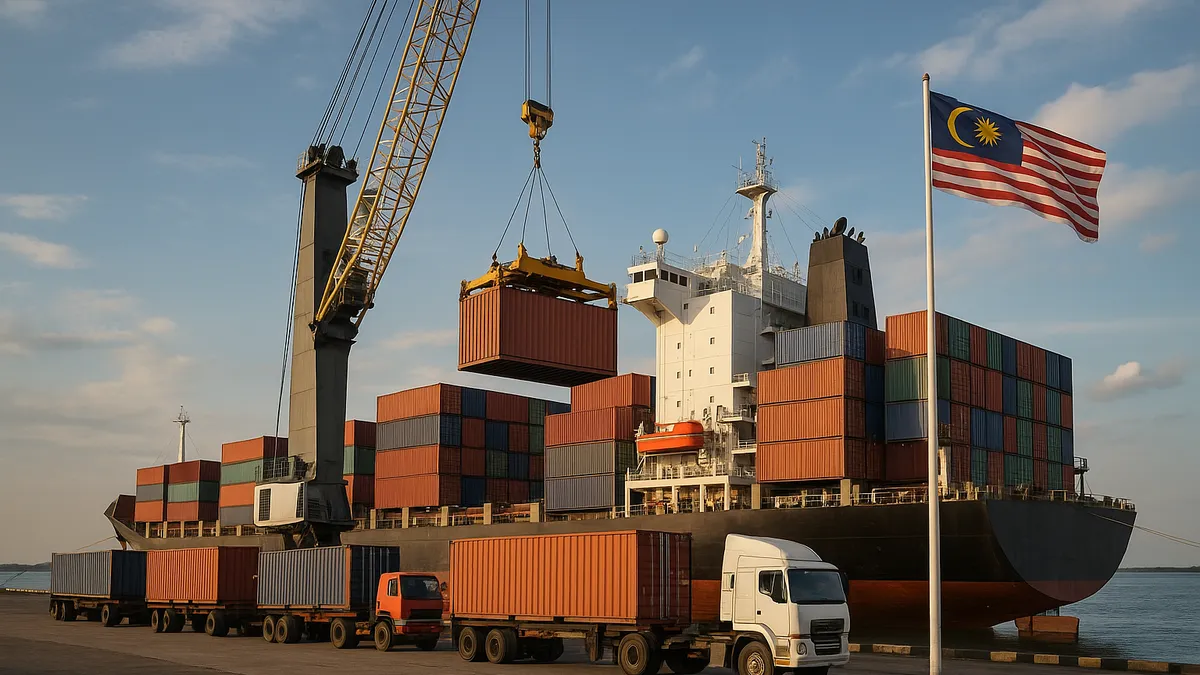
Malaysia is one of Southeast Asia's largest exporting nations. Electronics and electrical products, palm oil and palm-based products, petroleum and LNG, rubber goods, chemicals, and machinery flow outward through Malaysian ports every day, destined for markets across ASEAN, China, the European Union, the United States, Japan, and beyond. In 2025, Malaysia's total exports exceeded RM1.5 trillion, underscoring the country's position as a critical node in global supply chains.
Yet for many Malaysian manufacturers and traders — particularly those exporting for the first time — the export process can seem daunting. There are customs declarations to file, permits to obtain for controlled goods, Certificates of Origin to arrange if your buyer wants preferential tariff rates, and strict timelines for haulage and vessel bookings. Get any of these wrong and your cargo sits at port, racking up storage charges.
This guide walks through the entire Malaysian export process from start to finish: who can export, what documents you need, how the K2 customs declaration works, which goods require export permits, how Certificates of Origin tie into free trade agreements, and the practical logistics of getting your container from factory floor to vessel deck at Port Klang.
Who Can Export from Malaysia?
Any registered business entity in Malaysia can export goods, but you need the right registrations in place before your first shipment moves. The core requirements are:
- Company registration: Your business must be registered with the Suruhanjaya Syarikat Malaysia (SSM) — either as a Sdn Bhd, sole proprietorship, or partnership.
- Customs code: You must register with the Royal Malaysian Customs Department (JKDM) and obtain a customs code. This is a unique identifier tied to your company and is required for all customs declarations. Registration is done through the Customs portal.
- MATRADE exporter registration: While not mandatory for all exports, registration with the Malaysia External Trade Development Corporation (MATRADE) is required for certain product categories and provides access to export promotion programmes, trade missions, and market intelligence. Manufacturers exporting their own products should register to access MATRADE's support services.
- Sector-specific licences: Depending on what you export, you may need additional licences. Timber exporters require registration with the Malaysian Timber Industry Board (MTIB). Exporters of scheduled waste need Department of Environment (DOE) approval. Strategic goods require a permit under the Strategic Trade Act 2010.
If you are a manufacturer operating under a Licensed Manufacturing Warehouse (LMW) or within a Free Trade Zone (FTZ), your export procedures differ from standard exporters — we cover this in a dedicated section below.
The Export Process: Step by Step
Here is the standard sequence for exporting goods from Malaysia, from the moment you confirm an order with your overseas buyer to the point the vessel departs:
Step 1: Prepare Commercial Documents
Before anything moves, you need your commercial documentation in order. At minimum, this means a Commercial Invoice and Packing List. If your buyer has requested a Certificate of Origin for preferential tariff treatment under a free trade agreement, you need to arrange that as well (more on this below). These documents form the basis of your customs declaration and must be accurate — discrepancies between your invoice and your K2 declaration will trigger queries or rejections from JKDM.
Step 2: Obtain Export Permits (If Required)
Check whether your goods fall under Malaysia's list of controlled or restricted export items. If they do, you must obtain the relevant export permit or licence before your cargo is presented to Customs. Shipping without the required permit is an offence under the Customs Act 1967 and can result in seizure of goods and prosecution.
Step 3: Book Freight
Coordinate with your freight forwarder or shipping line to book space on a vessel. You will need to confirm the container type (20-foot, 40-foot, or 40-foot high-cube), the port of loading (typically Westport or Northport at Port Klang for Klang Valley exporters), and the sailing schedule. Early booking is important — popular trade lanes to China, the EU, and the US can have tight space availability during peak seasons.
Step 4: Arrange Haulage and Container Stuffing
Your freight forwarder arranges haulage to collect an empty container from the port depot and deliver it to your factory or warehouse for stuffing. Once loaded, the container is sealed with a customs-approved seal, and the truck returns it to the port for export.
Step 5: Submit K2 Customs Declaration
Your forwarding agent submits the K2 export declaration electronically through the Customs system. The K2 must be lodged and approved before the container can be loaded onto the vessel. We cover the K2 in detail below.
Step 6: Customs Inspection (If Selected)
JKDM may select your shipment for physical inspection. If selected, your container will be examined at the port before loading. Inspection rates vary — controlled goods and first-time exporters face higher inspection probabilities. Having your documents in order and your cargo properly declared significantly reduces the risk of delays during inspection.
Step 7: Cargo Loaded and Vessel Departs
Once the K2 is approved and any inspection cleared, your container is released for loading onto the vessel. The shipping line issues a Bill of Lading (B/L), which serves as the contract of carriage and the document of title for the goods. You send the B/L and other shipping documents to your buyer (or their bank, if payment is via letter of credit) so they can clear the goods at the destination port.
Export Timeline at a Glance
- Documents preparation: 2-5 working days before shipment
- Export permit application (if needed): 3-10 working days depending on agency
- Certificate of Origin: 1-3 working days
- Haulage and container stuffing: 1-2 days
- K2 declaration and approval: Same day (if documents are complete)
- Customs inspection (if selected): 1-2 days additional
Required Export Documents
Every export shipment from Malaysia requires a set of core documents. Missing or inaccurate documents are the single most common cause of export delays. Here is what you need:
- Commercial Invoice: Issued by the exporter to the buyer. Must show seller and buyer details, description of goods, quantity, unit price, total value, currency, Incoterms, and payment terms. The invoice value on the K2 must match the Commercial Invoice exactly.
- Packing List: Details the contents of each package, carton, or container — including dimensions, gross weight, net weight, and marks and numbers. This is cross-referenced against the K2 declaration and is essential for any physical inspection.
- K2 Export Declaration Form: The official customs export declaration submitted electronically to JKDM. This is the legal document that authorises the export of your goods.
- Bill of Lading (B/L): Issued by the shipping line after the cargo is loaded. For air freight, this is an Air Waybill (AWB). The B/L serves as proof of shipment and document of title.
- Certificate of Origin (CO): Required if the buyer wants to claim preferential (reduced or zero) import duty at the destination country under a free trade agreement. Not required for every shipment — only when the buyer requests it and the goods qualify under the relevant FTA's rules of origin.
- Export Permit/Licence: Required only for controlled or restricted goods. The specific permit depends on the product category and the issuing agency.
Export Permits and Controlled Items
Not all goods can be freely exported from Malaysia. Certain categories require an export licence or Approved Permit (AP) from the relevant government agency. Exporting controlled goods without the proper permit is a serious offence.
MATRADE's Role
MATRADE administers export licences for several categories of goods. Beyond licensing, MATRADE plays a broader role in promoting Malaysian exports through trade missions, market development grants (under the Market Development Grant or MDG scheme), and export readiness programmes. Exporters should register with MATRADE to access these resources.
Common Categories Requiring Export Permits
- Timber and timber products: Export of logs, sawn timber, and certain processed timber products requires a licence from the Malaysian Timber Industry Board (MTIB). Malaysia's timber export controls support sustainable forestry management and compliance with international conventions like CITES for protected species.
- Scheduled waste: Export of scheduled waste (as defined under the Environmental Quality Act 1974) requires prior written approval from the Department of Environment (DOE). This includes certain industrial by-products, chemical waste, and e-waste. The Basel Convention governs transboundary movement of hazardous waste, and Malaysia enforces its provisions strictly.
- Arms, ammunition, and explosives: Controlled under the Arms Act 1960 and require permits from the Ministry of Defence and Royal Malaysia Police.
- Strategic goods: Under the Strategic Trade Act 2010 (STA), Malaysia controls the export of goods that could be used in the development of weapons of mass destruction or for military purposes. The Strategic Trade Secretariat (under the Ministry of Investment, Trade and Industry — MITI) administers the STA. Exporters of dual-use goods — items that have both civilian and military applications — must check whether their products fall under the STA's Strategic Items list before exporting. If they do, a strategic trade permit is required.
- Petroleum and petroleum products: Export controlled by the Ministry of Domestic Trade and Cost of Living (KPDN) and Petronas.
- Rice, sugar, and controlled food items: Certain essential food items have export restrictions administered by the Ministry of Agriculture and Food Security.
If you are unsure whether your product requires an export permit, check with your forwarding agent or contact the relevant agency before booking your shipment. Discovering a permit requirement at the port is far more expensive than checking in advance.
Certificate of Origin: Types, Application, and Processing
A Certificate of Origin (CO) is a document that certifies in which country the goods being exported were manufactured or produced. While not required for every export shipment, a CO becomes essential when your buyer wants to claim preferential tariff rates under a free trade agreement (FTA) at the destination country.
Types of Certificate of Origin
Malaysia is party to multiple FTAs, and each has its own CO form:
- Form D: For exports to ASEAN member countries under the ASEAN Trade in Goods Agreement (ATIGA). This is the most commonly used preferential CO for Malaysian exporters shipping to Singapore, Thailand, Indonesia, Vietnam, the Philippines, and other ASEAN markets.
- Form E: For exports to China under the ASEAN-China Free Trade Agreement (ACFTA). Widely used given the volume of Malaysia-China trade.
- Form AK: For exports to South Korea under the ASEAN-Korea Free Trade Agreement.
- Form AJ: For exports to Japan under the ASEAN-Japan Comprehensive Economic Partnership (AJCEP).
- Form AANZ: For exports to Australia and New Zealand under the ASEAN-Australia-New Zealand FTA.
- Form AI: For exports to India under the ASEAN-India FTA.
- RCEP Certificate of Origin: For exports to any RCEP member country (ASEAN + China, Japan, South Korea, Australia, New Zealand). The RCEP CO provides an alternative to the bilateral FTA forms and can sometimes be simpler to obtain.
- CPTPP Certificate of Origin: For exports to Comprehensive and Progressive Agreement for Trans-Pacific Partnership member countries. Under CPTPP, exporters can self-certify origin in some cases.
- Ordinary CO (non-preferential): A standard CO that certifies the country of origin but does not confer any tariff preference. Used when the destination country requires proof of origin for statistical or regulatory purposes.
Where to Apply
Preferential COs are issued by MATRADE or authorised Chambers of Commerce (such as the Malay Chamber of Commerce, Associated Chinese Chambers of Commerce and Industry of Malaysia, or the National Chamber of Commerce and Industry of Malaysia). Exporters must register with the issuing body and submit supporting documents including the Commercial Invoice, Packing List, and a production cost statement demonstrating that the goods meet the FTA's rules of origin criteria.
Processing Time
Standard processing takes 1 to 3 working days from the date of application, provided all documents are in order. Urgent or same-day processing is available at some issuing bodies for an additional fee. Applications submitted with incomplete documentation or incorrect origin calculations will be returned for amendment, adding days to the timeline.
CO Tip for Exporters
- Always confirm with your buyer which specific FTA form they need — using the wrong form means the buyer cannot claim the tariff preference
- Ensure the product description, HS code, and value on the CO match the Commercial Invoice exactly
- Keep records of your production cost breakdown — the issuing body may audit your origin calculations
- For RCEP, check whether self-certification is available for your product and destination
The K2 Export Customs Declaration
The K2 form is the official customs export declaration for goods leaving Malaysia. It is submitted electronically by your licensed forwarding agent through the JKDM customs system. The K2 serves as the legal basis for the export — without an approved K2, your cargo cannot be loaded onto the vessel.
Key Fields on the K2
- Exporter details: Company name, address, and customs code
- Consignee: The overseas buyer or receiver of the goods
- HS tariff code: The correct Harmonized System classification for each item. Incorrect HS codes are one of the most common causes of K2 rejections and can trigger penalties. (See also: our guide to Malaysian customs forms.)
- Description of goods: Must match the Commercial Invoice
- Quantity and unit of measurement: As per Packing List
- FOB value: Free on Board value in the declared currency
- Country of destination: Final destination country
- Port of loading: Typically Westport or Northport (Port Klang), Penang Port, Johor Port, or other gazetted port
- Permit/licence number: If applicable for controlled goods
Electronic Submission
K2 declarations are submitted electronically through the JKDM customs system. Your forwarding agent lodges the declaration along with supporting documents. The system performs automated checks — verifying that the HS codes are valid, that any required permits are attached, and that the exporter's customs code is active. If everything passes, the K2 is approved and a release number is generated. If the system flags any discrepancies, the declaration is held for manual review by a Customs officer.
Supporting Documents for K2
The following documents must be available to support the K2 declaration, and may need to be uploaded to the system:
- Commercial Invoice
- Packing List
- Export permit or licence (if applicable)
- Certificate of Origin (if issued)
- Any other agency-specific documentation (e.g., MTIB licence for timber, DOE approval for scheduled waste)
Haulage to Port: Factory to Vessel
Getting your cargo from your factory or warehouse to the port is a critical step that requires careful coordination. For exporters in the Klang Valley, this typically means haulage to Port Klang — either Westport or Northport, depending on which terminal your shipping line uses.
Container Collection and Stuffing
The standard process for full container load (FCL) export shipments is:
- Empty container collection: Your haulier collects an empty container from the port or an inland container depot (ICD). The container must match the booking — 20-foot, 40-foot, or 40-foot high-cube.
- Delivery to factory: The empty container is delivered to your factory or warehouse for stuffing (loading).
- Stuffing and sealing: Goods are loaded into the container according to the Packing List. The container is sealed with a numbered seal, and the seal number is recorded for the customs declaration and B/L.
- Return to port: The loaded container is transported back to the port terminal for export.
For less than container load (LCL) shipments, your cargo is delivered to a consolidation warehouse where it is combined with other exporters' shipments into a shared container.
VGM: Verified Gross Mass
Under the SOLAS (Safety of Life at Sea) Convention, every packed export container must have a Verified Gross Mass (VGM) declaration submitted to the shipping line before the container can be loaded onto the vessel. The VGM is the total weight of the cargo plus the tare weight of the container itself.
There are two methods for determining VGM:
- Method 1: Weigh the packed container on a calibrated weighbridge after stuffing. This is the most straightforward approach.
- Method 2: Weigh all packages and cargo items individually, add the container tare weight (printed on the container door), and calculate the total. This method requires a certified calculation process.
Failure to submit VGM means your container will not be loaded. This is a hard rule — no exceptions. Your forwarding agent can handle VGM submission as part of the export process, but the shipper (exporter) is ultimately responsible for the accuracy of the declared weight.
Exporting from FTZ or LMW
If your factory operates within a Free Trade Zone (FTZ) or under a Licensed Manufacturing Warehouse (LMW) licence, your export procedures are simplified compared to standard exporters.
FTZ Exports
Goods manufactured or processed within an FTZ and exported directly to an overseas destination enjoy simplified customs procedures. Export from an FTZ to an overseas destination does not require a standard K2 declaration in the same way. Instead, the movement is documented under the FTZ's own framework, with JKDM oversight at the zone level.
LMW Exports
Licensed Manufacturing Warehouses are bonded facilities where imported raw materials can be stored and processed without payment of import duty, provided the finished goods are exported. Exports from LMW premises may use the K8 form instead of the K2 for certain movements, particularly for the removal of goods from the bonded premise. The specific form depends on whether the goods are moving to a port for direct export, to another bonded facility, or to the domestic market (in which case full duty and tax become payable).
FTZ and LMW Advantage
- No import duty on raw materials used in export-oriented production
- Simplified export documentation and customs procedures
- Faster clearance times due to zone-level customs oversight
- Duty-free treatment on re-export of imported components
Common Export Mistakes to Avoid
After handling thousands of export shipments, we have seen the same mistakes cause delays and penalties repeatedly. Here are the most common pitfalls:
- Missing permits for controlled goods: Exporters discover at the point of K2 submission that their product requires an export licence they do not have. This can delay your shipment by days or weeks while the permit is processed. Always check permit requirements during the order stage, not at the shipping stage.
- Incorrect HS codes on the K2: Using the wrong Harmonized System tariff code is one of the most frequent causes of declaration rejections. HS codes affect duty rates (if applicable), permit requirements, and statistical reporting. A wrong code can trigger a Customs query, delay your shipment, and in serious cases lead to penalties for misdeclaration.
- Certificate of Origin not matching the invoice: If the product description, quantity, value, or HS code on the CO does not match the Commercial Invoice, the CO will be rejected by the buyer's customs authority. Your buyer loses the preferential tariff rate, pays full duty, and is unlikely to be happy about it. Double-check every field before submitting your CO application.
- VGM not submitted on time: The shipping line will not load your container without VGM. If you miss the VGM cut-off, your container rolls to the next sailing — adding days or weeks to your delivery timeline, plus potential storage charges at the port.
- Late booking: During peak shipping seasons, vessel space fills up quickly. Booking too late can mean your cargo misses the intended sailing. For time-sensitive shipments, book at least 1-2 weeks in advance and confirm space allocation with the shipping line.
- Inconsistent documents: Discrepancies between the Commercial Invoice, Packing List, K2, and B/L — even minor ones like a difference in the number of decimal places on the weight — can trigger Customs queries. Use a single source of data for all documents to avoid transcription errors.
- Ignoring Incoterms implications: The Incoterm (FOB, CIF, CFR, etc.) on your invoice determines the responsibilities and risks for both buyer and seller. Misunderstanding your Incoterm obligations can lead to situations where nobody has arranged insurance, or both parties are trying to arrange haulage. Clarify Incoterms with your buyer before the first shipment.
How DNE Forwarding Handles Your Exports
At DNE Forwarding, we have been managing export shipments through Port Klang for over 25 years. We handle the entire export logistics chain so you can focus on manufacturing and selling. Here is what we do:
- K2 export declarations: Our licensed forwarding agents prepare and submit your K2 declarations accurately, with the correct HS codes and supporting documents. We flag any issues before submission, not after.
- Certificate of Origin assistance: We help you determine which CO form your buyer needs, prepare the application documentation, and coordinate with the issuing body. Whether it is a Form D for ASEAN, Form E for China, or an RCEP CO, we handle the process.
- Export permit coordination: If your goods require an export licence, we advise you on which permits are needed and help coordinate the application timeline so your shipment is not held up.
- Haulage: We arrange container collection, delivery to your factory for stuffing, VGM weighing, and return to port — all under our own coordination so you have a single point of contact.
- Carrier booking and port handling: We book vessel space with our network of shipping lines, manage container gate-in at the terminal, and track your shipment from port to vessel departure.
- End-to-end documentation: Invoice, Packing List, K2, B/L, CO — we ensure every document is consistent, accurate, and submitted on time. No discrepancies, no delays.
Whether you are exporting electronics to Singapore, palm oil products to the Middle East, or machinery to Europe, the fundamentals are the same: accurate documentation, correct customs classification, proper permits, and reliable logistics. That is what we deliver, shipment after shipment.