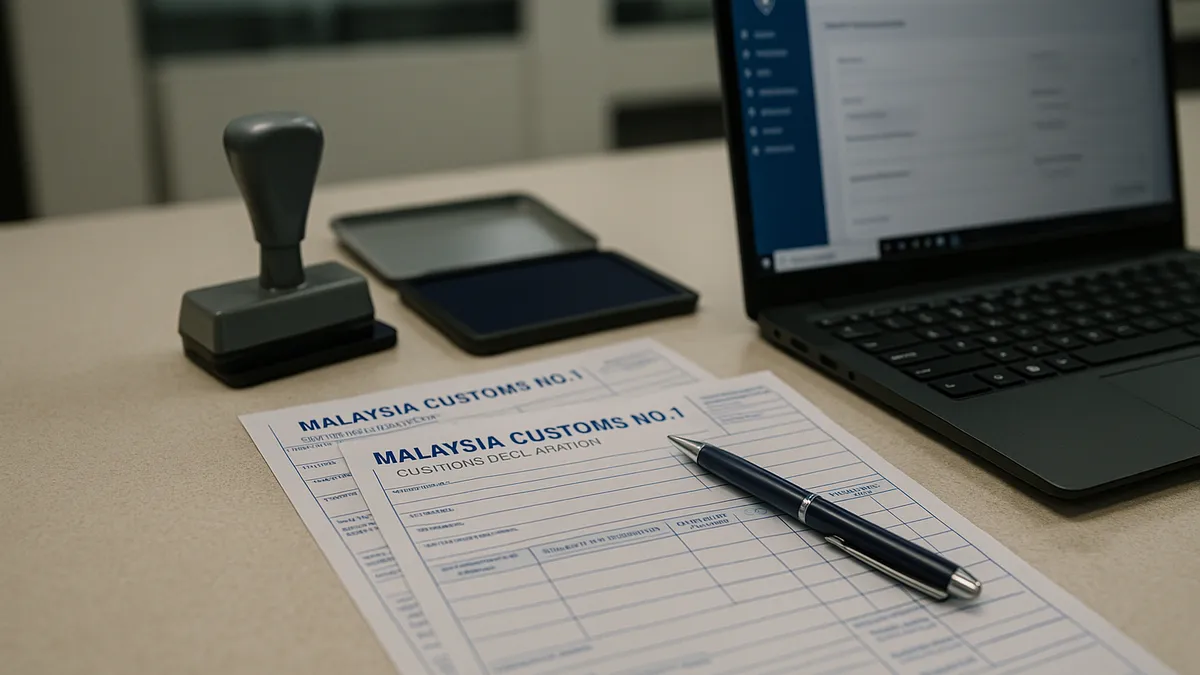
Every commercial shipment that crosses Malaysia's borders must be declared to the Royal Malaysian Customs Department (Jabatan Kastam Diraja Malaysia, or JKDM). The declaration is made using a family of prescribed forms — each identified by a "K" number — that tell Customs exactly what is moving, where it is going, and how much duty or tax is owed. Get the form right and your cargo clears smoothly. Get it wrong and you face delays, penalties, or seizure.
This guide explains the four most common customs declaration forms — K1, K2, K8 and K9 — in plain English. We also cover the lesser-known forms, the electronic filing system, supporting documents, common errors, and the penalties that follow mistakes. Whether you are a first-time importer or a seasoned manufacturer, understanding these forms is fundamental to doing business in Malaysia.
How the Malaysian Customs Declaration System Works
Under the Customs Act 1967 (Act 235), all goods imported into, exported from, or transiting through Malaysia must be declared to JKDM. The declaration serves multiple purposes: it enables the assessment and collection of import duties and Sales and Service Tax (SST), ensures compliance with trade regulations and permit requirements, and provides the government with trade statistics.
Declarations are submitted by the importer or exporter — or, far more commonly, by their licensed forwarding agent — using the prescribed Borang Kastam (Customs Forms). Each form type covers a specific scenario: importing, exporting, transhipping, moving goods within bonded areas, or removing goods from warehouses. The form you need depends entirely on what you are doing with the goods.
Quick Reference: Which Form Do You Need?
- K1 — Importing goods into Malaysia (paying duty and tax)
- K2 — Exporting goods from Malaysia
- K8 — Moving goods between bonded areas, free zones, or for transhipment
- K9 — Removing dutiable goods from a bonded warehouse or Licensed Manufacturing Warehouse (LMW)
K1 Form (Borang Kastam No. 1): Import Declaration
The K1 form is the most widely used customs declaration in Malaysia. Every time goods are imported into the country — whether by sea, air, or land — a K1 must be submitted to JKDM before the goods can be released from customs control.
When It Is Used
A K1 declaration is required for all commercial imports entering Malaysia's Principal Customs Area (PCA). This applies regardless of the mode of transport: full container load (FCL) arriving at Port Klang, less-than-container-load (LCL) consolidated cargo, air freight through KLIA, or overland shipments through Johor or Padang Besar.
Who Files It
While the legal obligation rests with the importer (the consignee named on the Bill of Lading or Airway Bill), in practice the K1 is almost always filed by a licensed customs agent — a forwarding agent registered with JKDM and authorised to make declarations on behalf of importers. The agent submits the declaration electronically through the uCustoms system.
Key Fields on the K1 Form
The K1 form captures all the information JKDM needs to assess duties and verify compliance. The critical fields include:
- Importer details: Company name, registration number, and customs code of the importing party
- HS/AHTN code: The Harmonised System tariff code that classifies the product, using the ASEAN Harmonised Tariff Nomenclature (typically 8 or 10 digits in Malaysia)
- Country of origin: Where the goods were manufactured — this determines whether preferential duty rates under Free Trade Agreements (e.g., ATIGA, RCEP, CPTPP) apply
- CIF value: The total Cost, Insurance and Freight value of the goods in the currency of transaction, which forms the basis for ad valorem duty calculation
- Duty and tax calculation: Import duty rate (applied to CIF value), plus Sales Tax (typically 5% or 10%) calculated on the assessable value (CIF + duty)
- Quantity and weight: Net and gross weight, number of packages, and unit of measurement
- Description of goods: A detailed plain-language description matching the commercial invoice
- Vessel/flight details: Name of the carrying vessel or flight number, port of loading, and date of arrival
- Permit references: Any Approved Permit (AP) or licence numbers from controlling agencies such as MITI, MAQIS, SIRIM, BOMBA, or the Pharmacy Board
Number of Copies
The K1 form is prepared in four copies: one for JKDM (the assessing officer), one for the importer's records, one for the forwarding agent, and one retained at the customs station. With electronic filing through uCustoms, the system generates and distributes these copies automatically.
Processing
Once submitted, the K1 is assessed by a customs officer who verifies the HS code, checks the declared value against reference databases, confirms that all required permits are in order, and calculates the duty and tax payable. The importer (or agent) must pay the assessed duties before a release order is issued and the goods can leave the port or airport.
K2 Form (Borang Kastam No. 2): Export Declaration
The K2 form is the mirror image of the K1 — it declares goods being exported from Malaysia. Under the Customs Act 1967, all goods leaving the country must be declared to JKDM, even if no export duty is payable.
When It Is Used
A K2 declaration is required whenever commercial goods are exported from Malaysia by sea, air, or land. This includes manufactured products, raw materials, commodities, re-exported goods, and goods being sent for repair or return abroad.
Key Fields on the K2 Form
The K2 form captures similar information to the K1 but from the export perspective:
- Exporter details: Company name, registration number, and customs code
- HS/AHTN code: Tariff classification of the exported goods
- FOB value: Free On Board value of the goods (the export equivalent of CIF)
- Country of destination: The final destination country for the shipment
- Export duty calculation: Where applicable — most Malaysian exports are duty-free, but certain commodities such as crude petroleum and crude palm oil attract export duties
- Permit references: Export licences or permits where required (e.g., MITI export licence for strategic goods, CITES permits for protected species, MPOB licences for palm oil products)
Exemptions and Special Cases
While the K2 is broadly required, certain categories may follow simplified procedures:
- Low-value exports: Goods below a prescribed threshold may qualify for simplified declaration
- Re-exports from Free Trade Zones: These may require a K8 form instead, depending on the movement
- Temporary exports: Equipment sent abroad for exhibition or repair may use different procedures, though a K2 is typically still filed
The K2 is also essential for obtaining a Certificate of Origin (COO) from chambers of commerce such as FMM or MICCI — you cannot apply for a COO without a validated K2 declaration.
K8 Form (Borang Kastam No. 8): Transhipment and Bonded-Area Movements
The K8 form is used for goods that are moving between customs-controlled areas without entering Malaysia's domestic market. It covers transhipment, movements within and between Free Trade Zones (FTZs), and transfers to or from bonded warehouses and inland clearance depots.
When It Is Used
The K8 declaration applies to a range of scenarios where goods remain under customs control but need to be physically moved. Understanding these scenarios is critical, particularly for businesses operating near Free Trade Zone warehousing facilities:
- Transhipment: Goods arriving at a Malaysian port (e.g., Port Klang) that are being transferred to another vessel for onward shipment to a third country, without clearing customs into Malaysia
- FTZ to port: Goods stored in a Free Trade Zone being moved to the port for export by sea or air
- Port to FTZ: Imported goods being moved from the port into a Free Trade Zone for storage before re-export or eventual clearance
- Between bonded areas: Goods being transferred from one bonded warehouse to another, or from a port to an inland clearance depot (ICD)
- Airport to warehouse: Air cargo being transferred from a customs airport to a bonded storage facility
- Between FTZs: Goods moving from one Free Trade Zone to another (e.g., from North Port FTZ to West Port FTZ)
Key Principle
The K8 is used when goods are moving between customs-controlled points but have NOT been cleared for domestic consumption. No duty or tax is assessed on K8 movements because the goods remain under customs bond.
Filing Requirements
The K8 form must be submitted to the customs officer in charge at the point where the goods are being removed. For example, if goods are being moved from a customs airport to a bonded warehouse, the K8 is filed at the customs airport. The form must be lodged at the time of removal or loading for export.
Like K1 and K2 declarations, the K8 is filed by a licensed forwarding agent through the electronic declaration system. The agent must ensure that the goods are accompanied by the K8 throughout transit, and that they are delivered to the declared destination within the stipulated time frame.
K9 Form (Borang Kastam No. 9): Removal from Bonded Warehouses
The K9 form is the declaration used when dutiable goods are removed from a customs-bonded warehouse or a Licensed Manufacturing Warehouse (LMW) for specific approved purposes within Malaysia.
When It Is Used
The K9 form comes into play in several important scenarios:
- Partial removal from bonded warehouse: When an importer stores goods in a bonded warehouse and wants to remove a portion for domestic sale, paying duty and tax only on the portion removed
- LMW to Principal Customs Area (PCA): When a manufacturer operating in a Licensed Manufacturing Warehouse sends finished goods or raw materials into the domestic market
- Subcontract work: When goods stored in an LMW are sent to a subcontractor in the PCA for processing, then returned to the LMW
- Local sales from LMW: When an LMW operator sells manufactured goods into the Malaysian domestic market rather than exporting them
How It Differs from K1
The K9 and K1 are sometimes confused because both involve goods entering the domestic market with duty and tax payment. The key difference is where the goods are coming from. A K1 is used when goods arrive from overseas and clear customs at the port or airport. A K9 is used when goods are already in Malaysia — sitting in a bonded warehouse or LMW — and are being released into domestic circulation. The goods were previously brought into the bonded area under a K8 or other bonded movement form.
Duty Assessment on K9
When goods are removed via K9 declaration, the duty and tax are assessed at the rates prevailing on the date of removal — not the date the goods originally arrived in Malaysia. This is an important distinction: if duty rates have changed since the goods were warehoused, the current rate applies.
Other Customs Forms You Should Know
While K1, K2, K8, and K9 are the most commonly encountered forms, JKDM prescribes additional forms for specific situations:
| Form | Name | Purpose |
|---|---|---|
| K3 | Borang Kastam No. 3 | Used for inter-territory movement of goods between Peninsular Malaysia, Sabah, Sarawak, and Labuan (where different duty regimes apply). Filed for domestic shipments by sea or air between these territories. |
| K4 | Borang Kastam No. 4 | Submitted by shipping operators or carriers to declare cargo information and produce a Delivery Order. Used in conjunction with the manifest during import processing. |
| K6 | Borang Kastam No. 6 | Used for claims of duty drawback — a refund of import duties paid on materials that are subsequently re-exported as part of finished goods. |
| K10 | Borang Kastam No. 10 | Transportation permit form used for the movement of goods in specific controlled scenarios, including coastal trade within Malaysian waters. |
Additionally, Free Trade Zone operations use a separate series of forms — ZB1, ZB2, and ZB3 — for movements into, out of, and within Free Zones. These work alongside the K-series forms depending on the nature of the goods movement.
Electronic Declaration: The uCustoms System
Since 2019, Malaysia has been transitioning customs declarations to the uCustoms (Ubiquitous Customs) system — a fully integrated, single-window platform that handles declarations, permit verification, duty payment, and cargo release electronically.
How It Works
The "u" in uCustoms stands for "ubiquitous," reflecting the system's design to be accessible from any connected device at any time. All K1, K2, K8, and K9 declarations are now submitted electronically through uCustoms. The system covers eight main operational clusters: registration and licensing, clearance, audit and enforcement, control and prevention, revenue and accounting, knowledge management, system management, and technology.
The electronic workflow typically follows these steps:
- Declaration preparation: The forwarding agent enters all required data into the uCustoms portal, including goods descriptions, HS codes, values, and permit references
- Document upload: Supporting documents (invoices, packing lists, permits) are uploaded to the system and linked to the declaration
- Submission and validation: The system validates the data against its rules engine, checking for errors and inconsistencies
- Risk assessment: uCustoms runs the declaration through an automated risk assessment engine to determine the clearance channel — Green (automatic release), Yellow (document check), or Red (physical inspection)
- Duty assessment: For K1 and K9 declarations, the system calculates the duty and tax payable
- Payment: Duties and taxes are paid electronically through the system
- Release order: Once payment is confirmed and all checks are satisfied, the system generates an electronic release order allowing the cargo to be collected
The Role of the Forwarding Agent
Only registered customs agents — forwarding agents licensed by JKDM — are authorised to submit declarations through uCustoms. While importers and exporters can technically register themselves, the complexity of tariff classification, valuation rules, and permit requirements means that virtually all commercial declarations are handled by professional forwarding agents. The agent acts as the bridge between your business and JKDM, translating your commercial documents into compliant customs declarations.
Supporting Documents Required with Each Declaration
A customs declaration form alone is not sufficient. JKDM requires a set of supporting documents to verify the information declared. These documents must be uploaded to the system or made available for inspection. Here is what you need for the most common scenarios:
For K1 (Import) Declarations
- Commercial Invoice: The seller's invoice showing the description, quantity, unit price, and total value of the goods. Must match the declaration exactly.
- Packing List: Detailed breakdown of how the goods are packed — number of cartons, pallets, or crates; net and gross weights; dimensions.
- Bill of Lading (B/L) or Airway Bill (AWB): The transport document proving carriage of the goods and identifying the shipper, consignee, and notify party.
- Certificate of Origin (COO): Required if claiming preferential duty rates under FTAs such as ATIGA (ASEAN), RCEP, or CPTPP. The COO must be issued in the prescribed format for the relevant agreement.
- Import Permit (AP): Required for controlled goods — items that need prior approval from government agencies such as MITI (heavy machinery, vehicles), MAQIS (food, plant, and animal products), SIRIM (electrical appliances), or BOMBA (fire safety equipment).
- Insurance Certificate: Evidence of cargo insurance, used to verify the insurance component of CIF value.
- Other certificates: Depending on the goods — halal certificates, health certificates, phytosanitary certificates, radiation-free certificates, and so on.
For K2 (Export) Declarations
- Commercial Invoice and Packing List
- Bill of Lading or Airway Bill
- Export licence or permit (where applicable)
- Certificate of Origin (if required by the destination country)
- MPOB licence (for palm oil and palm oil products)
For K8 and K9 Declarations
K8 and K9 declarations require the original import documentation (commercial invoice, packing list, B/L) plus additional documents specific to the movement: warehouse receipts, LMW operator licences, FTZ authority approvals, and the original K1 or K8 declaration number under which the goods first entered customs control.
Common Errors on Customs Declaration Forms
Even experienced traders make mistakes on customs forms. Some errors are innocent oversights; others result from carelessness or lack of understanding. All of them cause problems. Here are the most frequent issues we see at customs clearance:
1. Wrong HS Code
This is the single most common — and most consequential — error. The HS code determines the duty rate, so a wrong code means either overpaying duty (costing you money) or underpaying duty (which JKDM treats as an offence). Malaysia uses the ASEAN Harmonised Tariff Nomenclature (AHTN) with 8 to 10 digits, and many product categories have fine distinctions. For example, different grades or forms of the same material can attract very different duty rates. When in doubt, consult the JKDM HS Explorer or ask your forwarding agent to verify the classification. (For help estimating your duty liability, see our customs duty calculator guide.)
2. Incorrect CIF Value
Under-declaring the value of goods to reduce duty is a serious offence. But even unintentional errors — such as using the wrong exchange rate, omitting freight or insurance costs from the CIF calculation, or declaring a partial shipment value — will trigger problems. JKDM maintains reference price databases and will flag declarations where the declared value appears abnormally low.
3. Missing or Wrong Permit References
Many goods require an Approved Permit (AP) from a controlling agency before they can be imported. If you fail to reference the AP number on your K1 declaration, or if the AP has expired, the goods will be held at the port until the permit issue is resolved. This is particularly common with food products (MAQIS), electrical goods (SIRIM), and pharmaceutical products (Pharmacy Board).
4. Declaration Does Not Match Physical Goods
If your K1 declaration says "500 cartons of ceramic tiles" but the container is opened and found to contain 600 cartons — or a different type of tile — you have a compliance problem. Discrepancies between the declaration and the actual goods are treated seriously, regardless of the reason. Ensure your supplier's packing list is accurate before your agent files the declaration.
5. Incorrect Country of Origin
Declaring the wrong country of origin can invalidate preferential duty claims under FTAs. If you claim ATIGA preferential rates by declaring the origin as an ASEAN country but the Certificate of Origin does not match, the preferential rate will be denied and full MFN duty will be assessed — plus potential penalties.
6. Outdated or Mismatched Information
Using an old company registration number, referencing a superseded permit, or mismatching the consignee details between the Bill of Lading and the K1 declaration will all cause delays. Keep your customs registration details updated with JKDM.
Penalties for Declaration Errors
The Customs Act 1967 imposes significant penalties for incorrect customs declarations. It is important to understand that JKDM does not require proof of fraudulent intent for many offences — even honest mistakes can attract penalties. Staying compliant with customs regulations is not optional.
Section 133: Incorrect Declarations
Section 133(1) of the Customs Act makes it an offence to make any incorrect or untrue declaration, or to furnish any false document, in connection with customs matters. Critically, Section 133(2) removes the defence of inadvertence — you cannot claim the error was accidental or that you had no fraudulent intent. The penalties under this section include:
- A fine of up to RM500,000
- Imprisonment of up to 7 years
- Or both
Section 135: Smuggling and Evasion of Duty
Section 135 addresses more serious offences, including the wilful evasion of customs duty, smuggling, and fraudulent declarations intended to reduce or avoid duty. Penalties under Section 135 are severe:
- A fine of not less than 10 times the amount of duty evaded (or RM50,000, whichever is greater) and not more than 20 times the duty evaded (or RM500,000, whichever is greater)
- Imprisonment of up to 7 years
- Or both
- Seizure and forfeiture of the goods in question
Other Consequences
Beyond fines and imprisonment, incorrect declarations can result in:
- Cargo detention: Goods held at the port while discrepancies are investigated, incurring storage and demurrage charges
- Audit triggers: JKDM may flag your company for a post-clearance audit, reviewing past declarations for patterns of non-compliance
- Blacklisting: Repeat offenders may have their customs privileges suspended, meaning all future shipments receive Red Channel (physical inspection) treatment
- Agent liability: The forwarding agent who filed the declaration may also face penalties and risk having their customs agent licence revoked
The Bottom Line on Penalties
- Even accidental errors on customs forms are punishable under Section 133
- Fines can reach RM500,000 for incorrect declarations
- "I didn't know" is not a legal defence — Section 133(2) explicitly says so
- The cost of getting expert help with your declarations is always less than the cost of getting them wrong
How DNE Forwarding Handles Your Customs Declarations
At DNE Forwarding, customs declarations are not a side activity — they are core to what we do. We are an ISO-certified forwarding company with over 25 years of experience processing K1, K2, K8, and K9 declarations at Port Klang and across Malaysia. Here is how we ensure your declarations are accurate, compliant, and processed efficiently:
- Licensed customs agents: Our team includes JKDM-licensed customs agents who are authorised to file all types of customs declarations on your behalf through uCustoms
- HS code verification: Before every declaration is filed, we verify the tariff classification against the current AHTN schedule and JKDM rulings. If there is any ambiguity, we seek a classification ruling before filing — not after
- Value and document cross-checking: We cross-reference your commercial invoice, packing list, and Bill of Lading to ensure all values, quantities, and descriptions are consistent before the declaration is submitted
- Permit coordination: For controlled goods, we coordinate with the relevant agencies (MAQIS, SIRIM, BOMBA, MITI) to ensure your Approved Permits are obtained and referenced correctly on the declaration
- Electronic submission and tracking: All declarations are filed electronically through uCustoms, and we monitor the status in real time — from submission through assessment, payment, and release
- Duty optimisation: We identify opportunities to reduce your duty burden legitimately, including preferential rates under FTAs, applicable exemptions, and correct use of Schedule C provisions for manufacturers
- Full-service logistics: Because we also handle haulage, warehousing, and freight forwarding, we coordinate every aspect of your shipment under one roof — reducing handoff errors between separate service providers
Customs declarations are where compliance, cost, and speed intersect. A single error on a K1 form can cost you thousands in penalties and days in delays. A well-prepared declaration, filed by an experienced agent, gets your goods cleared and delivered without drama. That is what we do every day.