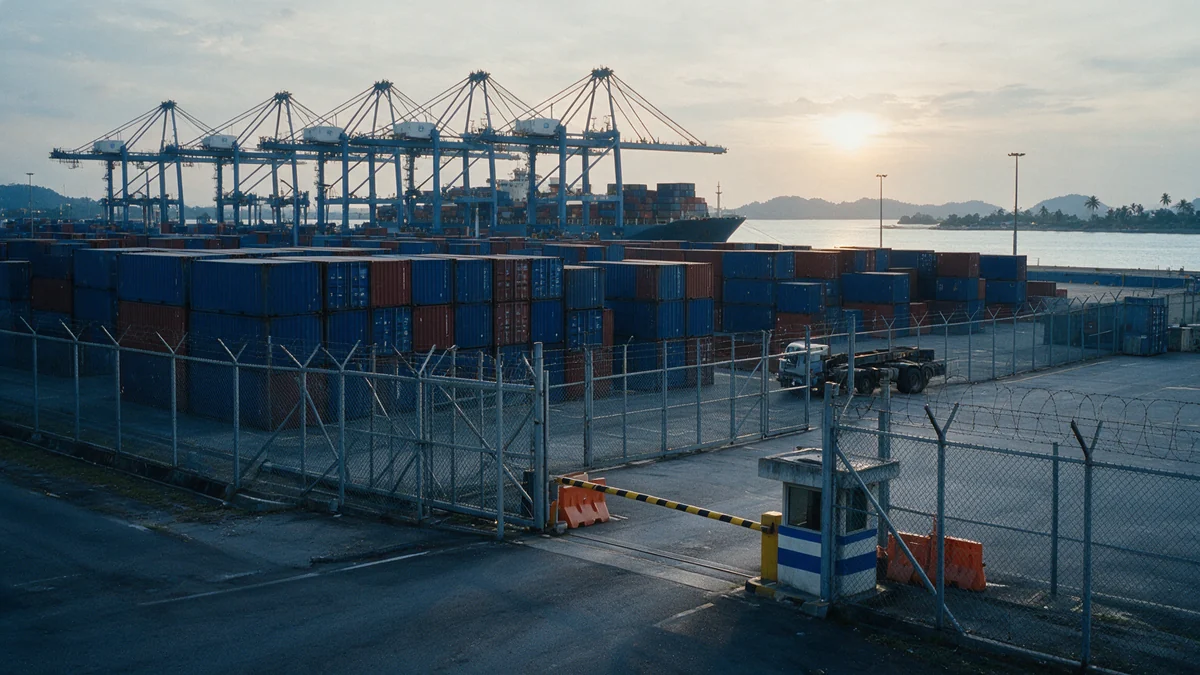
ZB forms are the customs declarations for cargo entering or leaving a Malaysian free zone. According to Royal Malaysian Customs' official movement table, only Borang ZB No. 1 (the ZB1) is named, and only for four of its 25 movements. The Free Zones Regulations 1991 prescribe the same single declaration, Form FZ No. 1. ZB2, ZB3 and ZB4 are declaration types in Dagang Net's ALDEC filing module; neither the Customs table nor the Regulations names any of them.
Key takeaways
- Royal Malaysian Customs' table of 25 free zone movement scenarios puts only four on Borang ZB No. 1; twelve use Borang Kastam No. 8.
- The Free Zones Regulations 1991, as amended in 2019 and 2023, name exactly one free zone goods declaration: Form FZ No. 1 (Borang ZB No. 1).
- Under the Free Zones Act 1990, moving goods from the principal customs area into a free zone is legally an export; bringing them back out is an import.
- A statutory Borang ZB No. 4 does exist — but it is an application to carry out an activity in a free zone, not a cargo declaration.
- The oldest traceable source for the circulating ZB1, ZB2 and ZB3 definitions is an unsourced blog post from August 2008 that never mentions ZB4.
What is a ZB form in Malaysia?
A ZB form (from Zon Bebas, Malay for free zone) is the declaration lodged with a Free Zone Authority when cargo enters or leaves a gazetted Malaysian free zone. Because a free zone sits outside the principal customs area under the Free Zones Act 1990, ordinary K-forms do not automatically apply, and the movement has to be declared and approved before the container is released.
Malaysia's free zones are created under the Free Zones Act 1990 (Act 438). Section 2 defines the "principal customs area" as "any part of Malaysia but excluding a free zone, Labuan, Langkawi, Tioman and Pangkor". That single definition is why free zone paperwork exists: the zone is carved out of the customs area, so goods crossing the fence line have crossed a customs border without leaving Malaysian soil. Section 7 makes the consequence explicit:
"(a) goods which are taken out from any part of the principal customs area and brought into a free zone shall be deemed to be exported from Malaysia; and (b) goods which are brought out of a free zone and taken into any part of the principal customs area shall be deemed to be imported into Malaysia." — Free Zones Act 1990, section 7(1)
Section 7(2) adds that "custom duty, if any, on any goods deemed to be exported from or imported into Malaysia shall be payable". Royal Malaysian Customs confirms the flip side on its free zone introduction page: under section 4, goods imported into, exported from or produced within a free zone are exempt from customs and excise duties. The Act treats the zone fence, not the coastline, as the point where duty liability begins.
What is the difference between a Free Commercial Zone and a Free Industrial Zone?
The Act draws the line itself. Section 3(1) lets the Minister declare an area to be "a free commercial zone or a free industrial zone", and section 10(1) fixes what each is for: First Schedule activities in a free commercial zone, Second Schedule manufacturing activities in a free industrial zone.
The entry rules follow. Section 12(1) admits "goods of any description" to a free commercial zone; section 11(1) admits to a free industrial zone only goods "used directly for the manufacture of other goods" or PCA-manufactured goods meant for export; section 8(1) lets FIZ-manufactured goods leave only for export, or with the Authority's approval for transmission to a free commercial zone. FCZ is trading and handling, FIZ is export manufacturing — statute, not convention.
As of the list published by Royal Malaysian Customs (last updated 4 March 2026), Malaysia has 24 gazetted Free Commercial Zones and 21 Free Industrial Zones, each with its own named Free Zone Authority. If you are weighing a free zone against other duty-deferral options, our comparison of bonded warehouses, FTZs and Licensed Manufacturing Warehouses sets out where each one wins.
Which declaration form does each free zone movement need?
Royal Malaysian Customs publishes a single authoritative table, "Declaration of Forms in Free Zones", covering 25 movement scenarios. Four of those movements are declared on Borang ZB No. 1. The remaining 21 use ordinary customs forms — Borang Kastam No. 1, 2, 3 or 8, or Borang Eksais No. 8 — which is why most of the movement types on the Customs table are K-form work, not ZB work.
The table below reproduces that official Customs list (last updated 4 March 2026), with the Malay movement descriptions rendered into English and the Malay abbreviations kept in brackets. It is the fastest way to settle an argument about which form a specific movement needs, and it is worth checking before you assume a ZB form is involved at all.
| # | Movement of goods | Form required |
|---|---|---|
| 1 | Foreign country to free zone | Borang ZB No. 1 |
| 2 | Foreign country to free zone (goods excluded from free status) | Borang Kastam No. 1 |
| 3 | Free zone to foreign country | Borang ZB No. 1 |
| 4 | Ship transfer within a free zone (pindah kapal di ZB) | Borang ZB No. 1 |
| 5 | Principal customs area (KUK) to free zone | Borang Kastam No. 2 |
| 6 | Free zone to principal customs area | Borang Kastam No. 1 |
| 7 | Foreign country to principal customs area via free zone | Borang Kastam No. 1 |
| 8 | Principal customs area to foreign country via free zone | Borang Kastam No. 2 |
| 9 | Port/airport free zone to Malaysian territories, duties and taxes unpaid | Borang ZB No. 1 |
| 10 | Between Malaysian territories via free zone, duties and taxes paid | Borang Kastam No. 3 |
| 11 | Free zone to foreign country via principal customs area | Borang Kastam No. 8 |
| 12 | Foreign country to free zone via principal customs area | Borang Kastam No. 8 |
| 13 | Free zone to free zone via principal customs area (land) | Borang Kastam No. 8 |
| 14 | Free zone to licensed warehouse (GB) via principal customs area (land) | Borang Kastam No. 8 |
| 15 | Licensed warehouse to free zone via principal customs area (land) | Borang Kastam No. 8 |
| 16 | Free zone to Licensed Manufacturing Warehouse (GPB) | Borang Kastam No. 1 |
| 17 | Licensed Manufacturing Warehouse to free zone | Borang Kastam No. 2 |
| 18 | Free zone to inland container depot (ICD) via principal customs area (land) | Borang Kastam No. 8 |
| 19 | Inland container depot to free zone via principal customs area (land) | Borang Kastam No. 8 |
| 20 | Free zone to duty-free shop (KBC) via principal customs area (land) | Borang Kastam No. 8 |
| 21 | Duty-free shop to free zone via principal customs area (land) | Borang Kastam No. 8 |
| 22 | Free zone to petroleum supply base via principal customs area (land) | Borang Kastam No. 8 |
| 23 | Petroleum supply base to free zone via principal customs area (land) | Borang Kastam No. 8 |
| 24 | Excise warehouse or excise manufacturing warehouse to free zone via principal customs area (land) | Borang Eksais No. 8 |
| 25 | Free zone to duty-free island (PBC) via principal customs area | Borang Kastam No. 8 |
Four Malay abbreviations in that table do work the English can hide, and each one is Customs' own. Row 13 is free zone to free zone (ZB ke ZB). Rows 20 and 21 are free zone to and from a KBC — Kedai Bebas Cukai, a licensed duty-free shop, which Royal Malaysian Customs abbreviates that way in its own drawback guideline. Rows 14 and 15 are a GB — Gudang Berlesen, the licensed warehouse Customs licenses under section 65 of the Customs Act 1967 — and not the GPB, the licensed manufacturing warehouse, at rows 16 and 17. That is the pair that changes the form: a GB movement is Borang Kastam No. 8 at rows 14 and 15, a GPB movement Borang Kastam No. 1 or No. 2 at rows 16 and 17. Row 25 is a PBC — Pulau Bebas Cukai, the term Royal Malaysian Customs uses for a duty-free island in its own divisional listing and its duty-free island orders; section 2 of the Free Zones Act excludes Langkawi, Labuan, Tioman and Pangkor from the principal customs area.
Which movements need Borang Kastam No. 8?
Counting the rows surfaces something none of the three AI answers we checked mentions. Twelve of the 25 take Borang Kastam No. 8 — rows 11 to 15, 18 to 23 and 25 — because they involve trucking cargo across the principal customs area between two duty-free locations. That is the form Royal Malaysian Customs prescribes for goods moving in transit under customs control: its own partial-shipment guideline puts a transit movement running from a customs port, a customs airport, a free zone or a bonded area to another station on Borang Kastam No. 8. Only four rows take a ZB form. Free zone to Licensed Manufacturing Warehouse, or free zone to inland container depot: no ZB declaration arises at all. Our guide to the K1, K2, K8 and K9 customs forms explains what each of those declarations asks for.
What do ZB1, ZB2, ZB3 and ZB4 each declare?
The ZB1 form is named in three places: Royal Malaysian Customs' movement table, the Free Zones Regulations 1991 (as Form FZ No. 1, First Schedule) and Malaysia's National Single Window flow, which splits it into ZB1 (Import) and ZB1 (Export). ZB2, ZB3 and ZB4 appear in none of them. As declaration types they appear only in Dagang Net's ALDEC filing module, the one primary document we could retrieve that names them.
What does the ZB1 form declare?
The clearest primary evidence is the Malaysian National Single Window ZB form process flow hosted by MITI, whose legend defines "ZB1 (Import) – Free Zone Authority declaration form for import into Free Commercial Zone" and "ZB1 (Export) – Free Zone Authority declaration form for export from Free Commercial Zone". Across all 13 pages it never mentions ZB2, ZB3 or ZB4 at all.
One label that circulates online has no counterpart in that legend: ZB1-T, offered as a transhipment variant of ZB1, which is what Gemini returned when we asked it in July 2026. The National Single Window flow defines only ZB1 (Import) and ZB1 (Export), and transhipment at a free zone is already carried by Form FZ No. 1 under regulation 23 of the Free Zones Regulations 1991. Neither document contains a ZB1-T.
What do the Free Zones Regulations 1991 prescribe?
The forms are prescribed by subsidiary legislation, not by the Act: the Free Zones Regulations 1991 [P.U. (A) 321/1991], made under section 47 of the Free Zones Act 1990. Two gazetted amendments rewrote almost every declaration regulation in them — the Free Zones (Amendment) Regulations 2019 [P.U. (A) 416], in force 1 January 2020, and the Free Zones (Amendment) Regulations 2023 [P.U. (A) 131], deemed in force from 1 January 2023. Between them they name exactly one free zone declaration form, and it is Form FZ No. 1 — the English name the gazette gives Borang ZB No. 1:
- Regulation 21, goods imported from outside Malaysia into a free zone: "an import declaration in Form FZ No. 1 as specified in the First Schedule".
- Regulation 23, goods on transhipment at a free zone: "an import declaration in Form FZ No. 1 as specified in the First Schedule".
- Regulation 26, goods transported from a free zone to any territory: "a declaration in Form FZ No. 1 as specified in the First Schedule".
Every other movement those Regulations cover takes an ordinary customs or excise form — Form Customs No. 1, 2, 3, 4, 5, 8, 10 or 11, or Form Excise No. 8 — and the 2023 amendment replaced each of those with "the form and manner as determined by the Director General", leaving Form FZ No. 1 as the one form still named in a schedule. Across the 51 pages of the 2019 gazette the string "ZB" occurs three times, every one of them "Borang ZB No. 1".
Regulation 23 also settles the question the ZB3 folklore turns on. What Malaysian law calls transhipment at a free zone — "remove any imported goods from any place, vessel or aircraft in a free zone for transhipment at a free zone" — is declared on Form FZ No. 1, with a thirty-day limit on how long that cargo may stay in the zone.
What do the ZB2, ZB3 and ZB4 forms declare?
For those three the only primary document is Dagang Net Technologies' ZB Declaration Form User Manual (version 1.0, dated 1 February 2021), formally titled "ALDEC Customs Declaration (ZB1-ZB4)". It carries a chapter for each of the four, though the ZB4 chapter turns out to repeat the ZB3 instructions (below).
| Type | What the primary sources state | Where it is documented |
|---|---|---|
ZB1 | Free Zone Authority declaration for import into, and export from, a Free Commercial Zone; in the Regulations, Form FZ No. 1 for import, transhipment and transport to a Malaysian territory. In ALDEC: "For Import to free zone, select ZB1". Manifest number is mandatory when the transport mode is sea. | Customs movement table; Free Zones Regulations 1991, First Schedule; MITI National Single Window flow; ALDEC manual |
ZB2 | Export declaration from a free zone. In ALDEC: "For Export from free zone, select ZB2". Its screen can attach a supporting ZB1 import document and a registered ZB4 document. | ALDEC manual only |
ZB3 | In ALDEC the instruction printed for ZB3 is also "For Import to free zone, select ZB3". Widely described elsewhere as the transhipment declaration — but regulation 23 puts that movement on Form FZ No. 1, as above, and the manual says nothing about transhipment anywhere in its 72 pages. | ALDEC manual only |
ZB4 | A registered document a ZB2 export declaration can be linked to; the manual states no purpose for it. Two descriptions circulate without a source: "change of trader", and the fuller version AI assistants return — "if an agent intends to do a value added activity for local sales consumption then a ZB4 shall be declared to the Free Zone Authority". Neither appears in any Customs publication or gazette. | ALDEC manual only; the statutory Borang ZB No. 4 is a different document (below) |
What to do, for all four. Settle the movement on the Customs table first: if it is row 1, 3, 4 or 9, the named form is Borang ZB No. 1, and for sea cargo the manifest has to be lodged and matched before the declaration will go through. If your filing system offers ZB2, ZB3 or ZB4 for the movement, confirm the declaration type with the Free Zone Authority that operates your zone before you file — no published Customs document or gazette assigns those three a purpose, so the zone authority's own practice is the only authority there is.
Is there a statutory ZB4 form?
A statutory ZB No. 4 does exist, and it is not the one the internet describes. The form set published under the Free Zones Act 1990 includes ZB No. 4 / FZ No. 4, headed "Permohonan Untuk Menjalankan Aktiviti / Application to Carry Out an Activity" — the form a company files with a Free Zone Authority to become an operator in the zone, ticking whether it will trade, break bulk, grade, repack, relabel or transit. ZB No. 5 applies to erect or rent a building or lease land; ZB No. 6 continues the series. None is a cargo declaration.
"ZB4" therefore names two different documents: a statutory application form for zone operators, and a declaration type in ALDEC whose purpose the manual never states. Worth knowing before you ask a Free Zone Authority for "the ZB4".
The ALDEC manual is also explicit about where a ZB declaration lands. Its user-role table lists application type "ZB1-ZB4", submitted by the Forwarding Agent, for the purpose of applying a "customs declaration form via ALDEC to SMK", with the result "Acknowledged by Customs if the job is Approved". SMK is Sistem Maklumat Kastam, the system a Borang Kastam is lodged in: Royal Malaysian Customs' own MyCIEDS portal describes itself as carrying the supporting documents "for each Borang Kastam that has been declared through the Sistem Maklumat Kastam. (SMK)". We cover that split between declaration and documents in our guide to MyCIEDS and Malaysia's digital customs systems.
Why do online sources disagree about ZB2, ZB3 and ZB4?
The oldest source we could retrieve for the circulating ZB1, ZB2 and ZB3 definitions is a Malaysian logistics blog post dated 28 August 2008 that cites no circular, no regulation and no Customs publication, and never mentions ZB4. Later summaries point to a Free Zone Authority Penang circular and to document-sharing uploads that cannot be opened, so neither chain can be checked.
The online disagreement has a traceable shape. That 2008 blog post describes ZB1 as the form "for taking the container into free zone after container discharges in the port", ZB2 as the form "for loading the container onto the vessel which means out from the free zone", and ZB3 as the form "for transhipment purpose, for exporting container to destination country". Those three sentences match, almost word for word, what most sites — and most AI assistants — still return today.
An older origin is claimed but cannot be confirmed. When we asked ChatGPT, Claude and Gemini in July 2026, Claude's answer cited — as its very first source, and three times over — a Course Hero upload titled "Types of forms and discription.docx — FCZ Free Commercial Zone 1- Types of forms Circular from Free Zone Authority Penang Reference FCZ/2006/002", which would predate the blog by two years. ChatGPT and Gemini did not cite it at all. Nor could we read it: the page returns HTTP 403 Forbidden, so neither the circular's existence nor its wording can be checked.
Dagang Net's ALDEC manual compounds the confusion. Its chapter 4 is titled "HOW TO CREATE ZB4 FORM" — but the first sub-heading reads "4.1 Create ZB3", and the chapter then repeats the ZB3 instructions. A copy-paste error in the only publicly available system manual is exactly the kind of gap a search engine fills for you, so treat any undated third-party breakdown of ZB2, ZB3 and ZB4 as a hypothesis and check it against the gazette before you act on it.
Who submits a ZB declaration, and how does it reach Customs?
A licensed forwarding agent prepares and submits the ZB declaration electronically to the Free Zone Authority, which approves or rejects it, then updates the terminal operator so the container can be released. The National Single Window process flow shows the declaration reaching Royal Malaysian Customs through the SMK system, and the ALDEC manual requires the agent's licence to be active before any submission is accepted.
The MITI-hosted National Single Window process flow sets out the sequence for a re-export from a Free Commercial Zone. Stripped to its essentials, it runs like this:
- The exporter prepares invoice, packing list and shipping instruction; the shipping agent or forwarder finalises freight charges.
- The forwarding agent takes the clearance instruction and prepares the ZB1 (Export) declaration.
- The agent submits it electronically through the Free Zone-EDI system (FZA-EDI) to the Free Zone Authority.
- The Authority may hold the transaction pending supporting documents, then releases the hold once they arrive.
- The Authority approves or rejects it and updates the terminal operator on the release.
- The forwarder raises the request for delivery and container movement order, pays port charges and arranges the gate pass.
The Regulations use the same terms: under regulations 21, 23 and 26 the importer, transhipper or transporter "or his agent shall submit to a proper officer of the Authority at the free zone" the Form FZ No. 1 declaration plus any documents that officer requires.
Is the ZB3 form declared by the shipping line rather than the forwarding agent?
AI assistants often add a detail the primary sources do not carry: that ZB3 "is declared by the box owner (liner)", and that for movements out of free zones by air, "local cargo agents taking goods out are responsible for declaring ZB2". Neither the ALDEC manual (72 pages) nor the MITI process flow (13 pages) contains "liner", "box owner" or "cargo agent" anywhere.
ALDEC uses "Shipping Agent" only as a trading-partner field to complete when the transport mode is sea — never as the party that submits — and its single user-role table assigns ZB1-ZB4 to the Forwarding Agent. The liner and air-cargo-agent attributions trace to the same unsourced secondary chain as the ZB3 transhipment description, so treat them as unconfirmed.
One more circulating detail is nearly right and worth correcting rather than repeating: that "all ZB1 (Import) declarations require the manifest registration number". The ALDEC manual scopes it to one transport mode — "for ZB1, Manifest number is mandatory if you transportation mode by sea" — so air cargo is not covered by that rule. The manual also makes it a pre-requisite that "before users submitting any declaration, you must make sure that your agent license is still active", so a lapsed licence stops a movement before it starts.
What must a free zone declaration state, and what happens if it is wrong?
Section 8A of the Free Zones Act 1990 requires every declaration to give a full and true account of five things: the number and description of packages, the description of the goods, their weight, measure or quantity, the value of all the goods, and the country of origin. Unexplained shortfalls inside a free zone are treated as illegal removal into the customs area.
Section 8A applies to "any person who makes any declaration under this Act or any regulations made thereunder" — so it binds the ZB1 as squarely as it binds a K1 — and lists exactly what a full and true account must cover:
- the number and description of the packages;
- the description of the goods;
- the weight, measure or quantity of the goods;
- the value of all of the goods; and
- the country of origin of the goods.
Section 8B covers the shortfall case: if goods in a free zone are found short and the deficiency is not accounted for to a proper officer of customs, the owner or operator is "deemed to have illegally removed such goods from the free zone into the principal customs area" until the contrary is proved, unless the Director General accepts unavoidable leakage, breakage or other accident.
Duties then become payable on demand made within six years of the date they were payable. A shortfall found in year four is still fully assessable, with the burden of proof on the goods' owner — see our walkthrough of how customs clearance works in Malaysia step by step.
How does this apply at Port Klang?
Two different gazetted areas share the name. Port Klang Free Zone appears twice on Royal Malaysian Customs' list of free zones — once as a Free Commercial Zone, once as a Free Industrial Zone. The container terminals are separately gazetted Free Commercial Zones of their own. Customs assigns ship transfer within a free zone to Borang ZB No. 1, so a transhipment move at Port Klang is a free zone declaration by definition.
Port Klang the port — Northport and Westports — handled a record 15.14 million TEUs in 2025, Transport Minister Anthony Loke Siew Fook said on 16 March 2026. Those are port figures, not Port Klang Free Zone figures — on the Customs list PKFZ is a separate entry with its own Free Zone Authority.
Those port figures still bear on free zone paperwork, because the terminals are themselves gazetted zones. The Customs list carries Pelabuhan Utara (Northport), Pelabuhan Barat (Westports) and Pelabuhan Selatan as Free Commercial Zones in their own right, each with Lembaga Pelabuhan Klang as its Free Zone Authority. Regulation 23 and row 4 of the Customs table therefore put a ship-to-ship transfer at Port Klang on Borang ZB No. 1 — a free zone declaration, not an edge case.
Is Port Klang Free Zone an FCZ or an FIZ?
Port Klang Free Zone is gazetted as both, and that is the point. The question is never "is my cargo in PKFZ" but "which zone status applies to this consignment and this activity". The commercial side takes the open section 12 entry test and the section 5 handling rights; the industrial side carries the narrower section 11 entry test and the section 8 exit conditions set out above. A manufacturing consignment and a trading consignment at the same address do not follow the same rules.
DNE Forwarding has cleared cargo through Westport and Northport since 1999 and handles over 1,000 containers a month as a JKDM-licensed forwarding agent, with documentation compliance above 99 per cent. In our own clearance work at those two terminals, the free zone declarations that stall are rarely the complicated ones: they stall because the movement was mapped to the wrong form — a free zone to Licensed Manufacturing Warehouse transfer filed as a ZB when the table calls for Borang Kastam No. 1. That is what we see from our own desk, not an industry statistic. For background on the terminals, see our guide to Westport and Northport and our note on FTZ warehousing at Port Klang.
Frequently asked questions
What is the difference between ZB1 and ZB2?
In law there is no ZB2. Export from a free zone to a foreign country is row 3 of Customs' movement table, and the form it names is Borang ZB No. 1 — the same form as the inbound movement at row 1. The ZB1/ZB2 split is a filing-system distinction: Dagang Net's ALDEC module offers ZB1 for an import into a free zone and ZB2 for an export from one.
Is ZB3 the transhipment form in Malaysia?
Not in law. Regulation 23 of the Free Zones Regulations 1991 puts goods on transhipment at a free zone on Form FZ No. 1 — Borang ZB No. 1 — and Customs' table says the same at row 4. ZB3 is widely described online as the transhipment declaration, but no gazette or Customs page carries that description, and the ALDEC manual's own instruction for it reads "For Import to free zone, select ZB3".
Do I need a ZB form to move goods from a free zone to a Licensed Manufacturing Warehouse?
No. Customs' declaration table lists free zone to Licensed Manufacturing Warehouse (GPB) as row 16, requiring Borang Kastam No. 1, and the reverse as row 17, requiring Borang Kastam No. 2. Regulation 24 of the Free Zones Regulations 1991 matches it: goods brought into a free zone from the principal customs area or from a manufacturing warehouse licensed under section 65A of the Customs Act 1967 are declared on Form Customs No. 2.
Who can submit a ZB declaration in Malaysia?
The Regulations say the owner "or his agent" submits it to a proper officer of the Free Zone Authority at the zone. In practice that agent is a licensed forwarder: Dagang Net's ALDEC user manual lists the ZB1-ZB4 application types as submitted by the Forwarding Agent, filed through ALDEC to Customs' SMK system and acknowledged by Customs once the job is approved.
Is a Malaysian free zone legally part of Malaysia for customs purposes?
For customs purposes it sits outside the principal customs area. Section 2 of the Free Zones Act 1990 defines the principal customs area as any part of Malaysia excluding a free zone, Labuan, Langkawi, Tioman and Pangkor, and section 7 deems goods moved from the customs area into a free zone to be exported from Malaysia, and goods moved out of a free zone into the customs area to be imported into it.
Sources
- Royal Malaysian Customs Department — Declaration of Forms in Free Zones / Pengikraran Borang di Zon Bebas (last updated 4 March 2026; accessed 27 July 2026) — the 25-row table, published in Malay
- Royal Malaysian Customs Department — Free Zone: Introduction (last updated 4 March 2026; accessed 27 July 2026)
- Royal Malaysian Customs Department — List of Free Zones & Free Zone Authorities (accessed 27 July 2026)
- Laws of Malaysia, Act 438 — Free Zones Act 1990 (PDF), via InvestMalaysia (accessed 27 July 2026)
- Federal Government Gazette — Free Zones (Amendment) Regulations 2019, P.U. (A) 416 (PDF), hosted by Royal Malaysian Customs, 31 December 2019 (accessed 27 July 2026) — amends the Free Zones Regulations 1991 [P.U. (A) 321/1991]
- Federal Government Gazette — Free Zones (Amendment) Regulations 2023, P.U. (A) 131, 19 April 2023, via the Attorney General's Chambers Law of Malaysia portal (accessed 27 July 2026)
- Free zone administrative forms under the Free Zones Act 1990 — ZB No. 4, ZB No. 5 and ZB No. 6 (PDF), Ministry of Industry and Entrepreneur Development Sarawak (accessed 27 July 2026)
- Royal Malaysian Customs Department — Prosedur dan Garis Panduan Drawback, Seksyen 93 Akta Kastam 1967 (PDF) (accessed 27 July 2026) — cited for the abbreviations "Kedai Bebas Cukai (KBC)" and "Kawasan Utama Kastam (KUK)"
- Royal Malaysian Customs Department — Gudang Berlesen: Pelesenan (last updated 11 January 2026; accessed 27 July 2026) — cited for "GB" = Gudang Berlesen, licensed under section 65 of the Customs Act 1967
- Royal Malaysian Customs Department — Customs Division (last updated 4 March 2026; accessed 27 July 2026) — cited for "PBC" = Pulau Bebas Cukai
- Royal Malaysian Customs Department — Prosedur dan Garis Panduan: Customs (last updated 22 July 2026; accessed 27 July 2026) — the duty-free island Customs Duties Orders for Langkawi, Labuan, Tioman and Pangkor, filed under "pulau-bebas-cukai"
- Royal Malaysian Customs Department — Kemudahan Partial K8 (last updated 6 January 2026; accessed 27 July 2026) — cited for Borang Kastam No. 8 as the transit-movement declaration
- Royal Malaysian Customs Department — MyCIEDS: About Us (accessed 27 July 2026) — cited for "Sistem Maklumat Kastam. (SMK)"
- Ministry of Investment, Trade and Industry — National Single Window for Malaysia: ZB Form Process Flow (PDF) (accessed 27 July 2026)
- Dagang Net Technologies Sdn Bhd — ZB Declaration Form User Manual: ALDEC Customs Declaration (ZB1-ZB4), Version 1.0 (PDF), 1 February 2021 (accessed 27 July 2026)
- Malay Mail — Loke: Port Klang hits record 15.14 million TEUs in 2025 as new PKA annex opens, 16 March 2026 (accessed 27 July 2026)
- All About Logistics (blog) — ZB (Zone Bebas) Declaration, 28 August 2008 (accessed 27 July 2026) — cited as the oldest traceable source for the circulating definitions, not as an authority
- Course Hero — "Types of forms and discription.docx", citing Free Zone Authority Penang circular FCZ/2006/002, at coursehero.com/file/31897649/Types-of-forms-and-discriptiondocx/ — not publicly retrievable: returned HTTP 403 Forbidden on 27 July 2026, so its contents could not be verified