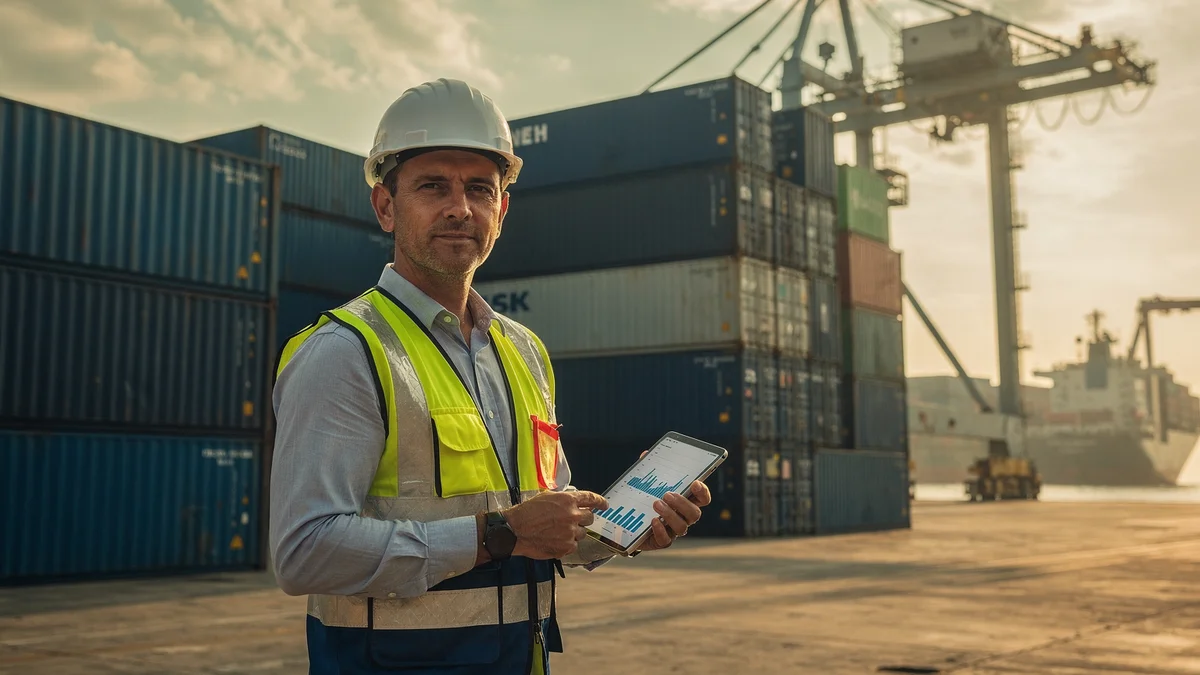
Scope 3 emissions reporting means disclosing the indirect greenhouse-gas emissions across a company's value chain, including the freight your goods travel on. Malaysian exporters are being asked for this because Bursa Malaysia-listed buyers must now report it — and a forwarder holds the raw shipment data that starts the calculation.
Key takeaways
- Malaysia's National Sustainability Reporting Framework (NSRF) phases in mandatory reporting for Main Market issuers worth RM2 billion or more from FY2025, other Main Market issuers from FY2026, and ACE Market issuers from FY2027 — with Scope 3 disclosure carrying extra transition relief on top of those dates.
- Just 21% of Malaysian public-listed companies disclosed Scope 3 emissions in 2023, versus 39% across Asia-Pacific (KPMG/Pacific Basin Economic Council) — the shortfall most buyer questionnaires are now trying to fill.
- Freight and haulage sit inside GHG Protocol Category 4 (Upstream Transportation and Distribution), one of 15 Scope 3 categories — and it's the one category your freight forwarder can speak to directly.
- The EU's Corporate Sustainability Reporting Directive (CSRD), not just Malaysia's own NSRF, is why many exporters' EU buyers are asking first.
- Capital Markets Malaysia's Simplified ESG Disclosure Guide (SEDG) gives SME suppliers a 38-point checklist to answer buyer requests without hiring a full-time ESG consultant.
What is Scope 3 emissions reporting, and why does it involve your freight forwarder?
Scope 3 covers the 15 indirect-emissions categories a company doesn't control directly but influences through its value chain. Category 4, Upstream Transportation and Distribution, is exactly where your freight forwarder's records live: which mode a shipment took, which route, how many containers, and how far it travelled.
The GHG Protocol's Corporate Value Chain (Scope 3) Standard is the global accounting rulebook almost every buyer's ESG questionnaire is built on. Scope 1 is a company's own direct emissions (its trucks, its factory); Scope 2 is the electricity it buys; Scope 3 is everyone else's emissions that happen because of that company's activity — a supplier's factory, a customer's landfill, or a forwarder's ship and truck. For an exporter, that last one usually shows up first, because it's the easiest data for a buyer to ask for by name: how a shipment travelled, and how far.
Why are Malaysian exporters suddenly being asked for this data?
Bursa Malaysia-listed buyers are now required to report their own supply-chain emissions, so they're passing that request down to every supplier who touches their product — including the freight side. The clearest external driver is the EU: its Corporate Sustainability Reporting Directive (CSRD) makes Scope 3 disclosure mandatory for large in-scope companies, including data from their suppliers.
Under CSRD's ESRS E1 standard, in-scope EU companies must disclose material Scope 3 emissions across their value chain — which is why a Malaysian exporter's EU buyer can start asking for shipment data years before Malaysia's own NSRF applies to the exporter directly.
A parallel EU mechanism adds separate cost pressure on top of that data request. Malaysia's own securities regulator found, in its Capital Market Stability Review 2023, that 75% of Malaysia's exports to the EU will be impacted by the Carbon Border Adjustment Mechanism (CBAM), even though those exports are only around 8% of Malaysia's total export volume — see our CBAM guide for how that separate, tariff-side mechanism works.
The US has moved the opposite way: in June 2026 the SEC proposed withdrawing its own climate-disclosure rule entirely. Japan hasn't mandated Scope 3 disclosure either — its ISSB-aligned SSBJ standards are still voluntary — but many large Japanese listed companies already disclose Scope 3 emissions as market practice, so a Japanese buyer can still ask even without a legal requirement behind it. For now, the hardest external pressure on Malaysian exporters stays EU-centred, layered on top of Malaysia's own NSRF cascade.
When exactly does Scope 3 reporting become mandatory in Malaysia?
The National Sustainability Reporting Framework (NSRF), launched by the Securities Commission Malaysia on 24 September 2024, phases mandatory reporting in by issuer size rather than switching on for everyone at once. Scope 3 emissions specifically carry additional transition relief on top of those start dates.
| Issuer group | First reporting period (NSRF) |
|---|---|
| Main Market, market cap ≥ RM2 billion | FY2025 |
| Other Main Market issuers | FY2026 |
| ACE Market issuers | FY2027 |
(Source: Securities Commission Malaysia's NSRF media release, 24 September 2024.) Scope 3 disclosure itself carries extra transition relief on top of these start dates — secondary guides differ on the exact number of relief periods per group, since Bursa's Listing Requirements amendments were still being finalised at the time of writing, so confirm your buyer's specific Scope 3 year with their investor-relations team rather than assuming one. The SC has framed the whole exercise as a competitiveness play, not just paperwork: SC Chairman Dato' Mohammad Faiz Azmi said when the NSRF launched, "As a major trading country and an open economy that has an important role in the global supply chain, it is important we adopt these requirements in an open way to reap the benefit of being an adopter."
What transport data can your freight forwarder actually give you?
A forwarder that runs your shipments already logs the inputs a Category 4 calculation needs: container count and size, transport mode, the lane and distance travelled, and often the vessel or truck type. Under the GHG Protocol's own guidance, these are exactly the activity-data inputs Category 4 calculations start from.
- Container/shipment count — by month, by lane, by mode.
- Mode split — sea FCL/LCL, air, or road haulage leg.
- Distance/lane — origin port to Port Klang (Westport/Northport), and the onward haulage leg to your buyer or warehouse.
- Equipment type — 20ft/40ft dry, reefer, or flatrack, which changes the load factor a consultant will apply.
A Port Klang freight forwarder moving 1,000+ containers a month, as DNE does, holds this at the individual-shipment level for the jobs it clears — not an estimate, a record already sitting in the job file.
Why can't your freight forwarder calculate your Scope 3 number for you?
Handing over shipment records is not the same as producing a Scope 3 number. Turning "3 containers, Shanghai to Port Klang" into a kilogram-of-CO2e figure needs an emissions factor tied to vessel class, fuel type and route — something the GHG Protocol's Category 4 calculation guidance pulls from an emissions database or a consultant, not a forwarder's job file.
The stakes are real: Scope 3 emissions typically make up 70-90% of a company's total carbon footprint, according to the Carbon Trust — so getting the transport slice wrong skews the biggest number on the page, not a rounding error. Conflating "shipment records" with "a finished Scope 3 number" is the most common mistake we see SME exporters make when a buyer's questionnaire lands in their inbox.
| What your forwarder can give you | What still needs you or a consultant |
|---|---|
| Container counts, mode, lane, distance | The emissions factor per tonne-km/mode |
| Shipment-level job records | Aggregating records into a Category 4 total |
| Confirmation of equipment/vessel type | Filing the figure into your buyer's ESG portal |
How are other Malaysian SME suppliers responding right now?
Most Malaysian suppliers are still building this muscle. A KPMG and Pacific Basin Economic Council study found barely one in five Malaysian public-listed companies disclosed Scope 3 emissions in 2023 — well behind the wider Asia-Pacific figure, a gap that helps explain why the request is now landing on suppliers directly.
That gap (21% in Malaysia versus 39% across Asia-Pacific, per the same Eco-Business report) is what the quotes below are describing first-hand. Lim Chee Yoong, Executive Director of Thumbprints Utd Sdn Bhd, described the difficulty from the supplier side: "It's difficult for us to get reports from our own [paper] suppliers for Scope 3 since most of them are SMEs and it's not mandatory [for them at the moment]." Najwa A'liah Fairuz, Head of Brand Engagement at the UN Global Compact Network Malaysia & Brunei, framed the shift bluntly: "Large corporations and regulatory bodies have begun embedding ESG criteria into procurement policies. For SMEs, aligning with these standards is no longer a matter of choice but an essential strategic move for continued growth, competitive advantage and market relevance."
Capital Markets Malaysia built the Simplified ESG Disclosure Guide (SEDG) for exactly this gap. Its General Manager, Navina Balasingam, told Eco-Business: "Being able to adopt and report on the 38 disclosures [included in the SEDG] will give Malaysian SMEs the assurance that they are complying with the majority of the [reporting] requirements expected of them by their global customers." A separate 2023 Alliance Bank study, "ESG Insights from Malaysian SMEs", found only one in four Malaysian SMEs (25%) had adopted elements of ESG practice at all — so if you haven't started, you are still in the majority, but the gap is closing fast.
What should a Malaysian exporter do in the next 90 days?
There's no single fix, but exporters who move fastest treat this as a data-collection habit, not a one-time report. Five steps take most Malaysian exporters from "we don't have this" to "here's our shipment data" well before their biggest buyer's reporting year-end arrives.
- Find out which of your buyers are Bursa Main Market or ACE Market issuers, or report under CSRD in the EU, and check their financial year against the table above — that tells you when their first request to you is likely due.
- Ask your freight forwarder to pull container counts, modes and lanes from your existing job files for the last 12 months — that's the starting dataset almost every buyer questionnaire asks for.
- Work through the SEDG's 38 disclosures before you commission a full ESG consultant — many SME suppliers can answer most of them from records they already keep.
- Decide who owns the emissions-factor calculation — your forwarder supplies the shipment facts, but the factor and the final number are a separate, specialist step.
- Make data collection quarterly, not annual — a buyer's audit window rarely waits for your year-end.
Frequently asked questions
Do all Malaysian exporters have to report Scope 3 emissions?
Only Bursa Malaysia Main Market and ACE Market-listed companies are directly mandated under the NSRF, phased in from FY2025 (large Main Market issuers), FY2026 (other Main Market) and FY2027 (ACE Market). SME exporters aren't mandated directly yet, but are increasingly asked for the same data by Malaysian and EU buyers who are.
What is GHG Protocol Category 4, and why does it matter to my shipment?
Category 4, Upstream Transportation and Distribution, is one of the GHG Protocol's 15 Scope 3 categories, and it's the one that covers the freight moving your goods — the exact data a forwarder's job file already contains.
Can my freight forwarder calculate my Scope 3 number for me?
No. A forwarder can supply the shipment-level facts — container counts, mode, distance, equipment type — but applying an emissions factor and filing the final figure is a separate step, usually done by the exporter or an ESG consultant.
What is the Simplified ESG Disclosure Guide (SEDG)?
SEDG is a 38-disclosure checklist built by Capital Markets Malaysia to help SME suppliers answer listed buyers' ESG questionnaires without needing a full-time sustainability team.
When will my buyer first ask me for Scope 3 data?
It depends on whether they report under Malaysia's NSRF (Main Market from FY2025/FY2026, ACE Market from FY2027, with extra Scope 3 transition relief) or the EU's CSRD, which can trigger a request from an EU buyer sooner. Confirm the exact year with your buyer rather than assuming.
If your biggest buyer's ESG questionnaire has already landed in your inbox, don't wait for a deadline to force the conversation. I'm Dan Duar, Director at DNE Forwarding — our Port Klang team can pull the container counts, modes and lanes behind the shipments we've cleared for you, so you walk into that questionnaire with real numbers instead of a guess. Browse more compliance guides for Malaysian exporters while you're at it.
Sources: GHG Protocol Scope 3 calculation guidance; Securities Commission Malaysia — NSRF media release; Anthesis: "CSRD Scope 3 Reporting Requirements" (2026); US SBA Office of Advocacy: "SEC's Rescission of Climate-Related Disclosure Rules" (2026); Persefoni: "ISSB Adoption in Japan: SSBJ Standards Explained"; The Star: "75% of Malaysia's exports to EU impacted by Carbon Border Adjustment Mechanism — SC"; Carbon Trust: "Scope 3 emissions: what are they and why do they matter?"; Eco-Business: "As Scope 3 reporting deadline looms, Malaysian SMEs under pressure to provide sustainability disclosures"; Alliance Bank Malaysia: "ESG Insights from Malaysian SMEs" (2023).
Part of a guide: this article is part of our complete guide to How to Calculate Import Duty & SST in Malaysia: Step-by-Step With Real HS Codes.