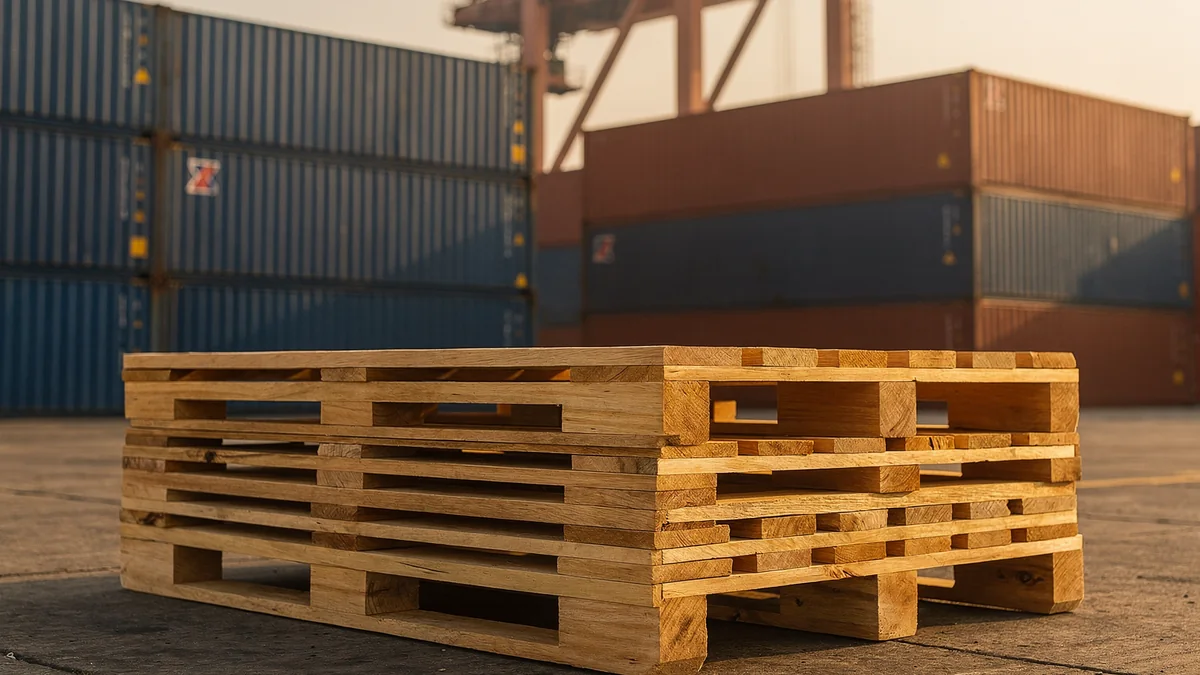
Yes. Malaysia requires almost all solid-wood packaging — pallets, crates, cases and dunnage thicker than 6 mm — to be heat-treated or fumigated and stamped under ISPM 15 before it enters the country. The Department of Agriculture (DOA) has enforced the standard on imports since 1 January 2010, and untreated or unmarked wood found at Port Klang can be held, treated, re-exported or destroyed at the importer’s cost.
Key takeaways
- ISPM 15 covers raw solid-wood packaging thicker than 6 mm — pallets, crates, cases, dunnage, skids and pallet collars. Manufactured wood such as plywood, particle board and veneer is exempt (DOA Malaysia; IPPC / ISPM 15).
- Malaysia’s Department of Agriculture has enforced ISPM 15 on imports since 1 January 2010 (IPPC implementation dates), under the Plant Quarantine Act 1976, Plant Quarantine Regulations 1981 and the MAQIS Act 2011 (WTO import-licensing notification, Malaysia).
- The two approved treatments are heat treatment to a core temperature of 56 °C for at least 30 minutes, or methyl-bromide fumigation to the prescribed dosage (DOA Malaysia).
- Compliant wood carries the IPPC “wheat” mark — the IPPC symbol, the ISO country code, the treatment provider’s number and the treatment code (HT or MB) — stamped on at least two sides (DOA Malaysia; ISPM 15).
- Non-compliant WPM is a hold, not a fine: your container waits while the wood is treated, returned or destroyed — and that wait is where demurrage and detention charges start running.
What is ISPM 15, and does Malaysia require it on imports?
ISPM 15 is the international phytosanitary standard that regulates how wooden packaging is treated so it cannot carry pests across borders. Malaysia adopted it and, through the Department of Agriculture, has required treated-and-marked wood packaging on imported consignments since 1 January 2010. It is a mandatory border requirement, not a voluntary guideline, for wood entering the country.
The standard was prepared by the International Plant Protection Convention (IPPC) and endorsed in March 2002; more than 80 countries and territories now enforce it, which is why a shipment leaving almost any origin for Malaysia is expected to arrive on compliant wood (ISPM 15). In Malaysia the legal backbone is the Plant Quarantine Act 1976 (Act 167), the Plant Quarantine Regulations 1981 and the MAQIS Act 2011 (Act 728), administered by the Department of Agriculture as Malaysia’s National Plant Protection Organization (WTO import-licensing notification, Malaysia; DOA Malaysia). The Department of Agriculture’s own guidance is blunt about why the rule bites at the border:
“Any WPM that does not bear the required treatment and marking stipulated in ISPM 15 will be rejected at port of entry of importing countries.” — Department of Agriculture, Malaysia, Certification of Wood Packaging Material
That single line is the whole reason this matters to a Port Klang importer: the goods inside the box may be perfectly legal, but the pallet under them can still stop the shipment at the gate.
Which wood packaging is regulated — and what is exempt?
ISPM 15 regulates raw solid-wood packaging more than 6 mm thick: pallets, crates, cases, boxes, dunnage, skids, load boards, drums and pallet collars. It does not regulate manufactured wood products — plywood, oriented strand board, particle board, veneer, sawdust, wood wool and wood shavings — because the heat and pressure used to make them already kill any pests.
The distinction the Malaysian DOA draws is simple: regulated WPM is “made of raw coniferous or non-coniferous wood,” while packaging “made entirely of wood-based products such as plywood, particle board, veneer, saw dust, wood wool and wood shavings” is not regulated (DOA Malaysia). Anything under 6 mm thick is also outside the standard (ISPM 15). The practical trap for a Malaysian importer is a mixed pallet: an exempt plywood box sitting on a raw-wood pallet still needs that pallet treated and marked. If any part of the packaging is raw solid wood over 6 mm, treat the whole packaging as in-scope until the IPPC mark proves otherwise.
What treatment methods does ISPM 15 accept?
Malaysia’s DOA lists two approved measures: heat treatment (HT) to a wood core temperature of 56 °C held for at least 30 minutes, or fumigation with methyl bromide (MB) to a prescribed dosage. Both must be carried out by a facility accredited under the Department of Agriculture’s schemes, after which the wood is stamped with the treatment code that proves which method was used.
Heat treatment is increasingly the default, because methyl bromide is a Class I ozone-depleting substance under the Montreal Protocol — phased out for most uses since 2005, though quarantine and pre-shipment fumigation such as ISPM 15 remains an exempted use — and because HT leaves no chemical residue (US EPA). In Malaysia, methyl-bromide fumigation is governed by the national standard MS 2546:2013, “Methyl bromide fumigation — Requirements” and must be done by a provider accredited under the Malaysian Fumigation Accreditation Scheme (MAFAS); heat-treatment providers are accredited under the parallel MAHTAS scheme (Department of Standards Malaysia / DOA, MS 2546:2013). The code stamped on the wood tells a quarantine officer exactly what was done:
| Mark code | Method | What it means |
|---|---|---|
HT | Heat treatment | Wood core reached 56 °C for a minimum of 30 minutes (DOA) |
MB | Methyl-bromide fumigation | Fumigated to the prescribed dosage by a MAFAS-accredited provider (MS 2546:2013) |
DH | Dielectric heating | A newer microwave heat-treatment route recognised under ISPM 15 (ISPM 15) |
DB | Debarked | Added when the wood was debarked before treatment — not a treatment itself (ISPM 15) |
A Malaysian exporter or importer never has to choose the method personally — the treatment provider does — but knowing the codes lets you check a supplier’s pallets before a container is stuffed, rather than discovering the problem at the port.
How do you read the IPPC mark on a pallet?
A compliant pallet carries the IPPC “wheat stamp”: the IPPC ear-of-wheat symbol, a two-letter ISO country code, the unique registration number of the accredited treatment provider, and the treatment code (HT or MB). Malaysia’s DOA requires the mark on at least two opposite sides of each piece of wood packaging so it is visible however the pallet sits.
The mark is a permanent stamp or brand, never hand-written or on a paper certificate — ISPM 15 deliberately uses a mark on the wood itself rather than a document that can be lost or copied (ISPM 15). Malaysia’s guidance adds one local detail worth knowing: the mark should not be printed in orange or red, because those colours are reserved for dangerous-goods labelling (DOA Malaysia). If you receive wood packaging with a smudged, missing, painted-over or clearly hand-drawn “stamp,” treat it as non-compliant and raise it with your forwarder before the box reaches Port Klang — an unreadable mark is treated the same as no mark.
What happens if your cargo reaches Port Klang on non-compliant wood?
If wood packaging arrives at Port Klang untreated, unmarked or with an unreadable IPPC mark, it can be detained by quarantine. The importer is then given options at their own cost: have the wood treated by an accredited provider, separate and destroy the wood, or re-export the whole consignment. Whichever route you take, the container sits while it is arranged.
The cost of non-compliance is rarely the penalty itself — it is the delay. A held container keeps accruing port storage, and once the shipping line’s free time runs out, demurrage and detention charges begin, often dwarfing what the treatment would have cost at origin. Malaysia’s DOA guidance is explicit that non-compliant WPM “will be rejected at port of entry” (DOA Malaysia), and for transhipment or re-export cargo the department’s advice is to have the wood treated and certified in the country of origin in the first place. The lesson for a Port Klang importer is that ISPM 15 is a problem to solve before the vessel sails, not a fine to pay after it berths.
ISPM 15 for Malaysian exporters: don’t get your shipment rejected abroad
The same rule runs in reverse. If you export from Malaysia on wooden pallets or in wooden crates, the destination country will expect ISPM 15-compliant, IPPC-marked wood — because more than 80 countries enforce the standard. Using an untreated pallet can get your goods held, treated or turned back at the far port, with your buyer watching the delay.
For exports, the wood must be heat-treated or fumigated and marked by a provider accredited under Malaysia’s DOA schemes (MAHTAS for heat treatment, MAFAS for methyl-bromide fumigation), carrying the MY country code in the IPPC mark (DOA Malaysia; MS 2546:2013). The safest habit for a Malaysian exporter is to buy pallets that already carry the IPPC mark, keep them dry and undamaged, and confirm the mark is legible before the container is sealed. A single unmarked pallet in an otherwise-perfect export shipment is enough to trigger a quarantine hold at the destination — a self-inflicted delay that a two-second stamp check prevents.
How does a Port Klang forwarder help you stay compliant?
A freight forwarder does not treat or stamp wood — that is done by DOA-accredited facilities — but it manages everything around the requirement: flagging WPM risk before you ship, clearing the consignment, and, if inbound wood is detained, arranging an accredited treatment provider and the follow-on haulage so the container moves again quickly.
DNE Forwarding has cleared imports and exports through Port Klang’s Westport and Northport terminals since 1999 and moves more than 1,000 containers a month as a JKDM-licensed customs broker with its own KA-licensed haulage fleet. In practice that means we check the WPM declaration and supplier pallets on your behalf before a box is stuffed, handle the customs and quarantine clearance at Port Klang, and — if a shipment is flagged for untreated wood — coordinate a DOA-accredited treatment or fumigation provider and re-schedule the haulage to your door, keeping the standing time (and the demurrage clock) as short as possible. The treatment and IPPC stamp always come from the accredited facility; our job is to make sure the wood never becomes the reason your goods are stuck. For the wider picture of clearing goods into Malaysia, see our guide to how customs clearance works in Malaysia.
Frequently asked questions
Do I need a fumigation or phytosanitary certificate as well as the ISPM 15 stamp?
Not for the wood packaging itself. ISPM 15 deliberately relies on a permanent mark stamped on the wood rather than a paper certificate, so a compliant pallet needs no accompanying document. A phytosanitary certificate is a separate requirement that may apply to the goods — for example plants, timber or certain foods — not to the packaging under them. Confirm the two separately with your forwarder.
Is plywood or a plywood box exempt from ISPM 15 in Malaysia?
Yes. Packaging made entirely of manufactured wood — plywood, oriented strand board, particle board, veneer, sawdust, wood wool or wood shavings — is exempt, because the manufacturing process already destroys any pests (DOA Malaysia). The catch is a mixed load: a plywood box on a raw-wood pallet still needs that pallet treated and marked.
Does ISPM 15 apply to air freight and to goods moving within Malaysia?
ISPM 15 governs wood packaging in international trade, so it applies to sea and air freight crossing borders, including cargo arriving at KLIA on wooden packaging. Purely domestic movements within Malaysia are generally outside the standard, but as soon as the wood packaging is used for an export or an import it must comply.
What does non-compliant wood packaging cost me at Port Klang?
There is usually no headline fine — the cost is the delay. The container is held while you treat, destroy or re-export the wood, and meanwhile port storage and then demurrage and detention charges accrue. Because that clock runs per container per day, a wood-packaging hold can cost far more than compliant pallets would have at origin.
Can my freight forwarder treat or stamp my pallets for me?
No. Heat treatment and methyl-bromide fumigation must be carried out by a facility accredited under Malaysia’s DOA schemes (MAHTAS for heat treatment, MAFAS for fumigation), and only that facility applies the IPPC mark. A forwarder like DNE coordinates the clearance, arranges an accredited provider if your inbound wood is flagged, and handles the haulage — but the treatment and stamp itself come from the accredited facility, never the forwarder.
Sources
- Department of Agriculture, Malaysia — Certification of Wood Packaging Material (ISPM 15) guidelines
- International Plant Protection Convention (IPPC) / ISPM 15 — standard scope, treatments and marking
- World Trade Organization — Malaysia import-licensing notification: plants, plant products and regulated articles
- ISPM 15 country implementation dates — Malaysia date of enforcement, 1 January 2010
- Department of Standards Malaysia / DOA — MS 2546:2013, Methyl bromide fumigation — Requirements
- US Environmental Protection Agency — Methyl bromide and the Montreal Protocol phase-out
Part of a guide: this article is part of our complete guide to Do You Need an Import Permit? A Guide to MITI AP, SIRIM, MAQIS & Other Requirements.