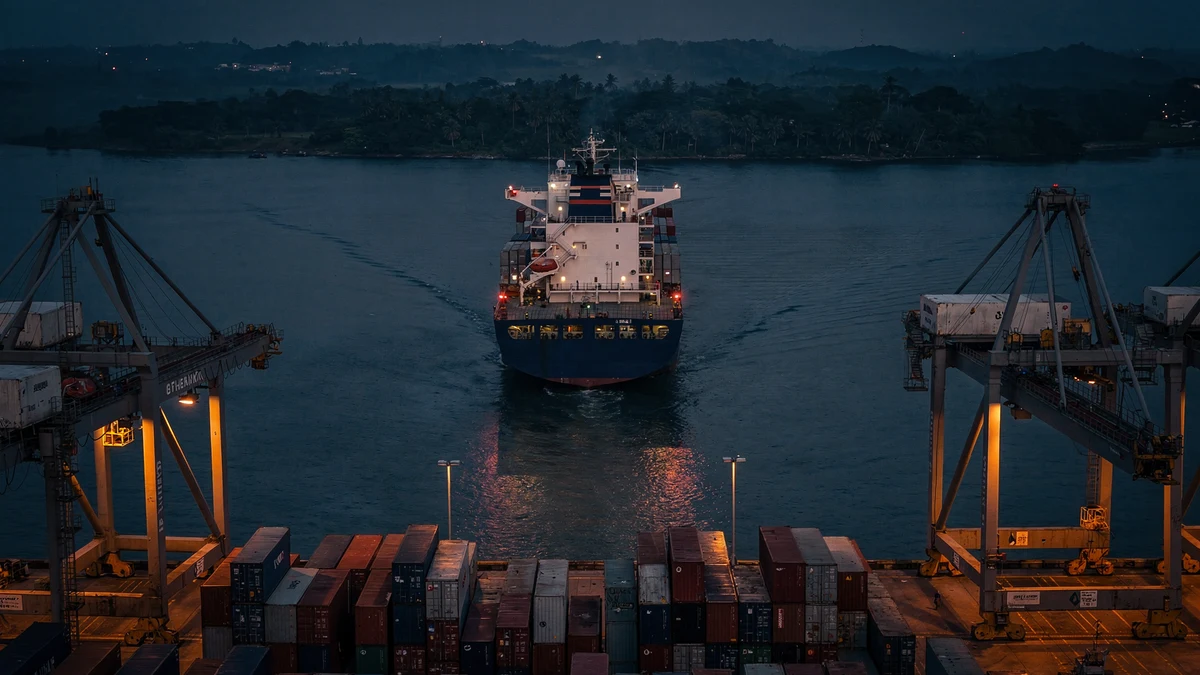
Malaysia's cabotage policy reserves cargo shipping between domestic ports for Malaysian-registered vessels, under the Merchant Shipping Ordinance 1952. Containerised cargo between Peninsular and East Malaysia has been exempt since 1 June 2017, but the policy still limits route competition — a key reason freight into Sabah specifically runs 15–25% above equivalent Peninsular distances today. No separately published freight-premium figure exists for Sarawak; its own trade data shows a large surplus instead, a separate point covered below.
Key Takeaways
- Cabotage has restricted Malaysia's domestic shipping to Malaysian-flagged vessels since 1980, under the Merchant Shipping Ordinance 1952 (MITI, Ministry of Investment, Trade and Industry).
- Containerised cargo between Peninsular Malaysia and Sabah, Sarawak and Labuan has been exempt from the domestic shipping licence requirement since 1 June 2017 — but for cargo outside that blanket exemption, a foreign vessel's own case-by-case exemption still tops out at 3 months, versus 6 months–2 years for a Malaysian-flagged carrier (Skrine, 2021).
- Sabah's 2024 trade hit RM107.8 billion (DOSM, released July 2025), but its big export commodities move as bulk cargo, not containers — so container flow at the main terminals still runs roughly 80% imports, leaving Sabah-bound vessels sailing back roughly two-thirds empty and pricing Sabah-bound freight 15–25% above equivalent Peninsular routes (Jesselton Times, October 2025; also carried by Bernama).
- A former President of the Chartered Institute of Logistics and Transport Malaysia has proposed a time-bound cabotage exemption for Sabah modelled on UK and Indonesian reforms, projecting a 10–20% freight-cost reduction within the first year (Jesselton Times, October 2025).
- Malaysia's Ministry of Transport is running a Maritime Masterplan 2026–2040 aimed at strengthening domestic shipping, raising service quality and expanding the sector's economic contribution (Bernama, March 2026).
What Is Malaysia's Cabotage Policy?
Cabotage is the rule that only Malaysian-registered, Malaysian-owned vessels may carry cargo or passengers between two points inside Malaysia, including within its exclusive economic zone. It was introduced in 1980 through amendments to the Merchant Shipping Ordinance 1952, which also created the Domestic Shipping Licensing Board (DSLB) to police it (MITI).
The policy's stated goal was to build up Malaysia's shipping industry and reduce dependence on foreign vessels and the outflow of foreign exchange in freight payments (MITI). Section 65L of the Ordinance requires a DSLB licence for any "domestic shipping" between two Malaysian ports; Section 65KA bars non-Malaysian ships from it altogether unless an exemption applies (Skrine, 2021).
To count as "Malaysian," a vessel must be wholly citizen-owned, or Malaysian-incorporated with management based in Malaysia, at least 51% Malaysian shareholding, and a majority-Malaysian board (Skrine, 2021). The policy has long been criticised by some economists and shippers for adding freight cost and letting domestic operators dominate routes with limited competition, costs ultimately passed on to consumers (Clyde & Co, 2017).
Which Ships Are Exempt From Malaysia's Cabotage Rules? (Feeder & Transhipment Vessels)
Foreign vessels can carry cargo between Malaysian ports only with a Domestic Shipping Licence Exemption. The two exemptions that matter most to importers: containerised transhipment (feeder) cargo between Peninsular ports and East Malaysia — allowed since 2009, broadened to a full cargo exemption on 1 June 2017 — and, since 2024, ships repairing or laying submarine telecommunications cables.
The timeline below traces how the exemption widened — each step opened more of the Peninsular–East Malaysia lane to foreign-flagged feeder vessels, but never touched shipping within Sabah, Sarawak and Labuan, which stays cabotage-protected.
| Year | What changed | Still restricted |
|---|---|---|
| 1980 | Cabotage policy introduced; Domestic Shipping Licensing Board established | All domestic cargo and passenger routes |
| 2009 | Containerised transhipment cargo between select Peninsular ports and East Malaysia exempted (Clyde & Co, 2017) | Non-containerised and intra-East-Malaysia cargo |
| 1 Jun 2017 | Full exemption for containerised cargo carriage between Peninsular and East Malaysia, announced by then-PM Najib Razak (Clyde & Co, 2017) | Cargo movement within Sabah, Sarawak and Labuan |
| 1 Jun 2024 | Non-Malaysian cable-laying/repair vessels exempted (under Section 65U) for subsea telecom cable work, reversing a 2020 revocation (Submarine Networks, 2024) | All other foreign-flagged domestic cargo runs |
In practice, a foreign container ship can carry a box straight from Port Klang to Kota Kinabalu or Kuching under the standing 2017 exemption (Clyde & Co, 2017). It cannot then move that box, or any other cargo, between two East Malaysian ports, or carry non-containerised (bulk, breakbulk, project) cargo on that same leg.
For cargo outside that blanket exemption, a foreign vessel needs its own case-by-case Domestic Shipping Licence Exemption: an endorsement from the Malaysian Shipowners' Association (MASA) first, then DSLB approval, capped at 3 months — versus 6 months to 2 years for a Malaysian-flagged vessel (Skrine, 2021). That short cycle is one reason foreign carriers rarely build long-term schedules outside the blanket-exempt categories.
Why Does Cabotage Make Shipping to Sabah & Sarawak More Expensive?
Sabah imports far more than it exports by sea, so container vessels arrive full but return to the Peninsula roughly two-thirds empty (Jesselton Times) — leaving barely a third of return capacity in use. Carriers price that empty backhaul into the forward leg, and limited competition on the cabotage-restricted route means Sabah shippers pay a 15–25% premium over equivalent Peninsular routes.
The specific figures below are Sabah's — the clearest published cost data on this route. Sarawak sits under the exact same cabotage exemption regime. Its own containerised-cargo balance on the Peninsular feeder route isn't independently published, so no comparable backhaul-imbalance claim is made here for it.
That's because the two states' trade structures genuinely differ. DOSM's 2024 release put Sarawak's total trade at RM198.7 billion — a RM71.1 billion trade surplus (exports RM134.9 billion against imports of just RM63.8 billion), driven by strong LNG, crude petroleum and palm oil exports (DOSM/Bernama, July 2025). That's the opposite of Sabah's import-heavy container profile. Sarawak's bulk LNG cargo also moves on specialised carriers rather than the general container terminals behind Sabah's near-empty backhaul, so the same cabotage exemption produces a measurable, published freight premium in Sabah but not (on current data) an equivalent one in Sarawak. Treat Sabah's numbers as the best available benchmark for the shared exemption regime, not a Sarawak-confirmed figure.
Malaysia's Department of Statistics (DOSM) put Sabah's 2024 total trade at RM107.8 billion — imports up 10.2% to RM46.4 billion against exports down 2.3% to RM61.3 billion, narrowing the trade surplus 27.9% to RM14.9 billion. Crude petroleum, palm oil and LNG made up 70.4% of exports.
Writing in the Jesselton Times in October 2025, CILT Malaysia's former president Datuk Ts Dr Hj Ramli Amir frames this as a structural gap, not just a policy surcharge: those bulk export commodities leave little cargo to fill the return voyage, and container flow at main terminals such as Sapangar Bay and Tawau runs roughly 80% imports — which is what drives that near-empty backhaul. Bernama, Malaysia's national news agency, carried the same freight-rate finding in its own report on his proposal: carriers on the route face rates "higher by up to 25 per cent" than equivalent Peninsular distances.
This isn't a new complaint. As far back as 2020, EMIR Research analyst Amanda Yeo noted, writing via Bernama, that higher shipping freight costs were among several factors — alongside weak distribution channels and inefficient port operations — already raising Sabah's cost of living by up to 30% above Peninsular Malaysia prices, evidence the freight-cost premium long predates today's reform proposals.
| Route | Freight cost vs. an equivalent Peninsular distance | Main driver |
|---|---|---|
| Port-to-port within Peninsular Malaysia | Baseline | Balanced two-way vessel utilisation |
| Port Klang to Sabah, under today's rules | +15% to +25% | Vessels return roughly two-thirds empty; near-empty backhaul priced into the forward leg |
| Port Klang to Sabah, under the proposed time-bound exemption | −10% to −20% from today's rate (projected, first year) | Added foreign-carrier competition on the route |
Cost-impact figures are Sabah-specific industry estimates from Datuk Ts Dr Hj Ramli Amir's October 2025 analysis in the Jesselton Times, not DNE's own pricing and not confirmed for Sarawak separately — treat them as directional, and get an actual quote for your specific route and volume.
"Sabah stands as one of the clearest candidates in Malaysia for a time-bound cabotage exemption, not because it seeks to bypass national policy, but because its fundamental trade and logistics realities reflect the exact structural imbalances that prompted successful exemptions in Indonesia and the United Kingdom." — Datuk Ts Dr Hj Ramli Amir, former President, Chartered Institute of Logistics and Transport (CILT) Malaysia
How Does Cabotage Affect Cargo Moving Through Port Klang?
Feeder shipping between Port Klang and East Malaysia — containerised cargo clearing Westport or Northport for onward carriage to Sabah or Sarawak — generally moves under the exemption that has applied since 1 June 2017, so a foreign-flagged feeder vessel can carry it directly. Importers should confirm with their forwarder which leg of a multi-port shipment is DSL-exempt and which still needs a Malaysian-flagged carrier, since getting that wrong is exactly what drives Sabah/Sarawak shipping costs higher than they need to be.
A shipment landing at Westport or Northport for onward carriage to Kuching or Kota Kinabalu typically moves under that exemption, so carrier choice is comparatively flexible — see our guide to how transhipment through Port Klang works for the customs side of that same leg, including the K8 vs K1/K2 form treatment that determines how it's declared. Breakbulk cargo, or a leg between two East Malaysian ports, falls back under full cabotage restriction — fewer vessel options, and real schedule risk if no Malaysian-flagged ship is available. Plan for that before cargo lands, not after.
Is Malaysia's Cabotage Policy Changing in 2026?
Malaysia's Ministry of Transport is running a Maritime Masterplan 2026–2040, aimed at strengthening the domestic shipping sector, raising service quality and expanding the sector's economic contribution. Separately, industry figures are pushing for a specific, time-bound cabotage exemption for Sabah, arguing it could cut freight costs 10–20% in its first year.
Bernama, Malaysia's national news agency, reports the Ministry of Transport is developing the Masterplan as a long-range strategy — not an immediate rule change — building on the earlier 2017–2022 Shipping Master Plan. Separately, Dr Ramli Amir's October 2025 proposal — his own view, not a government position — points to the UK's and Indonesia's selective cabotage exemptions as a template for Sabah. Neither track has produced a gazetted change, so plan around today's rules and treat any 2026 relaxation as upside, not a certainty.
What Should Importers & Exporters Do About Cabotage-Driven Costs?
Build the Sabah/Sarawak freight premium into your landed-cost calculation up front rather than treating it as a surprise, confirm with your forwarder which leg of a multi-port shipment is DSL-exempt, consolidate volume where possible to offset the empty-backhaul premium, and work with a forwarder who tracks exemption categories closely enough to route your cargo correctly the first time.
- Quote the full multi-leg cost, not just the Peninsular leg. Ask for a landed-cost estimate that separately itemises the Port Klang-origin freight, the East Malaysia leg, and any cabotage-related surcharge, so you're not blindsided at invoicing.
- Confirm exemption status before booking. Containerised cargo moving straight through as transhipment is generally exempt; breakbulk, project cargo, or any leg between two East Malaysian ports is not — and needs a Malaysian-flagged carrier, or a foreign carrier with a current MASA-endorsed licence, with the sailing dates to match.
- Consolidate for East Malaysia where you can. On the Sabah route, where vessels return largely empty, shippers who can offer fuller, more predictable volumes are better placed to negotiate against the backhaul-driven premium. Sarawak's own containerised-cargo balance on the Peninsular feeder route isn't independently published, so treat this as Sabah-specific guidance unless your forwarder confirms it applies to your Sarawak lane too.
- Track the policy, don't bet on it. The Maritime Masterplan and the Sabah exemption proposal are both real, current discussions — but neither has changed the law yet. Plan your 2026 shipments on today's rules.
This is squarely where a Port Klang-based forwarder earns its keep. DNE has cleared and hauled cargo through Westport and Northport for 25+ years. It currently moves 1,000+ containers a month, with documentation compliance above 99% — so when your cargo's next leg depends on exact transhipment paperwork, the origin-port side of that chain isn't where the delay happens. If you need the cabotage-driven premium broken out from the rest of your landed cost for a specific Sabah or Sarawak-bound shipment, ask DNE's Port Klang team for that quote before you book — see our breakdown of every charge in a container's true landed cost for how that surcharge fits into your wider budgeting.
Frequently Asked Questions
What law created Malaysia's Domestic Shipping Licensing Board?
The Domestic Shipping Licensing Board was created in 1980 through amendments to the Merchant Shipping Ordinance 1952, alongside the cabotage policy itself. It is the body that issues, and can exempt vessels from, the domestic shipping licences that cabotage requires.
Can foreign or feeder vessels carry containers between Port Klang and Sabah or Sarawak?
Yes. Since 1 June 2017, containerised feeder and transhipment cargo moving between Peninsular Malaysia and East Malaysia has been exempt from the domestic shipping licence requirement, so foreign-flagged vessels can carry it directly. Non-containerised cargo, and any leg between two East Malaysian ports, is still cabotage-restricted.
Could the freight premium to Sabah get cheaper?
Possibly, but not yet. A proposed time-bound cabotage exemption for Sabah is projected to cut freight costs 10–20% in its first year by adding foreign-carrier competition — but this is one industry expert's proposal, not a gazetted policy, so today's 15–25% Sabah premium still applies. No separate projection has been published for Sarawak.
How does a foreign vessel get a Domestic Shipping Licence exemption in Malaysia?
For cargo not already covered by the 2017 blanket exemption, a foreign vessel must first obtain an endorsement from the Malaysian Shipowners' Association (MASA), then apply to the Domestic Shipping Licensing Board. Even once granted, that licence is valid for a maximum of 3 months, versus 6 months to 2 years for a Malaysian-flagged vessel.
Is Malaysia's cabotage policy considered controversial?
Yes, in part. Critics, including some economists and shippers, argue it adds freight cost and lets domestic operators dominate routes with limited competition, with those costs passed on to consumers (Clyde & Co, 2017). The policy's own stated rationale (MITI) is to build up Malaysian ownership and local shipping capacity while cutting dependence on foreign vessels; both views are active in the current policy debate.
Does consolidating cargo reduce the Sabah/Sarawak freight premium?
It can help on the Sabah route, where vessels return largely empty and carriers favour shippers who offer fuller, more predictable volumes. Consolidating shipments to build that kind of volume gives you more room to negotiate against the backhaul-driven premium than shipping small, irregular loads. Sarawak's own containerised-backhaul balance on the Peninsular feeder route isn't independently published, so no comparable consolidation argument can be made for it here.
Sources
- MITI (Ministry of Investment, Trade and Industry) — Cabotage Policy glossary entry
- Skrine (Siva Kumar Kanagasabai, Trishelea Ann Sandosam, Grace Mah Yen Ru), 2021 — Updates on Malaysia's Cabotage Policy (also syndicated on Mondaq) — Sections 65L/65KA, the Malaysian-ownership test, DSL validity periods, MASA endorsement
- Gerald Yee, Clyde & Co, 16 June 2017 — Lifting Cabotage Laws in Sabah, Sarawak and Labuan
- Department of Statistics Malaysia (DOSM) — External Trade Statistics, Sabah, 2024 (4 July 2025), figures as reported by Free Malaysia Today
- Department of Statistics Malaysia (DOSM) — External Trade Statistics, Sarawak, 2024 (4 July 2025), figures as reported by Bernama
- Jesselton Times, 23 October 2025 — Selective Cabotage Policy Exemptions: Lessons from the UK and Indonesia for Solving Sabah's Shipping Imbalance, by Datuk Ts Dr Hj Ramli Amir
- Sarawak Tribune / Bernama, 27 October 2025 — Cabotage Flexibility Could Ease Shipping Costs
- Bernama, 11 December 2020 — Time To Revisit Cabotage Policy Liberalisation In Sabah, by Amanda Yeo, EMIR Research
- Bernama — Sailing Toward Sustainability Via Malaysia Maritime Masterplan 2026–2040, March 2026
- Submarine Networks (Winston Qiu) — Malaysia Reinstates Cabotage Exemption for Subsea Cable Ships, 3 June 2024