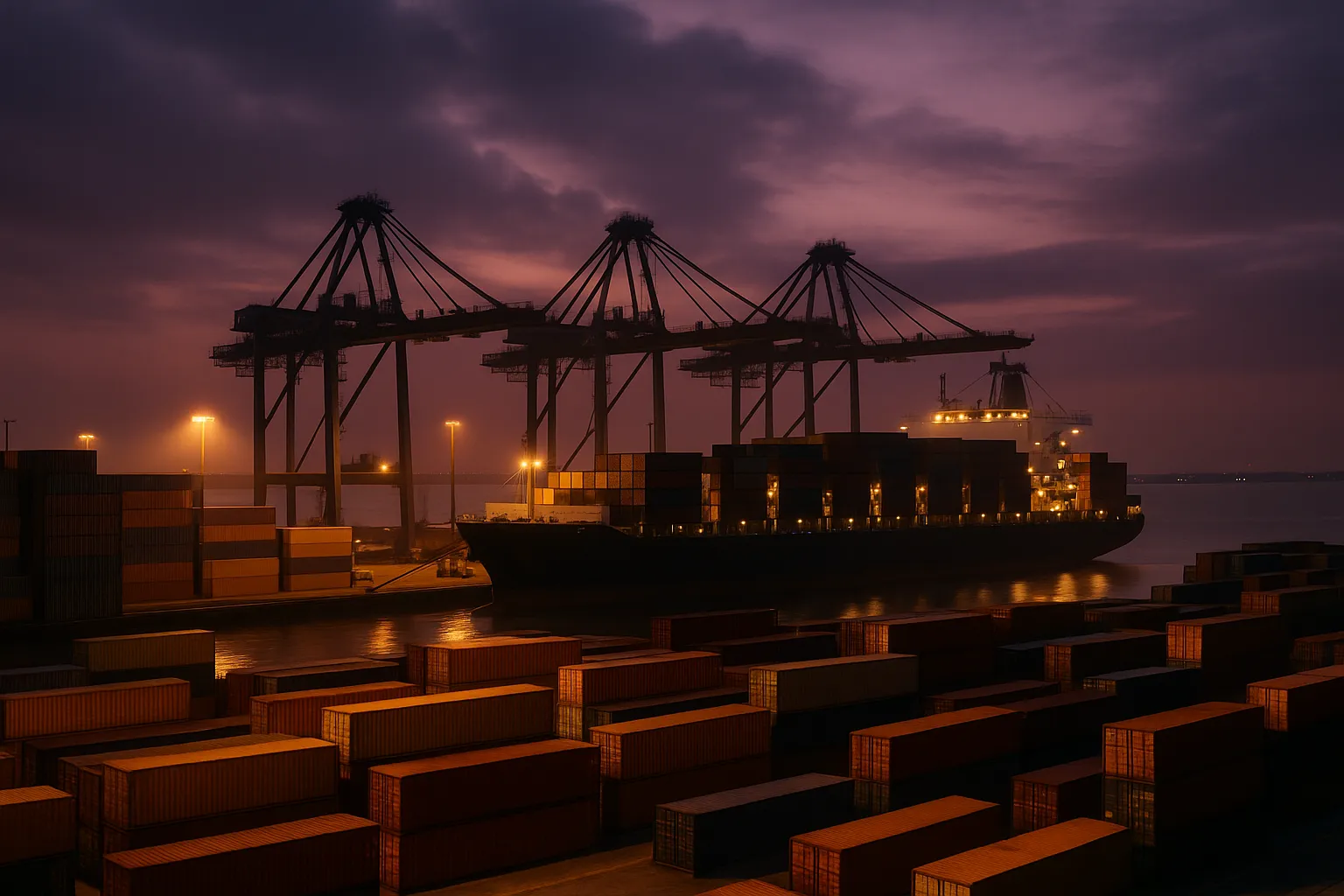
On 21 April 2026, MATRADE Chairman Datuk Seri Reezal Merican announced that Malaysia's 47 overseas trade offices are being repurposed into “frontline intelligence hubs” to help Malaysian exporters navigate the current trade turmoil. As part of that announcement, four specific alternative ports were named as potential diversion hubs for Malaysian cargo: Port Lekki (Nigeria), Tanger Med (Morocco), Cai Mep (Vietnam), and Mundra (India).
If you export out of Port Klang, this list matters. But read as a route planning exercise rather than a press release, only one of those four is genuinely operational for most Malaysian SME exporters in April 2026. The others require specific customer geographies or cargo profiles to make commercial sense. This article breaks down each of the four ports, what cargo actually fits where, and how to turn the MATRADE list into a real Q3 action item.
The 4 Ports At A Glance
- Port Lekki (Nigeria): New deep-water West Africa gateway. Useful only if you have active Lagos or wider West Africa buyers.
- Tanger Med (Morocco): Top-5 global transshipment hub with 9 million TEU capacity. Real value if you sell into Morocco, Spain, France, or wider North Africa.
- Mundra (India): Deep-water, efficient terminal operator, but customs paperwork is heavy on the buyer side.
- Cai Mep (Vietnam): 2 to 3 days from Port Klang, deep-water, increasingly direct-call by major lines. The most immediately useful of the four for most Malaysian SME exporters.
What MATRADE Actually Announced
The Chairman's framing was clear: “These offices are no longer just promotional centres; they now act as our eyes and ears on the ground, capturing real-time data.” The announcement included three concrete shifts:
- 47 overseas offices are being converted from market-development posts into intelligence nodes that report on buyer demand, port conditions, and route alternatives in real time.
- MIVA (MATRADE Interactive Virtual Assistant) was launched as a 24/7 AI support tool on the Madani Digital Trade Platform, oriented at SME and MSME exporters who need fast answers during a crisis.
- RM60 million has been allocated for SME expansion support, with a stated focus on the 74.5% of Malaysian SMEs currently facing working capital pressure.
Within that broader package, the four named ports represent MATRADE's suggestion that if your traditional routing is exposed to Red Sea, Hormuz, or West Asia volatility, these are credible hubs that can serve as alternative gateways to your end market. The problem is that “credible hub” is not the same as “commercially sensible alternative for your cargo.” Let's take them one by one.
Port Lekki (Nigeria): The New Gateway Still Finding Its Feet
Port Lekki is a deep-water greenfield port east of Lagos, commissioned in 2023. It was designed to relieve chronic congestion at Apapa and Tin Can Island, and it fills a real capacity gap in West Africa. The bigger picture for Malaysian exporters, though, is more narrow than the map suggests.
What's real about it:
- Deep-water access (16m draft) allows modern mainline vessels to call directly.
- It's a credible alternative gateway into the Nigerian domestic market, which is West Africa's largest economy.
- Infrastructure is new, which means fewer legacy issues on the quayside.
What makes it a niche play for Malaysian SMEs:
- Nigerian import documentation remains complex. Form M, PAAR, and SONCAP pre-shipment inspection requirements mean that the documentation work starts weeks before the container loads in Port Klang.
- Unless your buyer is already set up for Nigerian imports, the paperwork friction is a project in itself.
- Very few Malaysian SMEs have active Nigerian customer bases outside of a handful of commodity and food-product verticals.
When it makes sense: you already sell into Lagos or wider West Africa and your existing routing runs through a Middle East or European transshipment port that's exposed to current disruption. In that narrow case, a direct Port Klang to Lekki routing is worth pricing. Outside that profile, Port Lekki is a future option, not a current one.
Tanger Med (Morocco): A Credible Hub, For The Right Cargo
Tanger Med is the most serious infrastructure on the MATRADE list. It handled more than 10.2 million TEU in 2024, making it one of the top five container ports in the world by throughput, and more than 40% of transhipment traffic heading to Africa passes through it. The port complex has 4 container terminals, 3,600 metres of quay, and 18 metres of draft. This is a genuine Mediterranean gateway.
For Malaysian exporters, Tanger Med is useful under two specific conditions:
- You sell directly into Morocco, Spain, France, or wider North Africa. In that case, a Port Klang to Tanger Med routing avoids Red Sea and Suez risk on the final leg and gives you a well-managed transshipment point. Carriers like Maersk, MSC, and CMA CGM call Tanger Med regularly, so rate options are real.
- You use Tanger Med as a transshipment hub to wider European buyers. Short-sea services from Tanger Med to Algeciras, Barcelona, Marseille, and several Italian ports are frequent and competitive on cost.
What it does not do: solve a route problem if your actual buyer is in Germany, the Netherlands, or the UK. For those end markets, Rotterdam, Antwerp, and Felixstowe remain your natural delivery ports, and a Tanger Med diversion adds time and cost rather than removing it.
Mundra (India): Operationally Sound, Customs-Heavy
Mundra, operated by Adani Ports, is the largest private port in India. It's well-run, deep-water, and has strong rail connectivity into the Indian interior. For Malaysian exporters selling into India, Mundra is a perfectly reasonable gateway, and many lines already call it directly from Port Klang.
The practical problem isn't the port itself. It's that the India leg of the journey doesn't disappear once the container is discharged. Indian customs procedures are documentation-heavy, the Bill of Entry process requires specific importer-side expertise, and ICEGATE system issues periodically slow clearance across the board. If your buyer already imports regularly through Mundra, that's not your problem. If they don't, it becomes your problem fast.
When Mundra makes sense:
- You have an established Indian buyer with their own customs clearance setup.
- Your cargo profile (non-hazardous, standard HS codes, no specialised licensing) fits a routine clearance flow.
- Your rates through Mundra are genuinely better than via Nhava Sheva or Chennai, which should be checked before commitment.
Mundra is not a route problem solver for West Asia or Red Sea disruption the way Tanger Med is. It's a destination port for India itself.
Cai Mep (Vietnam): The One Worth Adding To Your Rate Review
Cai Mep is the port on this list that most Malaysian SME exporters should be pricing right now. Here's why:
- Transit time from Port Klang is short: 2 to 3 days on most direct feeder or mainline services.
- Deep-water capability: channel depths of 15.5 to 18 metres allow vessels of 160,000 to 200,000 DWT to call independent of tide.
- Growing direct-call status: carriers are increasingly treating Cai Mep as a mainline port rather than just a Ho Chi Minh feeder, which is improving rate options and schedule reliability.
- Operational fallback value: when Port Klang has a berth delay spike or a transshipment bottleneck, Cai Mep is close enough to serve as a genuine alternative routing for Vietnam-bound cargo, not a theoretical one.
For Malaysian exporters whose customer base is in Vietnam itself, Cai Mep is your primary gateway. For exporters shipping further afield via Asian transshipment, Cai Mep can serve as a secondary hub for specific lanes. And for exporters who simply want redundancy in their route planning in case Port Klang transshipment slows down, adding Cai Mep to your forwarder's rate list is a low-cost insurance policy.
The right way to read the MATRADE announcement is not as a list of four alternative routings you should adopt in parallel. It's a prompt to look at your actual customer geography and pick the one port on that list that matches it.
Matching Port to Cargo: A Simple Decision Table
| If your end market is... | The MATRADE port to focus on | Priority for most SME exporters |
|---|---|---|
| Vietnam or intra-ASEAN | Cai Mep | High (immediate) |
| Morocco, Spain, France, North Africa | Tanger Med | High (if you sell there) |
| Established India business | Mundra | Medium (compare vs Nhava Sheva) |
| Existing Nigerian buyer relationships | Port Lekki | Low (niche play) |
| EU (Germany, Netherlands, UK) | None of the 4 fit cleanly | Keep using North Sea ports |
| US East or West Coast | None of the 4 fit cleanly | Evaluate Pacific transshipment options separately |
What This Means For Your Q3 Route Planning
The single biggest operational risk facing Malaysian exporters right now is not rates, it's routing concentration. If your entire export flow goes through one transshipment hub, one chokepoint, or one port pair, you're one vessel delay away from a customer conversation you don't want to have.
The MATRADE list is an invitation to spread that risk intelligently. But it only works if you match port to cargo rather than adopt the list wholesale. Most Malaysian SMEs should do exactly three things in response to this announcement:
- Audit your customer geography. List your top 20 buyers by revenue and the port each one's cargo arrives at today. That list tells you which of the four MATRADE ports, if any, is structurally relevant to your book of business.
- Request a rate review. Ask your forwarder for indicative rates and transit times via the relevant MATRADE port for your largest lane. If Cai Mep applies, you'll likely get a quote back inside 48 hours. If Tanger Med applies, expect a few more days.
- Check MIVA once. MATRADE's new virtual assistant is free, runs on the Madani Digital Trade Platform, and can flag current port conditions for the ports you're actively considering. It's not a replacement for a forwarder's quote, but it's a useful sanity check.
What To Do Monday
If you're reading this on a Monday morning, here's the tightest version of the action list:
- Pull your top 10 export lanes from the last 6 months.
- For each lane, mark whether one of the four MATRADE ports could plausibly serve that end market.
- Where the answer is yes for Cai Mep or Tanger Med, send your forwarder a one-line email requesting a rate comparison vs your current routing.
- Where the answer is no, don't force a pivot. Keep your primary routing and focus instead on contract rate protection and managing current freight rate volatility.
- Separately: review your Incoterms on your biggest lanes. If you're shipping CIF, you don't control the routing anyway, and the MATRADE list is moot unless you switch to FOB.
The exporters who get the most out of the MATRADE announcement will be the ones who treat it as a prompt to audit their own routing rather than a prescription to follow. Four hubs named in a press conference don't do anything for your P&L. A second routing option priced and ready on your largest lane does.
How DNE Forwarding Can Help
At DNE Forwarding, we handle export routing out of Port Klang into more than 50 destination countries every month. When the MATRADE announcement landed, we already had carrier rate schedules on Cai Mep and Tanger Med, and buyer-side experience on Mundra clearance. That means:
- Rate benchmarking: we can price your current primary lane against a Cai Mep, Tanger Med, or Mundra alternative within 48 hours on most cargo profiles.
- Carrier access: we work with mainline and regional carriers that call each of the four MATRADE-named ports directly, so we can compare direct-call rates against transshipment rates honestly.
- Documentation support: for tricky destinations like Nigeria (Form M, SONCAP) or India (Bill of Entry, ICEGATE), we can coordinate with your buyer's side to reduce clearance delays.
- Lane diversification advice: if your current export flow is over-concentrated on one transshipment hub, we'll say so, and show you what a realistic Plan B looks like on rate and transit.
The MATRADE list is useful. It becomes actionable once you pair it with your own customer geography and a forwarder who can quote the alternatives honestly.