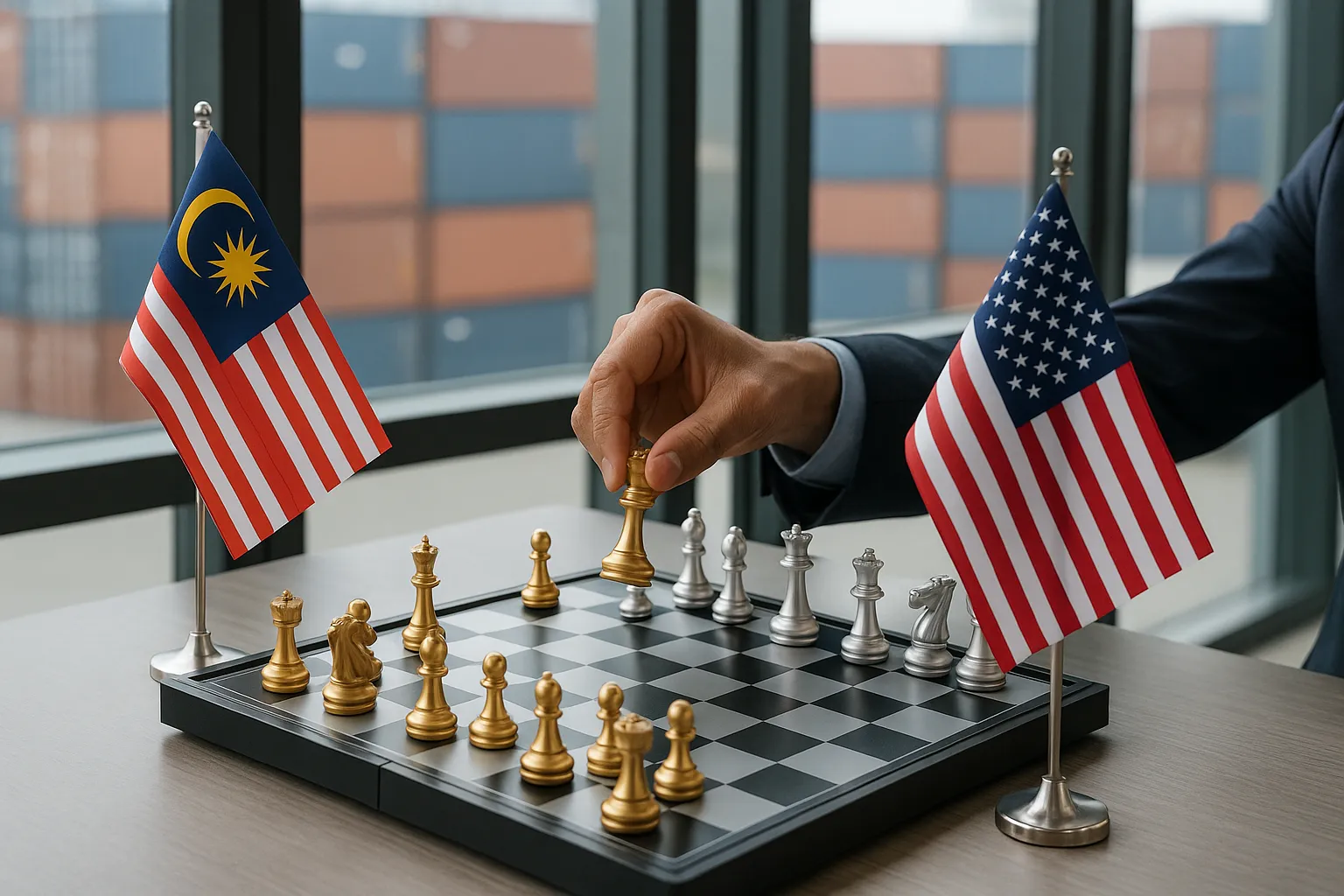
On 15 March 2026, Malaysia became the first country in the world to formally walk away from the United States' reciprocal tariff framework. Trade Minister Johari Abdul Ghani declared the Agreement on Reciprocal Trade (ART) between Malaysia and the US "null and void," ending months of politically costly concessions that had become economically pointless.
For Malaysian importers and exporters, this is not just a diplomatic headline. It changes the tariff landscape, shifts strategic priorities, and opens up opportunities that many businesses are not yet seeing. This article breaks down exactly what happened, what it means for your business, and what you should be doing right now.
What Happened: A Timeline of the Trade Deal Collapse
To understand why Malaysia walked away, you need to understand the sequence of events:
| Date | Event |
|---|---|
| April 2025 | The Trump administration imposed reciprocal tariffs on Malaysian goods at 47%, one of the highest rates applied to any country. |
| May–July 2025 | Malaysia negotiated the ART, reducing the tariff from 47% to 24%, and subsequently to approximately 19%. Malaysia made concessions on US agricultural imports, defence procurement, and digital trade rules. |
| 20 February 2026 | The US Supreme Court ruled that the president does not have authority under the International Emergency Economic Powers Act (IEEPA) to impose broad reciprocal tariffs. The ruling struck down the entire framework. |
| Late February 2026 | The US government imposed a uniform 10% tariff on all trading partners under Section 122, replacing the struck-down reciprocal tariffs. This applied equally to countries with deals and without. |
| 15 March 2026 | Malaysia declared the ART null and void, becoming the first country to formally exit. |
The logic was straightforward: Malaysia had made significant concessions to get from 47% down to 19%. But after the Supreme Court ruling, every country — whether they signed a deal or not — faces the same 10% tariff. The deal no longer offered any advantage. Why maintain politically and economically costly concessions for zero benefit?
What the Uniform 10% Tariff Means for Malaysian Exporters
If you export goods to the United States, here is what you need to know right now:
Key Facts for Exporters
- All Malaysian goods entering the US now face a uniform 10% tariff under Section 122
- This is lower than the 19% that applied under the negotiated ART deal
- The 10% applies equally to competitors in Vietnam, Thailand, Indonesia, and other ASEAN nations
- No country currently has a preferential rate — the playing field is level
- Section 122 tariffs can be adjusted by the US president without new legislation
The immediate impact is actually positive for Malaysian exporters. You are paying less to access the US market now (10%) than you were under the deal (19%). However, this advantage is fragile. Section 122 tariffs can be changed at any time, and the political environment in Washington remains unpredictable.
Sectors Most Affected
The sectors with the highest exposure to US tariff changes include:
- Electronics and semiconductors: Malaysia is the world's sixth-largest semiconductor exporter. The US is a major destination, and any tariff increase directly impacts competitiveness against factories in Taiwan, South Korea, and China.
- Rubber products: Medical gloves, industrial rubber goods, and tyres face margin pressure from the 10% tariff on top of existing freight and logistics costs.
- Palm oil and derivatives: Already facing competition from Indonesian producers, Malaysian palm oil exporters must absorb or pass through the tariff cost.
- Furniture and wood products: A significant export category to the US, where Malaysian manufacturers compete on price with Vietnamese and Chinese producers who now face the same 10% rate.
- Machinery and equipment: Capital goods exports to the US represent a growing segment, and the tariff adds friction to procurement decisions by American buyers.
What It Means for Malaysian Importers
For businesses importing goods from the United States into Malaysia, the trade deal exit has a different set of implications:
Concessions Rolled Back
Under the ART, Malaysia had agreed to reduce or eliminate tariffs on certain US goods, particularly agricultural products and digital services. With the deal voided, these concessions are no longer in effect. Malaysian import duties on US goods revert to MFN (Most Favoured Nation) rates under WTO rules.
This means:
- US agricultural imports (soybeans, corn, wheat) may see higher duties than during the deal period
- US machinery and equipment imports revert to standard tariff rates
- Digital trade provisions that favoured US tech companies no longer apply
If your business sources materials or goods from the US, review your current duty calculations immediately to account for the changed rates.
The Diversification Imperative
The collapse of the US trade deal is the clearest signal yet that dependence on any single market is a strategic risk. Malaysian businesses that have built their export model around US demand are exposed every time Washington changes policy — which, as the last two years have shown, can happen overnight.
The good news is that Malaysia has more trade agreement coverage than almost any country in the region:
Malaysia's Active Trade Agreements
- RCEP — Regional Comprehensive Economic Partnership covering 15 Asia-Pacific countries including China, Japan, South Korea, Australia, and all of ASEAN
- CPTPP — Comprehensive and Progressive Agreement for Trans-Pacific Partnership covering 12 countries including Canada, Mexico, Japan, Australia, and the UK
- ASEAN FTAs — Free trade agreements with China, Japan, South Korea, India, Australia, and New Zealand through ASEAN
- Bilateral FTAs — Individual agreements with Japan, Pakistan, Chile, Turkey, and others
- EU-Malaysia FTA — Negotiations actively progressing as of 2026
Under RCEP and CPTPP alone, Malaysian exporters can access markets covering over 2.2 billion consumers with reduced or zero tariffs — provided they meet rules of origin requirements. For a detailed guide on using these agreements, see our article on how to use RCEP, CPTPP, and FTAs to pay zero duty.
Practical Steps for Diversification
- Map your market exposure: Calculate what percentage of your exports go to each market. If any single country represents more than 30% of your export revenue, you are over-concentrated.
- Identify FTA-covered alternatives: For every product you export to the US, identify at least two alternative markets where you can access preferential tariff rates through existing FTAs.
- Get your certificates of origin right: Preferential tariff rates under RCEP and CPTPP require proper documentation. Work with your forwarding agent to ensure your certificates of origin are correctly issued and accepted at destination.
- Review your supply chain routes: Diversifying markets may require new shipping routes. Port Klang's position as a major transshipment hub gives Malaysian exporters access to direct services to Europe, the Middle East, Africa, and intra-Asia — often with competitive transit times.
- Build relationships now: Don't wait for the next trade shock. Start developing buyer relationships in target markets before you need them urgently.
Port Klang: Positioned for the Pivot
One of Malaysia's strongest assets in this shifting trade landscape is Port Klang's strategic position. As the country's busiest port handling over 13 million TEUs annually, Port Klang offers:
- Direct services to over 200 ports across Asia, Europe, the Middle East, Africa, and the Americas
- Westport and Northport providing world-class container handling facilities with competitive terminal charges
- Free Trade Zone facilities enabling duty-free storage, consolidation, and re-export — ideal for regional distribution models
- Proximity to manufacturing hubs in the Klang Valley, Penang, and Johor
For businesses pivoting toward ASEAN and intra-Asia trade, Port Klang is the natural gateway. Transit times to key ASEAN ports range from 2 to 7 days, and the Free Trade Zone at Port Klang offers significant cost advantages for businesses running multi-market distribution operations.
What Happens Next?
The trade policy environment remains fluid. Here is what to watch:
- Other countries may follow Malaysia's lead. Several ASEAN nations that signed similar deals are reassessing their positions. If more countries exit, the US may be forced to renegotiate on different terms.
- Section 122 is temporary by nature. The 10% uniform tariff was imposed as a stopgap. Congress may legislate a more permanent tariff framework, which could change rates again.
- EU-Malaysia FTA negotiations are accelerating. With the US deal off the table, Malaysia is doubling down on European trade ties. A completed FTA with the EU would give Malaysian exporters preferential access to a market of 450 million consumers.
- ASEAN integration is deepening. Intra-ASEAN trade is growing faster than trade with external partners. Businesses that invest in regional supply chains now will be best positioned for the next decade.
The companies that will win in 2026 are not the ones chasing the lowest tariff rate to a single market. They are the ones building redundant trade lanes across multiple markets, using every FTA available, and positioning themselves at the centre of regional supply chains.
How DNE Forwarding Can Help
At DNE Forwarding, we handle customs clearance, freight forwarding, and trade documentation at Port Klang every day. In a shifting tariff environment, having a forwarding partner who understands the rules of origin requirements, FTA documentation, and multi-market logistics is not optional — it is essential.
- FTA and tariff advisory: We help you identify which trade agreements apply to your products and ensure your documentation qualifies for preferential rates.
- Multi-market shipping: Whether you are shipping to ASEAN, Europe, the Middle East, or beyond, we manage end-to-end forwarding from Port Klang.
- Customs compliance: Tariff changes mean declaration requirements change too. We ensure every shipment is correctly classified and declared under the current rules.
- Cost optimisation: We review your total logistics costs — including duty, SST, freight, and handling — to find savings across your supply chain.
The trade landscape is shifting. Make sure your logistics partner is keeping up.