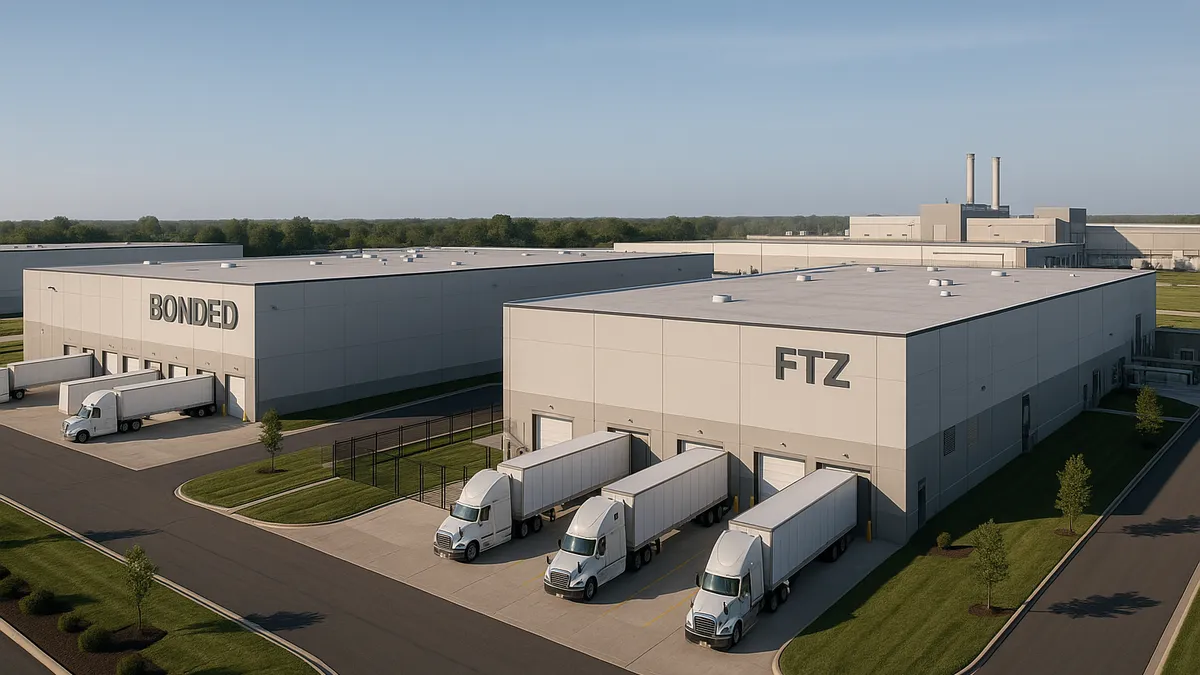
Malaysia offers several duty-suspension mechanisms that allow businesses to import, store, and process goods without immediately paying customs duties and Sales and Service Tax (SST). Choosing the right facility type is not a minor administrative decision — it can save your business hundreds of thousands of ringgit in cash flow costs, reduce your duty exposure, and determine whether your operations comply with JKDM (Jabatan Kastam Diraja Malaysia) requirements.
Yet many businesses in Malaysia operate in the wrong type of facility. Manufacturers store goods in bonded warehouses when a Free Trade Zone would eliminate time restrictions. Trading companies set up Licensed Manufacturing Warehouses when they have no manufacturing activity. These mismatches cost money, create compliance risk, and trigger JKDM audits that could have been avoided entirely.
This guide breaks down the three main duty-suspension facility types — bonded warehouses, Free Trade Zones (FTZ), and Licensed Manufacturing Warehouses (LMW) — and provides a practical framework for choosing the right one for your business.
Bonded Warehouse (Sections 65 and 65A, Customs Act 1967)
A bonded warehouse is a premises licensed by JKDM under Section 65 or Section 65A of the Customs Act 1967 where imported goods can be stored without payment of customs duties and SST. The duty liability is deferred — not eliminated — until the goods are released into the Principal Customs Area (PCA), meaning peninsular Malaysia's domestic market.
Types of Bonded Warehouses
There are two categories of bonded warehouses in Malaysia:
- Public bonded warehouse (Section 65): Operated by a licensed warehouse operator and available for use by multiple importers. Any importer can store goods here by paying the warehouse operator's storage fees. Public bonded warehouses are commonly found near ports and airports.
- Private bonded warehouse (Section 65A): Licensed to a specific company for its exclusive use. The licensee must demonstrate sufficient import volumes to justify a private facility. Private bonded warehouses give companies greater control over their inventory but come with higher compliance responsibilities.
Permitted Activities
The activities allowed inside a bonded warehouse are strictly limited. You may:
- Store imported goods pending duty payment or re-export
- Repack, sort, and relabel goods
- Break bulk (divide large consignments into smaller lots)
- Conduct basic quality inspection
What you cannot do in a bonded warehouse is manufacture, assemble, or substantially alter the goods. If your operations involve any form of production — even light assembly — a bonded warehouse is not the correct facility type.
Duty and SST Treatment
Goods in a bonded warehouse remain under customs control. Customs duty and SST are deferred — they become payable only when goods are released into the PCA for domestic consumption. If goods are re-exported directly from the bonded warehouse, no duty or SST is payable. This makes bonded warehouses attractive for businesses that import goods for both domestic sale and re-export.
Storage Period and JKDM Supervision
Goods may be stored in a bonded warehouse for a maximum of two years from the date of importation. Extensions beyond two years require written approval from the Director General of Customs, which is granted only in exceptional circumstances. Goods remaining beyond the permitted period may be seized and disposed of by JKDM.
Bonded warehouses are subject to regular JKDM supervision. Customs officers conduct periodic stock checks, and every movement of goods into and out of the warehouse must be documented with proper customs forms, including the K8 form for warehoused goods. Inventory records must reconcile with customs declarations at all times.
Bonded Warehouse at a Glance
- Legal basis: Section 65 (public) / Section 65A (private) of the Customs Act 1967
- Duty treatment: Deferred until goods enter PCA; no duty if re-exported
- Maximum storage: 2 years (extensions require DG Customs approval)
- Manufacturing: Not permitted
- Best for: Pure storage, re-export operations, break-bulk distribution
Free Trade Zone (Free Zones Act 1990)
A Free Trade Zone (FTZ) is an area gazetted under the Free Zones Act 1990 where goods are treated as being outside Malaysia's customs territory. This is a fundamentally different concept from a bonded warehouse — rather than deferring duties, an FTZ effectively places goods outside the country's customs boundary entirely, even though they are physically located within Malaysia.
Types of Free Zones
Malaysia's Free Zones are divided into two categories:
- Free Commercial Zone (FCZ): Designated for commercial and trading activities. FCZs are typically located at or near ports and airports. Port Klang Free Zone (PKFZ), for example, is an FCZ adjacent to Westport. Activities in an FCZ include storage, consolidation, grading, repacking, relabelling, transit, and light processing.
- Free Industrial Zone (FIZ): Designated for manufacturing and industrial activities. Companies operating in an FIZ can manufacture goods using imported raw materials without paying duties. FIZs are commonly found in industrial areas such as Bayan Lepas (Penang), Pasir Gudang (Johor), and several locations in Selangor.
Permitted Activities
The range of activities permitted in an FTZ is considerably wider than in a bonded warehouse:
- Storage with no time limit — goods can remain in an FTZ indefinitely
- Consolidation and deconsolidation of shipments
- Labelling, relabelling, and repackaging
- Light assembly and testing (in FCZ)
- Full manufacturing operations (in FIZ)
- Quality control and inspection
- Trade exhibition and display
Duty and SST Treatment
Goods within an FTZ are treated as being outside Malaysia. No customs duty or SST applies while goods remain in the zone. Duties and SST become payable only when goods cross from the FTZ into the PCA. Goods moving between FTZs, or from an FTZ to an export destination, attract no duty at all.
This treatment makes FTZs particularly attractive for regional distribution hubs. A company can import goods from multiple countries into an FTZ, consolidate them, and re-export to ASEAN or global markets without ever triggering Malaysian duty obligations.
No Storage Time Limit
Unlike bonded warehouses, there is no maximum storage period in an FTZ. Goods can be stored indefinitely, which is a significant advantage for businesses that hold large inventories or deal in slow-moving goods. This also eliminates the administrative burden of tracking two-year expiry dates and applying for extensions.
If your business regularly stores goods for longer than 12 months before selling or re-exporting, an FTZ eliminates the two-year bonded warehouse deadline entirely — and the compliance risk of forgetting to apply for an extension.
Free Trade Zone at a Glance
- Legal basis: Free Zones Act 1990
- Duty treatment: Goods treated as outside Malaysia; no duty/SST until PCA entry
- Maximum storage: No time limit
- Manufacturing: Permitted in FIZ; light assembly in FCZ
- Best for: Regional distribution, re-export hubs, long-term storage, trading companies
Licensed Manufacturing Warehouse (Section 65A, Customs Act 1967)
A Licensed Manufacturing Warehouse (LMW) is a hybrid facility licensed under Section 65A of the Customs Act 1967, designed specifically for export-oriented manufacturers. It allows a manufacturer to import raw materials, components, and machinery duty-free, provided the finished goods are predominantly exported.
Think of an LMW as a factory operating within a customs-controlled premises. The manufacturer gets the duty benefits of an FIZ without needing to physically relocate to a gazetted Free Industrial Zone.
The 80% Export Requirement
The defining feature of an LMW is the minimum 80% export ratio. At least 80% of the finished goods manufactured in the LMW must be exported. The remaining 20% (or less) may be sold into the PCA, but customs duty and SST become payable on the imported raw materials used to manufacture the domestically sold portion.
This 80/20 ratio is not a guideline — it is a binding condition of the licence. JKDM monitors export ratios closely, and consistently falling below 80% can result in licence revocation. Companies must maintain detailed records showing the raw material inputs for each production batch and the export/domestic split of finished goods.
Permitted Activities
- Full manufacturing and assembly operations
- Processing of raw materials into finished goods
- Storage of raw materials, work-in-progress, and finished goods
- Quality testing and inspection
- Packing and labelling for export
Duty and SST Treatment
Raw materials, components, and machinery imported into an LMW are exempt from customs duty and SST, provided they are used in the manufacturing process and the finished goods are exported. For the portion of finished goods sold domestically (up to 20%), duty and SST are calculated on the imported raw materials used in production — not on the finished goods value.
JKDM Supervision and Compliance
LMW facilities are subject to intensive JKDM oversight. This includes:
- Regular customs audits (typically quarterly or semi-annually)
- Mandatory maintenance of raw material consumption records
- Production yield tracking and wastage reporting
- Monthly or quarterly export ratio calculations submitted to JKDM
- Physical stock checks by customs officers
The compliance burden for an LMW is significantly higher than for a bonded warehouse or FTZ tenancy. Companies need dedicated customs compliance staff or a highly capable forwarding agent to manage the documentation requirements.
Licensed Manufacturing Warehouse at a Glance
- Legal basis: Section 65A, Customs Act 1967 (with MIDA recommendation)
- Duty treatment: Raw materials imported duty-free for manufacturing; duty payable on domestic sales portion
- Export requirement: Minimum 80% of finished goods must be exported
- Manufacturing: Required — this is a manufacturing facility
- Best for: Export-oriented manufacturers who cannot or prefer not to locate in an FIZ
Detailed Comparison: Bonded Warehouse vs FTZ vs LMW
The following table compares the three facility types across key criteria. Use this as a quick reference, but read the detailed sections above for the full picture.
| Criteria | Bonded Warehouse | Free Trade Zone | LMW |
|---|---|---|---|
| Legal Basis | Sections 65/65A, Customs Act 1967 | Free Zones Act 1990 | Section 65A, Customs Act 1967 |
| Customs Status | Within PCA, under customs control | Outside customs territory | Within PCA, under customs control |
| Permitted Activities | Storage, repacking, sorting, break-bulk | Storage, consolidation, light assembly (FCZ), full manufacturing (FIZ) | Full manufacturing and assembly |
| Manufacturing Allowed | No | Yes (FIZ); limited (FCZ) | Yes (required) |
| Duty Treatment | Deferred until PCA release | No duty while in zone; payable on PCA entry | Exempt on raw materials for export production |
| SST Treatment | Deferred until PCA release | No SST while in zone; payable on PCA entry | Exempt on imported inputs for export goods |
| Storage Time Limit | 2 years (extension possible) | No limit | No specific limit (tied to production cycle) |
| Export Requirement | None | None | Minimum 80% of finished goods |
| JKDM Audit Frequency | Periodic stock checks | Zone authority oversight; periodic JKDM checks | Quarterly to semi-annual audits |
| Location Flexibility | Any approved premises | Must be within gazetted FTZ area | Any approved premises (factory location) |
| Application Authority | JKDM (Director General of Customs) | Ministry of Finance / Free Zone Authority | MIDA recommendation + JKDM licence |
| Typical Approval Timeline | 1-3 months | 3-6 months (tenancy); longer for new zone | 3-6 months (MIDA + JKDM combined) |
| Best Suited For | Importers, traders, re-exporters | Regional hubs, trading companies, distribution centres | Export-oriented manufacturers |
Decision Framework: Choosing the Right Facility
The right facility depends on what your business actually does with imported goods. Here is a practical framework based on business type:
Pure Storage and Re-Export
If you import goods and either re-export them or sell them domestically without any processing, your choice is between a bonded warehouse and an FTZ (FCZ). The decision factors are:
- Storage duration: If goods typically move within 6-12 months, a bonded warehouse works fine. If you hold inventory longer than 12 months, an FCZ eliminates the two-year limit.
- Volume: High-volume operations benefit from FTZ infrastructure. Smaller operations may find bonded warehouse rental more economical.
- Location: FTZs are fixed locations. If you need a warehouse near your customers rather than near a port, a private bonded warehouse offers more flexibility.
Regional Distribution Hub
If you are consolidating goods from multiple origins and redistributing across Southeast Asia, an FCZ within an FTZ is almost always the best option. The ability to receive, consolidate, and re-export without duty obligations — combined with unlimited storage — makes FTZs the natural home for distribution operations. Port Klang Free Zone is positioned precisely for this purpose.
Export-Oriented Manufacturing
If you manufacture goods primarily for export (80% or more), you have two options: FIZ or LMW. The choice depends on whether you want to relocate to a gazetted industrial zone or stay at your current factory location. An LMW lets you convert your existing factory into a customs-controlled manufacturing premises, avoiding the cost and disruption of relocation. An FIZ, on the other hand, provides purpose-built industrial infrastructure and may offer additional incentives from state investment agencies.
Mixed Domestic and Export Manufacturing
If your domestic sales exceed 20% of output, an LMW will not work — you will breach the export ratio requirement. In this case, consider operating from outside any duty-suspension facility and using standard customs clearance with Schedule C exemptions for raw materials. Alternatively, you could split operations: manufacture export goods in an LMW or FIZ, and produce domestic goods in a separate standard factory.
Cost Comparison
The total cost of operating in each facility type varies significantly. Here is a general guide to the cost categories — actual figures depend on location, size, and the specific operator or zone authority.
Bonded Warehouse Costs
- Licence fee: RM1,000-RM5,000 per annum (private bonded warehouse)
- Rental: RM1.50-RM3.50 per sq ft per month (depending on location and whether public or private)
- JKDM supervision fees: Charges apply for customs officer attendance during stock checks and cargo movements
- Security deposit: Typically RM50,000-RM200,000 bank guarantee
- Compliance costs: Lower than LMW; mainly inventory record-keeping and K8 documentation
FTZ Costs
- Tenancy fees: Vary by zone authority; PKFZ rates range from RM2.00-RM4.00 per sq ft per month for built-up space
- Zone entry/exit charges: Gate pass fees for every vehicle entry, typically RM5-RM20 per movement
- No JKDM supervision fee: Zone authority handles oversight, which is built into tenancy costs
- Infrastructure charges: Some FTZs charge separately for utilities, maintenance, and shared infrastructure
- Compliance costs: Moderate; zone authority requirements plus customs documentation for PCA transfers
LMW Costs
- Licence fee: RM2,000-RM10,000 per annum
- Premises: Your own factory — rental or ownership costs as per normal industrial property
- JKDM supervision fees: Higher than bonded warehouse due to manufacturing complexity
- Security deposit: Typically RM100,000-RM500,000 bank guarantee (proportional to estimated duty exposure)
- Compliance costs: Highest of the three — dedicated customs compliance personnel, production tracking systems, quarterly reporting
When comparing costs, do not focus only on rental and licence fees. The cash flow benefit of duty suspension often dwarfs the facility costs. A manufacturer importing RM10 million of raw materials annually at a 10% duty rate saves RM1 million in upfront duty payments by operating in an LMW or FIZ. That capital remains in the business instead of being locked up with JKDM. (For more on optimising your logistics costs, see our detailed guide.)
Application Process
Bonded Warehouse Application
- Submit application to JKDM at the relevant state customs office with supporting documents: company registration (SSM), premises details, floor plan, projected import volumes, and intended use
- JKDM site inspection: Customs officers inspect the premises to verify security, access control, and suitability for customs-controlled storage
- Licence issuance: Upon approval, JKDM issues the warehouse licence with conditions (operating hours, security requirements, record-keeping obligations)
- Timeline: Typically 1-3 months from complete application
FTZ Tenancy Application
- Identify suitable FTZ: Contact the zone authority (e.g., PKFZ Authority for Port Klang Free Zone) for available space
- Submit tenancy application to the zone authority with business plan, projected volumes, and company credentials
- Zone authority approval: The authority evaluates whether your business activity is appropriate for the zone
- Sign tenancy agreement and register with JKDM for customs documentation purposes
- Timeline: 3-6 months for tenancy; establishing a new FTZ is a government-level process taking years
LMW Application
- Apply to MIDA (Malaysian Investment Development Authority): Submit manufacturing licence application with detailed production plan, projected export ratios, raw material requirements, and capital investment details
- MIDA evaluation and recommendation: MIDA assesses whether your manufacturing project qualifies for LMW status based on export orientation, technology level, and economic contribution
- JKDM licence application: With MIDA's recommendation letter, apply to JKDM for the Section 65A warehouse licence
- JKDM site inspection: Customs officers inspect the factory premises, production facilities, and security arrangements
- Licence issuance: JKDM issues the LMW licence with detailed conditions on export ratios, reporting requirements, and customs procedures
- Timeline: 3-6 months for the combined MIDA + JKDM process
Common Mistakes to Avoid
After years of helping businesses navigate these facility types, we see the same errors repeatedly. Avoid these costly missteps:
1. Using a Bonded Warehouse When an FTZ Is Better
Trading companies that predominantly re-export goods sometimes default to bonded warehouses because they are more familiar. But if more than half your goods are re-exported and you hold inventory for extended periods, an FCZ offers unlimited storage, no two-year deadline risk, and often comparable or lower total costs. The two-year limit in a bonded warehouse is not just an inconvenience — goods exceeding this period can be seized by JKDM.
2. Failing to Meet the LMW 80% Export Ratio
This is the single most common compliance failure in LMW operations. Companies start with strong export numbers but gradually increase domestic sales as the local market grows. Before they realise it, their export ratio has dropped below 80%. JKDM monitors this closely, and the consequences are severe: duty assessments on all imported raw materials (retroactively, in some cases), penalties, and potential licence revocation.
Mitigation: Track your export ratio monthly, not quarterly. If you see it trending toward 80%, take immediate action — either by increasing export orders or by shifting domestic production to a non-LMW facility.
3. Poor Inventory Controls in Any Facility Type
All three facility types require accurate inventory records that reconcile with customs declarations. JKDM auditors compare your physical stock against your declared movements. Discrepancies trigger investigations, penalties, and — in serious cases — criminal proceedings for duty evasion. Invest in a proper warehouse management system and ensure every inbound and outbound movement is documented in real time.
4. Ignoring the Total Cost Picture
Some businesses choose a bonded warehouse purely because the per-square-foot rental is lower than an FTZ. But they overlook JKDM supervision fees, the cost of managing two-year storage limits, and the cash flow impact of duty payments on goods that could have been re-exported duty-free from an FTZ. Always calculate the total cost of compliance, not just the rental line item.
5. Starting an LMW Application Without MIDA Alignment
Some manufacturers apply directly to JKDM for an LMW licence without first securing MIDA's recommendation. This wastes time and creates confusion. The process must start with MIDA, and your manufacturing plan must align with Malaysia's industrial development priorities. Engage with MIDA early — ideally before you finalise your factory premises.
How DNE Forwarding Helps
DNE Forwarding operates across all three facility types in the Port Klang region. Whether you are storing goods in a bonded warehouse, operating from an FTZ facility, or managing an LMW, we provide the customs documentation, inventory compliance, and advisory support to keep your operations running smoothly.
Here is what we bring to the table:
- Facility advisory: We assess your business model — import volumes, export ratios, storage durations, and processing requirements — and recommend the facility type that minimises your total duty and compliance costs.
- Customs documentation: We handle all customs declarations, K1/K2 forms for imports and exports, K8 forms for bonded warehouse movements, and FTZ transfer documentation.
- Warehousing services: We offer warehousing across multiple facility types near Port Klang, giving you flexibility to store goods in the most cost-effective environment.
- Compliance support: For LMW clients, we help maintain export ratio records, prepare for JKDM audits, and ensure your raw material consumption tracking meets customs requirements.
- Application assistance: We guide companies through the bonded warehouse, FTZ tenancy, and LMW application processes — from initial documentation through JKDM inspection to licence issuance.
The right facility type can save your business significant money and eliminate compliance headaches. The wrong one can cost you in penalties, lost time, and unnecessarily high duty payments. We help you get this decision right from the start.