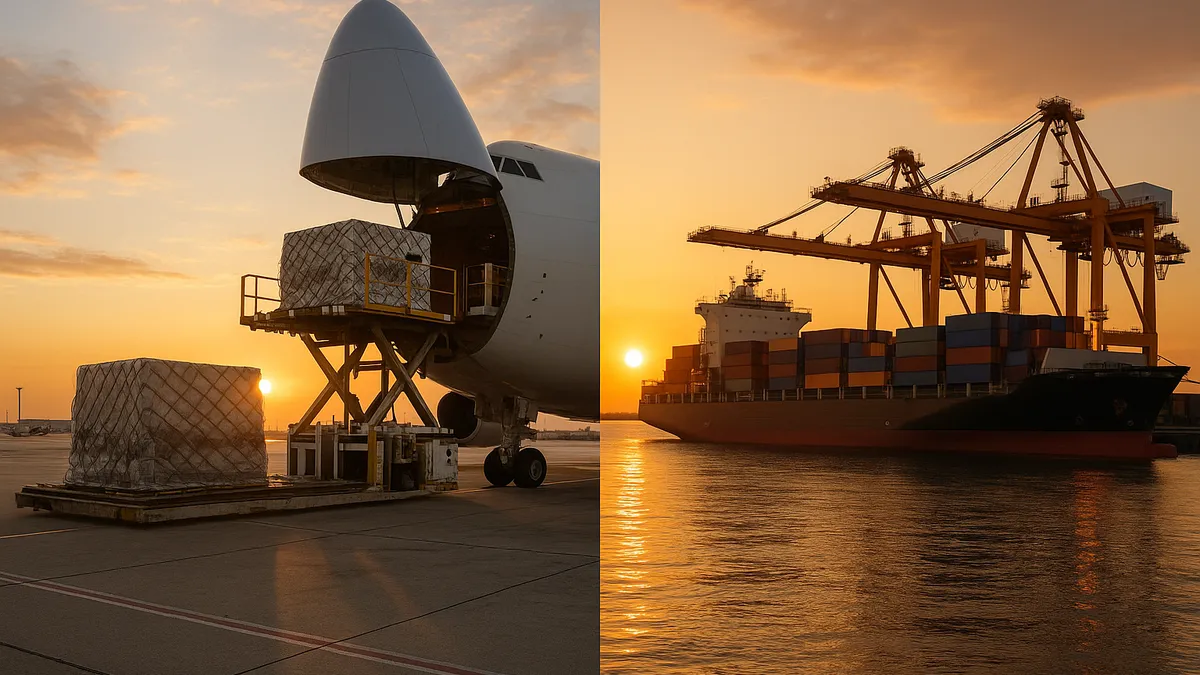
Every Malaysian importer faces the same fundamental question with each shipment: should this cargo move by air or by sea? The answer is rarely straightforward. It depends on the value of your goods, how urgently you need them, the weight and volume involved, and the trade lane you are operating on. Get it wrong and you either waste money on unnecessary air freight or lose revenue waiting weeks for a sea shipment that should have flown.
This guide breaks down both modes in detail — with realistic 2026 rates, transit times to Malaysia, customs clearance differences, and a practical framework for deciding which mode to use. Whether you are importing raw materials from China, electronics from Japan, machinery from Europe, or chemicals from India, the principles here will help you make smarter freight decisions.
The Two Modes: A Quick Overview
International cargo reaches Malaysia through two primary channels: ocean freight via container vessels arriving at ports like Port Klang, Penang Port, and Port of Tanjung Pelepas, and air freight via cargo aircraft landing at KLIA Cargo, Penang International Airport, and Senai International Airport in Johor.
Each mode has distinct characteristics in cost, speed, capacity, and reliability. The tradeoffs are significant — air freight typically costs 4 to 10 times more per kilogram than sea freight, but delivers in days rather than weeks. Understanding these tradeoffs at a granular level is what separates importers who optimise their logistics spend from those who simply default to one mode out of habit.
Sea Freight: The Workhorse of International Trade
Approximately 90% of global trade by volume moves by sea, and Malaysia is no exception. Port Klang — comprising Westport and Northport — handles the vast majority of Malaysia's containerised imports, processing over 13 million TEUs annually. Sea freight is the default choice for bulk cargo, regular scheduled shipments, and any situation where cost matters more than speed.
How Sea Freight Works: FCL vs LCL
Sea freight shipments are categorised into two loading types:
- Full Container Load (FCL): You book an entire container — typically a 20-foot (TEU) or 40-foot (FEU) unit — exclusively for your cargo. This is the most cost-effective option when you have enough volume to fill or nearly fill a container. A standard 20-foot container holds roughly 28-30 CBM of cargo, while a 40-foot holds 56-60 CBM. (For a detailed comparison, see our FCL vs LCL guide.)
- Less than Container Load (LCL): Your cargo is consolidated with shipments from other importers into a shared container. You pay per CBM or per weight ton (whichever is greater). LCL is practical for smaller shipments but adds 3-7 days to transit time due to consolidation and deconsolidation at both origin and destination.
Transit Times to Port Klang by Origin
Transit times vary significantly depending on the origin port, shipping line, and whether the service is direct or requires transhipment. Here are realistic ranges for the most common trade lanes serving Malaysian importers:
| Origin | Transit Time (Direct) | Transit Time (Transhipment) |
|---|---|---|
| China (Shanghai, Shenzhen, Ningbo) | 5 – 8 days | 8 – 12 days |
| Japan (Tokyo, Osaka, Kobe) | 7 – 10 days | 10 – 15 days |
| South Korea (Busan) | 7 – 10 days | 10 – 14 days |
| India (JNPT, Chennai) | 7 – 10 days | 12 – 18 days |
| Europe (Rotterdam, Hamburg) | 20 – 25 days | 25 – 35 days |
| USA West Coast (LA, Long Beach) | 18 – 22 days | 25 – 32 days |
| USA East Coast (New York, Savannah) | 28 – 32 days | 32 – 40 days |
| Middle East (Jebel Ali, Dammam) | 8 – 12 days | 12 – 18 days |
These are port-to-port transit times only. Add 2-5 days for customs clearance and haulage to your warehouse, and potentially 3-7 days for LCL deconsolidation. Disruptions such as the Strait of Hormuz crisis can add 7-14 days to Middle East and European routes when vessels are forced to reroute.
Sea Freight Costs
Ocean freight rates are quoted per container (FCL) or per CBM/weight ton (LCL). As of early 2026, typical all-in rates for imports to Port Klang are:
- FCL from China: USD 800 – 1,500 per 20-foot container (depending on port and season)
- FCL from Europe: USD 1,800 – 3,500 per 20-foot container
- FCL from USA: USD 2,000 – 4,000 per 20-foot container
- LCL from China: USD 30 – 60 per CBM
- LCL from Europe: USD 50 – 90 per CBM
When converted to a per-kilogram basis — which is essential for comparing with air freight — sea freight typically works out to RM 0.30 – 1.50 per kg depending on cargo density. Dense, heavy cargo benefits most from sea freight economics; light, voluminous cargo less so.
Air Freight: Speed at a Premium
Air freight accounts for less than 1% of global trade by weight but roughly 35% by value. This tells you everything about when air freight makes sense: high-value, time-sensitive, or lightweight goods where the speed premium is justified by the cargo's value or urgency.
How Air Freight Works
Air cargo moves on either dedicated freighter aircraft or in the belly hold of passenger flights. Cargo is typically palletised on Unit Load Devices (ULDs) — standardised aluminium containers that fit into aircraft fuselages. Key terms you need to know:
- Chargeable weight: Air freight is charged on the greater of actual gross weight or volumetric weight (calculated as Length x Width x Height in cm, divided by 6,000). This means bulky but light cargo is charged based on the space it occupies, not its actual weight.
- Weight breaks: Rates decrease as quantity increases. Common break points are 45 kg, 100 kg, 300 kg, 500 kg, and 1,000 kg. A 500 kg shipment may cost less per kg than a 100 kg shipment on the same route.
- Airport-to-airport vs door-to-door: Quoted rates usually cover airport-to-airport only. Add origin pickup, export customs, destination customs clearance, and final delivery to get the true landed cost.
Malaysia's Air Cargo Gateways
Malaysia has three primary air cargo facilities:
- KLIA Cargo (Kuala Lumpur): The main international air cargo hub, handling over 700,000 tonnes annually. Home to the KLIA Air Cargo Terminal, MASkargo facilities, and free zone areas. Most international air freight to Peninsular Malaysia routes through KLIA.
- Penang International Airport: Significant cargo volumes driven by the electronics manufacturing cluster in Penang. Direct freighter services from major Asian hubs.
- Senai International Airport (Johor): Growing cargo hub serving the Iskandar Malaysia economic zone, with connections to Singapore's air cargo network.
Air Freight Transit Times to Malaysia
Air freight transit times are dramatically shorter than sea, but remember these are flight times only — add 1-2 days for cargo handling and customs clearance at each end:
| Origin | Flight Time | Total Door-to-Door |
|---|---|---|
| China (Shanghai, Shenzhen) | 4 – 6 hours | 2 – 4 days |
| Japan (Tokyo, Osaka) | 6 – 7 hours | 2 – 4 days |
| India (Mumbai, Delhi) | 5 – 6 hours | 2 – 5 days |
| Europe (Frankfurt, Amsterdam) | 11 – 13 hours | 3 – 5 days |
| USA (Los Angeles, Chicago) | 18 – 22 hours | 3 – 6 days |
| Middle East (Dubai) | 6 – 7 hours | 2 – 4 days |
Air Freight Costs
Air freight rates vary by trade lane, weight break, and whether you are using general cargo rates or contract rates negotiated by your forwarding agent. Typical 2026 rates to KLIA for general cargo:
- China to KLIA: RM 7 – 15 per kg (depending on weight break; under 100 kg at the higher end, over 500 kg at the lower end)
- Europe to KLIA: RM 12 – 25 per kg
- USA to KLIA: RM 15 – 30 per kg
- India to KLIA: RM 8 – 16 per kg
- Japan/Korea to KLIA: RM 8 – 18 per kg
Express services (next-day or time-definite delivery via integrators like DHL, FedEx, or UPS) can cost 2 to 4 times these rates, but include door-to-door service and customs clearance.
Head-to-Head Cost Comparison
The table below compares realistic all-in costs for the same trade lanes, illustrating the cost gap between air and sea freight on a per-kilogram basis:
| Trade Lane | Sea Freight (per kg) | Air Freight (per kg) | Air Premium |
|---|---|---|---|
| Shanghai to KL | RM 0.40 – 1.20 | RM 7 – 15 | 8 – 18x |
| Shenzhen to KL | RM 0.35 – 1.00 | RM 7 – 14 | 10 – 20x |
| JNPT (India) to KL | RM 0.50 – 1.50 | RM 8 – 16 | 6 – 16x |
| Rotterdam to KL | RM 0.80 – 2.00 | RM 12 – 25 | 8 – 15x |
| Los Angeles to KL | RM 1.00 – 2.50 | RM 15 – 30 | 8 – 15x |
These figures make one thing abundantly clear: air freight costs roughly 8 to 20 times more per kilogram than sea freight. The question is not which mode is cheaper — it is always sea freight — but rather when the speed advantage of air freight justifies the premium.
The Break-Even Analysis: When Does Air Freight Make Financial Sense?
The standard framework for deciding between air and sea freight centres on the value-to-weight ratio of your cargo and the cost of time.
Value-to-Weight Ratio
As a general rule, air freight becomes economically rational when the cargo value exceeds USD 15 – 20 per kilogram. At this threshold, the freight cost represents a small enough percentage of the goods' value that the speed benefit — faster inventory turns, earlier revenue recognition, reduced working capital — outweighs the higher transport cost.
Consider a practical example:
Example: 500 kg of Electronic Components from Shanghai
- Cargo value: USD 25,000 (USD 50/kg)
- Sea freight cost: ~RM 500 (RM 1/kg) — delivery in 10-14 days
- Air freight cost: ~RM 5,000 (RM 10/kg) — delivery in 3 days
- Freight cost difference: RM 4,500
- Time saved: 7-11 days
- Cost of inventory holding for 10 days: At 8% annual cost of capital, holding USD 25,000 of inventory for 10 extra days costs approximately USD 55 (RM 250)
- Net air freight premium after inventory savings: ~RM 4,250
In this example, the pure financial calculation favours sea freight unless the 7-11 days of delay would cause production stoppages, missed delivery commitments to customers, or lost sales that exceed RM 4,250. For a manufacturer whose production line would idle without these components, the cost of a single day of downtime likely dwarfs the entire air freight premium.
The Time-Cost Framework
To make a rational mode choice, calculate:
- Days saved by choosing air over sea
- Revenue at risk if goods arrive late (lost sales, production downtime, contractual penalties)
- Inventory carrying cost for the additional sea freight transit time
- Compare total cost of delay against the air freight premium
If the cost of delay exceeds the air freight premium, fly it. If not, ship it by sea. This framework removes emotion from what can otherwise become a panic-driven decision.
Customs Clearance: Air Cargo vs Sea Cargo in Malaysia
One factor that importers sometimes overlook is that customs clearance procedures differ significantly between air and sea cargo. The processes, locations, and timelines are distinct.
Sea Cargo Clearance at Port Klang
Sea cargo is cleared through the customs facilities at Westport or Northport in Port Klang. The process involves:
- Pre-arrival declaration: Your forwarding agent submits the customs declaration (K1 form) via the uCustoms system before the vessel arrives.
- Document verification: Customs officers verify the declaration against supporting documents uploaded to MyCIEDS — commercial invoice, packing list, bill of lading, certificate of origin, and any required permits.
- Physical inspection: If flagged for inspection (Red Lane), the container is moved to an inspection area. This can add 1-3 days. Green Lane shipments are released without physical inspection.
- Duty and tax payment: Import duties, SST, and any applicable excise duties must be paid before release. Your forwarding agent typically handles this through a duty payment facility.
- Typical clearance time: 1-3 days for Green Lane, 3-5 days if physical inspection is required. Delays beyond this often relate to documentation issues, permit requirements, or demurrage situations.
Air Cargo Clearance at KLIA
Air cargo customs clearance at KLIA operates differently:
- Arrival manifest: The airline files a cargo manifest with customs upon arrival. Cargo is offloaded to the cargo terminal's bonded area.
- Faster processing cycles: Air cargo customs operates with faster turnaround expectations. The clearance window is typically shorter — declarations are often processed within hours rather than days.
- Airway Bill (AWB) vs Bill of Lading: Air shipments use an Airway Bill rather than a Bill of Lading. The AWB is not a document of title (unlike a B/L), which simplifies the release process.
- Free storage period: Air cargo terminals typically allow only 2-3 days of free storage before storage charges begin accruing, compared to 3-5 days at sea ports. This creates urgency to clear cargo promptly.
- Typical clearance time: Same-day to 1-2 days for standard cargo. Goods requiring permits (MAQIS, SIRIM, DOE) may take 2-3 days.
Key difference: Air cargo clearance is generally faster, but the margin for error is smaller. With only 2-3 days of free storage, any documentation delay translates immediately into storage charges. Ensure your forwarding agent has your documents ready before the cargo lands.
When to Use Sea Freight
Sea freight is the right choice when:
- Bulk or heavy cargo: Raw materials, building materials, machinery, steel, chemicals — anything where weight and volume make air freight prohibitively expensive.
- Non-urgent shipments: Regular production inputs where you have buffer stock and can plan around 2-5 week transit times.
- Cost-sensitive goods: Products with thin margins where freight costs as a percentage of cargo value must be minimised. If your cargo is worth less than USD 10/kg, sea freight is almost always the correct choice.
- Large or oversized items: Cargo that exceeds air freight dimensions or weight limits. Standard air cargo pallets accommodate a maximum height of about 160 cm; sea containers offer far more flexibility.
- Scheduled, predictable supply chains: When you can forecast demand and place orders with sufficient lead time to accommodate ocean transit. This is where good planning directly reduces logistics costs. (See also: our guide to cutting logistics costs.)
- Hazardous goods: Many dangerous goods classes are restricted or prohibited on aircraft but can move by sea with proper documentation and container labelling.
When to Use Air Freight
Air freight makes sense in these scenarios:
- Urgent or emergency shipments: A production line is down waiting for a critical component. A customer order has a firm delivery deadline. A stock-out of a key product is costing you daily revenue.
- High-value, low-weight goods: Electronics, semiconductors, pharmaceuticals, precision instruments, luxury goods — anything with a value-to-weight ratio above USD 15-20/kg.
- Perishable goods: Fresh food, cut flowers, live animals, temperature-sensitive pharmaceuticals, and biological samples that cannot survive 2-4 weeks at sea.
- Samples and prototypes: Pre-production samples needed for approval before a larger sea freight order is placed. The speed of air freight keeps your product development cycle tight.
- Time-sensitive production inputs: Just-in-time manufacturing operations where holding buffer stock is more expensive than paying the air freight premium.
- During sea freight disruptions: When geopolitical events such as the Strait of Hormuz shipping crisis cause severe delays or route diversions, air freight becomes a necessary backup to keep supply chains moving.
- Seasonal or promotional goods: Products tied to a specific launch date, festival, or promotional window where arriving late means missing the entire selling season.
- Small shipments: Packages under 100-200 kg where LCL consolidation fees and minimum charges make sea freight less cost-effective than expected.
Multimodal Options: The Best of Both Worlds
Sometimes the optimal solution is neither pure air freight nor pure sea freight, but a combination of both. Multimodal shipping options available to Malaysian importers include:
Sea-Air
Cargo moves by sea for the longest leg of the journey, then transfers to air freight for the final stretch. For example, goods from Europe might sail to Dubai (approximately 10-12 days), then fly from Dubai to KLIA (6-7 hours). This delivers transit times of about 14-18 days — faster than full sea freight (25-35 days) but cheaper than full air freight. Dubai and Singapore are the most common sea-air transhipment hubs for cargo bound to Malaysia.
Air-Sea
Less common but occasionally used: urgent initial stock flies in to meet immediate demand while the bulk order follows by sea. This works well for product launches or restocking situations where you need some inventory immediately but can wait for the full quantity.
Cross-Docking
For importers managing multiple suppliers, cross-docking at a hub port or airport allows cargo from different origins to be consolidated before final delivery. This reduces per-shipment handling costs and can optimise both air and sea freight utilisation.
Environmental Considerations
Carbon footprint is an increasingly relevant factor in freight mode selection, driven by both corporate sustainability commitments and emerging regulatory requirements.
The difference is stark: air freight produces approximately 500-600 grams of CO2 per tonne-kilometre, compared to 10-20 grams per tonne-kilometre for sea freight. This means air freight generates roughly 30 to 50 times more carbon emissions per unit of cargo transported than sea freight.
For Malaysian manufacturers supplying multinational customers, this matters. Many global brands now require Scope 3 emissions reporting from their supply chains, and freight mode selection is one of the most significant variables. Choosing sea freight where feasible is one of the simplest ways to reduce your supply chain carbon footprint.
Some forwarding agents can provide carbon emission calculations for each shipment, allowing you to track and report your transport-related emissions accurately.
How DNE Forwarding Handles Both Modes
At DNE Forwarding, we have operated at Port Klang for over 25 years, building deep expertise in sea freight operations — from FCL and LCL shipments to customs clearance, haulage, and warehousing. Our Port Klang base gives us direct relationships with shipping lines, terminal operators, and customs authorities that translate into faster clearance and better rates for our clients.
For air freight, we coordinate shipments through KLIA Cargo, managing the entire process from airline booking through customs clearance to final delivery. Our team handles:
- Mode advisory: We analyse your cargo profile — value, weight, urgency, trade lane — and recommend the most cost-effective mode for each shipment. No one-size-fits-all approach.
- Rate negotiation: Our volume across multiple clients gives us access to competitive rates on both sea and air freight lanes, particularly on the high-traffic China-Malaysia corridor.
- Customs clearance at both gateways: Whether your cargo clears at Port Klang or KLIA, our licensed customs agents handle the full declaration process, duty calculation, and document management through MyCIEDS.
- Multimodal coordination: When sea-air or split shipments make sense, we manage the logistics across both modes seamlessly — one forwarding agent, one point of contact.
- Contingency planning: When disruptions hit sea freight routes, we can quickly pivot your shipment to air freight and keep your supply chain moving. We monitor global shipping conditions and alert clients proactively when route changes or mode switches may be needed.
The right freight mode is not a permanent decision — it is a shipment-by-shipment calculation. Having a forwarding agent who understands both modes and can advise objectively is the key to keeping your logistics costs optimised and your supply chain resilient.