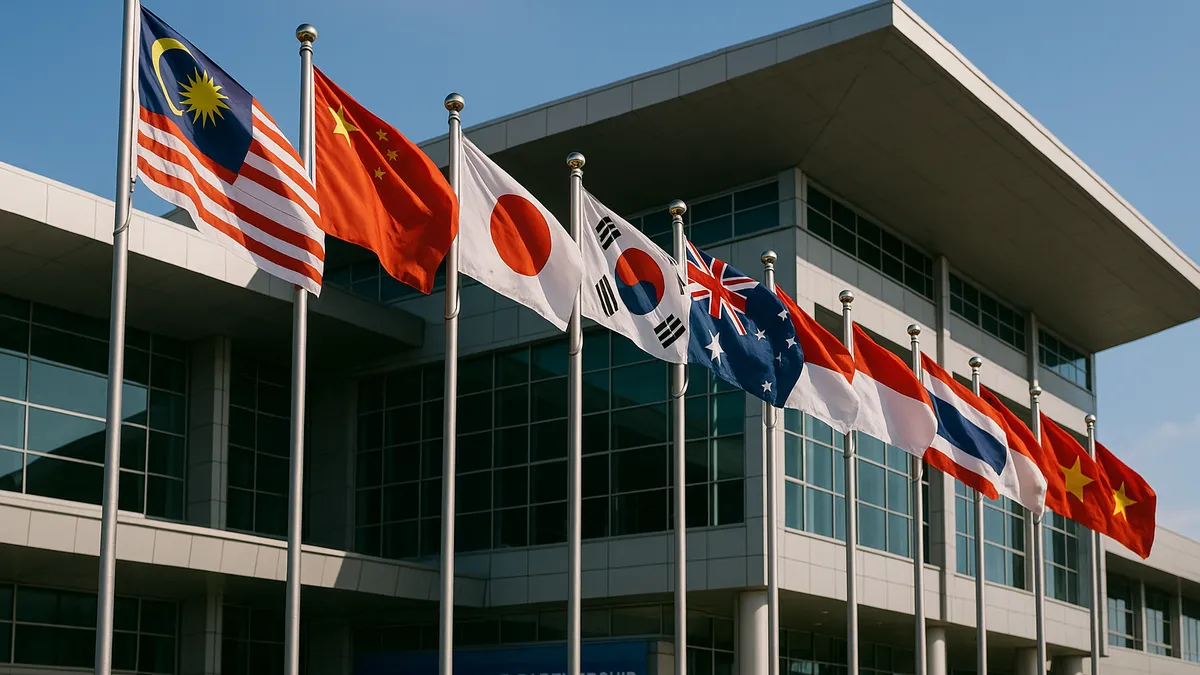
Malaysia has one of the most extensive free trade agreement networks in the world. With 17 FTAs in force covering over 60 countries, Malaysian importers have access to preferential duty rates that can slash import costs from 30% down to zero — yet the vast majority of businesses never claim them. According to MITI data, FTA utilisation rates for imports into Malaysia remain below 40%, meaning billions of ringgit in potential savings go unclaimed every year.
This guide breaks down exactly how your business can use RCEP, CPTPP, ATIGA, ACFTA, and Malaysia's other free trade agreements to reduce or completely eliminate import duties — with worked examples showing real ringgit savings.
Malaysia's FTA Network: A Global Advantage Most Importers Ignore
Malaysia has signed and ratified 17 free trade agreements — eight bilateral and nine regional — plus two partial scope preferential trade agreements. Together, these cover Malaysia's largest trading partners including China, Japan, South Korea, Australia, New Zealand, India, and all ten ASEAN member states.
In 2025, Malaysia's trade with FTA partner countries reached RM2.005 trillion, accounting for 65.5% of total trade. That means nearly two-thirds of all goods entering and leaving Malaysia are potentially eligible for preferential duty treatment under one or more FTAs.
Malaysia's Key FTAs for Importers
- ATIGA (ASEAN) — Form D — 10 ASEAN countries, near-zero duties on most goods
- RCEP — Form RCEP — 15 countries (ASEAN + China, Japan, Korea, Australia, NZ)
- CPTPP — Form CPTPP — 11 countries including Japan, Australia, Canada, Mexico
- ACFTA (ASEAN-China) — Form E — Preferential rates on Chinese imports
- MJEPA (Malaysia-Japan) — Form MJEPA — Bilateral preferential rates
- MAANZFTA — Form AANZ — Australia and New Zealand preferential access
- AKFTA (ASEAN-Korea) — Form AK — Korean imports at reduced rates
- AIFTA (ASEAN-India) — Form AI — Selected Indian goods at lower duties
The critical point for importers: different FTAs offer different duty rates for the same product from the same country. For goods imported from Japan, you could claim preferential treatment under RCEP, CPTPP, MJEPA, or AJCEP — and the applicable duty rate may differ under each agreement. Choosing the right FTA for each shipment is where the real savings happen.
ATIGA: Zero Duty Across ASEAN
The ASEAN Trade in Goods Agreement (ATIGA) is the most mature and widely used FTA in the region. Under ATIGA, approximately 99% of tariff lines among ASEAN-6 countries (Brunei, Indonesia, Malaysia, Philippines, Singapore, Thailand) have been reduced to 0%.
If you are importing raw materials, components, or finished goods from any ASEAN country, ATIGA should be your first port of call. The Certificate of Origin required is Form D, which can now be issued electronically through the ASEAN Single Window as an e-Form D.
Common imports that benefit from ATIGA zero-duty treatment include rubber products from Thailand, palm oil derivatives from Indonesia, electronic components from Singapore, and processed food from the Philippines.
RCEP: The World's Largest Trade Bloc
The Regional Comprehensive Economic Partnership (RCEP) entered into force on 1 January 2022. It covers 15 countries — all ten ASEAN members plus China, Japan, South Korea, Australia, and New Zealand — creating the world's largest free trade area by GDP and population.
What RCEP Adds Beyond Existing FTAs
RCEP does not replace existing bilateral FTAs like ACFTA or MJEPA. Instead, it provides an alternative pathway to preferential treatment that may offer advantages in specific situations:
- Unified rules of origin: A single set of origin rules across all 15 members, simplifying compliance for multi-country supply chains
- Full cumulation: Materials and processing from any RCEP member country can count towards meeting origin requirements — this is a major advantage over bilateral FTAs
- Progressive tariff elimination: RCEP aims to eliminate tariffs on up to 92% of goods over a 20-year phase-down period, with many lines already at zero
- Self-certification: Approved exporters can self-certify origin without applying for a formal CO from the issuing authority, reducing paperwork and processing time
- Retroactive claims: Importers can apply for a refund of duties paid within one year of importation if they subsequently obtain a valid proof of origin
The Certificate of Origin for RCEP is the Form RCEP, issued in Malaysia through MITI's ePCO system. For imports, the proof of origin can be either a CO issued by the exporting country's competent authority or a declaration of origin by an approved exporter.
CPTPP: Higher-Quality Market Access
The Comprehensive and Progressive Agreement for Trans-Pacific Partnership (CPTPP) entered into force for Malaysia on 29 November 2022. It currently includes 11 member countries: Australia, Brunei, Canada, Chile, Japan, Malaysia, Mexico, New Zealand, Peru, Singapore, and Vietnam. The United Kingdom acceded in December 2024.
Why CPTPP Matters for Malaysian Importers
CPTPP offers several advantages over RCEP for specific trade lanes:
- Deeper tariff cuts: CPTPP generally provides faster and more comprehensive tariff elimination schedules than RCEP
- Unique country access: Canada, Mexico, Chile, and Peru are CPTPP members but not in RCEP — CPTPP is the only FTA route for preferential access from these countries
- Flexible origin certification: CPTPP does not require a prescribed form — the certification of origin can appear on a commercial invoice, company letterhead, or a standalone document, provided it contains the minimum data requirements from Chapter 3, Annex 3-B
- Services and investment: Beyond goods, CPTPP covers services, investment protection, intellectual property, and government procurement
In Malaysia, exporters apply for Form CPTPP through the ePCO system at MITI. For imports, Malaysia accepts both third-party CO certification and importer self-certification (to be fully implemented within five years of Malaysia's date of entry into force).
ACFTA: Your Primary Route for Chinese Imports
Given that China is consistently Malaysia's largest trading partner, the ASEAN-China Free Trade Agreement (ACFTA) is arguably the most commercially significant FTA for Malaysian importers. Under ACFTA, the majority of goods from China enter Malaysia at preferential rates using Form E.
For many product categories, ACFTA offers lower duty rates than RCEP for Chinese imports because ACFTA has been in force since 2010 and has completed more tariff phase-downs. However, RCEP may offer better rates for certain products where ACFTA's product-specific rules are restrictive, or where cumulation with materials from Japan, Korea, or Australia is needed to meet origin requirements.
Pro tip: Always compare the ACFTA (Form E) rate against the RCEP rate for Chinese imports. The difference can be significant — and either one could be lower depending on the specific HS code.
Other Key FTAs: MJEPA, MAANZFTA, and AKFTA
MJEPA (Malaysia-Japan Economic Partnership Agreement)
Japanese imports can enter under Form MJEPA, which often provides the best preferential rates for goods from Japan — particularly for automotive parts, machinery, and electronic components. MJEPA has been in force since 2006 and most tariff lines have reached their final reduced rates.
MAANZFTA (ASEAN-Australia-New Zealand FTA)
Australian and New Zealand imports qualify under Form AANZ. The Second Protocol to AANZFTA, which entered into force on 21 April 2025, expanded the agreement's scope with additional proof of origin types and an approved exporter scheme. This is particularly relevant for imports of dairy products, meat, wine, agricultural machinery, and minerals.
AKFTA (ASEAN-Korea FTA)
Korean imports — including electronics, steel, chemicals, and automotive components — can enter under Form AK. As with Chinese imports, compare the AKFTA rate against the RCEP rate for each product to find the best option.
How to Claim Preferential Duty: Step by Step
Claiming FTA preferential rates is not automatic. Your shipment must meet specific requirements, and the right documentation must be in place before or at the time of customs declaration. Here is the process:
- Identify the correct HS code for your goods — the tariff classification determines both the MFN rate and the preferential rate under each FTA
- Check which FTAs apply based on the country of origin — use MITI's FTA portal or the duty calculator to compare rates across agreements
- Verify rules of origin — confirm that your goods meet the origin criteria under the chosen FTA (more on this below)
- Obtain the Certificate of Origin from your supplier — the CO must be issued by the competent authority in the exporting country, or self-certified by an approved exporter where applicable
- Present the CO at import declaration — your forwarding agent submits the CO together with the customs declaration to claim the preferential rate
- Retain records — keep all origin documentation for at least five years, as JKDM may conduct post-clearance audits
Certificate of Origin Quick Reference
- ATIGA (ASEAN): Form D / e-Form D
- RCEP: Form RCEP or Declaration of Origin (approved exporters)
- CPTPP: Form CPTPP or Certification of Origin (no prescribed format)
- ACFTA (China): Form E
- MJEPA (Japan): Form MJEPA
- MAANZFTA (Australia/NZ): Form AANZ
- AKFTA (Korea): Form AK
- AJCEP (ASEAN-Japan): Form AJ
Rules of Origin: The Make-or-Break Requirement
A Certificate of Origin alone is not enough. Your goods must genuinely originate in the FTA partner country according to the rules of origin (ROO) specified in the agreement. There are three main criteria:
1. Wholly Obtained (WO)
Goods that are entirely grown, harvested, extracted, or manufactured in a single member country. This applies to agricultural products, minerals, fish, and goods made exclusively from these inputs. For example, natural rubber harvested and processed entirely in Thailand qualifies as wholly obtained under ATIGA.
2. Regional Value Content (RVC)
For goods that incorporate non-originating materials, most FTAs require a minimum Regional Value Content of 40%. This means at least 40% of the product's FOB value must be added within the FTA member country or countries. The formula is typically:
RVC = ((FOB Price - Value of Non-Originating Materials) / FOB Price) x 100
Under RCEP, the RVC threshold is generally 40%, calculated using either the build-up or build-down method. The cumulation provision means that value added in any RCEP member country counts towards the 40% threshold — a significant advantage when your supply chain spans multiple countries.
3. Change in Tariff Classification (CTC)
This criterion requires that non-originating materials undergo sufficient transformation to change their tariff classification at a specified level — either Change in Chapter (CC), Change in Tariff Heading (CTH), or Change in Tariff Sub-Heading (CTSH). For example, if you import steel sheets (HS Chapter 72) from a non-member country and manufacture them into steel furniture (HS Chapter 94) in an RCEP country, the change in chapter satisfies the CTC rule.
Product-Specific Rules (PSR)
Many FTAs, including RCEP, apply product-specific rules that vary by HS code. Some products require CTC only, some require RVC only, and some offer co-equal rules — meaning the exporter can choose to meet either the CTC or the RVC threshold. Always check the PSR annex for your specific product before assuming which rule applies.
Worked Examples: Real Duty Savings
The following examples illustrate how FTA preferential rates translate into real savings for Malaysian importers. Rates are based on Malaysia's published tariff schedules and FTA concession schedules.
Example 1: Auto Parts from Japan (HS 8708)
A Malaysian automotive manufacturer imports brake assemblies from Japan with a CIF value of RM500,000 per shipment, 12 shipments per year.
| Tariff Regime | Duty Rate | Duty per Shipment | Annual Duty |
|---|---|---|---|
| MFN (no FTA) | 25-30% | RM125,000 - RM150,000 | RM1,500,000 - RM1,800,000 |
| MJEPA (Form MJEPA) | 0-5% | RM0 - RM25,000 | RM0 - RM300,000 |
| CPTPP (Form CPTPP) | 0% | RM0 | RM0 |
| RCEP (Form RCEP) | 0-10% | RM0 - RM50,000 | RM0 - RM600,000 |
Potential annual savings: up to RM1,800,000. In this case, CPTPP typically offers the best rate for fully liberalised auto parts lines. However, some sub-headings under HS 8708 may have better rates under MJEPA. The key is to check the rate for your exact 8-digit HS code under each applicable FTA.
Example 2: Electronics from China (HS 8542 — Integrated Circuits)
An electronics assembler imports integrated circuits from China with a CIF value of RM200,000 per shipment, 24 shipments per year.
| Tariff Regime | Duty Rate | Duty per Shipment | Annual Duty |
|---|---|---|---|
| MFN (no FTA) | 0-15% | RM0 - RM30,000 | RM0 - RM720,000 |
| ACFTA (Form E) | 0% | RM0 | RM0 |
| RCEP (Form RCEP) | 0-5% | RM0 - RM10,000 | RM0 - RM240,000 |
Potential annual savings: up to RM720,000. For most electronics from China, ACFTA (Form E) provides the most favourable rates because the agreement has been in force for over 15 years and most electronic components have reached 0%. RCEP rates for electronics from China are still phasing down on some lines. Always compare both.
Example 3: Dairy Products from Australia (HS 0402 — Milk Powder)
A food manufacturer imports milk powder from Australia with a CIF value of RM150,000 per shipment, 6 shipments per year.
| Tariff Regime | Duty Rate | Duty per Shipment | Annual Duty |
|---|---|---|---|
| MFN (no FTA) | 5-10% | RM7,500 - RM15,000 | RM45,000 - RM90,000 |
| MAANZFTA (Form AANZ) | 0% | RM0 | RM0 |
| RCEP (Form RCEP) | 0-5% | RM0 - RM7,500 | RM0 - RM45,000 |
Potential annual savings: up to RM90,000. MAANZFTA has had more time to phase down agricultural tariffs than RCEP, making Form AANZ the better choice for most Australian food imports. The updated Second Protocol (effective April 2025) further streamlined the process with electronic CO issuance.
Common Mistakes That Cost Importers Money
After 25 years of handling customs clearance at Port Klang, we see the same FTA mistakes repeatedly. Each one costs importers real money:
1. Not Requesting the CO from the Supplier
This is the most common failure. The Certificate of Origin must be obtained from the exporter's side — typically from the chamber of commerce or trade ministry in the exporting country. If your purchase order does not specify that the supplier must provide a CO, they simply will not arrange one. By the time your goods arrive at Port Klang without a CO, you pay full MFN duty.
2. Selecting the Wrong FTA
When a country is covered by multiple FTAs, the preferential rate can vary significantly between agreements. Using RCEP when ACFTA offers a lower rate for Chinese goods — or vice versa — leaves money on the table. This requires checking the actual gazetted rates for your specific HS code under each applicable agreement.
3. Not Meeting Rules of Origin
A CO will be rejected if JKDM determines that the goods do not actually meet the rules of origin. This happens when the product incorporates too many non-originating materials (failing the 40% RVC threshold) or when the manufacturing process does not achieve the required change in tariff classification. Post-clearance audits can result in back-duty assessments plus penalties.
4. CO Errors and Description Mismatches
The product description on the CO must match the commercial invoice and customs declaration exactly. Discrepancies in product descriptions, quantities, weights, or HS codes between the CO and other shipping documents are grounds for rejection. Even minor inconsistencies — such as "stainless steel bolts" on the invoice versus "steel fasteners" on the CO — can trigger a query or denial.
5. Expired or Late COs
Most FTAs require the CO to be issued within a specific period relative to the shipment date. Under RCEP, the proof of origin is valid for one year from the date of issuance. Presenting an expired CO means paying MFN duty. Under RCEP, you can apply for a retroactive refund within one year of importation — but this requires additional paperwork and processing time.
Strategic FTA Utilisation: Structuring Supply Chains for Maximum Savings
Beyond simply claiming COs on existing shipments, forward-thinking importers can restructure their supply chains to maximise FTA benefits:
Cumulation Under RCEP
RCEP's full cumulation provision is a game-changer for complex supply chains. If your product incorporates components from multiple countries, RCEP allows you to combine the value added across all 15 member countries when calculating origin. A product assembled in Vietnam using Japanese motors, Korean steel, and Chinese electronics can qualify as RCEP-originating if the combined regional value content meets the 40% threshold — even if no single country's contribution reaches 40%.
This was not possible under most bilateral FTAs, which only allowed bilateral cumulation between the two signatory countries.
Supplier Diversification
When evaluating alternative suppliers, factor in FTA duty savings. A supplier in an FTA partner country may offer a higher unit price but a lower total landed cost once zero-duty access is factored in. This calculation can shift sourcing decisions significantly — especially for goods subject to high MFN tariff rates.
Back-to-Back Certificates of Origin
When goods transit through a third ASEAN country, a back-to-back CO can be issued by the intermediate country to preserve the preferential origin. For example, Chinese goods shipped to Malaysia via Singapore can still qualify for Form E treatment if a back-to-back CO is properly issued in Singapore. This is common in the ACFTA and ATIGA frameworks.
Approved Exporter Schemes
Under RCEP and the updated AANZFTA Second Protocol, approved exporters can self-certify origin without applying for a formal CO from the issuing authority. If your overseas supplier is an approved exporter, this streamlines the process and eliminates one of the most common causes of delays — waiting for the CO to be issued and sent.
How DNE Forwarding Helps You Maximise FTA Savings
At DNE Forwarding, we do not just clear your goods through customs — we actively work to minimise your duty exposure. With over 25 years at Port Klang and deep expertise in Malaysia's FTA network, we offer:
- FTA duty comparison analysis: For every shipment, we check the applicable preferential rates across all relevant FTAs and recommend the one that delivers the lowest duty. This is not a one-time exercise — rates change as phase-down schedules progress, and we track these changes continuously.
- CO verification: Before your goods arrive, we review the Certificate of Origin against your commercial documents to catch description mismatches, HS code errors, and formatting issues that would cause rejection at customs.
- Supplier coordination: We work directly with your overseas suppliers and their chambers of commerce to ensure COs are issued correctly and on time. We provide suppliers with the exact format, description, and HS codes needed to match the import declaration.
- Rules of origin advisory: We assess whether your goods meet the origin criteria under each FTA and advise on the most practical pathway — whether that is RVC, CTC, or product-specific rules.
- Retroactive refund applications: If you have been paying MFN duty on shipments that qualified for preferential treatment, we can help you apply for refunds under RCEP's one-year retroactive claim provision.
- End-to-end logistics: FTA savings are part of a broader cost optimisation strategy. Combined with our freight forwarding, haulage, and warehousing services, we help you reduce total landed cost — not just duty.
Every shipment that clears Port Klang without claiming an available FTA preference is money left on the table. If you are importing from China, Japan, Korea, Australia, or any ASEAN country, there is almost certainly a preferential rate available — and we can help you claim it.