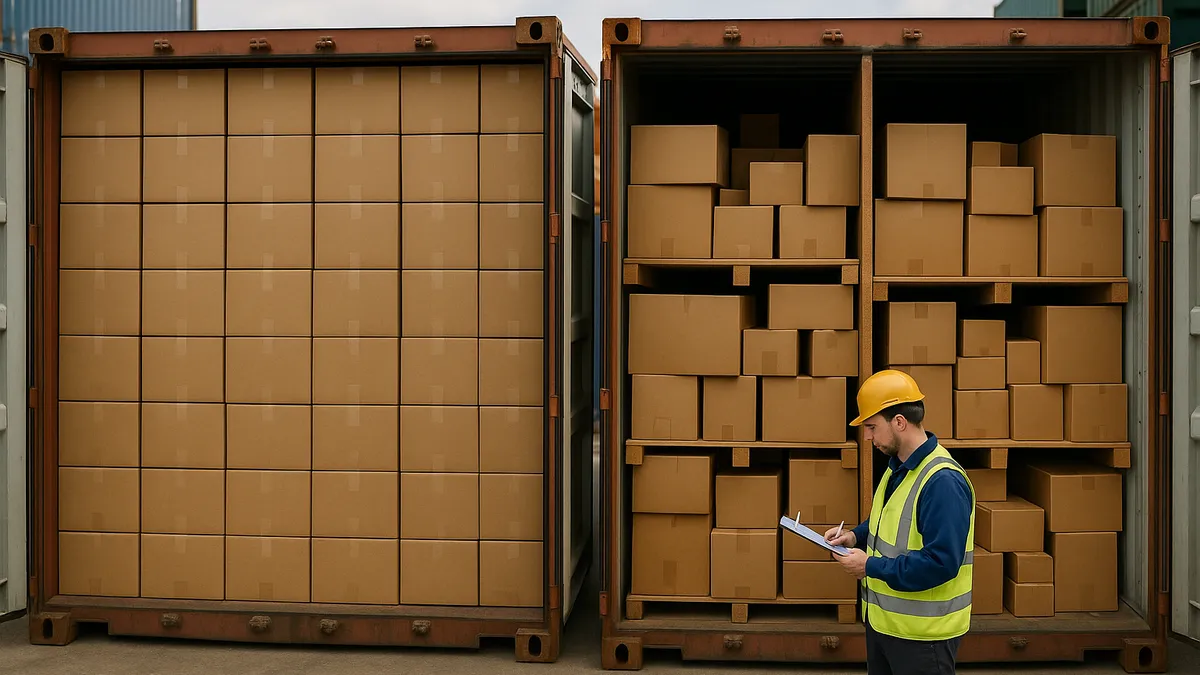
If you are importing goods into Malaysia, one of the first decisions you will face is whether to ship FCL or LCL. The answer can mean the difference between overpaying by hundreds of dollars or leaving money on the table with every shipment. Yet many importers — especially those new to international trade — choose one mode out of habit without ever running the numbers.
This guide breaks down everything you need to know about FCL and LCL shipping to Malaysia: how each works operationally, what they actually cost on key trade lanes into Port Klang, and the exact volume threshold where switching modes saves you money.
What Is FCL? Full Container Load Explained
FCL (Full Container Load) means you book an entire shipping container exclusively for your cargo. It does not matter whether you fill the container to capacity or ship it half-empty — you pay a flat rate for the whole unit. The container is sealed at the origin warehouse or factory, loaded onto a vessel, and only opened again at the destination.
The key operational characteristics of FCL are:
- Exclusive use: No other shipper's cargo shares your container. The container is sealed with a unique seal number at origin and remains sealed until it reaches the destination port or warehouse.
- Door-to-door integrity: Your goods are loaded once and unloaded once. There is no intermediate handling, sorting, or repacking at any freight station.
- Flat-rate pricing: You pay a fixed price per container regardless of how much space you actually use. Whether you load 10 CBM or 28 CBM into a 20-foot container, the ocean freight charge is the same.
- Faster customs clearance: At the destination port, the entire container clears customs as a single unit under one bill of lading and one customs declaration.
What Is LCL? Less Than Container Load Explained
LCL (Less than Container Load) means your cargo shares container space with shipments from other importers. A freight consolidator combines multiple smaller shipments into one container, and each shipper pays only for the space they use — measured in cubic metres (CBM).
The LCL process involves several additional steps compared to FCL:
- Origin consolidation: Your cargo is delivered to a Container Freight Station (CFS) at the origin port. The CFS operator receives shipments from multiple shippers, inspects and measures each consignment, and loads them together into a single container.
- Ocean transit: The consolidated container travels on the same vessel and the same route as an FCL container. The ocean transit time itself is identical.
- Destination deconsolidation: When the container arrives at Port Klang, it is transported to a destination CFS. There, the container is opened, and each shipper's cargo is separated, sorted, and made available for individual collection or delivery.
- Individual customs clearance: Each shipper's consignment must be cleared through customs separately, each with its own declaration and documentation.
This consolidation and deconsolidation process is what drives both the cost advantage and the time disadvantage of LCL shipping.
Container Sizes and Capacity: Know Your Numbers
Understanding container dimensions is essential for calculating whether FCL or LCL makes financial sense for your shipment. Here are the three standard dry container types used on trade lanes into Malaysia:
| Container Type | Total Volume | Usable Volume | Max Payload |
|---|---|---|---|
| 20ft (1 TEU) | 33 CBM | 28-30 CBM | 21,600 kg |
| 40ft (1 FEU) | 67 CBM | 56-58 CBM | 26,500 kg |
| 40ft HC | 76 CBM | 66-68 CBM | 26,500 kg |
Why "usable volume" is lower than total volume: In practice, stacking patterns, air gaps between cartons, uneven cargo shapes, and the need for load-securing materials reduce what you can actually fit inside. Always plan with usable volume figures, not theoretical maximums.
Weight limits matter too. A 20ft container can hold approximately 28 CBM of space, but its maximum payload is 21,600 kg. If you are shipping dense goods like tiles, steel parts, or canned food, you will hit the weight limit long before you fill the volume. Conversely, lightweight goods like plastic products or textiles will fill the space before reaching weight limits. This distinction directly affects whether FCL or LCL is the better choice for your specific cargo.
Cost Comparison: Real Numbers on Key Trade Lanes
Let us look at actual rate ranges for shipping to Port Klang, Malaysia's busiest port, as of early 2026. These figures represent ocean freight charges and do not include local charges, customs duties, or haulage — but they illustrate the economics clearly.
FCL Rates to Port Klang (Indicative Range)
| Origin | 20ft Container | 40ft Container | Transit Time |
|---|---|---|---|
| Shanghai, China | USD 800 - 1,200 | USD 1,200 - 1,800 | 6-8 days |
| Shenzhen, China | USD 700 - 1,100 | USD 1,100 - 1,600 | 5-7 days |
| Nhava Sheva, India | USD 900 - 1,400 | USD 1,400 - 2,200 | 8-12 days |
| Rotterdam, Europe | USD 1,500 - 2,500 | USD 2,500 - 3,500 | 22-28 days |
Rates fluctuate based on season, carrier, and market conditions. Peak season surcharges, fuel surcharges (BAF/LSS), and equipment availability affect final pricing. Always request a current quotation.
LCL Rates to Port Klang (Indicative Range)
LCL is priced per cubic metre (CBM), with a minimum charge typically applied for shipments under 1 CBM. Current indicative rates:
- China to Port Klang: USD 40 - 80 per CBM (ocean freight component)
- India to Port Klang: USD 50 - 100 per CBM
- Europe to Port Klang: USD 80 - 150 per CBM
However, the per-CBM ocean freight rate is only part of the LCL cost. You must also factor in:
- Origin CFS charges: USD 150 - 400 for consolidation handling, documentation, and container stuffing
- Destination CFS charges: USD 150 - 350 for deconsolidation, sorting, and storage
- Bill of lading fee: USD 30 - 75 per shipment
- Fuel and currency surcharges: Typically 10-20% on top of the base rate
The Break-Even Point: Where FCL Beats LCL
This is the most important calculation for any importer. Let us work through a real example on the China-to-Port Klang route:
Example: Shanghai to Port Klang
- FCL 20ft rate: USD 1,000 (flat, all-in ocean freight)
- LCL rate: USD 60 per CBM + USD 350 in CFS and handling charges
- LCL total for 5 CBM: (5 x 60) + 350 = USD 650 — LCL wins
- LCL total for 10 CBM: (10 x 60) + 350 = USD 950 — LCL still wins, but barely
- LCL total for 12 CBM: (12 x 60) + 350 = USD 1,070 — FCL is now cheaper
- LCL total for 15 CBM: (15 x 60) + 350 = USD 1,250 — FCL saves USD 250
- LCL total for 20 CBM: (20 x 60) + 350 = USD 1,550 — FCL saves USD 550
The industry rule of thumb: once your shipment exceeds 12-15 CBM, FCL almost always costs less than LCL. On the China-to-Malaysia lane, the crossover typically happens around 10-12 CBM because of the relatively low FCL rates on this route.
Remember: even if your FCL container ships with empty space, you are not wasting money once you cross the break-even threshold. You are paying the same flat rate whether you load 12 CBM or 28 CBM into that 20-footer. That "empty" space is effectively free. (For more strategies on reducing your landed cost, see our guide on cutting logistics costs in Malaysia.)
Transit Time: Why FCL Gets There Faster
The ocean voyage itself takes the same number of days regardless of whether your cargo travels FCL or LCL — both ride on the same ships. The difference lies in what happens before and after the vessel voyage.
FCL Timeline
- Cargo loaded at factory or warehouse (Day 1)
- Container sealed and transported to port (Day 1-2)
- Vessel departure (Day 3)
- Ocean transit — e.g., Shanghai to Port Klang (6-8 days)
- Arrival and customs clearance as single unit (1-2 days)
- Haulage to your warehouse (same day or next day)
Total: approximately 11-14 days door-to-door
LCL Timeline
- Cargo delivered to origin CFS (Day 1)
- Wait for consolidation window — CFS accumulates enough cargo to fill a container (1-5 days)
- Container stuffed and transported to port (Day 2-7)
- Vessel departure (Day 3-8)
- Ocean transit — same route, same duration (6-8 days)
- Container moved to destination CFS for deconsolidation (1-2 days)
- Deconsolidation, sorting, and individual cargo release (2-4 days)
- Individual customs clearance for your consignment (1-2 days)
- Haulage to your warehouse (same day or next day)
Total: approximately 16-25 days door-to-door
The difference of 5-11 additional days for LCL comes from consolidation delays at origin, deconsolidation processing at destination, and the fact that the CFS may need to wait for enough cargo to justify stuffing a container. On busy trade lanes like China to Malaysia, consolidation windows are frequent — often daily. On less popular routes, you could wait several days.
Cargo Risk: Handling, Damage, and Security
The risk profile of FCL and LCL differs significantly, and this is a factor many importers underestimate.
FCL Risk Profile
- Minimal handling: Your cargo is loaded once at origin and unloaded once at destination. It is not touched, moved, or sorted at any intermediate point.
- Sealed container: The container seal is applied at origin and only broken at the final destination. You can verify the seal number against your bill of lading to confirm no tampering occurred.
- No co-loading risk: Your goods are not mixed with other shippers' cargo, eliminating the risk of cross-contamination, accidental swaps, or damage from incompatible goods.
- Damage rate: FCL shipments have significantly lower damage and loss rates compared to LCL, precisely because of reduced handling.
LCL Risk Profile
- Multiple handling points: Your cargo is handled at least four additional times — loaded into origin CFS, stuffed into the container with other cargo, destuffed at destination CFS, and sorted for collection. Each handling point introduces risk.
- Shared space: Your goods travel alongside cargo from other shippers. If another shipper's goods leak, shift, or are improperly secured, your cargo can be affected.
- Higher damage/loss rates: Industry data consistently shows that LCL shipments experience higher rates of damage, pilferage, and misdelivery compared to FCL.
- Cargo insurance recommendation: If shipping LCL, cargo insurance is strongly advisable. The increased handling and shared-space risks make it a worthwhile investment.
For high-value goods, fragile items, or cargo that is sensitive to contamination (food products, chemicals, electronics), the security advantages of FCL often justify the cost premium even when volumes are below the break-even point.
Customs Clearance Differences at Port Klang
The customs clearance process differs between FCL and LCL, and the difference directly affects how quickly you get your goods. (For a deeper look at the customs clearance process in Malaysia, see our dedicated guide.)
FCL Customs Clearance
An FCL container clears customs as a single unit. Your forwarding agent submits one customs declaration covering all goods in the container. If the container is selected for inspection, it is examined as a whole. Once cleared, the container is released for haulage to your warehouse, where you unstuff it at your own facility.
LCL Customs Clearance
An LCL shipment cannot clear customs until the container has been deconsolidated at the destination CFS. The process works like this:
- The consolidated container arrives at port and is moved to the CFS
- The CFS operator breaks down the container and separates each shipper's cargo
- Each consignment is individually declared to customs under its own bill of lading
- If any consignment in the same container triggers an inspection, it can delay the release of the entire container — including your cargo
- Once cleared, your cargo is available for collection from the CFS or delivery to your warehouse
This process typically adds 1-3 working days compared to FCL clearance. The additional time comes from the physical deconsolidation process and the sequential nature of individual customs declarations.
When to Choose FCL
FCL is the better choice when:
- Your shipment exceeds 12-15 CBM: Beyond this volume, you are almost certainly paying more for LCL than you would for a full container.
- You ship regularly: If you import monthly or fortnightly, FCL gives you predictable costs, faster turnaround, and simpler documentation.
- Your cargo is high-value: The sealed, single-shipper environment of FCL dramatically reduces theft and damage risk.
- Time is critical: If your production line depends on timely material delivery, the 5-11 day advantage of FCL can be decisive.
- Your goods are fragile or sensitive: Fewer handling points mean fewer opportunities for damage. Electronics, glass, precision machinery, and perishables all benefit from FCL.
- You need temperature control: Reefer (refrigerated) containers are only available as FCL. There is no LCL option for temperature-controlled cargo.
- You want simpler documentation: One container, one bill of lading, one customs declaration. The administrative burden is lighter.
When to Choose LCL
LCL is the better choice when:
- Your shipment is under 10 CBM: For small volumes, paying per CBM is significantly cheaper than booking an entire container.
- You are a first-time importer: LCL lets you test a new supplier, a new product, or a new market without committing to a full container.
- You are importing samples: Product samples, trial orders, and prototype shipments are ideal for LCL.
- Your orders are irregular: If you import only occasionally or unpredictably, LCL gives you flexibility without the fixed cost of FCL.
- Cash flow is a priority: LCL requires less upfront capital because you are paying for only the space you use, making it easier to manage working capital.
- Transit time is not critical: If your inventory planning accommodates longer lead times, the cost savings of LCL below the break-even point outweigh the speed advantage of FCL.
Hybrid Strategies: The Best of Both Worlds
Experienced importers do not treat FCL and LCL as an either-or decision. They use hybrid strategies to optimise costs across their entire supply chain.
Buyer's Consolidation
If you source from multiple suppliers in the same region — say three different factories in Guangdong — you can consolidate all three orders into a single FCL container. Instead of shipping three separate LCL consignments (paying per-CBM rates plus CFS charges three times), you arrange for all three suppliers to deliver to a single warehouse or CFS, where the goods are loaded into one container under your control.
This strategy works best when:
- Your individual orders are 3-8 CBM each, but combined they exceed 12-15 CBM
- Your suppliers are in the same geographic region
- The orders can be timed to arrive at the consolidation point within a reasonable window
Order Timing Optimisation
Rather than placing small orders monthly, consider placing larger orders less frequently. If you currently import 8 CBM per month via LCL, shifting to a 16 CBM order every two months via FCL could save 20-40% on freight costs — even after accounting for the additional warehousing costs of holding more inventory. (Our logistics cost-cutting guide covers inventory-freight trade-offs in detail.)
Mixed-Mode Shipping
For businesses with both regular bulk orders and occasional small top-up orders, use FCL for planned replenishment shipments and LCL for urgent, small-quantity top-ups. This gives you cost efficiency on your core volumes while maintaining flexibility for demand spikes.
Common Mistakes to Avoid
In our 25 years of handling freight at Port Klang, we see importers make these errors repeatedly:
- Never comparing total landed cost: Importers compare ocean freight rates alone and ignore CFS charges, handling fees, and the cost of additional transit days (warehouse rent, production delays). Always compare total cost, door to door.
- Shipping 14 CBM via LCL: This is the most expensive mistake. At 14 CBM, you are paying almost as much as FCL in freight charges, plus CFS charges on top. Switch to FCL and save immediately.
- Ignoring weight-based pricing: LCL is charged on whichever is greater: actual volume or weight-converted volume (1 tonne = 1 CBM). If your cargo is dense, your LCL cost could be double what you expected.
- Not insuring LCL shipments: The additional handling in LCL increases damage risk. Skipping cargo insurance to save a few dollars is false economy.
- Choosing based on habit: Market conditions change. FCL rates that were high during peak season may drop significantly during quieter months. Review your shipping mode every quarter.
FCL vs LCL: Quick Comparison Summary
| Factor | FCL | LCL |
|---|---|---|
| Pricing | Flat rate per container | Per CBM + CFS charges |
| Best for | 12+ CBM shipments | Under 10 CBM shipments |
| Transit time | Faster (no CFS delays) | 5-11 days longer |
| Cargo security | High (sealed, exclusive) | Moderate (shared, more handling) |
| Customs clearance | Single unit, faster | Individual, after deconsolidation |
| Damage risk | Lower | Higher |
| Flexibility | Requires volume commitment | Ship any quantity |
| Documentation | Simpler (one BL) | More complex |
How DNE Forwarding Helps You Choose — and Save
At DNE Forwarding, we handle both FCL and LCL shipments through Port Klang every day. We do not push one mode over the other — we recommend whichever option genuinely saves you money based on your specific cargo profile.
Here is what we bring to every shipment:
- Mode advisory: We analyse your cargo volume, weight, value, and frequency to recommend FCL, LCL, or a hybrid strategy. If switching modes saves you money, we will tell you.
- Consolidation services: For importers sourcing from multiple suppliers, we coordinate buyer's consolidation to help you reach FCL volumes and avoid per-CBM LCL charges.
- Competitive rates on both modes: Our long-standing relationships with shipping lines and consolidators mean we secure rates that individual importers cannot access on their own.
- End-to-end handling: From origin coordination to customs clearance at Port Klang to haulage to your warehouse — we manage the entire chain so nothing falls through the cracks.
- Transparent costing: We provide complete cost breakdowns including all surcharges, CFS charges, and local fees. No hidden charges, no surprises at destination.
Whether you are shipping 3 CBM of samples or 60 CBM of production materials, the right shipping mode is the one that matches your cargo, your timeline, and your budget. We help you find that match — every shipment, every time.