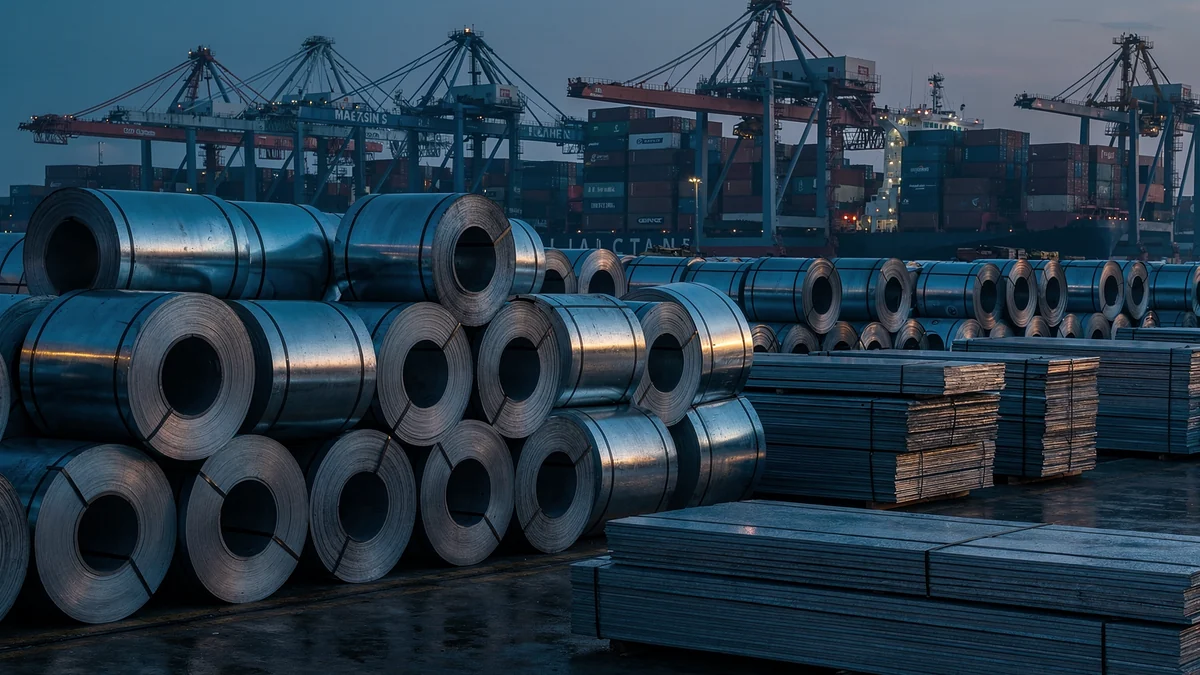
Anti-dumping duty is an extra import duty Malaysia charges on specific goods from specific countries that are sold here below their home-market price. It is governed by the Countervailing and Anti-Dumping Duties Act 1993, administered by MITI, and collected by Customs on top of your normal duty and SST. Whether it hits you depends on your exact HS code and country of origin.
Key takeaways
- Anti-dumping duty is a separate, additional duty — charged on top of your normal import duty and sales tax, not instead of them.
- An FTA certificate of origin (Form D, Form E) lowers your normal tariff. It does not remove an anti-dumping duty.
- Two 2025 steel measures dominate the list: tinplate from China, India, Japan and South Korea, and galvanised steel from China, South Korea and Vietnam — with rates up to 57.90% on some Vietnamese galvanised steel.
- Whether you pay turns on your HS classification, the country of origin, and sometimes the exact exporter. Check the MITI Trade Remedies list before you ship.
- Definitive anti-dumping duties run for five years. Getting the HS code right is often the difference between paying and not paying.
What are anti-dumping duties in Malaysia?
Anti-dumping duty is a duty Malaysia imposes when a foreign producer exports goods to Malaysia at a price below their normal value in the home market, and that dumping causes material injury to a Malaysian industry. The legal basis is the Countervailing and Anti-Dumping Duties Act 1993, enforced through investigations run by the Ministry of Investment, Trade and Industry (MITI).
The principle is straightforward. As the World Trade Organization puts it:
“If a company exports a product at a price lower than the price it normally charges on its own home market, it is said to be ‘dumping’ the product.”
Malaysia’s framework follows the WTO Anti-Dumping Agreement. An investigation must be terminated if the dumping margin is below 2% of the export price, or if the dumped imports from a country make up less than 3% of total imports of that product (the WTO de minimis and negligibility thresholds, per the WTO). The duty is set to offset the dumping, and where MITI finds a lower duty is enough to remove the injury, the Act allows that lower “lesser duty” to be applied instead.
This is not a niche tool. According to a Conventus Law review of Malaysia’s trade-remedy regime, Malaysia maintained 25 anti-dumping measures in force as of June 2022 — and the pace has accelerated since, with a wave of fresh steel rulings in 2025.
Anti-dumping, countervailing, or safeguard — which one hit you?
Malaysia has three trade remedies and importers often confuse them. Anti-dumping duty targets under-priced goods from named countries. Countervailing duty targets foreign government subsidies. Safeguard duty targets a sudden surge of fairly-traded imports and applies to every country at once. Reading the gazette order tells you which one you are facing.
| Remedy | What it targets | Governing law | Country scope |
|---|---|---|---|
| Anti-dumping duty | Goods sold below their home-market (normal) value | Countervailing & Anti-Dumping Duties Act 1993 | Specific countries / exporters |
| Countervailing duty | Goods that benefited from a foreign government subsidy | Countervailing & Anti-Dumping Duties Act 1993 | Specific countries / exporters |
| Safeguard duty | A surge of fairly-traded imports causing serious injury | Safeguards Act 2006 | All countries (global) |
In Malaysia, anti-dumping is by far the most-used. The same Conventus Law review notes that Malaysia has not, to date, initiated a single countervailing (anti-subsidy) investigation reported to the WTO. Safeguard measures sit under a separate law, the Safeguards Act 2006 and the Safeguard Regulations 2007. The practical difference for you: an anti-dumping or countervailing duty depends on where your goods come from, while a safeguard duty applies no matter the origin — so switching supplier countries can dodge the first two but not the third.
Which imports are currently subject to anti-dumping duty?
As of 2026, Malaysia’s largest active anti-dumping measures cover flat-rolled steel and galvanised steel from China, India, Japan, South Korea and Vietnam. Rates range from a few per cent to 57.90%, depending on the exporter and origin. Steel dominates the list, but the regime can apply to any product MITI has investigated.
| Product | Origin | Anti-dumping duty | In force |
|---|---|---|---|
| Flat-rolled iron / non-alloy steel, tin-coated (electrolytic tinplate) | China | 4.48% – 20.42% | 11 May 2025 – 10 May 2030 |
| India | 27.88% | ||
| Japan | 15.74% – 36.80% | ||
| South Korea | 21.60% – 35.43% | ||
| Hot-dip galvanised flat-rolled steel | China | 5.60% – 26.80% | 1 Nov 2025 – 31 Oct 2030 |
| South Korea | 2.21% – 31.47% | ||
| Vietnam | up to 57.90% (some exporters: nil) |
The tinplate rates and five-year window were reported by The Star and Bernama in May 2025. The galvanised-steel decision — from an investigation initiated on 6 February 2025 — was reported by Business Today in November 2025. Note how the rate often varies within a country: cooperating exporters who were individually investigated can receive a lower rate than the “all others” residual rate, which is why the exporter on your invoice matters, not just the flag. In the galvanised-steel case, some individually-investigated Vietnamese exporters were found not to be dumping at all and carry no duty, while others face up to 57.90%.
This table is not the full list and it changes as new orders are gazetted and old ones expire. Always confirm the current measures for your product on the MITI Trade Remedies portal (traderemedies.miti.gov.my) before you commit to a shipment.
How do I check if my product is affected?
To check if your import faces anti-dumping duty, first fix your correct HS code, then match it against the active MITI Trade Remedies orders for your country of origin and exporter. The product scope in each gazette order is defined by HS code and a physical description — if both match, the duty applies on top of your normal tariff.
Work through it in order:
- Confirm the HS code. Anti-dumping orders are scoped by tariff line — galvanised and tin-coated flat steel, for instance, sits in HS heading
7210. If you are unsure of yours, our guide to finding the right HS code in Malaysia walks through the JKDM HS Explorer and advance rulings. A mis-classified product can either trigger a duty you should not pay, or hide one you do owe. - Check the country of origin — the real one. Origin is where the goods were substantially produced, not where they were shipped from. Routing Chinese steel through a third country to escape duty is “circumvention” and can be caught by anti-circumvention rules.
- Match the exporter. Many orders list company-specific rates. Find your supplier on the order, or you fall under the higher residual rate.
- Read the gazette order, not the headline. The legal scope in the order — HS codes plus product description plus exclusions — is what Customs applies, not a news summary.
- Verify before you buy. A licensed customs agent can confirm the classification and check the live measures before your purchase order is placed, when you can still change supplier or terms.
MITI has made this easier for smaller importers. Alongside the Countervailing and Anti-Dumping Duties (Amendment) Bill 2025 — passed by the Dewan Negara to tighten enforcement and align the Act with WTO standards — it launched a Trade Remedy Investigation Management (TRIMA) system to streamline petitions, especially for SMEs.
Does an FTA (Form D or Form E) exempt me from anti-dumping duty?
No. A free-trade-agreement certificate of origin — Form D under ATIGA, Form E under the ASEAN-China FTA — reduces or removes your normal import duty. It has no effect on anti-dumping duty. The two are separate determinations: origin forms set your tariff rate, while anti-dumping duty is an extra remedy that applies regardless of any preferential tariff.
This is the single most expensive misunderstanding we see. An importer secures a valid Form E expecting 0% duty on Chinese steel, then gets a Customs bill anyway — because the anti-dumping order sits on a different track entirely. The FTA delivered exactly what it promised (zero normal duty), but the anti-dumping duty is an additional charge designed to offset unfair pricing, and no certificate of origin switches it off. If you want to understand how the preferential side works, see our guide to using RCEP, CPTPP and other FTAs to pay zero duty — just don’t assume it covers trade-remedy duties, because it does not.
How much does anti-dumping duty add to my landed cost?
Anti-dumping duty is calculated on your customs (CIF) value and charged in addition to normal import duty. Sales tax is then applied to the value plus all duties — including the anti-dumping duty — so a high anti-dumping rate cascades into a higher SST bill too. On steel at the top rates, it can add a third or more to your customs bill.
Here is an illustrative worked example for a galvanised-steel shipment from China hit at the upper China rate. Use it to understand the structure, then confirm your own HS line’s actual duty and SST treatment:
| Line | Basis | Amount (RM) |
|---|---|---|
| CIF customs value | — | 100,000 |
Normal import duty (illustrative MFN 0%) | on CIF | 0 |
Anti-dumping duty (e.g. 26.80%) | on CIF | 26,800 |
| Duty-paid value | subtotal | 126,800 |
Sales tax (illustrative 10%) | on CIF + all duties | 12,680 |
| Total payable to Customs | — | 39,480 |
On a RM100,000 shipment, a 26.80% anti-dumping duty plus the knock-on sales tax adds RM39,480 — and that figure is duties and sales tax only, payable on top of the RM100,000 you pay for the goods, before haulage, port and clearance charges. Two cautions: many flat-steel lines carry 0% MFN duty but some do not, and sales tax treatment varies (some goods are exempt, and manufacturers may qualify for a Schedule C exemption). Run your real numbers with our Malaysia import duty & SST calculator and read how SST on imports actually works before you price the deal.
How long do anti-dumping duties last?
Definitive anti-dumping duties in Malaysia normally run for five years from the date of imposition, in line with the WTO sunset rule. They can be extended after an expiry review if MITI finds that ending them would let injurious dumping resume, and they can be adjusted earlier through interim or administrative reviews.
During an investigation, MITI can impose provisional anti-dumping duties (often as a deposit or bank guarantee) before reaching a final decision; the law requires the final determination to be made within 120 days of an affirmative preliminary determination. Once definitive duties are gazetted they run for five years — the two 2025 steel measures, for instance, are set to expire in 2030. The WTO standard, which Malaysia follows, is that anti-dumping measures “must expire five years after the date of imposition, unless an investigation shows that ending the measure would lead to injury.” If the measure is reviewed and your specific situation has changed, the rate can move — another reason to stay on top of the current order rather than the original one.
What should I do if my shipment is hit with anti-dumping duty?
If Customs assesses anti-dumping duty on your shipment, do not just pay and move on. First confirm the HS classification and product scope are correct, then check whether your specific exporter has an individual rate. Many surprise charges are classification or exporter-matching errors that a licensed agent can correct before the K1 is finalised.
The practical playbook:
- Re-check the classification. If the HS code on your K1 import declaration is wrong, the wrong duty regime can attach. A correct, defensible classification is your first line of defence.
- Confirm the product is actually in scope. Gazette orders contain precise descriptions and exclusions. Goods that look similar are not always covered.
- Find your exporter’s rate. If your supplier was individually investigated and given a lower rate, make sure that rate — not the residual rate — is applied.
- Keep the paper trail. Origin documents, the supplier’s invoices and the gazette reference all support your declaration if Customs queries it later in a post-clearance audit.
- Plan ahead on future orders. If the duty genuinely applies, model it into your landed cost or evaluate an alternative origin that is outside the measure.
This is exactly where a licensed customs broker earns its fee. At DNE Forwarding, a JKDM-licensed forwarder clearing 1,000+ containers a month through Westport and Northport with 99%+ documentation compliance over 25+ years, we check classification and live trade-remedy measures before the declaration is filed — so an anti-dumping duty is something you planned for, not something that ambushes your margin. If you import steel, ceramics, chemicals or anything that might fall under a measure, our customs clearance team at Port Klang can verify your exposure first.
Frequently asked questions
Can I avoid anti-dumping duty by importing through a different country?
No — not legally. Anti-dumping duty follows the true country of origin, which is where the goods were substantially produced, not where they were last shipped from. Routing goods through a third country to disguise origin is circumvention, and Malaysia’s rules allow such schemes to be investigated and the duty extended. Genuinely sourcing from a producer in a country not covered by the measure is different and legitimate.
Does anti-dumping duty apply to all steel?
No. It applies only to the specific products, HS codes and countries named in each gazette order. The 2025 measures cover defined categories of flat-rolled and galvanised steel from particular countries — not steel in general. Your exact HS classification and origin decide whether you are inside or outside the scope.
Who pays the anti-dumping duty?
The importer of record pays it. The Royal Malaysian Customs Department collects anti-dumping duty at the point of import, the same way it collects normal import duty and SST, based on your declaration. It is not paid by the overseas exporter.
Is anti-dumping duty refundable like duty drawback?
Generally no. Anti-dumping duty is a trade remedy, not an ordinary duty, so it is not refunded under the usual duty-drawback facility for re-exports. The amount can change only through MITI’s review mechanisms — interim, administrative or expiry reviews — or if the measure is revoked. Always check the current order rather than assuming the original rate still stands.
How do I find the official list of products under anti-dumping duty in Malaysia?
The authoritative sources are the MITI Trade Remedies portal (traderemedies.miti.gov.my) and the gazetted Customs orders that give each measure legal effect. Because measures are added and expire over time, treat any third-party list as a starting point and confirm against MITI or a licensed customs agent before you ship.
Sources
- World Trade Organization — Anti-dumping, subsidies, safeguards (definition, de minimis thresholds, five-year sunset rule).
- Conventus Law — WTO Trade Remedies in Malaysia (25 measures in force as of June 2022; no countervailing investigation to date; Safeguards Act 2006).
- Azmi & Associates — The Law Relating to Anti-Dumping (petition, lesser-duty rule).
- The Star / Bernama — tinplate anti-dumping duties, May 2025.
- Business Today — galvanised-steel anti-dumping duties, November 2025.
- MIDA / MITI — review of the Act, the 120-day rule, the Amendment Bill 2025 and the TRIMA system.
Last reviewed and updated: 17 June 2026. Anti-dumping measures change as orders are gazetted and expire — confirm the current position with MITI or a licensed customs agent before you ship.