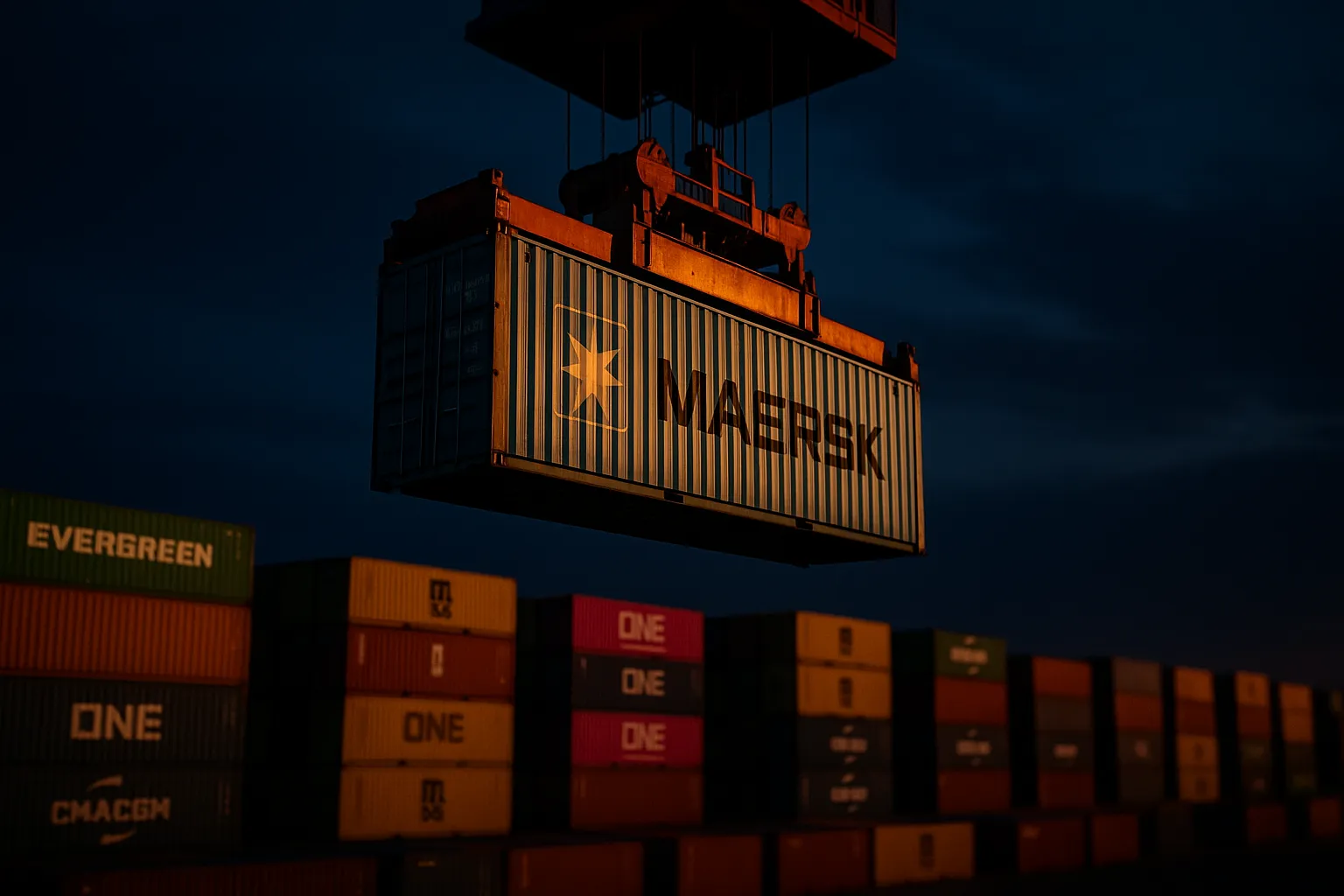
Look around the room you are in right now. Your phone, your laptop, your t-shirt, your coffee, the chair you are sitting on. There is a strong chance more than half of it travelled here inside a 20 or 40 foot steel box. We never really see them. That is the magic of the shipping container, and the reason its story is one of the most under-told in modern economic history.
Most people credit globalisation to politics, the internet, or free trade agreements. They are not wrong, but they have missed the actual main character. Marc Levinson's book "The Box" makes the case beautifully: the modern world economy was built on top of a single boring invention that turned out to be anything but boring. Here is how a metal box, and a North Carolina trucker who never set foot on a ship until he was nearly 50, quietly rewired the planet.
The Day Shipping Changed: April 26, 1956
Before 1956, loading and unloading a cargo ship was one of the most expensive and chaotic activities in the world economy. Every barrel, sack, crate, and bale was lifted off the dock, slung into the hold by hand, stacked carefully to keep the ship balanced, and unloaded the same way at the destination. A typical cargo ship spent more time tied up at the dock being unloaded than it spent at sea. Half the cost of moving goods across an ocean was spent at the port itself, not on the journey.
This was the world Malcolm McLean walked into. He was not a shipping man. He was a trucker from North Carolina who built a small fleet by driving routes himself in the 1930s and 40s. By 1955 he owned one of the largest trucking companies in the United States, and he was tired of one specific frustration: his trucks would arrive at a port, then sit for hours or days waiting for cargo to be hand-loaded onto a ship.
His idea was almost insultingly simple. Why not skip the loading entirely? Just lift the whole truck trailer, or better, a detachable steel box from the truck, straight onto the ship and lift it back off at the other side. No more breaking down the cargo, no more hand-stacking, no more waiting.
On April 26, 1956, McLean did exactly that. He bought a worn-out World War II tanker, the SS Ideal-X, fitted racks onto her deck, and sailed her from Port Newark, New Jersey to the Port of Houston, Texas with 58 metal containers stacked above the oil tanks. As the ship pulled out of port, a longshoreman named Freddy Fields, watching from the dock, was asked what he thought. He replied, "I'd like to sink that son of a bitch."
He was right to be afraid.
Why Containers Worked: The 36x Cost Story
The economics behind that single voyage explain everything that came next. Hand-loading a ship in the mid-1950s cost about USD 5.86 per ton. Loading a containerised ship cost about USD 0.16 per ton. That is a 36 times cost reduction, and it happened almost overnight.
To put that in context: in 1961, ocean freight charges represented around 12 percent of the value of US exports. The average US import tariff at the time was about 7 percent. In other words, the cost of physically moving goods across an ocean was a bigger drag on global trade than the actual taxes governments charged on imports. Politicians spent decades negotiating tariff reductions while the much bigger barrier sat invisible at every wharf.
The container removed that barrier in roughly twenty years. By the late 1970s, ocean freight had collapsed to a small fraction of cargo value. By the 2000s, economists had begun to assume in their models that "moving goods is essentially costless." That is an absurd assumption from the perspective of 1955 and a perfectly reasonable one from the perspective of 2025. Something extraordinary happened in between.
What the box actually did
- Cut ocean shipping cost from USD 5.86 to USD 0.16 per ton (36x reduction)
- Made physical distance between factory and customer almost economically irrelevant
- Standardised on the 20 foot and 40 foot ISO sizes still used in 2026
- Compressed loading time from days to hours, freeing up port capacity
- Triggered the relocation of factories from city centres to wherever labour was cheapest
The Cities That Got Left Behind
The container did not just change shipping. It rewired entire cities. The great 19th century ports — New York, London, Liverpool, San Francisco — had grown up around hand-loading. Their wharves were narrow, their warehouses were deep, their workforces were enormous and unionised. None of that suited containers, which needed wide aprons for gantry cranes, deep water for bigger ships, and railyards or motorways to move boxes inland.
So the cargo went elsewhere. New York's port traffic shifted across the river to Newark and Elizabeth. London's docklands collapsed; Britain's main container port became Felixstowe, a small town on the Suffolk coast that nobody outside the industry had heard of. San Francisco's piers were quietly outpaced by Oakland across the bay. Within twenty years, the cargo capitals of the previous century were retail districts, and unfamiliar towns had become global trade nodes.
The same process played out around the world over the following decades. Asia's container hubs — Singapore, Hong Kong, Busan, Shanghai, Shenzhen, and our own Port Klang — were either built from scratch or massively expanded specifically because containerisation made them the right shape for the future. The geography of trade was redrawn around a piece of steel.
How the Vietnam War Quietly Standardised the World
One of the more remarkable parts of the container's story is how the United States military accidentally made it global. By the mid-1960s, the US was struggling to keep its forces in Vietnam supplied. Conventional break-bulk shipping was creating chaos at Saigon and Cam Ranh Bay; cargo sat in stacks on the docks for weeks while the war effort stalled.
The military turned to McLean's company, Sea-Land. Containers transformed the supply chain almost immediately. Ships were turned around in days instead of weeks. The military insisted on a common container standard so equipment from any ship could move on any chassis on any rail line. By the time the war ended, the global industry had effectively settled on the ISO 20 foot and 40 foot standards we still use today, and they had been pressure-tested at military scale. The container was no longer one company's experiment. It was infrastructure.
What Containers Made Possible
Once shipping became almost-free and standardised, the world reorganised around the new physics. Three of the biggest economic stories of the last fifty years are direct downstream effects of the box:
1. Asia Became "The World's Factory"
If shipping costs are high, factories have to be near customers. If shipping costs are low, factories can be wherever labour is cheapest. Once that calculation flipped, manufacturing left Western city centres and consolidated in coastal Asia. China's Pearl River Delta, Vietnam's industrial corridors, and Bangladesh's garment cluster all exist in roughly their current scale because containers made distance economically irrelevant.
2. Just-In-Time Manufacturing
Toyota's just-in-time manufacturing model, copied around the world, depends on parts arriving exactly when they are needed, often from suppliers in different countries. That is impossible without reliable, cheap, predictable shipping. The container is what made just-in-time globally workable instead of a single-country trick.
3. The Online Economy You Use Daily
Apple in Shenzhen, fast fashion that ships in days, your Amazon order arriving tomorrow, the ability to buy a USB cable from another continent for less than the cost of a coffee: all of it sits on top of containerised shipping. The economics that allow a t-shirt to travel 8,000 km and still cost RM 30 are not the work of e-commerce platforms. The platforms simply harvested the surplus that the container had already created decades earlier.
What This Means for Malaysia and Port Klang
Malaysia's economy as it stands today is a direct beneficiary of the container revolution. Port Klang is the country's main gateway to global trade, and it was built specifically for containerised cargo, with Westports and Northport between them handling tens of millions of TEUs every year. Every electronics export, every palm oil shipment, every imported car, every imported component for our local manufacturers, moves through these ports inside a 20 or 40 foot steel box.
That positioning is not accidental. Malaysia's emergence as a manufacturing and trading hub in the 1980s and 1990s tracks exactly with the global containerisation boom. The country built the ports, signed the trade agreements, and developed the industrial estates at the right moment in the global supply chain rewrite. The result is the economy we operate in today: deeply integrated into Asian manufacturing networks, dependent on smooth container flow through Klang.
It is also why container disruption matters so much when it happens. When freight rates spiked in 2021 and 2022, when the Suez was blocked, when port congestion hit the US West Coast, the effects ran all the way back to Malaysian importers and exporters within weeks. The container made the global economy efficient, but the same connectivity makes everyone vulnerable to a shock at any point along the chain.
The Lesson: Invisible Infrastructure Wins
The strangest part of the container's story is that the people who built it did not know what they were doing. McLean thought he was selling cheaper transport. The shipping companies thought they were modernising their fleet. The port authorities thought they were chasing efficiency. Nobody sat in a room in 1956 and decided, "let us redesign world trade so that Asia becomes the manufacturing base for the planet, factories leave Western cities, and consumers in Kuala Lumpur can buy a phone designed in California, made in Shenzhen, shipped through Singapore, and delivered to their door in three days."
That outcome emerged from one practical decision about how to load a ship.
It is a useful lesson in 2026, when we spend a lot of time talking about which technology will reshape the world next. The honest answer is that we usually do not know in advance. The container looked boring. The internet looked like a hobbyist's curiosity. The most consequential changes tend to start as practical fixes to specific problems, and then quietly compound for decades before anybody notices what they have actually built.
If you work in supply chain, and especially if you operate from somewhere like Port Klang where the entire economic case for your existence is downstream of containerisation, this story is worth keeping close. The boxes moving through your ops every day are not just freight. They are a 70 year inheritance. Every shipment is a small thread in a very large piece of fabric that nobody designed and almost nobody understands.
And if you do not work in supply chain — if you are reading this on a phone manufactured 4,000 km away, wearing clothes sewn 6,000 km away, drinking coffee that crossed two oceans to reach you — the container is the reason any of that is normal. We talk a lot about AI changing everything. The container already did, and almost nobody noticed.
"Cargo wasn't crossing the planet because moving things was simply too expensive. The metal box flipped that."
Further Reading
The full story sits in Marc Levinson's "The Box: How the Shipping Container Made the World Smaller and the World Economy Bigger" (Princeton University Press, second edition 2016). It is a serious, well-researched book that reads more like a thriller than economic history, and the chapters on the Vietnam War, the death of New York's docklands, and the long fight over ISO standards are particularly worth your time.
For anyone running an importer, exporter, or manufacturer in Malaysia, the operational picture sitting on top of all this matters too. We have separate pieces on working with Westport and Northport, on cutting logistics costs, and on the 2026 SST and compliance changes that affect how containerised cargo clears customs in Klang.